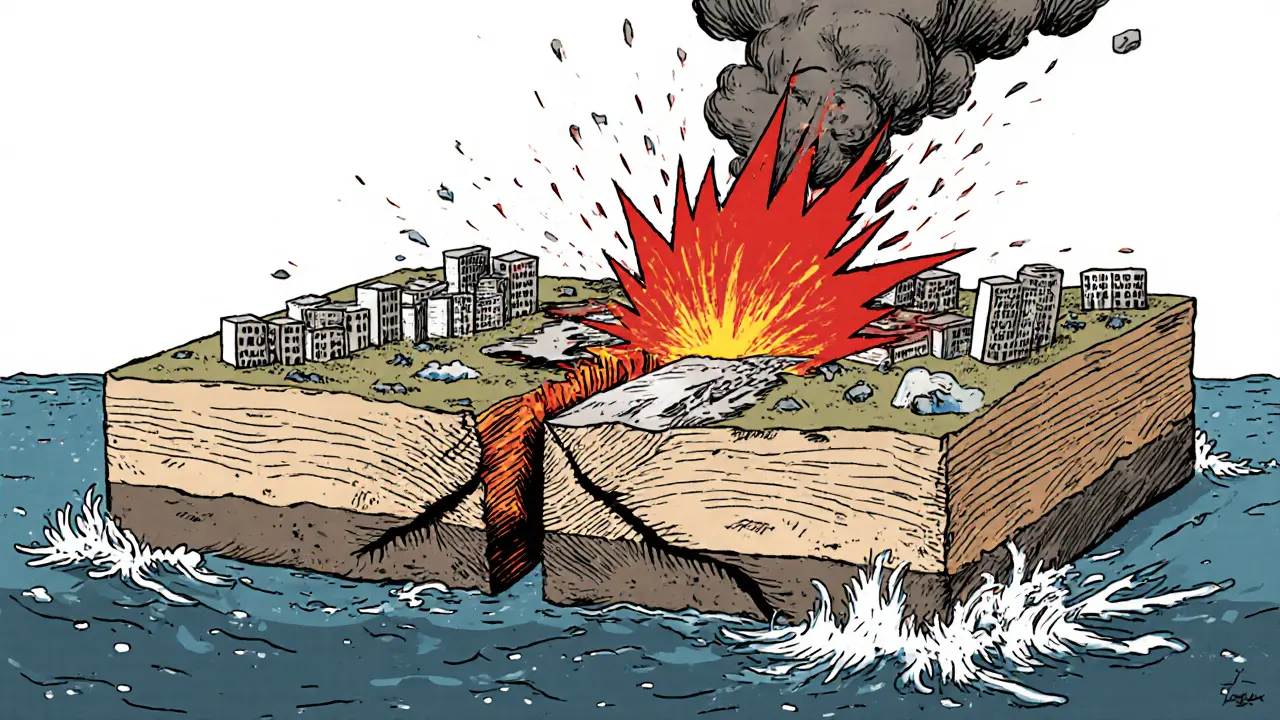
Megathrust Earthquake: What It Is, Why It Matters, and How It Shapes Our World
When we talk about the biggest, most destructive earthquakes on Earth, we’re really talking about megathrust earthquake, a type of earthquake caused by the sudden slip along a subduction zone where one tectonic plate is forced under another. Also known as tectonic earthquake, it’s not just a shake—it’s a planetary-scale release of energy that can reshape coastlines and trigger tsunamis thousands of miles away. These aren’t random events. They happen in specific places, mostly along the Ring of Fire, a horseshoe-shaped zone around the Pacific Ocean where most of Earth’s earthquakes and volcanic eruptions occur. This is where the Pacific Plate dives under the North American, South American, or Eurasian Plates, building up stress over decades—sometimes centuries—until it snaps.
What makes a megathrust earthquake different from other quakes? It’s the scale. While a typical quake might hit magnitude 6 or 7, megathrust events regularly exceed magnitude 8. The 2004 Sumatra quake? Magnitude 9.1. The 2011 Tohoku quake in Japan? Magnitude 9.0. Both triggered massive tsunamis. These aren’t theoretical risks—they’re proven, recurring patterns. And they’re not limited to Asia. The Pacific Northwest in the U.S. and Canada sits on a dormant megathrust fault that could rupture at any time, with scientists warning it’s overdue. The subduction zone, the boundary where one tectonic plate slides beneath another, creating immense pressure is the real engine behind these disasters.
Understanding megathrust earthquakes isn’t just about science—it’s about survival. Governments, engineers, and communities in high-risk areas use this knowledge to build better infrastructure, design early warning systems, and plan evacuation routes. But most people still don’t realize how common these events are in geological time. The same fault that caused the 1700 Cascadia quake in North America will do it again. And when it does, the impact won’t just be local—it’ll ripple across economies, supply chains, and global disaster response networks.
What you’ll find in the posts below isn’t a list of random earthquake facts. It’s a collection of real, grounded pieces that connect the science of tectonic forces to what’s happening in the world today—from how scientists track stress buildup on faults, to why coastal communities are preparing for the next big one. You’ll see how these massive quakes relate to broader geological patterns, how they’re studied, and why ignoring them isn’t an option.