Imagine piloting a spaceship across a digital solar system, mining asteroids for rare resources, and earning rewards in a cryptocurrency that powers your entire journey. That is exactly what Cometh offers. As an ERC-20 utility token designed to drive the economy of a space-themed blockchain game, Cometh represents a niche but fascinating intersection of gaming mechanics and decentralized finance.
If you have stumbled upon the ticker MUST and wondered what makes this coin tick, you are in the right place. This guide breaks down the core mechanics, the tokenomics, and the real-world implications of holding or playing with MUST. We will look at how the game works, who backs it, and what you need to know before diving into this micro-cap asset.
The Core Concept: Space Mining Meets DeFi
Cometh is not just a speculative token; it is the lifeblood of a specific metaverse. The project builds a play-to-earn ecosystem where players control NFT spaceships to mine "smart asteroids." These spaceships exist as ERC-721 and ERC-1155 tokens on the Ethereum network.
The gameplay loop is straightforward but technically intricate. Each spaceship follows a circular trajectory around a virtual sun. Interestingly, the initial path isn't random in the traditional sense; it is determined by the hash of the block in which the NFT was minted. This adds a layer of cryptographic uniqueness to each vessel's starting position. To optimize mining efficiency, players can use a "pulling service" to nudge their ships closer to valuable asteroid clusters. Every pull costs a small fee in MUST tokens, typically starting at 0.001 MUST per operation.
Understanding the MUST Token Economy
The MUST token serves three primary functions: transaction fuel, governance, and reward currency. With a strictly limited supply of exactly 1,000,000 tokens, the project positions itself as a deflationary digital commodity. This low total supply is a deliberate choice to create scarcity within the gaming ecosystem.
As of late 2025, data from major tracking platforms shows that only about 10% of the total supply is in active circulation. This means roughly 101,391 MUST tokens are floating around the market. The rest are likely locked in staking contracts or held by early investors. This low circulating supply contributes significantly to the token's price volatility, as even small trading volumes can cause noticeable price swings.
| Attribute | Detail |
|---|---|
| Ticker Symbol | MUST |
| Blockchain | Ethereum (ERC-20) |
| Total Supply | 1,000,000 |
| Circulating Supply | ~101,391 |
| Primary Use Case | In-game transactions, staking, and upgrades |
| All-Time High | $1,814.42 |
The TUBE: A Dual-Token Farming System
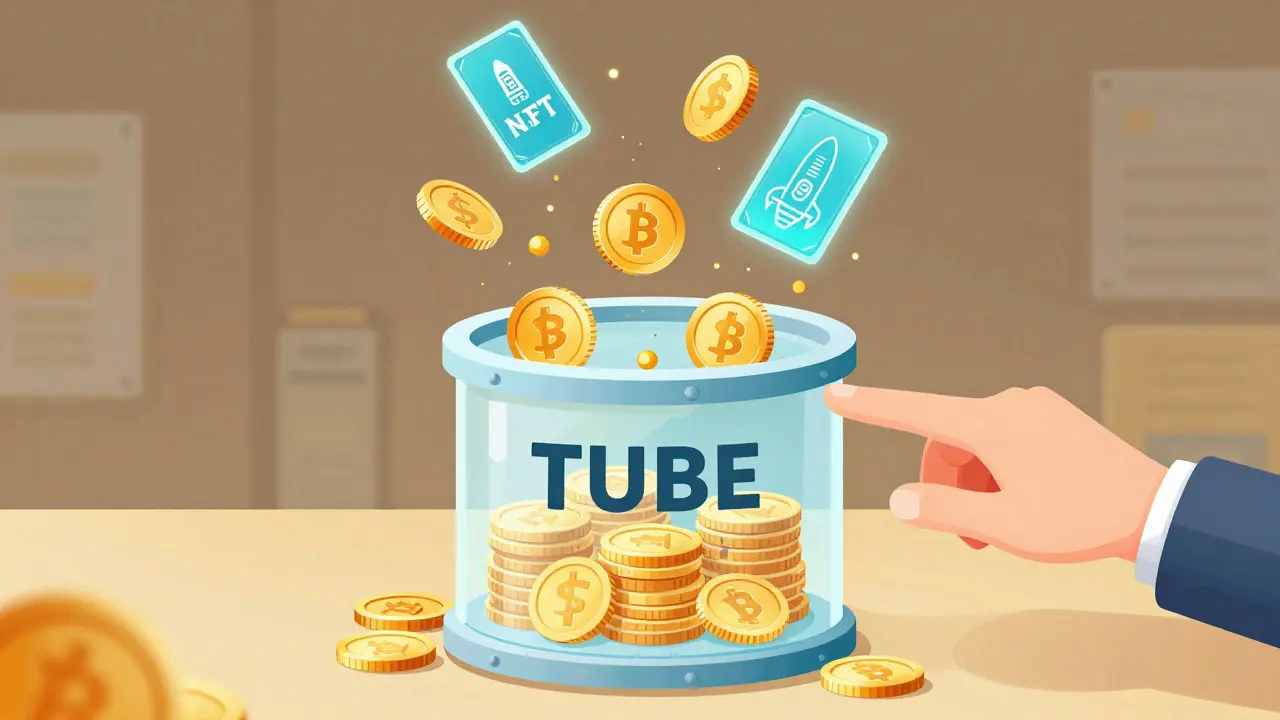
One of the most unique aspects of the Cometh ecosystem is the smart contract system known as "the TUBE." Think of the TUBE as a yield-generating engine for your holdings. Players deposit MUST tokens into the TUBE to unlock perks, such as access to rarer spaceship NFTs or enhanced mining tools.
In return for locking up their MUST, players earn "DUST counters." DUST acts as an alternative in-game currency. You can redeem these counters for new NFTs, effectively creating a dual-token economy. This mechanism encourages long-term participation because your deposited tokens remain productive while you farm for additional assets. It’s a clever way to keep the base token useful even when players aren't actively moving their ships around the map.
Market Reality: Liquidity and Volatility
Let’s talk numbers, because the market data tells a story of high potential but current friction. MUST is classified as a micro-cap cryptocurrency, ranking around #7400 in overall market capitalization. Estimates for its market cap vary between $104,000 and $140,000 depending on the source, reflecting the thin trading volume.
Liquidity is the biggest challenge here. The token primarily trades on ComethSwap, a specialized decentralized exchange. Daily trading volumes are often minimal, sometimes ranging from just a few dollars to under $150. This lack of deep liquidity means that buying or selling large amounts of MUST can result in significant slippage. Price discovery is difficult, leading to discrepancies between different exchanges. For instance, one platform might list the token at $0.86 while another shows it at $1.37. If you are considering entering this market, be prepared for wide spreads and careful execution.
Backers and Institutional Confidence
Despite the modest trading volumes, Cometh has attracted attention from notable names in the venture capital and gaming worlds. The investor roster includes Shima Capital, IDEO CoLab Ventures, White Star Capital, and Stake Capital Group. However, the standout name is Ubisoft Entertainment SA.
Ubisoft’s involvement is significant because it brings mainstream gaming credibility to the project. While no specific collaboration details or timelines have been publicly disclosed yet, having a giant like Ubisoft on the cap table suggests potential future integrations with established franchises. This backing provides a safety net of sorts, indicating that the project has passed rigorous due diligence processes typical of institutional investors.

Risks and Technical Constraints
No crypto asset is without risk, and MUST has a few specific hurdles. First, it operates entirely on the Ethereum mainnet. This means every action-from moving a spaceship to staking in the TUBE-requires ETH for gas fees. During periods of high network congestion, these fees can become prohibitive for casual gamers. The project has not announced plans for layer-2 scaling solutions, which could limit accessibility for cost-conscious users.
Second, the competitive landscape is fierce. Blockchain gaming is a crowded sector with well-funded competitors offering similar play-to-earn models. For Cometh to succeed, it needs to build a sustainable player base that generates genuine demand for MUST through gameplay, rather than relying solely on speculative hype. The token has also experienced significant depreciation from its all-time high, currently trading nearly 99.9% below peak valuation. This highlights the extreme volatility inherent in small-cap gaming tokens.
Who Should Care About Cometh?
Cometh appeals to a specific type of user: those interested in the technical intersection of NFTs and DeFi within a gaming context. If you are looking for a passive investment vehicle with stable returns, MUST might not be the best fit due to its low liquidity and high volatility. However, if you enjoy experimenting with novel blockchain mechanics, the TUBE farming system, and the idea of owning a piece of a space-mining metaverse backed by industry giants, it presents a unique opportunity.
For developers and gamers, the project offers a sandbox to test complex smart contract interactions. For investors, it serves as a case study in how niche utility tokens behave in a fragmented market. The key takeaway is that MUST is less about quick profits and more about participating in a structured, deflationary gaming economy.
What is the maximum supply of MUST tokens?
The maximum supply of MUST tokens is fixed at 1,000,000. This hard cap is enforced by the smart contract to ensure scarcity and support the token's deflationary model within the Cometh ecosystem.
How do I buy Cometh (MUST)?
Since MUST is not listed on major centralized exchanges like Binance or Coinbase Pro, you typically need to use a decentralized exchange (DEX) like ComethSwap. You will need a compatible wallet, such as MetaMask, funded with ETH or WMATIC to swap for MUST tokens.
What is the role of the TUBE in the game?
The TUBE is a staking mechanism where players deposit MUST tokens to earn DUST counters. These counters can be redeemed for NFTs and other in-game perks, making the TUBE central to the project's dual-token economy and long-term incentive structure.
Is Cometh safe to invest in?
Like all micro-cap cryptocurrencies, MUST carries high risk due to low liquidity and price volatility. However, it has institutional backing from firms like Ubisoft and Shima Capital, which adds a layer of credibility. Investors should only allocate funds they can afford to lose and monitor the project's development updates closely.
Does Cometh plan to move to a Layer-2 solution?
As of the latest available information, Cometh operates on the Ethereum mainnet. There have been no official announcements regarding a migration to a Layer-2 scaling solution like Polygon or Arbitrum, although such moves are common in the industry to reduce transaction costs.



nic c
Oh, look at this little digital toy. A spaceship that mines asteroids for a token with a market cap smaller than my last Uber ride. The 'TUBE' is just a fancy name for a staking pool that makes you feel smart while your capital evaporates into the ether. It's like watching a hamster run on a wheel, except the hamster is paying gas fees to do it.
Trista Dennis
Please tell me you're joking.
If you think Ubisoft backing means anything here, you haven't looked at their recent blockchain track record. They tried Axie Infinity and what happened? Silence. This is just another micro-cap trying to dress up in DeFi clothes to hide its lack of liquidity. Don't get your hopes up, darlings.
Kevin Payette
The scarcity is fake.
1 million tokens is a joke.
You need millions to have real price discovery.
This is a trap for retail.
Sell now or bleed out later.
Rebecca Springer
I actually find the circular trajectory mechanic based on block hashes quite elegant. It adds a deterministic layer to the randomness which feels more 'blockchain-native' than pure RNG. Just wondering if anyone has analyzed the distribution of starting positions yet? I suspect some orbits are inherently more profitable, creating an early adopter advantage that might be hard to overcome for new players entering the ecosystem now.
J Shepherd
From a technical standpoint, the ERC-1155 implementation for the ships is smart. It allows for efficient bundling of resources. However, the reliance on mainnet ETH for gas is a major UX bottleneck. Unless they migrate to L2 soon, the CAC (Customer Acquisition Cost) for casual gamers will be prohibitive. The TUBE mechanism is solid for retention, but without low fees, adoption stalls. Watch for their Layer 2 roadmap announcements closely; that's the key metric to watch.
Alan Hawkins
I agree with the point about the L2 migration. It's the biggest hurdle right now. I've been following the dev updates and they seem responsive, which is rare in this space. The community is small but very dedicated. I think if they can get the fees down, the gameplay loop is genuinely fun. Not just a cash grab.
Steve Sulley
UbiSoft is just washing there money through this. Its a scam. Everyone knows big names back shit coins to dump on us later. Dont believe the hype. The math dont add up. Look at the chart. Its going down. Always going down. Wake up sheeple.
Linda Jevne
There is something poetic about mining stars for digital dust. It mirrors our own human condition: we toil endlessly for rewards that often dissolve before we can grasp them. The 'DUST' currency is a brilliant metaphor for the ephemeral nature of value in the metaverse. We are all just particles orbiting a central sun, hoping to catch a sliver of light. Or perhaps that is just my romanticism projecting onto a smart contract.
Carey Thornton
One must appreciate the sheer audacity of pricing a micro-cap token at nearly $1 per unit when the circulating supply is a mere drop in the ocean. It reeks of insider control. The volatility is not a feature, it is a symptom of a market so thin that a single whale sneeze could wipe out the entire exchange rate. A bold, if somewhat reckless, experiment in monetary theory.
David Powell
Ellie Brooks
Okay so I read the whole thing and honestly I am super excited about the idea of the pulling service! I love how you have to pay a tiny fee to nudge your ship closer to the good asteroids because it makes every move feel intentional and strategic rather than just random luck. It reminds me a lot of those old arcade games where timing was everything but with a modern crypto twist which is really cool. I have been looking for a game that isn't just 'click to earn' but actually requires some brain power and planning so this hits the mark perfectly for me. The fact that it is backed by Ubisoft gives me a lot of confidence that it won't just disappear overnight like some other projects I have seen. I am definitely going to try setting up a wallet and getting in on the ground floor because I think the potential for growth is huge if they can keep the community engaged. Plus the space theme is just visually stunning from what I have seen in the previews!
Dave Worth
They are hiding the real agenda 🤔👀. Why else would Ubisoft touch this? To launder green money? Or maybe to track your movements in the metaverse? The 'smart asteroids' are just a front for data harvesting. Keep your eyes open, folks. The truth is out there. 🚨📉
Kelechi Precious Nwachukwu
It is very interesting project but the gas fees are a big problem for people in developing countries like mine. When ETH price goes up, playing becomes too expensive. I hope they fix this soon. Otherwise only rich people can play. That is not fair gaming. I support the team though because they are working hard. Just need better scaling solutions please. Maybe Polygon or something similar. Waiting for the next update with hope. 🙏
Valentine Okpala
Meh. Another NFT wrapper. But hey, if you like space, who am I to judge? 😐✨. Just don't expect moonshots. The liquidity is thinner than my patience. But the art is nice. Can't deny that. 🎨🌌. Good luck to the devs, I guess. 🍀
Sean Dalton
Typical American garbage. No soul, no culture, just code and greed. In Ireland, we understand true craftsmanship. This 'game' is a digital landfill. But I suppose you lot need your shiny new toys to feel alive. Pathetic. 🇮🇪🔥
Rajni Mathur
Respectfully, the analysis provided in the post is somewhat superficial. One must consider the broader macroeconomic implications of such niche utility tokens. While the Ubisoft backing is notable, it does not guarantee product-market fit. The deflationary model is theoretically sound, but execution remains the critical variable. 📊🧠. One should remain skeptical until sustained volume is observed. Do not let FOMO dictate your portfolio allocation. 📉💼
Bill Patterson
read the whitepaper first. most of you dont even know what a DEX is. stop crying about fees. it is crypto. take the risk or go home. simple as that.