Imagine handing over a $20 bill to buy coffee. The barista takes it, puts it in the register, and hands you your drink. That bill is now theirs. You can’t hand that exact same physical paper to someone else five minutes later because it’s no longer in your pocket. Digital money doesn’t work that way by default. A digital file is just code-ones and zeros. If I copy a text document, I still have the original, and so does you. Without a specific system to track ownership, that same digital token could be sent to two different people at once. This is the double-spending problem, and it is the single biggest threat to the value of cryptocurrency.
In 2008, Satoshi Nakamoto solved this with Bitcoin, but the solution isn’t magic. It’s math, time, and energy. Hackers and malicious actors are constantly looking for cracks in that armor. They don’t need to break the encryption; they just need to outsmart the network’s timing or overpower its consensus. Understanding how these attacks work is not just for coders. If you run a business accepting crypto, or if you hold significant assets, knowing the difference between a "confirmed" transaction and a "finalized" one can save you from losing everything.
The Core Problem: Why Digital Money Is Tricky
To understand the attacks, you first have to understand why the problem exists. Physical cash has a property called scarcity. There is only one of each note. Digital files do not have inherent scarcity. If Alice sends Bob a digital coin, her computer says "sent," and Bob’s computer says "received." But until a central authority or a decentralized network agrees on who owns that coin *now*, Alice’s computer might still think she owns it too.
In traditional banking, a central server (the bank) checks every transaction instantly. If Alice tries to spend $10 twice, the bank’s database rejects the second attempt. In blockchain, there is no bank. There is only a ledger shared by thousands of computers. These computers must agree on the order of transactions. Double-spending attacks exploit the tiny window of time where the network hasn't fully agreed yet, or where an attacker has enough power to force the network to disagree.
Race Attack: The Speed Trap
The simplest form of double-spending is the Race Attack, which exploits the speed of light-or rather, the lack thereof. Data travels fast, but not instantly. When you broadcast a transaction to the Bitcoin network, it ripples out across nodes globally. Some nodes see it before others.
Here is how the attack plays out:
- An attacker wants to buy a high-value item, like a rare digital art piece or a luxury watch, using Bitcoin.
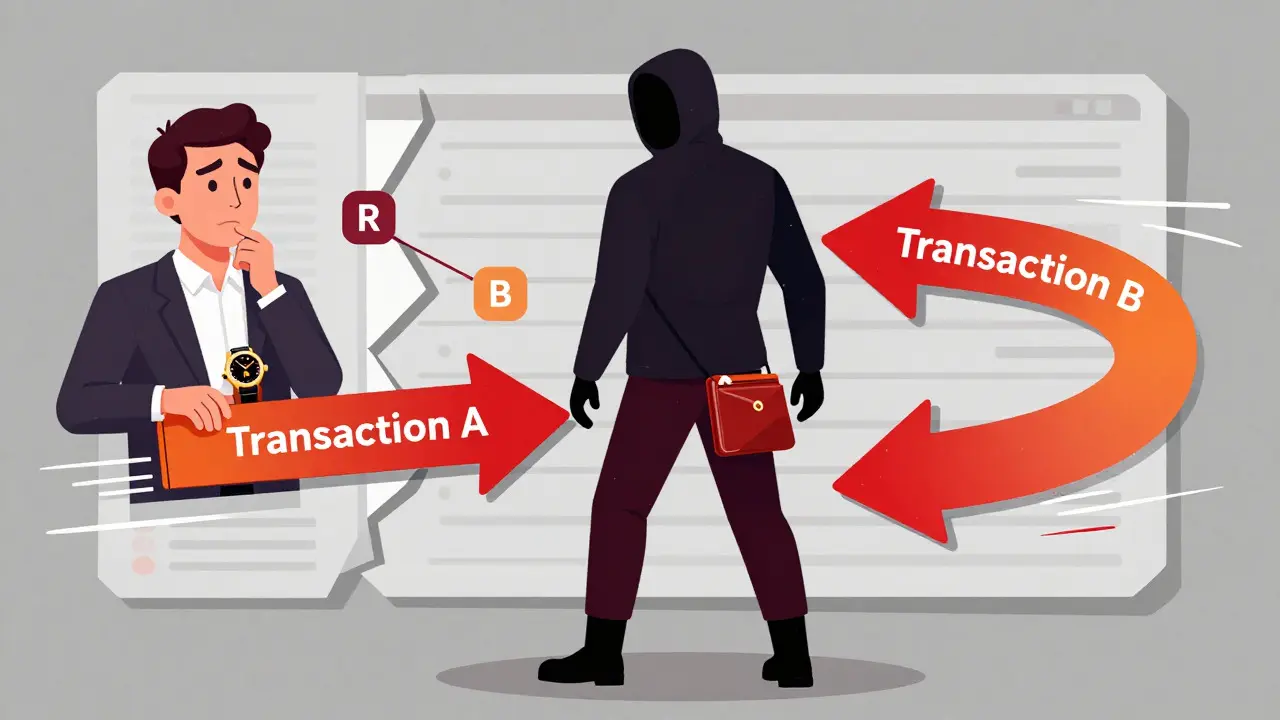
- They send Transaction A to the merchant, promising payment.
- At the exact same moment, they send Transaction B to themselves, spending those same coins back into their own wallet.
- Because the network is decentralized, some nodes might see Transaction B first. If the merchant accepts the goods as soon as they see Transaction A in their local node's memory pool (mempool), without waiting for block confirmations, they are vulnerable.
- If Transaction B gets included in the next block mined by the network, Transaction A becomes invalid. The attacker keeps the coins, and the merchant loses both the item and the payment.
This attack relies entirely on latency. It works best against merchants who release goods immediately upon seeing a pending transaction. The defense is simple but costly: wait. Most experts recommend waiting for at least one confirmation, though higher-value transactions require more.
Finney Attack: The Pre-Mined Ambush
Named after Hal Finney, one of the earliest Bitcoin developers, the Finney Attack is a more sophisticated version of the race attack. It requires the attacker to also be a miner. This makes it harder to pull off, but much more dangerous because it bypasses the initial delay of getting a transaction into a block.
Here is the setup:
- The attacker mines a block secretly on their own private chain. This block contains a transaction sending coins to themselves.
- While this block is being mined, they broadcast a *different* transaction spending those same coins to a merchant. Since the merchant sees this new transaction first, they accept it as valid.
- The attacker releases their pre-mined block to the network. Because it already has one confirmation (the work done to mine it), the network prefers this chain over the one containing the merchant's transaction.
- The merchant's transaction is orphaned (discarded). The attacker has successfully double-spent the coins.
This attack is most effective against small miners or networks with low hash rates. On Bitcoin today, it is nearly impossible for an individual to execute unless they control a significant portion of the mining power. However, on smaller altcoins, this remains a realistic threat for anyone selling high-ticket items without waiting for multiple confirmations.
51% Attack: Rewriting History
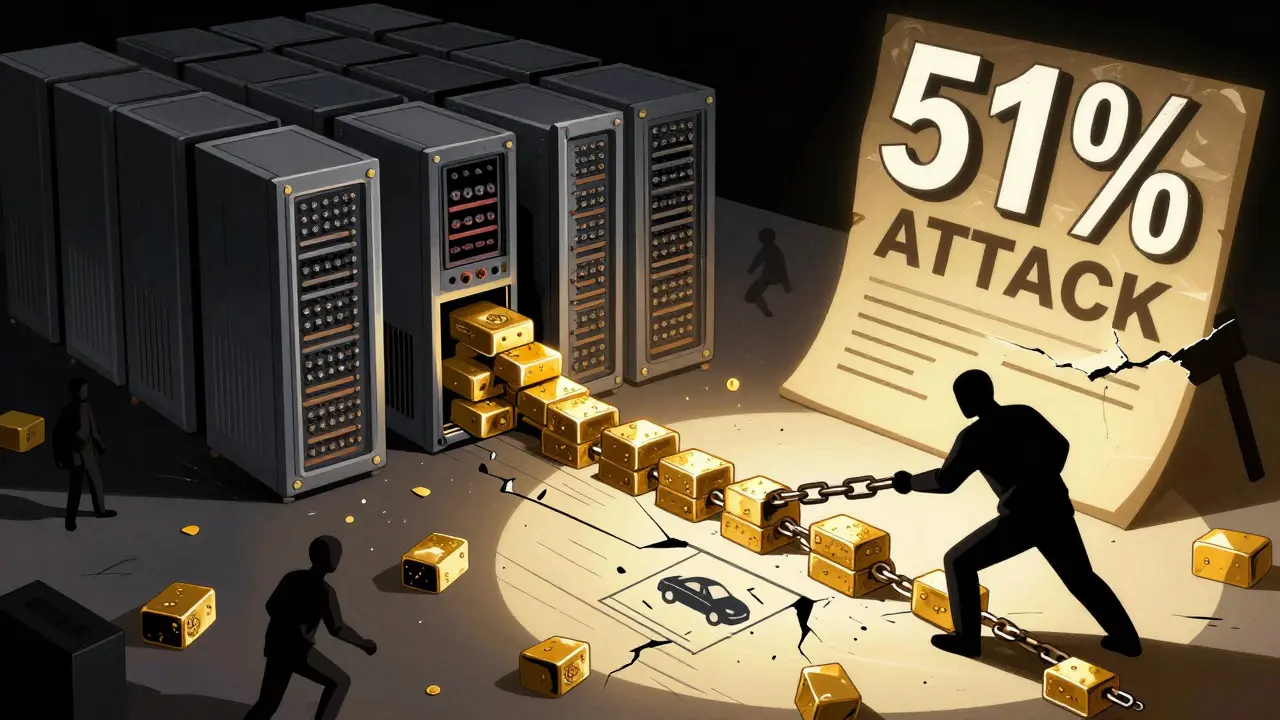
If the Race and Finney attacks are about tricking the network's timing, the 51% Attack is about brute force. This is the nuclear option. To execute this, an entity gains control of more than 50% of the network's total computing power (hash rate).
Why 50%? Because in Proof-of-Work systems like Bitcoin, the longest chain is considered the truth. If you control the majority of the power, you can mine blocks faster than everyone else combined. This allows you to:
- Mine blocks exclusively for yourself, excluding other users' transactions.
- Reverse transactions that have already been confirmed. You can build a secret, longer chain behind the scenes that excludes a specific transaction, then reveal it to the public. The network will switch to your longer chain, effectively erasing the transaction from history.
A 51% attack does not allow an attacker to steal coins from wallets they don't control (private keys still protect those funds). Instead, it allows them to double-spend their *own* coins. Imagine buying a car with Bitcoin, waiting for six confirmations, driving away, and then launching a 51% attack to reverse that payment. The dealership would lose the car and the money.
For Bitcoin, this is currently prohibitively expensive. As of 2024, the network hash rate exceeded 400 exahashes per second. Gaining 51% control would require billions of dollars in hardware and electricity, likely crashing the price of Bitcoin and ruining the attacker's investment. However, smaller chains like Ethereum Classic, Bitcoin Gold, and Vertcoin have fallen victim to this. Their lower hash rates make them cheap targets for rental mining pools.
Centralized vs. Decentralized Defense
Before blockchain, we relied on centralized trusted third parties. Banks solve double-spending by maintaining a single, authoritative ledger. When you swipe your card, the bank checks its database in real-time. If the balance is sufficient, it deducts the amount and approves the purchase. If you try again, the second attempt fails because the balance is already updated.
This is efficient and reliable, but it comes with a cost: trust. You must trust the bank not to freeze your account, not to make errors, and not to be hacked. Blockchain replaces this central trust with distributed consensus. Instead of trusting a bank, you trust the mathematics of the network. The trade-off is speed and finality. Centralized systems are instant; decentralized systems take time to reach agreement. Double-spending attacks thrive in that gap between "instant" and "agreed upon."
How to Protect Yourself: Practical Steps
Whether you are a merchant or a user, understanding the risk means taking action. Here is how to mitigate these threats in the real world.
| Attack Type | Vulnerability Window | Primary Defense | Difficulty to Execute |
|---|---|---|---|
| Race Attack | 0 Confirmations (Mempool) | Wait for 1+ Confirmation | Low (Anyone can try) |
| Finney Attack | 0-1 Confirmations | Wait for 2+ Confirmations | Medium (Requires Mining Power) |
| 51% Attack | Any Number of Confirmations | Use High-Hash Networks / Insurance | High (Massive Capital Required) |
For Merchants:
- Never ship based on zero confirmations. For low-value items, one confirmation might suffice. For anything above $1,000, wait for six. This is the industry standard for a reason.
- Use Payment Processors. Services like BitPay or Coinbase Commerce monitor the mempool for conflicting transactions. They use heuristics to detect if a transaction looks suspicious (e.g., sent from a known mixer or with unusually low fees).
- Accept Established Coins. Stick to Bitcoin or Ethereum. Avoid obscure altcoins with low market caps and low hash rates, as they are prime targets for 51% attacks.
For Users:
- Check Your Wallet. Ensure your wallet software is up to date. Outdated clients might not recognize new attack vectors or protocol updates.
- Understand Finality. Remember that "confirmed" does not always mean "immutable." On some networks, deep reorganizations can happen. Treat early confirmations as provisional.
- Diversify Holdings. Don't keep all your eggs in one basket. If a specific chain suffers a 51% attack, your exposure is limited if you hold assets across multiple secure networks.
The Future: Beyond Proof-of-Work
As blockchain technology evolves, so do the defenses. Proof-of-Stake (PoS) networks like Ethereum have changed the game. In PoS, validators lock up their own coins as collateral. If they try to double-spend or validate conflicting blocks, their stake is "slashed" (destroyed). This makes 51% attacks economically suicidal rather than just expensive. You aren't just paying for electricity; you are risking your entire capital.
Layer-2 solutions like the Lightning Network also address double-spending by moving transactions off the main chain. While this introduces new complexities, it reduces the load on the base layer and allows for near-instant settlement with cryptographic guarantees that don't rely solely on block confirmations.
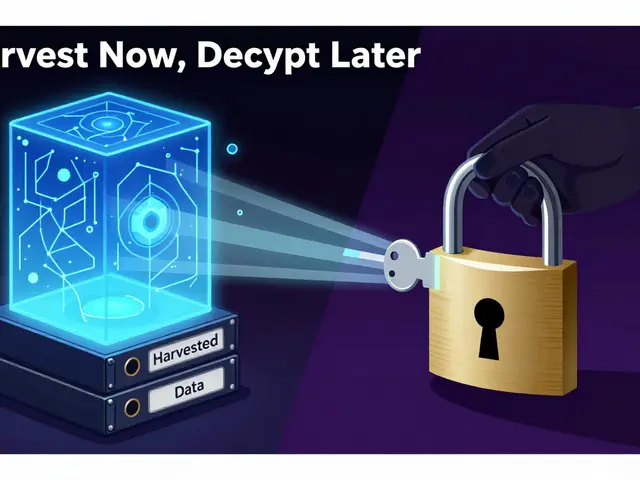
Quantum computing remains a long-term theoretical threat. Current cryptographic signatures could potentially be broken by future quantum machines, allowing attackers to forge signatures and double-spend. However, post-quantum cryptography research is already underway, and most major networks plan to upgrade their algorithms before this becomes a practical issue.
Can a double-spending attack happen on Bitcoin?
Yes, but it is extremely difficult and expensive. A Race or Finney attack could theoretically happen if a merchant accepts zero confirmations, but this is rare. A 51% attack on Bitcoin would require controlling over half of the global hash rate, costing billions of dollars in hardware and energy. As of 2026, Bitcoin has never suffered a successful 51% attack due to its massive network security.
How many confirmations are needed to prevent double-spending?
For most everyday transactions, one confirmation is often considered safe. However, for high-value transactions (over $1,000), the standard recommendation is six confirmations. Each additional confirmation exponentially increases the computational work required to reverse the transaction, making a double-spend economically unfeasible.
What is the difference between a Race Attack and a Finney Attack?
A Race Attack involves sending two conflicting transactions simultaneously to different nodes, relying on network latency to confuse the system. A Finney Attack is more advanced: the attacker pre-mines a block containing a self-payment while simultaneously sending a payment to a merchant. When the pre-mined block is released, it overrides the merchant's transaction because it already has one confirmation.
Are smaller cryptocurrencies more vulnerable to double-spending?
Yes. Smaller altcoins with lower hash rates or staking values are much easier targets for 51% attacks. Networks like Ethereum Classic and Bitcoin Gold have experienced successful double-spends because the cost to rent enough mining power to control the network was less than the value of the coins stolen. Always check the current hash rate and security metrics of any coin you use for commerce.
Does Proof-of-Stake eliminate double-spending risks?
It significantly raises the cost. In Proof-of-Stake, attackers must own and lock up a majority of the currency to attack the network. If they succeed in double-spending, the community can often identify them and slash their stake, destroying their investment. While not impossible, it is far less attractive than attacking a Proof-of-Work network where the primary cost is electricity.

Andrew Schneider
Oh, look at us, pretending we understand the 'math' behind this digital snake oil 🐍. You think waiting for six confirmations makes you safe? Please. The whole system is a house of cards built on electricity bills and hope. I’ve seen more security in my grandmother’s cookie jar than in these so-called immutable ledgers. It’s just a glorified spreadsheet with extra steps and ego involved. Don’t believe the hype.
Heather Austin
i mean its not that complicated honestly
you just gotta wait for the blocks to stack up. most people panic because they dont read the docs but really if you are selling something expensive just wait for 6 confs. its like waiting for paint to dry but with computers. simple as that
Lisa Chong
The elites want you to trust the machine over your own eyes. They say 'wait for confirmation' but who confirms the confirmer? It is all part of the great deception. The banks hate this because it strips away their power to freeze your assets at will. But do not be fooled by the 'decentralization' myth. There are still central points of failure. The miners are the new banksters. Wake up sheeple before they double spend your freedom.
Also why is there no capitalization in some of these comments? The decay of language mirrors the decay of society.
Alicia Hull
This article misses the forest for the trees. While the technical explanation of the Race Attack is adequate, it fails to address the human element of fraud which is far more prevalent than algorithmic exploitation. Furthermore, the assumption that Proof-of-Stake eliminates risk is dangerously naive given the recent slashing events on secondary networks. We need stricter regulatory frameworks, not just better code.
Anuj Kashyap
🤔 Interesting perspective but let's play devil's advocate. Is it really an 'attack' if the network behaves exactly as designed under specific conditions? Or is it just feature creep? 🧘♂️ The irony is that we built a system to remove trust, yet we still have to trust the math. And who audits the math? The same people selling the shovels during the gold rush. 📉
Ran Tao
You guys are missing the real drama here! 😱 It’s not about the tech, it’s about the psychology of greed! I once lost $50k because I trusted a 'confirmed' transaction on a shitcoin that got reorged 3 hours later. My life was ruined. I cried for weeks. Now I only trade on Bitcoin and even then I’m paranoid. The volatility is a mental health crisis waiting to happen. Who’s with me? 🎭💸
Ray Arney
Good breakdown. I run a small e-commerce store and we switched to accepting BTC via a processor that handles the confirmation waits automatically. It takes the stress out of manually checking block explorers. Seems like the practical advice at the end is spot on for anyone actually trying to use this for commerce rather than just speculation.
Eric Braddock
The narrative is controlled by the hash rate oligarchs. They tell you 6 confirmations are enough, but have you considered that the mining pools are colluding to censor transactions from political dissidents? The Finney attack is just a cover story for deeper systemic manipulation. The nodes aren't neutral; they're proxies for corporate interests. Stay vigilant against the consensus mechanism itself.
Nick G
It is truly fascinating how different cultures approach the concept of trust in financial systems. In many parts of the world, community-based lending circles operate without any blockchain technology, relying entirely on social capital and reputation. Perhaps we should look beyond the binary of centralized vs decentralized and consider hybrid models that incorporate traditional social verification methods alongside cryptographic proofs. This could bridge the gap between technological efficiency and human empathy.
Johan Otto
Boring stuff. Just buy the dip. 📈
Nick Wengel
I think the key takeaway is patience. Most people get impatient with crypto because they are used to instant gratification from credit cards. If you can accept that money moves slower when it is secure, you avoid most problems. Simple as that.