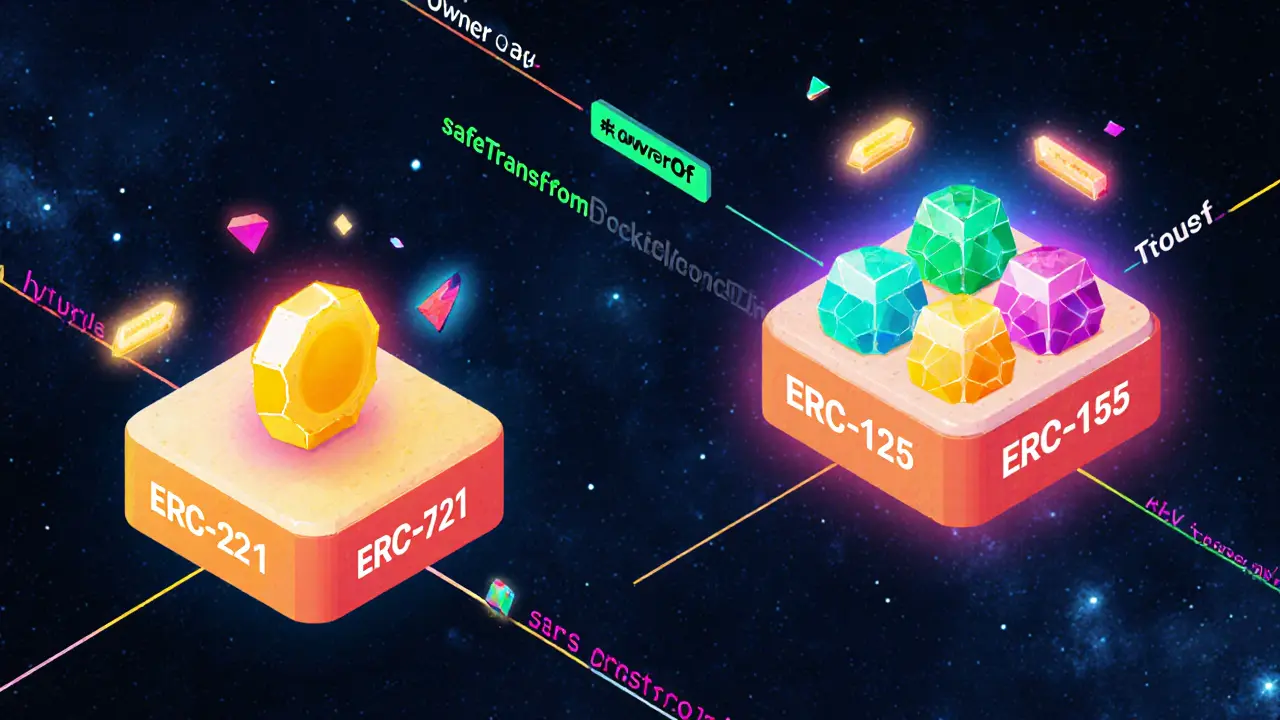
NFT Standards Comparison: ERC-721 vs ERC-1155 and What Really Matters
When you buy an NFT, you’re not just buying a picture—you’re buying a NFT standard, a set of rules on the blockchain that defines how digital ownership is recorded and transferred. Also known as token standards, these rules decide if your NFT can be sold in parts, bundled with others, or even burned after use. The two biggest standards today are ERC-721 and ERC-1155, and picking the wrong one can cost you money, time, or even your asset.
ERC-721 is the original. It’s what made CryptoKitties and Bored Apes possible. Each token is unique, one-of-a-kind, and takes up its own space on the blockchain. That’s great for collectibles, but terrible for efficiency. Every time you trade a single ERC-721 NFT, you pay a full transaction fee—even if you’re selling ten at once. That’s why many early NFT projects got expensive to use. Enter ERC-1155. This standard lets you create batches of tokens in one go. Think of it like printing a whole deck of cards instead of one at a time. It’s cheaper, faster, and lets you mix unique items (like a rare sword) with identical ones (like 100 health potions) in the same smart contract. Games, virtual worlds, and marketplaces use it because it cuts gas fees and simplifies inventory.
But here’s what most people miss: ERC-1155, a multi-token standard that allows both fungible and non-fungible tokens in one contract. Also known as semi-fungible token standard, it enables features like partial ownership and dynamic NFTs that change based on real-world events. Projects using ERC-1155 can update NFT metadata after minting—something ERC-721 can’t do without a complete re-mint. That’s why platforms like OpenSea now support both, but the smart money is shifting toward ERC-1155 for anything beyond single-item art. Meanwhile, digital ownership, the concept that you truly control your asset on-chain, not just have a link to it. Also known as decentralized ownership, it’s the core promise behind every NFT standard—and both ERC-721 and ERC-1155 deliver it, just in different ways.
What you’ll find below aren’t just technical deep dives. These posts show you real cases: how fake NFT projects misuse these standards to trick buyers, how gas fees wrecked small creators on ERC-721, and why the next big NFT game won’t use the old rules. You’ll see how scams hide behind vague terms like "exclusive NFT access" while using cheap, unverified standards. You’ll learn which wallets handle ERC-1155 better, and why some exchanges won’t list certain tokens at all. This isn’t theory—it’s what’s happening right now, in the wallets and marketplaces you use.