EU Crypto Compliance Cost Calculator
Calculate Your EU Compliance Costs
If you're running a crypto business in the European Union, you're not just dealing with code and wallets-you're navigating one of the strictest financial regulatory systems in the world. The EU doesn't just want to keep up with crypto. It wants to control it. And if you're not compliant, you won't just face fines. You could lose your license, get blocked from operating, or even see your executives held criminally liable.
Who Exactly Needs to Comply?
It’s not just exchanges. Under the EU’s current rules, any business that handles crypto assets as part of its service must register and follow full AML rules. That includes:- Fiat-to-crypto exchanges (like buying Bitcoin with euros)
- Custodial wallet providers (any service holding crypto for customers)
- Crypto-asset service providers (CASPs) under MiCA
- Peer-to-peer platforms that match buyers and sellers
- Stablecoin issuers and trading platforms
You don’t need to be based in the EU to be affected. If you serve EU customers-even one-you’re in scope. The EU doesn’t care where your servers are. If your users are in Germany, France, or Spain, you need to comply.
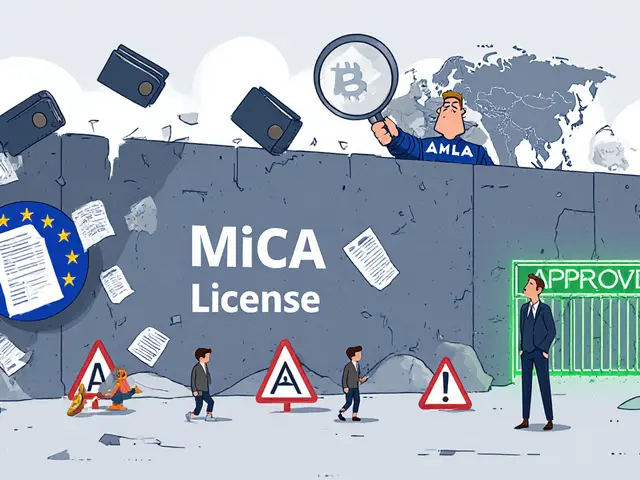
The Markets in Crypto-Assets Regulation (MiCA), which became fully enforceable in 2024, made this official. To operate legally across the entire EU, you now need a MiCA license. As of September 2025, 217 companies have one. Over 400 more are in the application queue. The process takes 9 to 12 months. And it costs between €350,000 and €500,000 just to set up compliance before you even apply.
The Core AML Rules You Can’t Ignore
The EU’s AML framework isn’t a checklist. It’s a system. And every piece connects to the next.Customer Due Diligence (CDD) is the foundation. You must verify every customer’s identity. But it’s not one-size-fits-all. The EU uses a tiered approach:
- Under €1,000: Name and address confirmation
- €1,000-€10,000: Official ID document (passport, driver’s license)
- Over €10,000: Full source of funds proof, senior management approval, and ongoing monitoring
And here’s the catch: you can’t just collect this data. You have to keep it for at least five years. And you have to prove you checked it properly. That means timestamps, screenshots, audit trails. No exceptions.
The Travel Rule is where most companies break. Unlike the U.S., which only applies it to transfers over $3,000, the EU applies it to every crypto transaction over €1,000. And it’s not just about sending the sender’s name. You must collect and verify six data points:
- Originator name
- Originator account number
- Originator physical address or date of birth
- Beneficiary name
- Beneficiary account number
- Beneficiary physical address
And if the transaction goes to a self-hosted wallet? You must verify the wallet belongs to the recipient. No guesswork. No "we assume it’s them." This is why firms like Kraken spent over €2 million just to connect to all 28 national Financial Intelligence Units (FIUs) across the EU.
Suspicious Activity Reporting (SAR) is mandatory. You must report anything odd-unusual patterns, rapid deposits and withdrawals, transactions with known blacklisted addresses. The EU doesn’t want you to be a detective. But if you see red flags and don’t report, you’re liable.
You also need a designated Money Laundering Reporting Officer (MLRO). This person can’t be your CEO or your dev lead. They need independence, authority, and direct access to regulators. They’re the one who signs off on every high-risk transaction and files every SAR. One mistake, and they can be personally fined or prosecuted.
The New Boss: AMLA
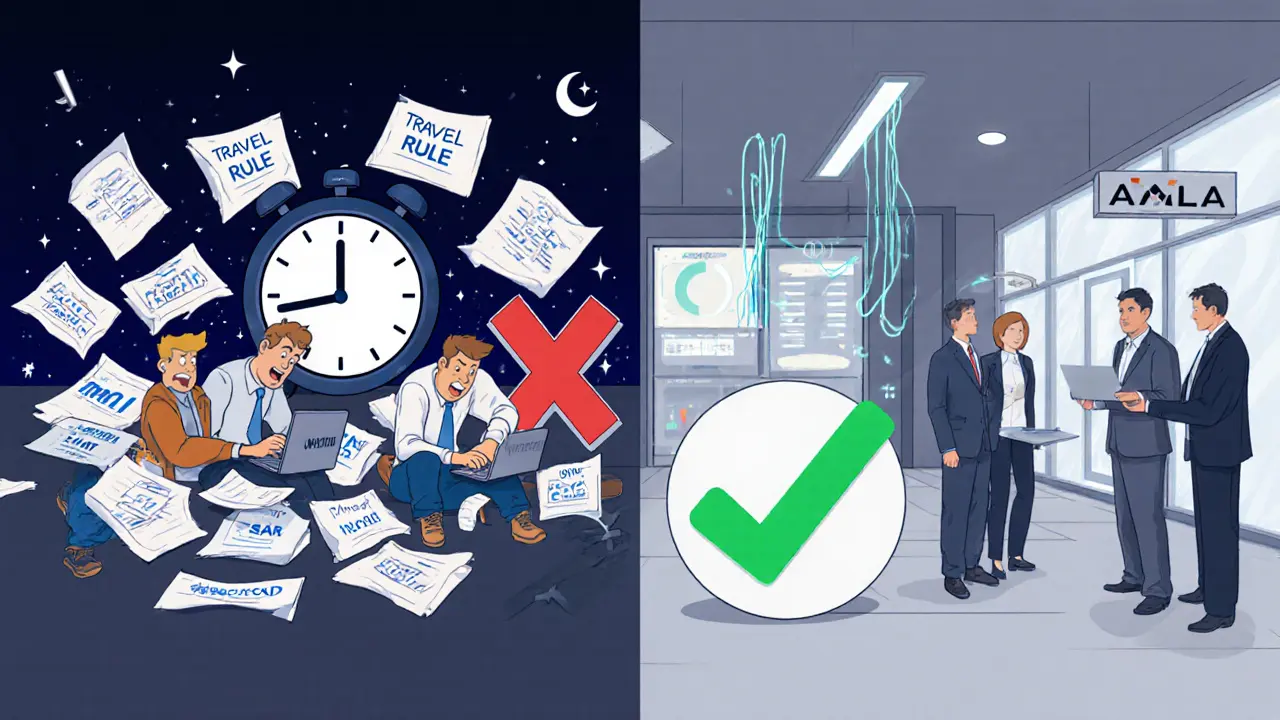
As of 2025, the European Union’s Anti-Money Laundering Authority (AMLA) is now in charge. Based in Frankfurt, AMLA doesn’t replace national regulators-it overrules them. If a crypto firm tries to get licensed in Malta because the rules are easier, AMLA can step in and say no. If a firm in Estonia processes €187 million through a Gibraltar shell company to avoid scrutiny, AMLA will find out. And they will act.AMLA’s first coordinated review of CASPs is scheduled for Q2 2026. They’re focusing on two things: Travel Rule compliance and who really owns these companies. Beneficial ownership is a big deal. Many firms used Dutch foundations or Maltese corporate structures to hide the real people behind the business. AMLA is cracking down. They’ve already identified over 12 cases of "forum shopping"-where firms move operations to weak-regulation countries just to get licensed faster.
What’s Coming in 2027?
The EU isn’t done. On July 1, 2027, the EU-wide AML Regulation (AMLR) replaces all previous directives. This isn’t an update. It’s a rewrite.- You’ll have just five working days to respond to FIU requests. Right now, timelines vary by country. That’s ending.
- Cash payments over €3,000 must be verified. Cash payments over €10,000 are banned for business transactions.
- The list of "obliged entities" expands. Crowdfunding platforms, football clubs, and high-value goods traders now fall under AML rules.
- Privacy coins like Monero and Zcash will face de facto bans. AMLA has already signaled it will target anonymity-enhancing technologies.
Expect more audits, more fines, and more public enforcement actions. AMLA’s chair, Bruna Szego, made it clear: "We welcome innovation. But not at the cost of financial integrity."
How Are Companies Handling This?
Big players like Kraken, Bitstamp, and Coinbase have spent millions. Kraken’s Travel Rule integration cost €2.1 million. Bitstamp used a middleware platform called Traveler to cut setup time from six months to eight weeks-but that still cost €420,000.Smaller firms? They’re struggling. According to the European Commission’s May 2025 SME report, 68% of crypto startups with fewer than 10 employees say compliance costs are prohibitive. Forty-two percent have scaled back EU operations or moved headquarters to Switzerland, Singapore, or the UAE.
But here’s the irony: the firms that stayed compliant are thriving. Regulated CASPs now handle 78% of all crypto trading volume in the EU-up from 41% in 2023. Institutional investors? 89% of them only work with licensed firms. That’s not a trend. That’s a market shift.
What About DeFi?
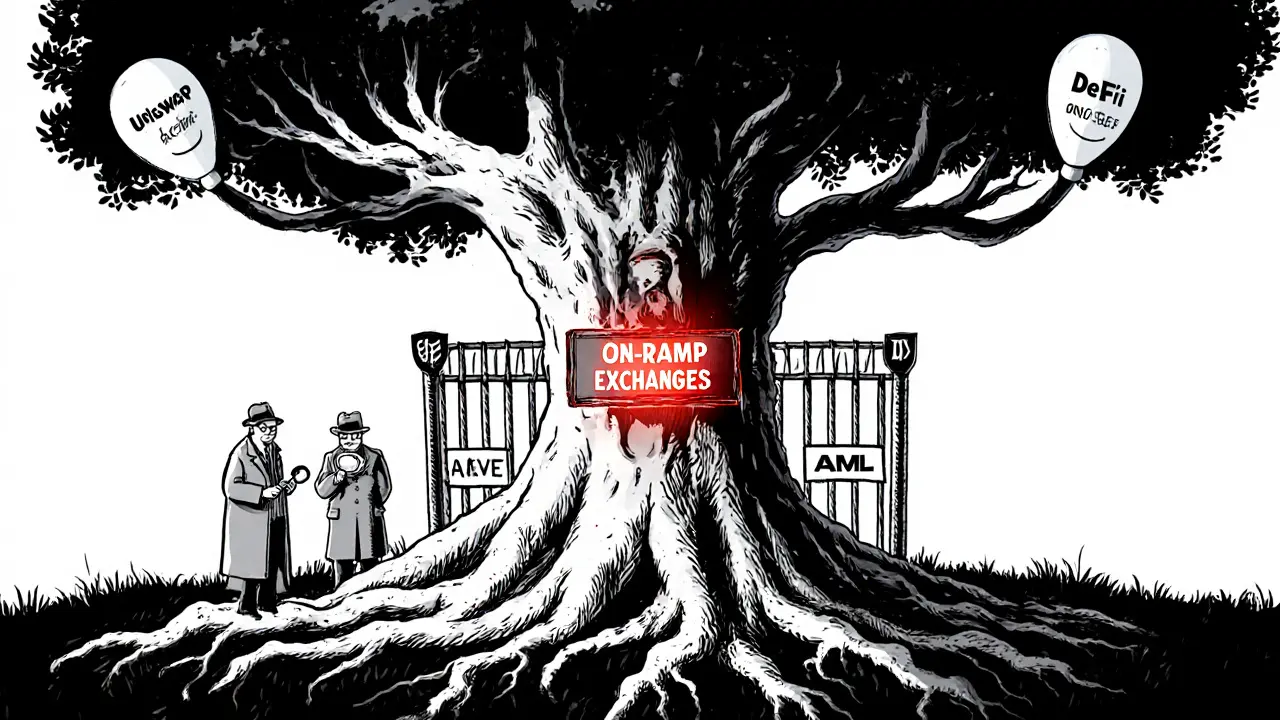
This is the EU’s biggest blind spot. Decentralized Finance (DeFi) protocols-like Uniswap or Aave-don’t have a company, a CEO, or a registered office. So who’s responsible when someone uses them to launder money?The EBA’s October 2025 report flagged this as the top regulatory gap. German regulator BaFin documented cases where criminals routed €12 million through DeFi bridges to obscure the trail. But under current rules, there’s no entity to hold accountable.
Some experts, like Professor Angela Walch from the University of Texas, argue the EU’s approach is flawed: "Trying to regulate DeFi like a bank ignores how it actually works. You’re not stopping crime-you’re killing innovation."
Others say the solution isn’t to regulate protocols, but to regulate the gateways: exchanges that on-ramp to DeFi, or wallets that connect to them. AMLA is expected to release guidance on this in Q1 2026.
Bottom Line: Compliance Isn’t Optional
The EU isn’t trying to stop crypto. It’s trying to make it safe, transparent, and accountable. If you’re serious about operating in Europe, you need to treat AML compliance like infrastructure-not an expense.That means:
- Starting the MiCA application process early-it takes over a year
- Building in Travel Rule compliance from day one, not as an afterthought
- Hiring a real MLRO, not assigning it to your junior analyst
- Using proven tech solutions (like Traveler or Chainalysis) instead of building from scratch
- Training every employee-compliance isn’t just for the legal team
Non-compliance isn’t a risk. It’s a death sentence for your business in Europe. The regulators aren’t waiting. They’re watching. And they’ve already caught the ones who thought they could slip through the cracks.
Do I need a MiCA license if I only serve EU customers from outside the EU?
Yes. If your service is accessible to EU customers-even if you’re based in the U.S., Asia, or elsewhere-you’re required to obtain a MiCA license to operate legally. The EU regulates based on where users are, not where your company is registered. Failing to comply can result in being blocked from EU markets or facing enforcement actions.
What happens if I don’t comply with the Travel Rule?
You risk losing your MiCA license, facing fines up to 5% of your annual turnover, or being banned from operating in the EU. National regulators have already fined multiple firms for incomplete or missing Travel Rule data. AMLA will also publicly name non-compliant firms in its 2026 enforcement report.
Can I use a third-party provider for AML compliance?
Yes, but you can’t outsource responsibility. You can use tools like Chainalysis, Elliptic, or Traveler for KYC, monitoring, or Travel Rule data handling-but you remain legally accountable. Regulators will hold your MLRO and management team responsible if those systems fail or aren’t properly configured.
Are privacy coins banned in the EU?
They’re not explicitly banned yet, but they’re effectively unusable by licensed CASPs. AMLA has signaled that privacy-enhancing technologies like Zcash and Monero pose unacceptable risks. Most regulated exchanges in the EU have already delisted them. Future AMLR guidance in 2026 is expected to formalize this restriction.
How much does it cost to get MiCA-compliant?
For a small to mid-sized firm, expect €350,000-€500,000 for setup, including legal, tech, staffing, and licensing fees. Larger firms spend over €1 million. Annual ongoing costs for monitoring, reporting, and training can add €150,000-€300,000. Most firms need 3-5 full-time compliance staff to maintain compliance.
Is the EU’s approach stricter than the U.S. or UK?
Yes. The EU’s Travel Rule applies to all transactions over €1,000, while the U.S. only requires it above $3,000. The EU also enforces a single licensing system across 27 countries, while the U.S. has 50 different state rules. The UK has similar AML rules but lacks MiCA’s harmonized licensing. The EU’s enforcement powers through AMLA are also far stronger than those in the U.S. or UK.
What Should You Do Next?
If you’re not compliant yet, here’s your roadmap:- Map out every service you offer. Are you a custodian? An exchange? A stablecoin issuer? Each has different rules.
- Start the MiCA application process immediately. The backlog is growing. Waiting means more delays.
- Choose a trusted Travel Rule solution. Don’t build your own unless you have a team of 10+ compliance engineers.
- Hire or contract a qualified MLRO. This is not a role you can delegate to an intern.
- Train your team. Everyone who touches customer data needs AML training-40 hours a year for compliance staff, 16 for everyone else.
- Review your customer onboarding flow. Are you collecting all six Travel Rule data points? Are you verifying self-hosted wallets for transfers over €1,000?
The EU’s crypto rules aren’t going away. They’re getting stronger. The firms that survive aren’t the ones that moved fastest. They’re the ones that understood this wasn’t about technology-it was about trust. And trust is built by following the rules-even when they’re hard.
Louise Watson
This is too much. Just stop.
Liam Workman
The EU is trying to turn crypto into a library card system 📚😭
They want every transaction traced, every wallet verified, every soul audited. It’s beautiful in theory - but what happens when innovation dies under the weight of paperwork? We’re not building banks. We’re building decentralized networks. And now they want to put them in a suit and tie.
Colin Byrne
The notion that a decentralized protocol can be regulated like a bank is not just flawed - it’s intellectually dishonest. The EU’s entire regulatory framework assumes centralized control where none exists. This isn’t compliance; it’s a performative gesture to appease legacy finance. You cannot regulate anonymity without eliminating the very essence of cryptocurrency. And yet, they proceed anyway, as if complexity is a bug to be fixed rather than a feature to be understood.
Alexis Rivera
I’ve seen this movie before. Every time a new tech emerges - the internet, mobile apps, cloud computing - governments panic and try to control it with old tools. The EU’s approach isn’t about safety. It’s about control. And the cost? $500k just to apply? That’s not regulation - it’s a tax on innovation. Small teams can’t compete. Only big players survive. That’s not a healthy market. That’s a monopoly in the making.
Finn McGinty
Let me be perfectly clear: this is not regulation. This is extortion dressed in legal jargon. The EU has turned compliance into a luxury good - available only to those who can afford the lawyers, the consultants, the middleware platforms, the MLROs with gold-plated resumes. Meanwhile, the real criminals? They’re not even on the radar. They’re using unregulated chains, mixing services, and offshore shells. The system doesn’t catch them. It just crushes the honest ones who dared to play by the rules.
Eric von Stackelberg
Did you know that AMLA has direct access to the European Central Bank’s surveillance systems? They’re not just tracking crypto transactions - they’re cross-referencing them with banking records, flight manifests, and even utility bills. This isn’t about money laundering. It’s about total financial surveillance. The moment you sign up for MiCA, you’re handing over your digital life to a centralized authority with no accountability. This is the end of financial privacy. And no one is talking about it.
Emily Unter King
The Travel Rule implementation is a technical nightmare. Six data points? For every transaction over €1,000? That’s not compliance - that’s architectural overkill. Most wallets don’t even store physical addresses. You’re forcing developers to invent fake identity fields just to satisfy regulators. And then you wonder why DeFi adoption is flatlining? It’s because the system is designed to fail. The only winners are the compliance SaaS vendors charging $200k/year for a bot that can’t even parse a Zcash shielded transaction.
Michelle Sedita
I get it. The EU wants to make crypto safe. But safety shouldn’t mean suffocation. Imagine if the first websites had to get licenses before going live. Or if every app had to submit its source code to the government. We wouldn’t have Twitter. We wouldn’t have Airbnb. We wouldn’t have crypto. Innovation doesn’t happen in boardrooms. It happens in garages. And right now, the EU is turning every garage into a courtroom.
John Doe
This is all a setup. AMLA? MiCA? The real goal is to force everyone onto CBDCs. They don’t want crypto to survive - they want it to die quietly so people have no choice but to use the digital euro. The €500k fee? That’s a bribe to make you give up. The Travel Rule? That’s a backdoor to track your every purchase. And don’t even get me started on privacy coins - they’re not banned because they’re risky. They’re banned because they’re free. And freedom? That’s the real threat.
Ryan Inouye
Oh look, another European nanny state trying to police the internet. You know what happens when you overregulate? People leave. And they don’t come back. The U.S. has its mess, but at least we don’t pretend we can control decentralized tech. You want to regulate crypto? Fine. But don’t be surprised when your entire crypto sector vanishes and your citizens start using Monero through Tor on a VPN from a cabin in Estonia. You’re not stopping crime - you’re exporting it.
Rob Ashton
To every founder reading this: don’t panic. This is hard, yes. But it’s not impossible. The firms that are thriving aren’t the ones who waited. They’re the ones who treated compliance like a product - not a cost center. Hire the MLRO. Use the tools. Train your team. It’s expensive, but it’s cheaper than getting shut down. And more importantly - it’s the only way to earn the trust of institutions, investors, and customers who are tired of chaos. You’re not fighting the system. You’re building the future - one compliant transaction at a time.
Cydney Proctor
Oh please. "Trust is built by following the rules." What a laughable, corporate mantra. The only thing trust is built on in this ecosystem is transparency - and the EU’s rules are designed to bury it under layers of bureaucracy. You think a 500k compliance budget makes you trustworthy? No. It makes you a vendor for the regulatory-industrial complex. Real trust comes from open-source code, verifiable audits, and decentralized governance - not from filing Form 7B in triplicate with a Frankfurt bureaucrat.
Cierra Ivery
Wait - so if I’m a solo dev in Ohio and I run a simple wallet app that lets people send BTC to their friends - and one person in France uses it - I need a MiCA license? And a €500k budget? And a full-time MLRO? And six data points for every transaction? And I can’t even use Monero? What planet are you on? This isn’t regulation - it’s a death sentence for anyone who isn’t a Fortune 500 corporation. The EU doesn’t want to regulate crypto. They want to erase it.
Veeramani maran
Bro, this is insane. We in India also trying to build crypto startup but now i see EU rules and i think maybe better to focus on Africa or SEA. Why? Because here they want to make crypto like bank but crypto is not bank. Crypto is freedom. Now they want to track every satoshi? Who gonna pay for this? Small dev like me? No way. I think EU will kill crypto in europe and then say "we told you so". Also, why they need address for every wallet? Wallet not have address! Only hash! This make no sense. 😅