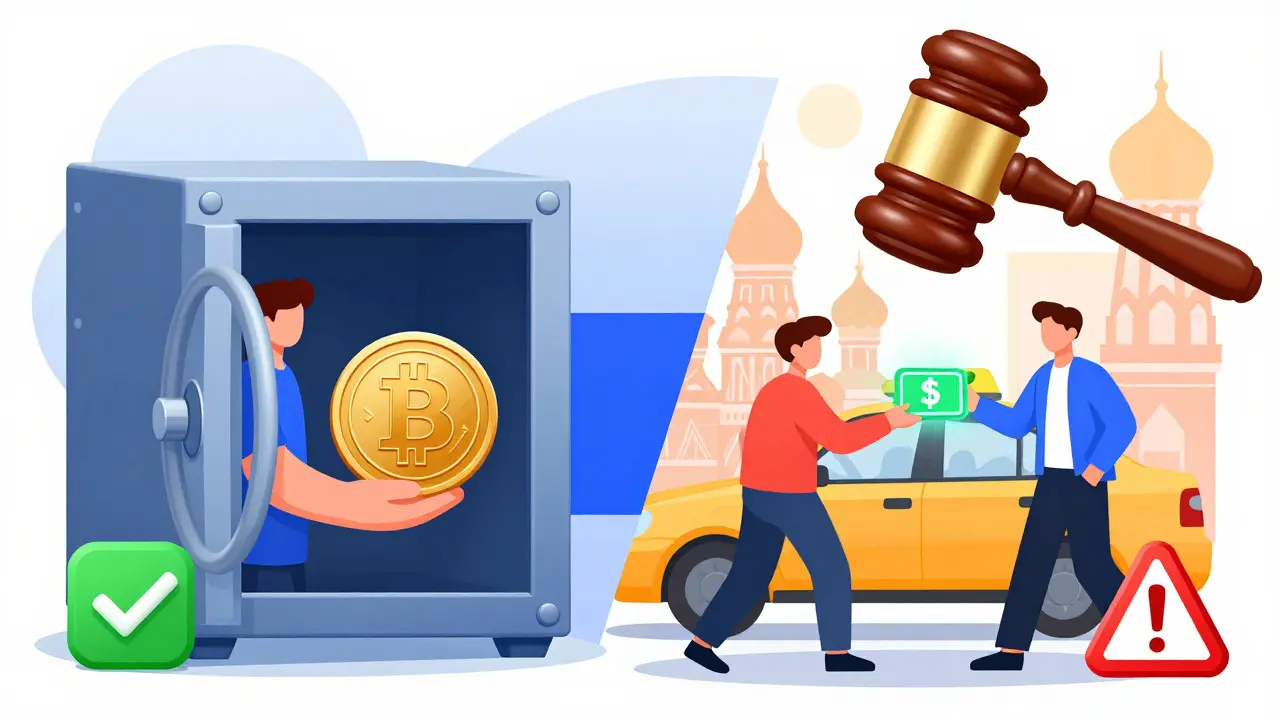
Imagine you're standing in a Moscow market, holding a phone with your Bitcoin wallet open. You want to buy some fresh bread. Can you scan the QR code and pay? The short answer is no. In fact, doing so could soon cost you up to 200,000 rubles. While Russians love their crypto-holding over $40 billion worth-the government has drawn a hard line: crypto payments are banned for domestic use. But the story gets more complicated when you look at international trade or the upcoming changes in 2026.
If you're trying to figure out where you stand legally, you need to understand the distinction between owning coins and using them as cash. This isn't just about being careful; it's about avoiding heavy penalties that are currently being tightened by the State Duma. Let's break down exactly what is allowed, what is forbidden, and how the new enforcement rules will change the game for individuals and businesses alike.
The Core Rule: Ownership vs. Payment
First, let's clear up the biggest misconception. Owning cryptocurrency is not illegal in Russia. You can buy, sell, hold, and mine digital assets without breaking any laws. The Russian Association of Cryptoeconomics notes that the number of crypto users in Russia has grown by 15% annually since 2021. So, why the crackdown on payments?
The issue lies in legal tender status. By law, the Russian ruble is the only official currency for settling debts within the country. Using anything else-including stablecoins like USDT or major assets like Ethereum-for buying goods or services domestically is prohibited. Think of it this way: your crypto is an investment instrument, not a wallet for your daily coffee run. If you swap BTC for RUB and then spend the rubles, you're fine. If you send BTC directly to a local merchant, you're stepping into grey territory that regulators are eager to close.
The Experimental Legal Regime: A Crack in the Door
Is there any exception? Yes, but it’s narrow. The Experimental Legal Regime (ELR) is a pilot program allowing Russian companies to use cryptocurrencies for international settlements. This setup was designed primarily to help Russian businesses bypass Western sanctions after 2022. Under this regime, certain approved companies can transact in crypto with foreign partners.
However, don't get excited if you're a regular person. The ELR doesn't apply to everyday consumers. It also grants limited access to "highly qualified" investors for trading derivatives, but ordinary citizens remain locked out of these specific benefits. For most people, the ELR is irrelevant unless you work for a large export-oriented corporation. It’s a tool for state-level economic strategy, not personal finance.
What Changes in 2026: The Fine Structure
This is the part that should keep you awake at night. For years, while crypto payments were technically banned, enforcement was weak. There was no clear penalty for the act itself. That changes in 2026. According to Anatoly Aksakov, head of the State Duma's financial market committee, new draft laws will introduce substantial fines.
Here is what the proposed legislation looks like:
- Individuals: Fines ranging from 100,000 to 200,000 rubles for using crypto to pay for goods or services.
- Legal Entities: Fines ranging from 700,000 to 1 million rubles for businesses caught accepting crypto payments.
- Confiscation: Any cryptocurrency used in a violation will be seized by authorities.
These numbers aren't trivial. A 200,000-ruble fine is roughly equivalent to several months of average wages for many professionals. Combined with the risk of losing the actual crypto assets involved, the economic risk of using crypto for local payments becomes very high. The goal is simple: make the shadow economy unprofitable.
Tax Obligations: Where Most People Slip Up
Even if you never use crypto for payments, you still have duties. The Russian tax system requires meticulous record-keeping. All income from crypto activities-including spot trades, mining rewards, staking yields, airdrops, and NFT sales-must be reported. Here are the key dates and rules you need to know:
- Reporting Deadline: File your cryptocurrency-related income declaration by April 30 for the prior year.
- Payment Deadline: Pay all owed taxes by July 15.
- Valuation: All crypto activity must be converted to rubles at official exchange rates for calculation purposes.
What happens if you hide it? The penalties are severe. If you fail to report transactions totaling 45 million rubles or more in two of the past three years, you face fines of 500,000 to 2,000,000 rubles. Worse, you could face forced labor for up to five years or imprisonment from 18 months to five years. Even smaller omissions trigger fines of 50,000 rubles plus up to 40% penalties on unpaid taxes. Automated systems now scan for undisclosed holdings, so assuming you're invisible is a dangerous gamble.
| Activity | Legal Status | Potential Penalty |
|---|---|---|
| Owning/Holding Crypto | Legal | None (if taxed properly) |
| Domestic Payment (Buying Bread) | Illegal | 100k-200k RUB fine + Confiscation |
| International Settlement (via ELR) | Legal (for approved entities) | None |
| Unreported Income >45M RUB | Criminal Offense | Up to 5 years prison + 2M RUB fine |

Why Is Russia Cracking Down Now?
You might wonder why the government is suddenly strict if they allow ownership. The answer lies in control. Since 2022, sanctions have pushed many Russians toward crypto to preserve wealth or move money abroad. This created a massive shadow economy. Experts like Irina Kuyantseva from BGP Litigation note that the new fines target these hidden practices, specifically those circumventing sanctions. The Central Bank wants to protect the ruble's dominance and ensure the state sees every transaction.
There is also a data point worth noting: Russia dropped to the bottom of the top 10 in Chainalysis's 2025 Global Adoption Index. Despite this drop, crypto-facilitated trade reached 1 trillion rubles in 2025. This contradiction shows that while retail adoption is cooling due to fear, institutional and cross-border usage is booming. The government wants to legitimize the latter while strangling the former.
Practical Advice for Users
If you live in Russia and hold crypto, here is how to stay safe:
- Stop Local Payments: Use cards, cash, or bank transfers for all domestic purchases. Don't take the risk.
- Keep Records: Track every trade, mint, and stake. Use reliable software to generate tax reports in rubles.
- Watch the News: Regulations are shifting. Keep an eye on announcements from the Central Bank and the Ministry of Finance.
- Consider Domestic Exchanges: Lawmakers are urging the licensing of local exchanges. Once these launch, they may offer safer, compliant ways to buy and sell.
The landscape is evolving. While the ban on domestic payments seems firm, the door for international trade is opening wider. For now, treat your crypto portfolio as an investment asset, not a spending account. Stay compliant, keep your taxes up to date, and wait for the regulatory dust to settle before experimenting with new payment methods.
Is it illegal to own Bitcoin in Russia?
No, owning Bitcoin is legal. The restriction applies only to using it as a direct payment method for goods and services within Russia. You can hold, trade, and mine Bitcoin freely, provided you report the income correctly to the tax authorities.
What is the maximum fine for paying with crypto in Russia?
For individuals, the proposed fine ranges from 100,000 to 200,000 rubles. For businesses, it can reach 1 million rubles. Additionally, the cryptocurrency used in the transaction may be confiscated by the state.
Can I use crypto to pay for imports or exports?
Yes, but only if your company is part of the Experimental Legal Regime (ELR). This allows specific Russian entities to use crypto for international settlements, helping to bypass sanctions. Ordinary individuals cannot use this pathway for personal cross-border payments.
When do I have to pay taxes on my crypto gains?
You must file your declaration by April 30 and pay the taxes by July 15 of the following year. All values must be converted to rubles at official rates. Failure to report large amounts can lead to criminal charges.
Will Russia ever allow crypto payments for everyone?
Currently, the Central Bank opposes it strongly. However, the Finance Ministry has suggested widening investor access. Future policy may expand international usage, but domestic payments are likely to remain restricted to the ruble for the foreseeable future.

Hicham Mounir
It is honestly wild to see how much the geopolitical landscape has shifted since 2022, isn't it? The way sanctions have forced a massive pivot towards digital assets for cross-border trade is a fascinating case study in economic resilience. It really highlights how technology can outpace regulation when national survival is on the line.
I think we are witnessing a unique experiment in monetary sovereignty that most other nations haven't had to undergo under such extreme pressure. It makes you wonder if this specific model could be replicated elsewhere or if it is truly a product of these specific historical circumstances.
Kate Staab
Oh, look at us, playing with fire again! Just because you can hold the torch doesn't mean you should light the house down. These people need to learn their place and stick to the ruble like everyone else. It's not just about the law; it's about moral order!
Carmene Jackson
Ugh, so basically they are trying to control everything? That just feels so suffocating. I bet it makes people feel like they are being watched all the time. It’s exhausting just thinking about how stressful that must be for them over there.
Jennifer Ulmer
You make a good point about the resilience aspect. It does seem like a very specific reaction to external pressure rather than a long-term strategy. I think it will be interesting to see if this model survives once the immediate political tensions ease. For now, it seems like a survival mechanism more than anything else.
Sarah Campbell
LOL finally some sense! 🇺🇸🔥 Let them use their own money. Why are we even talking about Russian crypto? They are enemies! 😤 Ban it all! No more excuses for them to move money around. This is what happens when you don't listen to your friends. Time to tighten the noose! 💪
Phelan Deihl
I guess that makes sense from a security standpoint. It’s just hard to imagine the logistics of enforcing something like that on a daily basis. But yeah, probably necessary given the situation.
Ami Elizabeth
yeah i read the article too and its kinda crazy how strict they are getting. like who actually pays with btc for bread anymore? its mostly just traders i think. but the fines sound brutal tbh.
michelle aguilar
One must consider the broader implications, one might say, of such draconian measures. It is, after all, a testament to the fragility of fiat currencies, one would argue, in the face of technological disruption. How quaint, the notion that a government can simply legislate away innovation, one wonders.
Lance Konig
The distinction between holding and paying is legally precise but practically blurry. Many small merchants in remote areas have already started accepting USDT due to inflation fears. The enforcement gap is where the real risk lies, not the statute itself. We are seeing a de facto parallel economy emerging before the law catches up. The 2026 fines are a reactive measure, not a proactive one. History suggests heavy-handed regulation often drives activity further underground. The state needs to provide an alternative, not just a penalty. Otherwise, it is merely taxation without representation. The legal framework is lagging behind market reality. This creates a compliance nightmare for honest users. The true test will be whether the ELR expands or collapses. Until then, the grey zone remains the only viable option for many. The regulatory pendulum is swinging violently right now. We are in the middle of a storm. The outcome is far from certain. One must remain vigilant. The next few months will be critical.
Dina Lazarova
It is rather tedious to watch the same old debate play out. While the legal nuances are certainly complex, one must admit that the average citizen is largely indifferent to these high-level policy shifts. The practical impact on daily life is minimal for the majority. Therefore, the outrage is somewhat misplaced. One should focus on one's own portfolio rather than foreign regulations. The discourse is often filled with noise rather than signal. It is a distraction from more pressing financial matters. The real story is in the data, not the headlines. Yet, here we are, arguing about bread and Bitcoin. How utterly exhausting. Perhaps we should wait for the dust to settle. In the meantime, silence is golden. Or at least, less annoying than this thread. Let us return to our individual pursuits. The world will continue to turn regardless of our comments. Do not take it personally. It is merely an observation. A polite one, I assure you. Good day to you all. May your spreadsheets be balanced. And your taxes, filed on time. That is all. Truly. Nothing more. Just a thought. A quiet thought. In a loud room. End of story. Thank you for your attention. Please do not reply. Seriously. Just let it go. It is better for everyone. Especially your blood pressure. Which is likely elevated by now. So, breathe. Relax. Move on. There are bigger fish to fry. Much bigger. And tastier. Anyway. Bye.
Walker Perry
They are doing this to hide their theft from the people. The ruble is a scam controlled by the deep state. Crypto is the only way to escape the matrix. You think they care about the bread? No. They want your data. Every transaction is tracked. The fines are just a way to confiscate your wealth. Wake up sheeple. The banks are coming for your gold next. Then your house. Then your freedom. This is the endgame. Trust no one. Not the government. Not the banks. Not even your neighbors. Only the blockchain saves us. The rest is propaganda. Keep your coins cold and your eyes open. The truth is out there. Find it before they find you. Stay safe out there. The wolves are hungry. And they are wearing suits. Remember that. Always remember.
Nia Franklin
Wow, this is such a colorful mess of rules!! 😂 Like, why can't they just pick ONE lane?? It's giving 'chaos energy' for sure. I love how they try to ban it but then allow it for big companies. Total double standard vibes. Makes me wanna hug my wallet tighter lol. At least we get to choose what to pay with (mostly). Kudos to those navigating this minefield. You guys are brave souls!! 🌟
Sonia Gomez Gomez
Don't you think it's just plain rude to hide money from the state? :P It's like stealing from your own country. You should be ashamed of yourself. Most people pay their taxes without complaint. Why are you making it hard for everyone? It's selfish behavior. Fix your act. Now. Before someone notices you. :)
SHIV SHANKAR KANTA
the essence of currency is trust... but here trust is broken... the state demands submission... yet the soul craves freedom... this is the eternal struggle... man vs system... man vs self... the fine is just a shadow... the real cost is the loss of autonomy... think deeply... truly deeply... about what it means to own nothing... yet control everything... paradoxical... isn't it?
Daniel Brown
I am curious about the specific technical implementation of the automated scanning systems mentioned in the text. How exactly are they correlating on-chain transactions with domestic merchant receipts? It seems like a significant logistical hurdle for the tax authorities to overcome effectively. Do you have any insight into the software infrastructure being deployed for this purpose? It would be helpful to understand the scope of their monitoring capabilities better.
Darren Moon
One observes a distinct lack of nuance in this discussion. The term 'shadow economy' is bandied about with little regard for its sociological implications. It is, in essence, a rational response to irrational policy. The friction costs are immense. Compliance is a burden. The state fails to account for the opportunity cost of capital flight. We are witnessing a textbook case of regulatory arbitrage. The market always finds a way. The question is not if, but how. And at what price. To whom. Ultimately. The answer is always: the consumer. Enjoy the ride. It gets bumpy. Very bumpy indeed. Don't forget your seatbelt. Or your wallet. Whichever is heavier. Probably both. Good luck. Safe travels. Through the fog. Of ignorance. Mostly. Self-inflicted. But still. Fog. Yes. Fog.
Quang Thai Tran
It is evident that the central bank is acting under duress. The sanctions are not just economic; they are existential. The move to restrict domestic crypto payments is a preemptive strike against capital flight. However, one must ask: who benefits from this opacity? Likely the oligarchs who have already moved their assets. The common man is left to navigate a labyrinth of red tape. This is not regulation; it is containment. A cage built of code and law. And the key? Held by the state. Forever. Or until the next crisis. Which is inevitable. Prepare accordingly. Or perish. The choice is yours. But know this: the clock is ticking. Loudly. And mercilessly. Do not sleep. Never sleep. Watch the horizon. For the storm. It is coming. Bring an umbrella. And a plan. B. And C. And D. Just in case. Because hope is a dangerous thing. In times like these. Stay sharp. Stay silent. Survive.
Tasha Davis
Okay so basically stop buying bread with bitcoin right?? Yikes. That is super important to remember! Let's stay safe folks! 💪 Keep your records clean and you will be totally fine! You got this! Let's crush this compliance thing! High five! ✋
miranda gamboa
From a macroeconomic perspective, the bifurcation of the market into retail and institutional segments is a critical variable. The ELR acts as a controlled valve for liquidity. If the friction coefficients for domestic transactions increase, we may see a shift in velocity of money. It is essential to monitor the correlation between fine enforcement rates and off-exchange trading volumes. The data suggests a potential inverse relationship. We need more granular telemetry on user behavior. Specifically regarding stablecoin adoption curves. This will inform future policy adjustments. Stay tuned for the Q3 report. It should clarify the trajectory. For now, assume volatility. Manage your risk. Diversify. Always diversify. That is the mantra. Repeat it. Until it becomes second nature. Then, and only then, will you be prepared. For what comes next. Which is uncertain. But manageable. With the right tools. And mindset. Focus. Clarity. Action. In that order. Do not skip steps. Precision matters. Here. More than anywhere else. Get it right. First time. Every time. That is the standard. Hold yourself to it. Others will follow. Lead by example. Quietly. Effectively. Without fanfare. Just results. Pure results. Unadorned. Honest. Real. That is what counts. Everything else is noise. Filter it out. See the signal. Act on it. Done.