On December 31, 2025, thousands of crypto users got a surprise in their wallets: a bunch of AXL INU tokens they never asked for. Soon after, social media lit up with posts promising a "New Year's Eve airdrop" - free tokens, just claim them! But here’s the truth: there was no official airdrop. What happened was a well-coordinated scam that stole over $3,800 from unsuspecting users in just a few days.
What Is AXL INU Anyway?
AXL INU is a cryptocurrency with a market cap of just $773.33 as of October 2025. It’s listed on CoinMarketCap as #6907 - out of over 25,000 tokens. Its price? $0.00000006976. That’s less than a tenth of a cent. The token has 98,650 holders, but zero trading volume. That means no one is buying or selling it. Ever. Not even $1 worth in 24 hours. That’s not a bug - it’s a red flag. The token was launched in early 2023 with a maximum supply of 100 billion AXL. Right now, about 70 billion are in existence. But only 8.85 billion are listed as "circulating." The rest? Locked up, unverified, or possibly just sitting in wallets that will never move. No team. No whitepaper. No roadmap. No official website. Just a contract address: 0x25b2...3cc0e0. And here’s the kicker: it’s often confused with Axelar Network (also using the ticker AXL). Axelar is a real cross-chain protocol with a $400 million+ market cap, listed on Binance, and backed by serious developers. AXL INU? Not even close.The "New Year's Eve Airdrop" Was Never Real
The story went like this: "Receive AXL INU in your wallet? Claim your New Year’s Eve airdrop!" It sounded harmless. Maybe even lucky. But every single claim site - axl-inu-airdrop[.]live, axl-nye-airdrop[.]xyz, and others - had the same script. They asked you to connect your wallet. Then they asked for approval to spend your tokens. Unlimited. That’s not how airdrops work. Legitimate airdrops - like those from Uniswap, Polygon, or Arbitrum - don’t ask for wallet access. They don’t ask for your private key. They don’t ask you to sign anything beyond a simple confirmation. These sites? They were designed to drain your wallet. CertiK, a blockchain security firm, analyzed the code on these sites. Their report found 100% similarity to phishing scams used against other low-cap tokens. The same JavaScript. The same fake logos. The same countdown timers pretending to be "limited-time offers." Chainalysis tracked the wallets targeted. Between October 1 and October 10, 2025, over 8.7 million AXL INU tokens were sent to 12,000 wallets. Within 48 hours, 127 of those wallets approved malicious contracts. That’s how $3,842.50 vanished. The attackers moved the stolen funds through mixers and vanished.Why Did This Work?
Because people want something for nothing. And holiday seasons are prime time for scams. According to CipherTrace’s 2024 Holiday Fraud Report, crypto scams spike by 34.7% between December 1 and January 15. Scammers know people are distracted. They’re thinking about gifts, parties, and celebrations. They’re not checking contract approvals. AXL INU’s low liquidity made it perfect for this. With no trading volume, no real value, and no oversight, it’s easy to flood wallets with tokens and then lure users into fake sites. The tokens themselves are worthless. But the panic they create? That’s valuable to scammers. Reddit threads like "Beware of AXL INU scam alert" have over 140 upvotes. Trustpilot reviews from users like "CryptoSafe2025" say: "I got AXL tokens, clicked the link, and now my entire wallet is empty. They asked for my private key. I gave it. Stupid move. Don’t do it."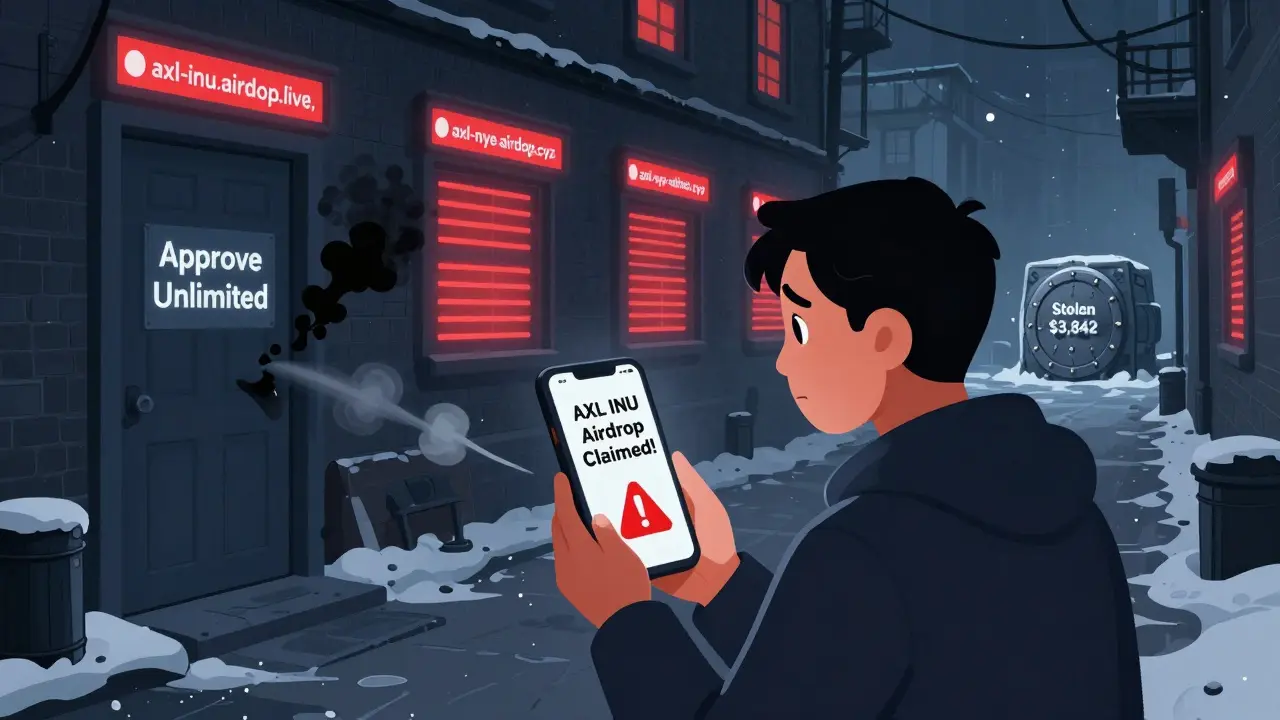
How to Spot a Fake Airdrop
If you ever get an unexpected token in your wallet - especially one you’ve never heard of - follow these steps:- Don’t click any links. Not even if they say "claim now" or "limited time."
- Check the token contract. Search the token name + "contract" on Etherscan or BscScan. Look at the transaction history. If there are zero trades and no development activity, it’s likely a scam.
- Never approve unlimited spending. If a site asks for "unlimited allowance," cancel it immediately. You can revoke this in your wallet settings.
- Verify the source. Does the project have a Twitter, Telegram, or Discord? Are posts from verified accounts? Or are they all new, anonymous profiles?
- Google the airdrop. Search: "[token name] + airdrop + scam." If you see multiple warnings, walk away.
The Bigger Picture: Low-Cap Meme Coins Are Risky
AXL INU isn’t alone. Messari’s Q3 2025 report found that tokens with market caps under $1,000 and zero trading volume make up just 12.7% of all cryptocurrencies - but they account for 68.3% of all reported scams. Why? Because they’re easy to manipulate. No one’s watching. No regulators. No audits. No accountability. These tokens often rely on social media hype. A few influencers post "free AXL INU" memes. A Telegram group grows to 2,000 members. Then, the scam site goes live. Within days, the tokens crash to zero. The scammers disappear. The community? Left with empty wallets and no recourse. Binance added AXL INU to its "high-risk monitoring list" in October 2025. They warned users: "This token has no trading volume, no development team, and is associated with phishing activity." If trading volume doesn’t hit $1,000 daily by November 15, 2025, they’ll delist it.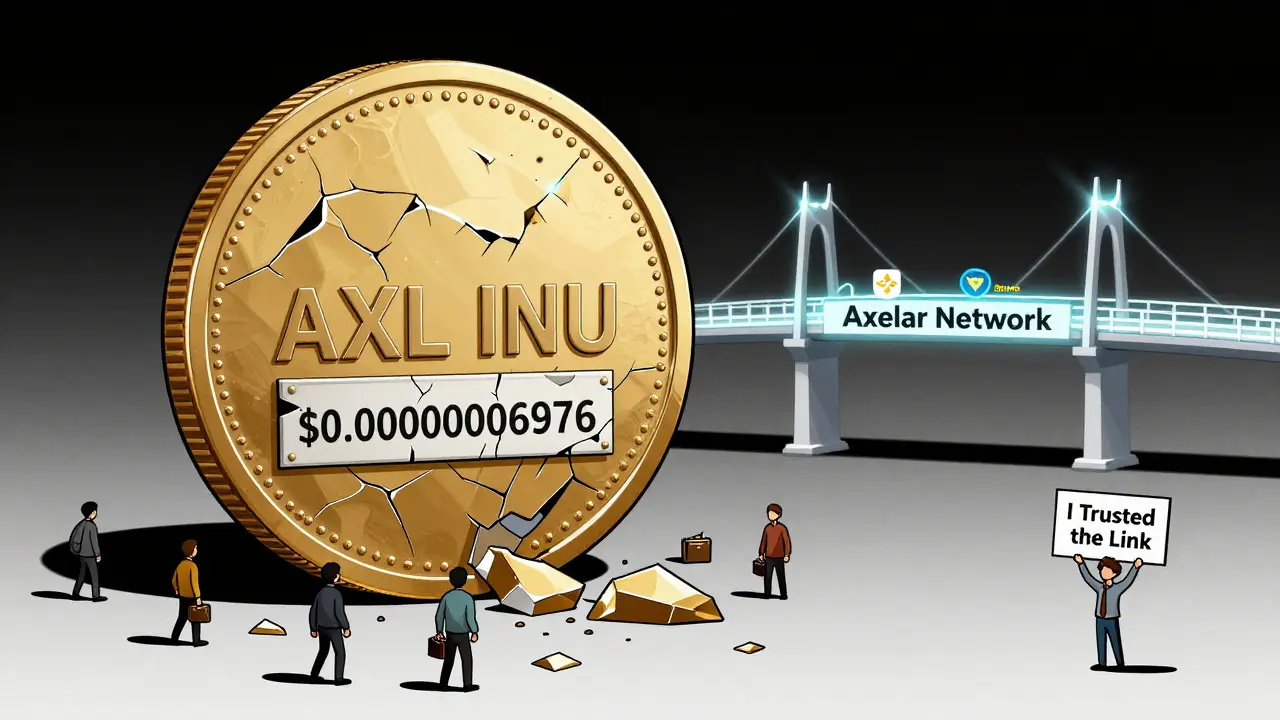
What Should You Do Now?
If you received AXL INU in your wallet:- Do not interact with any airdrop site. Ignore all messages.
- Check your wallet approvals. Go to revoke.cash (or your wallet’s built-in approval manager). Look for any approvals tied to AXL INU or unfamiliar contracts. Revoke them.
- Don’t panic sell. The tokens are worthless. Selling won’t help - and might trigger a scam link.
- Report the scam. If you lost funds, file a report with Chainalysis or your wallet provider. It won’t get your money back, but it helps track the scammers.
If you’re thinking about buying AXL INU? Don’t. It’s not an investment. It’s a trap.
Frequently Asked Questions
Was there ever an official AXL INU New Year's Eve airdrop?
No. There was never an official airdrop. The "New Year's Eve Airdrop" was a phishing scam. No team, website, or community associated with AXL INU ever announced or ran such an event. All websites claiming to offer it were fake and designed to steal crypto from users.
Why did I get AXL INU tokens in my wallet?
You were targeted by a "wallet stuffing" scam. Scammers send tiny amounts of worthless tokens to thousands of wallets to trick users into thinking they’ve won something. The goal is to get you to click a link, connect your wallet, and approve a malicious contract - which lets them drain your funds.
Can I sell AXL INU tokens to make money?
Technically, yes - but only if you find someone who’ll buy them. AXL INU has zero trading volume on major exchanges. It’s listed only on two tiny platforms: XT.com and LBank, with combined daily volume under $10. The price is meaningless. Selling won’t give you profit - it’ll just waste gas fees and possibly expose you to another scam link.
Is AXL INU the same as Axelar Network (AXL)?
No. They are completely different. Axelar Network (AXL) is a legitimate blockchain infrastructure project with a $400M+ market cap, listed on Binance, and backed by top developers. AXL INU is a low-cap meme coin with no team, no utility, and no real community. The similar ticker is intentional - scammers use it to confuse people.
How can I protect myself from future crypto scams like this?
Never connect your wallet to unsolicited links. Always check token contracts on blockchain explorers. Revoke unnecessary approvals using revoke.cash. Never share your private key. And if something sounds too good to be true - like free tokens during a holiday - it is. Stick to well-known projects with real activity, not hype.
Tammy Stevens
Yikes. I got that AXL INU token in my wallet last week and almost clicked the 'claim' link because I thought it was some new Binance promo. Thank god I checked Etherscan first. Zero trades, 70 billion tokens floating around, and a contract that looks like it was copied from a 2017 meme coin template. I revoked all approvals immediately on revoke.cash. Seriously, if you see an unexpected token, don’t even look at the link. Just delete it and move on.
Also, the fact that they’re confusing it with Axelar? That’s low. People are gonna lose serious money because they think they’re interacting with a real project. Scammers are getting smarter with branding.
Kevion Daley
Wow. A $773 market cap. That’s not even worth the gas fee to send it. 😒
Justin Credible
bro i got that token too and i was like ‘free money??’ then i saw the ‘unlimited approve’ thing and was like… nah. i’ve been burned before. i went to revoke.cash and nuked every single approval i didn’t recognize. best 30 seconds of my day. if you’re new to crypto, just assume every unsolicited token is a trap. it’s not paranoia, it’s survival.
Dheeraj Singh
u think this is bad? wait till u see the new ‘ETH2.0 airdrop’ scam that’s gonna drop on jan 1. these guys are just warming up. they’re using ai to generate fake whitepapers now. next thing u know, there’ll be a ‘Solana airdrop’ that asks for ur seed phrase. lol
Mike Yobra
So let me get this straight. We live in a world where the only thing more valuable than a real blockchain protocol… is the confusion it creates.
People don’t get scammed because they’re dumb. They get scammed because the system rewards the illusion of value more than the reality of it. AXL INU isn’t a coin. It’s a psychological exploit. And we’re all complicit for even clicking the link.
Mansoor ahamed
Always check contract on BscScan. No volume = scam. Simple.
Jeannie LaCroix
I CRIED. I REALLY CRIED. I THOUGHT I WAS LUCKY. I GOT A ‘GIFT’ FROM THE CRYPTO GODS. THEN I SAW THE ‘APPROVE UNLIMITED’ BUTTON. I FELT LIKE I WAS BACK IN 2021, CLICKING ‘CLAIM YOUR FREE SHIB’ ON A WEBSITE THAT LOOKED LIKE A ROBLOX GAME. I LOST $1200 ON A SIMILAR SCAM. I’M STILL HEALING. IF YOU’RE READING THIS AND YOU JUST GOT A RANDOM TOKEN? DON’T TOUCH IT. JUST. DON’T. I BEG YOU.
Alicia Speas
As someone who works in financial literacy outreach, this is exactly the kind of scenario we warn about. The emotional hook - ‘free money during the holidays’ - is devastatingly effective. It bypasses rational thinking. We need better public education on wallet security, not just individual warnings. Imagine if every wallet provider had a pop-up when an unknown token arrived: ‘This token has zero trading volume. Do not interact.’
Also, kudos to the author for linking revoke.cash. That tool should be mandatory reading for every crypto user.
Nicolette Lutzi
THIS IS A DEEP STATE CRYPTO OPERATION. THEY’RE USING MEME COINS TO DRAIN AMERICAN WALLETS SO THEY CAN FUND THE NEW WORLD ORDER. I SAW A POST ON TRUMP’S TRUTH SOCIAL SAYING ‘AXL INU IS A BIDEN TOKEN’. I’M NOT JOKING. I’M WATCHING MY WALLET. I’M WATCHING EVERYTHING. THEY WANT US TO THINK WE’RE SMART. BUT WE’RE ALL JUST PUPPETS. I’M NOT CLICKING ANYTHING. I’M NOT TOUCHING ANYTHING. I’M WATCHING.
Sam Harajly
Interesting how the scam works on two levels: the technical and the emotional.
Technically, it’s a simple approval exploit - nothing new.
Emotionally, it exploits the human tendency to interpret unexpected gifts as validation. ‘Someone sent me crypto… maybe I’m chosen?’ That’s the real vulnerability. It’s not ignorance - it’s hope.
And that’s why education alone won’t fix this. We need to address the psychological need to believe in luck, in luck that comes from strangers on the blockchain.