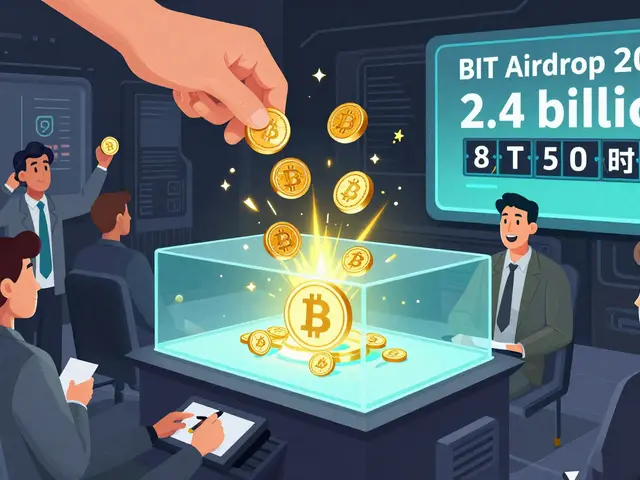
The Biconomy Exchange Token (BIT) airdrop wasn’t just another free token giveaway. It was a carefully designed engine to pull users into the Biconomy exchange ecosystem - and it worked. In April 2022, over 2.4 billion BIT tokens were handed out in a single campaign, with real rules, real stakes, and real utility attached. This isn’t a story about hype. It’s about how a token got distributed, who got it, and what it actually does today.
How the BIT Airdrop Actually Worked
The main airdrop didn’t happen on Biconomy’s own site. It ran on MEXC Kickstarter, a platform that lets exchanges test new tokens with real user participation. The setup was simple: you had to stake MX tokens - MEXC’s native currency - to vote. You couldn’t just sign up and claim. You had to lock up your MX tokens for a few hours. Here’s how it broke down:- Voting window: April 9, 2022, from 02:00 UTC to 10:50 UTC
- Minimum stake: 10 MX
- Maximum stake: 500,000 MX
- Token reward pool: 1.6 billion BIT for voters
- Extra pool: 800 million BIT reserved for top 500 affiliates
- Reference price: $0.00001355 USDT
What BIT Token Actually Does Today
A lot of airdrop tokens vanish after the hype dies. BIT didn’t. It’s still active - and it still has clear uses on the Biconomy exchange. Here’s what holding BIT gets you right now:- Reduced trading fees: The more BIT you hold, the lower your fees. This isn’t a vague promise - it’s a sliding scale built into the exchange’s fee structure.
- VIP status access: You can use BIT to buy monthly VIP plans that cut trading fees even further. Think of it like a loyalty card, but paid in crypto.
- Voting rights: BIT holders vote on key exchange decisions. Things like new coin listings, fee changes, or platform upgrades. Your voice has weight.
- Seasonal buyback rewards: Biconomy periodically uses a portion of its revenue to buy back BIT from the market and redistribute it to holders. This isn’t theoretical - it’s happened multiple times.
- Early access: Holders get first dibs on new token listings, exclusive events, and limited-time promotions.
Where BIT Is Traded and How It’s Performing
As of February 2026, BIT trades on three exchanges: Biconomy, MEXC, and PancakeSwap. That’s a mix of centralized and decentralized platforms - a smart move to cover both traditional traders and DeFi users. The current price? Around $0.000010 USD. That’s down from the original $0.00001355 reference price during the airdrop. But here’s the thing: the price hasn’t crashed. It’s held steady for years. Daily trading volume sits at $655,203 USD - not huge, but consistent. That’s not a dying asset. That’s a quiet, stable one. CoinMarketCap lists it at #3823 by market cap. That sounds low, but remember: it’s not a big coin because it wasn’t designed to be. It was designed to serve a specific exchange’s users. It doesn’t need to be top 100. It just needs to work for the people who use it.
Why the Airdrop Was Successful
Most airdrops fail because they’re lazy. They hand out tokens with no rules, no lock-up, no real incentive. The BIT airdrop avoided all that. It required action: staking, voting, waiting. That filtered out speculators and brought in users who cared. The reward system was fair - proportional to participation. The timing was tight - only 8 hours of voting - so people didn’t drag it out. And the token had immediate value: lower fees, voting power, rewards. The 800 million BIT reserved for top 500 affiliates also helped. Those weren’t random users. They were promoters, influencers, and early adopters who helped spread the word. That created organic growth.What’s Changed Since 2022?
There’s been no major update to the BIT token’s code since mid-2023. No new features. No blockchain upgrades. No major announcements. That doesn’t mean it’s dead. It means it’s working as designed. The token doesn’t need constant innovation. It’s a utility token. It’s not trying to be Ethereum or Solana. It’s a tool for Biconomy exchange users. As long as the exchange keeps operating and trading fees keep being discounted for BIT holders, the token keeps its value. The PancakeSwap integration helped too. Even if someone never used Biconomy’s website, they could still trade BIT on a decentralized exchange. That kept liquidity alive and gave people another way to access the token.
Should You Still Hold or Buy BIT?
If you’re already trading on Biconomy, holding BIT makes sense. Even a small amount reduces your fees. If you’re not using the exchange, there’s no reason to buy it. Don’t look at BIT as an investment. Look at it as a membership. You pay in tokens, and you get discounts, voting rights, and occasional rewards. It’s not going to make you rich. But if you trade regularly, it saves you money - and that’s valuable. The lack of recent development news might worry some. But for a utility token tied to a functioning exchange, that’s not always a bad sign. It means the system is stable. No need to fix what isn’t broken.What’s Next for BIT?
The future of BIT depends entirely on Biconomy exchange. If trading volume grows, more people will hold BIT to cut fees. If the exchange adds new features - like staking, lending, or NFT trading - BIT could become even more central. For now, the best path forward is simple: use the exchange. Trade. Vote. Hold. The token rewards action. It always has.Was the BIT airdrop really free?
No, it wasn’t free in the traditional sense. You had to stake MX tokens to vote. That meant locking up your own crypto. The reward came in BIT, but the cost was your participation and your staked assets. It was a trade: your MX for a chance at BIT, with rewards based on how much you staked.
Can I still claim BIT from the 2022 airdrop?
No. The airdrop ended in April 2022. All tokens were distributed by April 9, 2022. If you didn’t participate at the time, you can’t get those original tokens. But you can still buy BIT on exchanges like Biconomy, MEXC, or PancakeSwap today.
Is BIT a good investment?
Not if you’re looking for price growth. BIT’s price has stayed flat for years. But if you trade on Biconomy exchange, holding BIT lowers your fees and gives you voting rights. That’s not speculation - that’s cost savings. It’s a utility token, not a speculative asset.
How many people hold BIT today?
Exact holder numbers aren’t publicly tracked, but the token is active on three exchanges with consistent daily volume. The fact that it still trades over $650,000 daily suggests hundreds, if not thousands, of active holders. Most likely, the majority are Biconomy exchange users who use it to reduce fees.
Can I use BIT on other exchanges besides Biconomy?
Yes. BIT trades on MEXC and PancakeSwap. You can buy, sell, or swap it on any of these three platforms. But the only place where BIT gives you fee discounts, voting rights, and buyback rewards is on the Biconomy exchange. Other exchanges just let you trade it.
Is BIT still being developed?
There haven’t been any public code updates or major announcements since mid-2023. That doesn’t mean development stopped - it might mean the token is working as intended. The focus now seems to be on maintaining the existing system rather than building new features. For a utility token tied to an exchange, that’s not unusual.
Ruby Ababio-Fernandez
BIT? More like BORING. Staked MX, got tokens, now what? Still trading on Biconomy? Same old fees. No growth. No innovation. Just sitting there. 🤷♀️
Alex Williams
The real win here is the fee structure. Holding BIT isn't about speculation-it's about operational efficiency. The sliding scale directly correlates with volume, which incentivizes long-term engagement. That's a token design that actually aligns incentives. Most projects are still stuck in 'airdrop and dump' mode.
Andrew Edmark
This is actually one of the few airdrops that didn't feel like a scam 😊 I staked my MX, got my BIT, and honestly? It saved me like $40 in fees last month. Not bad for a token that's been quiet for years. Keep it real, Biconomy 👍
Ian Plunkett
Let’s be real. $0.000010? After 2.4B tokens? That’s a corpse with a pulse. The fact that it’s still trading at all is a miracle. And 'voting rights'? LOL. Who even votes? The same 50 people who hold 80% of the supply. This isn’t utility-it’s a zombie token with a PR team.
Charrie VanVleet
I’ve been holding BIT since day one and I’ll tell you-it’s not flashy, but it works. I use it to buy VIP monthly, cut my fees, and vote on new listings. Last time I voted, we got $LTC listed ahead of Binance. That’s power. Not hype. Just real utility. 🙌
Scott McCrossan
They called it a 'carefully designed engine'-more like a Rube Goldberg machine made of duct tape and delusions. You had to stake MX to get BIT so you could save pennies on fees? What a joke. This isn't innovation. It's a tax on your liquidity. And don’t get me started on 'seasonal buybacks'-they're just burning cash to pretend they care.
Beth Erickson
BIT is dead but the admins still post this like its some revolutionary thing. It’s not. It’s a ghost. $650k volume? That’s less than a single meme coin pump. You’re not saving money. You’re just feeding a dead ecosystem. Wake up
Jeremy Fisher
You know what’s wild? This whole thing works because it’s so deliberately unsexy. No whitepaper. No roadmap. No influencer shilling. Just a simple exchange with a token that reduces fees and gives you a say. Most projects overcomplicate everything. Biconomy? They just built a tool. And it works. That’s rare. It’s not glamorous, but it’s honest. And in crypto? That’s gold.
Sasha Wynnters
BIT isn’t a token-it’s a ritual. You don’t hold it to get rich. You hold it to belong. To be part of a quiet tribe that values utility over hype. You stake, you vote, you trade cheaper. It’s not about the price. It’s about the rhythm. The quiet hum of a system that doesn’t need to scream to be valid. In a world of screaming, that’s revolutionary.
Rajib Hossaim
The structure of this airdrop was commendable. Requiring staking ensured that only committed participants received rewards. This approach contrasts sharply with the prevalent airdrop culture that encourages speculative behavior. The continued utility of BIT as a fee-reduction mechanism demonstrates thoughtful tokenomics design.
Jenn Estes
You people act like this is some genius move. You staked MX. You got BIT. You saved $10 on fees. Congrats. You’re a crypto serf. The exchange owns you. You’re not empowered-you’re just a loyal customer with a loyalty card made of blockchain. Pathetic.
Anandaraj Br
BIT is the reason I still trade on Biconomy. I mean honestly if you think this is dead you never used it. I got 100k BIT from the airdrop and I still get buybacks every quarter. Last one was 15k more. That’s free money. And I vote on listings. I made them add $SOL because I voted. So yeah I’m still here
AJITH AERO
2.4 billion tokens and you’re still using it? Bro. You’re not saving money. You’re just addicted to a dead token. I got mine, sold it at 0.000012, and bought DOGE. You’re still holding? 😭
Angela Henderson
I remember when I first got BIT. I thought it was just free money. But then I started using it for fees and realized... wow. I actually save like 15% on trades. I don’t even think about it anymore. It’s just part of how I trade. Kinda nice when something just works without drama. 🌿
Geet Kulkarni
While the tokenomics of BIT may appear rudimentary on the surface, its underlying architecture exhibits a profound adherence to the principles of decentralized governance and utility-driven value accrual. The absence of speculative volatility is not a flaw-it is an elegantly executed design choice that prioritizes functional integrity over market manipulation. One must appreciate such restraint in an era of rampant hyperinflationary token schemes. 🌟
Lauren Brookes
I think people miss the point. BIT isn’t meant to be a moonshot. It’s meant to be a quiet anchor. Like a good pair of shoes. You don’t notice them until they’re gone. And when you do? You realize how much you depended on them. The fact that it hasn’t changed in years? That’s not neglect. That’s mastery.
Chris Thomas
Let’s cut through the noise. You’re calling this 'utility'? It’s a loyalty program with a blockchain sticker. The voting power? 90% of votes come from whales who bought BIT on MEXC after the airdrop. The buybacks? They’re funded by trading fees from users who don’t even hold BIT. This isn’t decentralization. It’s a corporate loyalty card with a crypto veneer. You’re being played.
James Breithaupt
The fact that BIT trades on PancakeSwap is genius. It bridges the gap between centralized users and DeFi natives. You don’t need to use Biconomy to hold it. That’s how you build organic liquidity. And the price stability? That’s not a bug. That’s the feature. No pump, no dump. Just steady utility. That’s the future.
Sarah Shergold
BIT? More like BIT me. I got mine, sold it for ETH, and moved on. Who even still holds this? It’s like keeping a 2015 iPhone because it 'still works'. It does. But why??
Dominica Anderson
A utility token? Please. It’s a corporate loyalty card with a blockchain logo. You’re not a participant-you’re a captive user. The 'voting rights'? A PR stunt. The 'buybacks'? A distraction. Real innovation doesn’t need a token. It just happens. This? This is crypto theater.