You see the name CHIHUA popping up in your Telegram groups or Twitter feed, and suddenly everyone is talking about an airdrop. But here’s the catch: when you look for concrete details-dates, amounts, eligibility-you hit a wall of zeros and vague promises. Is this the next big dog-coin winner, or just another ghost project fading into the blockchain void? If you are hunting for free tokens, you need to know exactly what you’re dealing with before you connect your wallet.
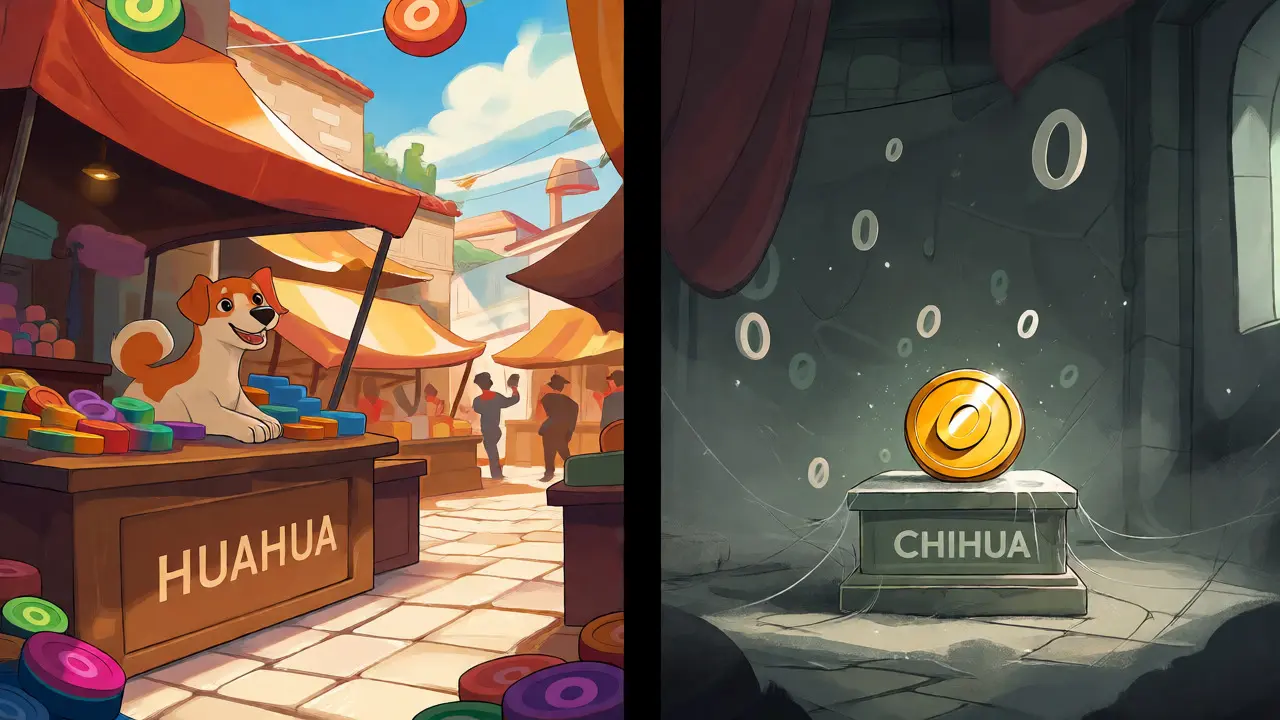
The confusion starts immediately because "Chihua" isn't a single, clearly defined entity in the crypto world. You might be mixing it up with HUAHUA, the token from the Chihuahua Chain that had a major airdrop back in January 2022. Or, you might be looking at the newer Chihua Token (CHIHUA), which claims to be a community-driven answer to Doge and Shiba Inu. The data on tracking platforms like CoinMarketCap shows zero circulating supply and minimal trading volume for CHIHUA as of late 2026. That’s a massive red flag. Does a token exist if no one is trading it?
Decoding the CHIHUA Token Identity
Let’s clear up the name game first. There are multiple projects using similar names, and scammers love this ambiguity. The Chihua Token listed on CoinMarketCap describes itself as a "community answer to Doge Coin." It claims a fair launch where founders bought tokens on Uniswap alongside regular users. The contract address starts with 0x26ff...798d18, placing it on the Ethereum blockchain.
But look at the numbers. The total supply is listed as 490 trillion tokens. Yet, the circulating supply is reported as zero. How can you have a max supply but no circulation? This usually means one of three things: the token hasn’t fully launched its liquidity pools, the data tracker is outdated, or the project is effectively dead. For the HUAHUA token, however, we have solid historical data. It distributed 7.2 million tokens via MEXC Exchange in 2022. If you are seeing news about "Chihuahua airdrops," check if they mean HUAHUA or CHIHUA. They are different beasts.
Tokenomics: Burn Mechanisms and Rug Pull Claims
The CHIHUA project makes bold claims about its security. They state the token is "100% rug pull proof." Why? Because of their aggressive burning strategy. According to their documentation, 51% of the initial supply was burned immediately. Another 48% went to Uniswap liquidity and was subsequently burned. That leaves only 1% of the supply for marketing and development.
Think about what that means for you as an investor or airdrop hunter. With 99% of the tokens gone, the remaining supply is tiny relative to the original mint. In theory, this creates scarcity. But in practice, if the liquidity pool is empty or the market cap is near zero, "scarcity" doesn’t pay your bills. The claim of being rug-pull-proof relies on the idea that since the team holds almost no tokens, they can’t dump them on you. It’s a clever narrative, but narratives don’t stop smart contracts from failing or communities from abandoning ship.
| Attribute | CHIHUA Token | HUAHUA Token |
|---|---|---|
| Blockchain | Ethereum (ERC-20) | Chihuahua Chain (Cosmos-based) |
| Airdrop Status | Unclear/Limited Data | Completed (Jan 2022) |
| Key Feature | Fair Launch, Aggressive Burns | Governance Pool, Community Voting |
| Current Market Activity | Near Zero Volume | Active Trading History |
| Risk Level | High (Data Gaps) | Moderate (Established Project) |
How to Spot a Legit Airdrop vs. a Scam
If you are waiting for CHIHUA tokens to drop into your wallet, pause. Most legitimate airdrops in 2025 and 2026 follow specific patterns. They reward activity. Did you bridge assets? Did you swap on a new DEX? Did you stake? Retroactive rewards are common. Projects like Hyperliquid or Monad gained traction by rewarding early users who actually used the network.
Does CHIHUA ask you to perform a task? Often, scammy airdrops will ask you to sign a transaction that looks harmless but actually grants unlimited spending approval to a malicious contract. Always check the permissions. If a site asks you to "claim" your CHIHUA tokens but requires you to send ETH first, run. Legit airdrops rarely require upfront payments unless it’s covering gas fees directly from your wallet without extra markup.
Also, verify the source. Go to the official website linked from verified social media accounts, not from a random DM. Look for the contract address. Copy it from CoinGecko or CoinMarketCap and paste it into Etherscan. If the transaction history is sparse or non-existent, the "airdrop" might just be a marketing ploy to get eyes on a dormant token.
The Reality of Low-Cap Meme Coins
Meme coins live and die by attention. Dogecoin has Elon Musk. Shiba Inu had Vitalik Buterin’s donation. What does CHIHUA have? Right now, it seems to have a strong narrative about fairness and burns, but little verifiable momentum. The zero-volume data suggests that even if you receive tokens, selling them might be impossible due to lack of buyers.
Consider the opportunity cost. Time spent farming a low-probability airdrop is time not spent learning how to spot high-conviction plays. In the current market, point-based systems and testnet participation are more reliable indicators of future rewards than static token lists. If CHIHUA launches a testnet or a specific quest platform, that changes the equation. Until then, treat any "guaranteed" allocation with skepticism.
Action Plan for CHIHUA Hunters
So, what should you actually do? Here is a practical checklist:
- Verify the Contract: Ensure you are interacting with the correct ERC-20 contract address. Beware of fake clones on other chains.
- Check Liquidity Locks: Use tools like DexScreener to see if the liquidity is locked. If it’s unlocked, the team can pull all the money out.
- Follow Official Channels Only: Ignore influencers pushing generic "dog coin" hype. Stick to the project’s official Discord or Telegram announcements.
- Don’t Connect Your Main Wallet: Use a burner wallet for any airdrop interactions. If something goes wrong, you lose pennies, not your life savings.
- Monitor On-Chain Activity: Watch the holder count. If it’s growing, there’s interest. If it’s flatlining, the project may be stagnant.
Remember, the goal of an airdrop is profit, not just possession. Holding a bag of worthless tokens feels good psychologically but hurts financially. If the CHIHUA token remains at zero volume, consider whether the effort to claim it is worth the potential return.
Is CHIHUA the same as HUAHUA?
No, they are distinct projects. HUAHUA is the native token of the Chihuahua Chain (a Cosmos-based blockchain) and had a completed airdrop in 2022. CHIHUA is an Ethereum-based meme token claiming to be a fair-launch alternative to Doge. Confusing them is a common mistake due to similar naming conventions.
Why does CHIHUA show zero circulating supply?
Zero circulating supply on trackers often indicates that the token has not yet been listed on major exchanges with active trading pairs, or that the majority of tokens were burned or locked in liquidity pools that haven't been indexed correctly. It can also signal a lack of market activity.
How do I participate in a CHIHUA airdrop?
Currently, there is no widely publicized, active airdrop campaign for CHIHUA with standard requirements like staking or voting. Users should monitor official social channels for announcements regarding snapshot dates or eligibility criteria. Be cautious of third-party sites asking for private keys.
Is CHIHUA a rug pull risk?
The project claims to be "rug pull proof" due to burning 99% of the supply. However, low liquidity and zero trading volume present different risks. While the team may not hold enough tokens to dump, the lack of buyers means you might not be able to sell if you acquire tokens.
Where can I trade CHIHUA tokens?
As of late 2026, CHIHUA has limited to no presence on major centralized exchanges. Any trading would likely occur on decentralized exchanges like Uniswap, provided liquidity exists. Always check the contract address on Etherscan to ensure you are swapping the correct token.

Write a comment