If you're trying to use Coinbase and keep hitting a wall-whether it’s a blocked deposit, a denied sign-up, or a message saying "This service isn't available in your country"-you're not alone. Millions of people around the world face these exact roadblocks every day. The truth is, Coinbase doesn't operate everywhere. It’s not a global free-for-all like some other crypto platforms. It’s a highly regulated U.S.-based exchange that picks and chooses where it can legally offer services. And that means your access to buying, selling, and even holding crypto on Coinbase depends entirely on where you live.
Why Does Coinbase Block Some Countries?
Coinbase doesn’t randomly decide which countries to block. It follows a strict set of rules set by governments and financial regulators. The main reason? Compliance. Specifically, compliance with the U.S. Treasury’s Office of Foreign Assets Control (OFAC). OFAC maintains a list of sanctioned countries and individuals-places like Russia, Iran, North Korea, Syria, and Crimea. If Coinbase lets someone from one of these places trade fiat for crypto, it risks massive fines or even criminal charges. But it’s not just about OFAC. Coinbase also has to follow local laws. In the European Union, the Markets in Crypto-Assets (MiCA) regulation took effect in 2025, forcing Coinbase to adjust how it offers staking, lending, and trading services across 30+ countries. In India, the Reserve Bank of India (RBI) has been unclear on crypto rules, so Coinbase pulled back its fiat services entirely until further notice. In Nigeria and Egypt, new government bans in early 2025 forced Coinbase to shut down local access. This isn’t about Coinbase being picky. It’s about survival. As a publicly traded company on NASDAQ, it has to avoid legal disasters. One misstep could cost billions.What’s the Difference Between Coinbase App and Coinbase Wallet?
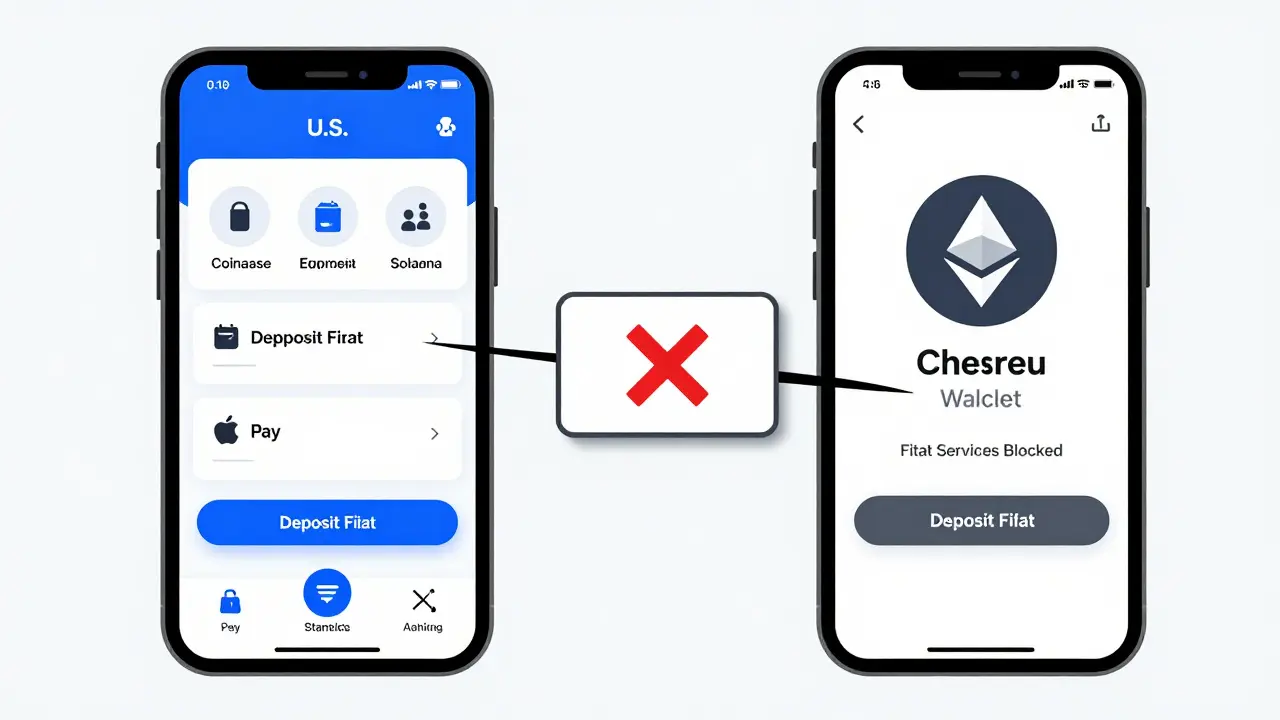
This is where things get confusing-and why so many users get frustrated. The Coinbase App is the full platform. It lets you buy crypto with a bank transfer, debit card, Apple Pay, or PayPal. It lets you sell crypto back to your bank account. It shows your balance in USD, EUR, GBP, and other fiat currencies. But here’s the catch: this app only works in 48 countries. That includes the U.S., U.K., Germany, France, Canada, Australia, Japan, and Singapore. If you’re outside that list, you can’t even sign up. Then there’s the Coinbase Wallet. This is a separate app-non-custodial, meaning you control your own keys. It doesn’t let you buy crypto with a credit card. But it does let you connect to decentralized apps (dApps), hold over 5,500 tokens, and interact with blockchain networks like Ethereum, Polygon, and Solana. And guess what? This wallet works almost everywhere-except in OFAC-sanctioned countries. So if you’re in Pakistan, you can install Coinbase Wallet, send and receive ETH, and swap tokens on Uniswap. But you can’t deposit rupees or withdraw to your local bank. Same in Colombia, the Philippines, or the UAE. The wallet works. The app? Blocked.Which Countries Are Fully Blocked?
Here’s the real list of places where Coinbase completely blocks the App and restricts Wallet access:- Russia (all services cut since February 2022)
- Iran
- North Korea
- Syria
- Crimea (per OFAC Directive 3A)
- Cuba
- Myanmar
- Libya
- Nigeria (since January 2025)
- Egypt (since February 2025)
Where Does Coinbase Work Best?
If you’re in the U.S., Canada, the U.K., or most of Western Europe, you’re in the sweet spot. Coinbase is fully licensed here. You can:- Deposit up to $50,000 per day (after full verification)
- Use SEPA transfers in Germany, France, and Spain (funds arrive in 1-2 business days)
- Buy crypto with Apple Pay or Google Pay
- Stake Ethereum, Cardano (in most EU countries), and Polkadot
Where’s the Gray Zone?
Some countries sit in a messy middle ground. Here’s what’s happening:- UAE: You can use Apple Pay and Google Pay to buy crypto, but bank transfers (IBAN) are blocked. Why? UAE regulators haven’t granted full licensing, so Coinbase limits access to digital wallets only.
- Philippines: The Coinbase Wallet works fine. But the App? Blocked. That means 83% of local crypto users (per Bangko Sentral’s 2025 survey) are forced to use local exchanges like PDAX, which charge 3.5% per trade-seven times higher than Coinbase’s 0.5%.
- Pakistan: Coinbase Wallet lets you receive and send crypto. But no fiat deposits. Users report having to use Binance P2P, where premiums can hit 8% just to buy USDT.
- India: Coinbase removed fiat services in 2023. As of March 2026, the RBI is still reviewing crypto regulations. No sign of return yet.
How Does Coinbase Know Where You Are?
It’s not just your IP address. That’s the first layer, but it’s easy to fake with a VPN. Coinbase uses three real checks:- IP geolocation: Where your device is connecting from.
- KYC documents: When you upload your ID, it checks the country of issuance. A Philippine driver’s license? You’re flagged.
- Bank details: If you link a U.S. bank account but live in Brazil, the system flags it. Transactions get paused.
What Happens If You Try to Bypass the Restrictions?
People try. A lot. Using a VPN to access Coinbase from a blocked country sounds smart. But here’s what actually happens:- Your account gets flagged for "suspicious activity."
- Your funds are frozen while they investigate.
- You’re asked to prove your location-sometimes with utility bills or tax documents.
- If you can’t prove you’re in an allowed country, your account is permanently closed.
How Does Coinbase Compare to Other Exchanges?
Coinbase isn’t the only game in town. But its restrictions are more predictable than others.- Binance: Operates in over 190 countries, but with heavy regional restrictions. In Canada and the Netherlands, Binance shut down fiat services in 2023. In Pakistan, it handles 200,000 daily transactions. It’s more flexible-but less regulated.
- Kraken: Supports fiat in 55 countries. More open than Coinbase, but still blocks OFAC nations. Known for better support in emerging markets.
- MetaMask: Not an exchange. Just a wallet. Works in 195+ countries. No KYC. No restrictions. But you can’t buy crypto with a credit card. You need to get it from another exchange first.
What’s Next? The Future of Geographic Restrictions
Coinbase is under pressure. The SEC lawsuit (filed June 2023) could force even tighter controls if the court rules against them. If they lose their "broker-dealer" status, they might have to pull out of more countries. Meanwhile, MiCA continues to roll out across Europe. By August 2025, users in Malta, Iceland, Liechtenstein, and Hungary will be moved from Coinbase Europe Limited to Coinbase Luxembourg S.A. It’s a legal reshuffle-but no change in service. The real threat? Fragmentation. As more countries create their own crypto rules, Coinbase will keep cutting off access. JPMorgan predicts Coinbase’s total addressable market could shrink by 40% by 2030 because of these borders. For now, the rule is simple: If you want full access to Coinbase, you need to live in a country where it’s legally allowed. No shortcuts. No workarounds. Just compliance.Can I use Coinbase Wallet in a country where the App is blocked?
Yes. Coinbase Wallet works globally except in OFAC-sanctioned countries like Russia, Iran, and North Korea. It lets you send, receive, and swap crypto, but you can’t buy or sell with fiat currency. It’s designed for self-custody, not trading.
Why can’t I deposit money from Pakistan on Coinbase?
Pakistan isn’t on Coinbase’s list of approved countries for fiat on-ramps. Even though crypto is popular there, Coinbase hasn’t met local regulatory requirements to offer bank transfers or card deposits. Users rely on Binance P2P or local exchanges like PDAX instead.
Does Coinbase block users based on VPN use?
Yes. If Coinbase detects you’re using a VPN to access the service from a restricted country, your account will be flagged. You may be asked to verify your location with official documents. If you can’t prove you’re in an allowed country, your account will be permanently suspended and funds locked.
Which countries have full access to Coinbase’s fiat services?
As of 2026, Coinbase offers full fiat services (bank transfers, cards, Apple Pay) in 48 countries, including the U.S., Canada, U.K., Germany, France, Australia, Japan, Singapore, and most of Western Europe. A full list is available in Coinbase’s Help Center under "Supported Countries."
Is Coinbase planning to expand to more countries in 2026?
Coinbase has not announced plans to expand into new countries in 2026. Instead, it’s focusing on deepening compliance in existing markets, especially under MiCA in Europe and potential U.S. regulatory changes. Expansion is unlikely until global crypto regulations become more aligned.
Tobias Wriedt
LMAO so now we’re all just supposed to accept that Big Crypto is just another bank with a blockchain logo? 🤡 I live in Canada and I can use Apple Pay but my buddy in Nigeria can’t even send ETH without getting flagged? This isn’t regulation - it’s digital colonialism. Coinbase gets to decide who gets to be part of the future? No thanks. I’m switching to MetaMask and never looking back. 💸🌍
iam jacob
I just don’t get why people are so mad. If you live in a country where the government hates crypto, why are you surprised Coinbase won’t risk it? I’m not saying it’s fair, but it’s business. You want access? Move. Or use Binance. Easy.
Jesse Pals
Honestly? I’m just glad I live in Canada. I can use my debit card, stake ADA, and not worry about my funds vanishing because some regulator in DC got nervous. 🙌 But I feel for folks in places like Pakistan or Colombia - they’re stuck between a rock and a hard place. Maybe we need a decentralized wallet network that doesn’t care where you live. Just saying. 🌐✨
Diane Overwise
Oh honey. You really thought crypto was about freedom? Sweetie. It’s about compliance. And if you’re not in the right zip code? You’re not in the club. 😘 Don’t take it personally - it’s not you, it’s the SEC. And yes, I spelled that right. No typos here. Just cold hard reality. 💅
Ann Liu
The distinction between Coinbase App and Coinbase Wallet is critical and often misunderstood. The App is a regulated financial services provider subject to AML/KYC and fiat on/off-ramp licensing. The Wallet is a non-custodial browser extension and mobile application that interfaces with blockchain protocols directly. Therefore, the Wallet’s global availability (excluding OFAC jurisdictions) is legally defensible under current U.S. and international frameworks. This is not a technical limitation - it’s a regulatory architecture.
Dionne van Diepenbeek
I used to think Coinbase was cool until I realized they block my cousin in Egypt just because their government said no. Meanwhile Binance lets anyone with a phone and a brain do whatever they want. Why does trustworthiness mean less access? Just saying. 🤷♀️
Graham Smith
Let’s be clear - this isn’t about geography. It’s about jurisdictional arbitrage. Coinbase operates under a U.S. regulatory umbrella, which means they’re bound by OFAC, FinCEN, and state-level money transmitter laws. The fact that you can use the Wallet abroad is a loophole, not a feature. If you’re relying on non-custodial tools to circumvent regulatory boundaries, you’re not a crypto pioneer - you’re a regulatory tourist. And tourists get deported.
Katrina Smith
Oh so now we’re supposed to feel bad for Coinbase because they’re too scared to operate in Nigeria? Bro. They made a business decision. Don’t turn it into a human rights issue. I’m just glad I’m not paying 8% premiums to buy USDT like some people. 🤭
Anastasia Danavath
I just want to buy some ETH. That’s it. Not a PhD in compliance. Why does this have to be so complicated? 😴
Bruce Doucette
You people are acting like this is a tragedy. Let me break it down: if you’re from a country where the government bans crypto or doesn’t have banking infrastructure, you’re not being discriminated against - you’re just not part of the target market. Coinbase is a public company. They don’t care about your dreams. They care about quarterly earnings. And if your country doesn’t generate revenue? You’re out. Period. 🧠💸
Marie Vernon
I just want to say - to everyone in the Philippines, Pakistan, Colombia: you’re not alone. I’ve been there. I’ve used Binance P2P. I’ve paid 7% premiums. But we’re building something bigger. We’re creating peer-to-peer networks that don’t need banks. One day, we won’t need Coinbase to let us in. We’ll just build our own. Keep going. You’re doing better than you think. 💪🌍
Ross McLeod
The real issue isn’t Coinbase’s restrictions - it’s the fragmentation of global financial infrastructure. The fact that MiCA is rolling out in Europe while India still has no clear regulatory framework creates a patchwork that forces platforms like Coinbase into a corner. They can’t operate in a legal gray zone. If governments want inclusive access, they need to harmonize their regulatory regimes. Until then, we’re stuck with this Kafkaesque mess. And yes, I’ve read all 147 pages of the MiCA text. It’s not pretty.
rajan gupta
This is the end of the dream. Crypto was supposed to be for everyone. Now it’s just another Wall Street game where the rich get to play and the rest of us have to beg for scraps. I saw a man in Mumbai cry because he lost his life savings trying to use a VPN. And Coinbase? They just block his IP and move on. This isn’t innovation. This is exploitation. 🌧️💔
Billy Karna
One thing people miss: Coinbase Wallet’s global availability isn’t an accident - it’s intentional. By separating custody from trading, they create a legal buffer. The wallet doesn’t hold your assets. It doesn’t facilitate fiat conversions. It’s just a key manager. That’s why it works in 190+ countries. But if you want to convert your INR to ETH? That’s a regulated activity. That’s where the wall goes up. It’s not about geography - it’s about activity. Understand that, and you understand the entire crypto regulatory landscape.
Arlene Miles
I don’t care if you’re in Nigeria or Norway - if you’re using crypto to build something real, you deserve access. This isn’t about rules. It’s about humanity. Coinbase is a corporation. Corporations don’t have morals. We do. So let’s build alternatives. Let’s fund local P2P networks. Let’s create community-run on-ramps. Let’s stop waiting for permission. The future isn’t in San Francisco. It’s in Lagos. In Manila. In Cairo. And we’re already building it. 💥
Jessica Beadle
The fact that you’re even asking if you can bypass geo-blocks with a VPN proves you haven’t read the User Agreement. Coinbase has a team of 47 people whose sole job is to detect and terminate VPN usage. They use behavioral analytics, device fingerprinting, and bank routing number correlation. You think you’re clever? You’re just another data point in their fraud dashboard. And your BTC? Gone. Forever. You’ve been warned.
Tony Weaver
Let’s not romanticize this. Coinbase isn’t a hero. It’s a compliance machine with a shiny UI. They block countries not because they’re evil - but because it’s cheaper than fighting lawsuits. The real villain? The SEC. The real tragedy? That we’ve turned decentralized finance into a gated community. And the irony? The people who scream the loudest about freedom are the ones who still trust a centralized exchange to protect their assets. Pathetic.
Patty Atima
I’m just here for the memes. And the ETH. That’s it. 🥱
Lucy de Gruchy
You think this is about regulation? No. This is about control. The U.S. government doesn’t want decentralized money. It wants to track every transaction. Coinbase is just their willing puppet. The Wallet works because it’s too decentralized to shut down - but soon, they’ll force them to add KYC there too. Mark my words. This is just the beginning. They’re coming for your keys next. 🕵️♀️🔒