Imagine trying to send money to a relative abroad, but every bank account you own is frozen because of international politics. For millions of Iranians, this isn't a hypothetical scenario; it’s daily life. Since 2017, when severe international sanctions cut off Iran from the global financial system, cryptocurrency has transformed from a niche tech experiment into a vital economic lifeline. It is no longer just about speculation or investment. For many citizens, digital assets are the only way to preserve wealth against hyperinflation and access the outside world.
The landscape has shifted dramatically. What started as individual curiosity has evolved into a sophisticated infrastructure involving domestic exchanges, government-regulated mining, and complex workarounds by everyday users. Today, we look at how this ecosystem operates under intense pressure, the recent crackdowns that have reshaped user behavior, and the strategies people use to stay financially connected despite the restrictions.
The Rise of Domestic Exchanges and Government Control
When traditional banking channels closed, Iranian entrepreneurs built local alternatives. Platforms like Nobitex is a leading domestic cryptocurrency exchange in Iran that allows users to trade digital assets for Iranian Rials. gained massive popularity because they offered a familiar interface and local currency support. However, these platforms operate in a gray zone. The government wants control, so it monitors transactions closely.
In December 2024, the Central Bank of Iran (CBI) attempted a hard line by blocking all website-based conversions between cryptocurrency and the Rial. This move caused immediate panic among users who relied on these sites for daily transactions. But the ban was short-lived. By January 2025, the CBI reversed course, unblocking exchanges that agreed to integrate with government APIs. These APIs provide authorities with full access to user data, including transaction histories and identity verification details.
This dual approach reveals the government's dilemma. On one hand, they want to prevent capital flight and enforce sanctions compliance. On the other hand, they recognize that cutting off crypto entirely would cripple the economy further. By forcing users onto monitored domestic platforms, the state maintains oversight while allowing limited financial freedom. For the average citizen, this means trading convenience for privacy. Every transaction on Nobitex or similar platforms is potentially visible to regulators.
Sanctions Evasion and the Role of State Actors
While regular citizens use crypto for survival, larger entities use it for strategy. The Islamic Revolutionary Guard Corps (IRGC) has become deeply embedded in Iran's crypto operations. U.S. Treasury Department officials have noted that cryptocurrency is no longer a peripheral tool for Iran but a core settlement mechanism for procurement and finance networks.
By the end of 2024, Iran commanded nearly 60% of all sanctions-related cryptocurrency activity by value globally. This dominance wasn't accidental. Iranian networks operate industrial-scale evasion schemes, often involving companies across China, Hong Kong, and the UAE. They use a technique called "layering," where funds are moved through multiple intermediary wallets to fragment audit trails before being off-ramped through exchanges with weak compliance standards.
The scale is staggering. In 2024, sanctioned jurisdictions received $15.8 billion in cryptocurrency, with Iran accounting for a significant portion of illicit flows. Between January and July 2025, total crypto flows reached approximately USD 3.7 billion. While this represents an 11% decline from the previous year, it still indicates robust demand. The drop likely reflects intensified enforcement rather than reduced need. As traditional banking options vanish, the reliance on digital assets grows, creating a high-stakes cat-and-mouse game between Iranian operators and international watchdogs.
The Great Stablecoin Shift: From USDT to DAI
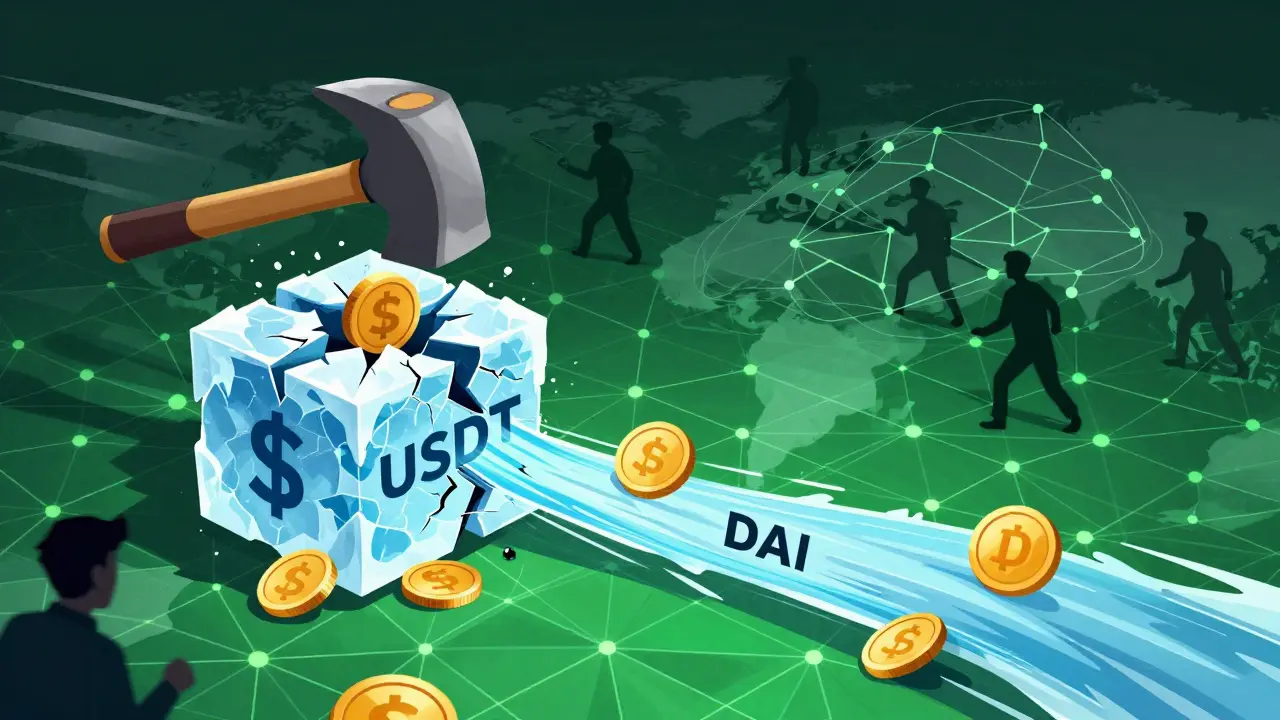
One of the most striking developments in 2025 was the rapid migration away from Tether (USDT). On July 2, 2025, Tether executed its largest-ever freeze of Iranian-linked funds, targeting 42 cryptocurrency addresses. Many of these wallets had substantial exposure to Nobitex and showed transactional links to IRGC-affiliated addresses flagged by Israeli counter-terrorism financing units.
The reaction from the Iranian crypto community was swift and coordinated. Within days, domestic exchanges, influencers, and government-aligned channels urged users to offload their USDT holdings. The destination? DAI, a decentralized stablecoin, specifically on the Polygon network.
Why Polygon? It offers faster transaction speeds and significantly lower fees compared to Ethereum mainnet. For users moving small amounts frequently, cost efficiency matters. Why DAI? Unlike USDT, which is issued by a centralized company subject to U.S. jurisdiction, DAI is algorithmically backed and harder for any single entity to freeze. This shift demonstrates a sophisticated understanding of blockchain economics and risk management among Iranian users. They aren't just hoarding Bitcoin; they are actively managing liquidity and censorship resistance.
| Feature | USDT (Tether) | DAI (on Polygon) |
|---|---|---|
| Centralization | Centralized (Tether Ltd.) | Decentralized (MakerDAO) |
| Freeze Risk | High (Subject to OFAC/Tether action) | Low (No central authority to freeze) |
| Transaction Cost | Moderate (Depends on network) | Very Low (Polygon L2) |
| Adoption Trend (2025) | Declining due to freezes | Rapidly increasing |
Mining Regulations and the Underground Economy
Cryptocurrency mining in Iran presents another layer of complexity. The government legalized mining in 2019, seeing it as a way to monetize cheap electricity and generate foreign currency revenue. However, the rules are strict. Licensed miners must sell their digital assets directly to the Central Bank of Iran. Additionally, they face high energy tariffs designed to make large-scale commercial mining less profitable unless operated at immense scale.
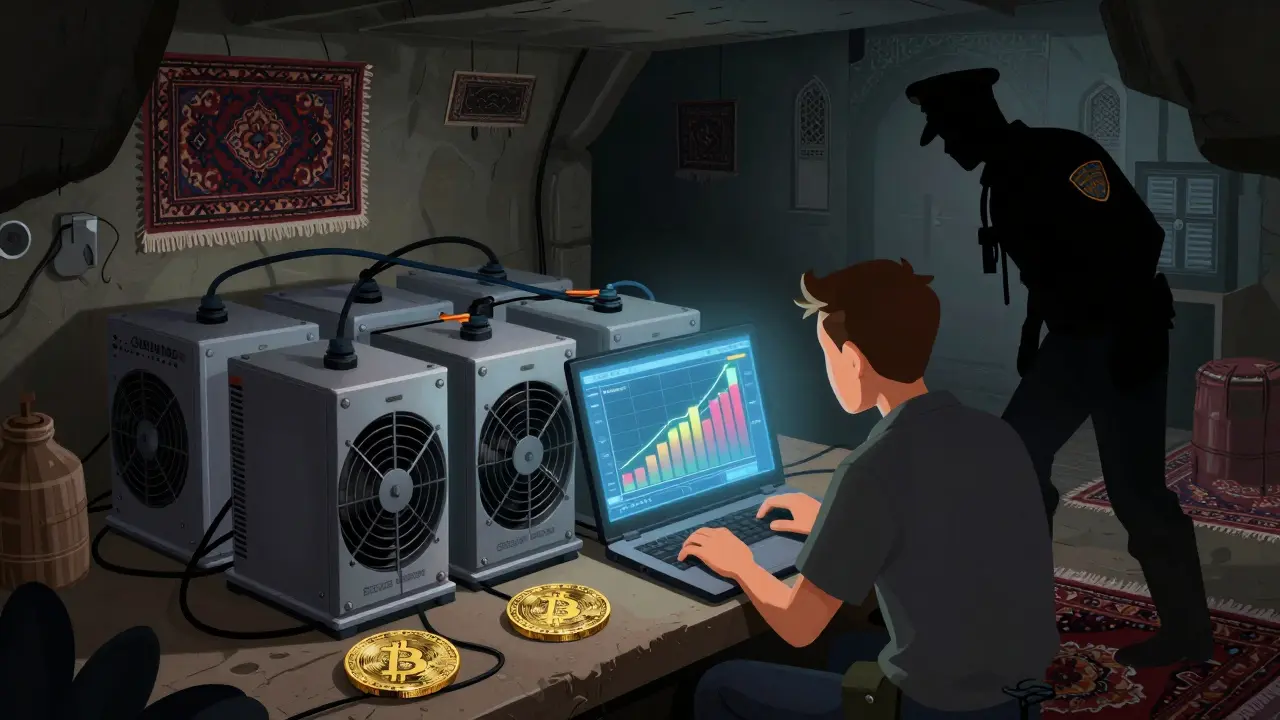
These regulations have driven a significant portion of mining activities underground. Unlicensed miners operate in secret, often using stolen electricity or hiding operations in residential areas to avoid detection. Despite the risks, the potential rewards keep them going. When the Rial loses value, earning in Bitcoin or Ethereum becomes a rational hedge against inflation.
The government’s stance on mining mirrors its broader approach: control where possible, tolerate where necessary. By requiring sales to the Central Bank, the state captures some value from the sector. But the persistent black market for mined coins shows that top-down regulation cannot fully suppress grassroots innovation. Miners find ways to bypass mandates, selling directly to peers or using peer-to-peer platforms to exchange their hash power for cash.
User Strategies: VPNs, Cross-Chain Swaps, and Community Knowledge
For the average Iranian citizen, navigating this environment requires technical savvy and vigilance. One universal tool is the Virtual Private Network (VPN). Despite government efforts to block access to foreign exchanges, widespread VPN usage allows users to connect to global platforms like Binance or Kraken. This circumvention is risky-authorities periodically crack down on VPN providers-but it remains essential for those seeking unrestricted access.
Community knowledge plays a crucial role. Platforms like Telegram and Reddit host active groups where Iranians share real-time updates on sanctions, exchange reliability, and new workarounds. After the Tether freezes, these communities circulated detailed guides on how to perform cross-chain swaps, moving assets from Ethereum to Polygon or other networks to avoid scrutiny. They also recommend exchanges with minimal compliance requirements, helping users find safer harbors for their funds.
This collective intelligence turns isolation into resilience. Instead of waiting for official guidance, users adapt quickly. If one bridge fails, they find another. If one token gets banned, they switch to a competitor. This agility is a direct response to the unpredictable regulatory environment. It transforms crypto from a static asset into a dynamic toolkit for financial survival.
Taxation and Formal Recognition
In August 2025, Iran took a step toward formalizing its crypto market by enacting the Law on Taxation of Speculation and Profiteering. This legislation imposed a capital gains tax on cryptocurrency trading for the first time, placing digital assets alongside gold, real estate, and forex. This move signals Tehran's intent to regulate and tax the market while acknowledging its legitimacy within the domestic economy.
Phased implementation suggests the government recognizes that immediate, harsh enforcement could destabilize the ecosystem. Many citizens depend on crypto for basic economic survival. A sudden crackdown might trigger capital flight or social unrest. By introducing taxes gradually, the state aims to bring more activity into the light, generating revenue while maintaining some level of control. For users, this means higher costs but potentially greater legal protection-if they comply with reporting requirements.
Looking Ahead: The Future of Crypto in Iran
The future of cryptocurrency adoption in Iran depends on the balance between international enforcement pressure and domestic economic stability. As long as traditional banking channels remain restricted, crypto will remain a critical lifeline. Enforcement agencies like OFAC continue to designate wallet addresses, vessels, and front companies, denying Iran easy access to global finance. Yet, Iranian responses show remarkable adaptability.
We can expect continued evolution in tactics. Users may explore more decentralized finance (DeFi) protocols that require no identity verification. Governments might tighten API controls on domestic exchanges. International firms could develop better screening tools to detect layered transactions. But the underlying demand won't disappear. For millions of Iranians, crypto is not a choice; it is a necessity. And necessity drives innovation, even under the heaviest sanctions.
Is cryptocurrency legal in Iran?
Yes, cryptocurrency is legal in Iran, but heavily regulated. Mining is permitted if licensed and sold to the Central Bank. Trading is allowed on domestic exchanges like Nobitex, which must report data to authorities. Using foreign exchanges via VPN is technically illegal but widely practiced.
Why did Iranians switch from USDT to DAI in 2025?
In July 2025, Tether froze dozens of Iranian-linked wallets, raising fears of further asset seizures. DAI, being decentralized and not controlled by a single company, offers lower freeze risk. Combined with Polygon's low fees, it became a preferred alternative for storing value safely.
How do Iranians access foreign crypto exchanges?
Most users rely on Virtual Private Networks (VPNs) to bypass internet restrictions and access global platforms. Community forums on Telegram and Reddit share reliable VPN services and tips for avoiding detection, though this carries legal and security risks.
What is the role of the IRGC in Iran's crypto market?
The Islamic Revolutionary Guard Corps (IRGC) uses cryptocurrency as a core settlement mechanism for procurement and finance. They engage in large-scale sanctions evasion, moving billions through layered transactions to avoid international tracking and restrictions.
Are there taxes on crypto profits in Iran?
Yes. Since August 2025, Iran has enforced the Law on Taxation of Speculation and Profiteering, which includes capital gains tax on cryptocurrency trading. This applies to profits made from buying and selling digital assets, treating them similarly to gold or real estate.

Write a comment