Imagine buying a cup of coffee with Bitcoin in Dhaka. In most countries, that’s just an eccentric transaction. In Bangladesh, it could land you in court. Since the central bank declared cryptocurrencies illegal in 2017, citizens have been navigating a minefield where digital assets exist in a legal gray zone that is rapidly turning darker. If you are thinking about trading crypto while living in Bangladesh, you aren't just betting on market volatility; you are betting against your own government’s financial stability policies.
The situation isn't simple prohibition-it's complex operational risk. While millions of Bangladeshi users still trade on platforms like Binance or KuCoin, they do so without the safety nets available to traders in India or Pakistan. This article breaks down exactly what happens when you click "buy" in a country where crypto possession can be interpreted as money laundering.
The Hard Ban and Legal Ambiguity
Bangladesh Bank issued a circular in February 2017 stating that cryptocurrencies are not legal tender. Unlike El Salvador, which adopted Bitcoin as currency, or even neighboring India, which taxes it heavily but allows it, Bangladesh took a hardline stance. The core argument? Cryptocurrencies threaten the stability of the banking system and facilitate money laundering. But here is the twist: the law doesn't explicitly define "possession" as a crime in every context, yet enforcement agencies treat it under anti-money laundering (AML) laws. This ambiguity is dangerous. It means if authorities decide to crack down, there is no clear legal defense for holding a wallet full of USDT.
Recent moves in 2025 have tightened the screws further. New biometric verification mandates were introduced, aiming to track who is moving money through digital channels. For many local exchanges, this meant losing up to 30% of their user base overnight because the onboarding process became a three-day ordeal. Users didn't stop trading; they just moved to Telegram groups and unregulated peer-to-peer (P2P) networks. This shift from regulated platforms to shadow markets increases the risk of fraud exponentially.
Financial Risks: The Cost of Going Underground
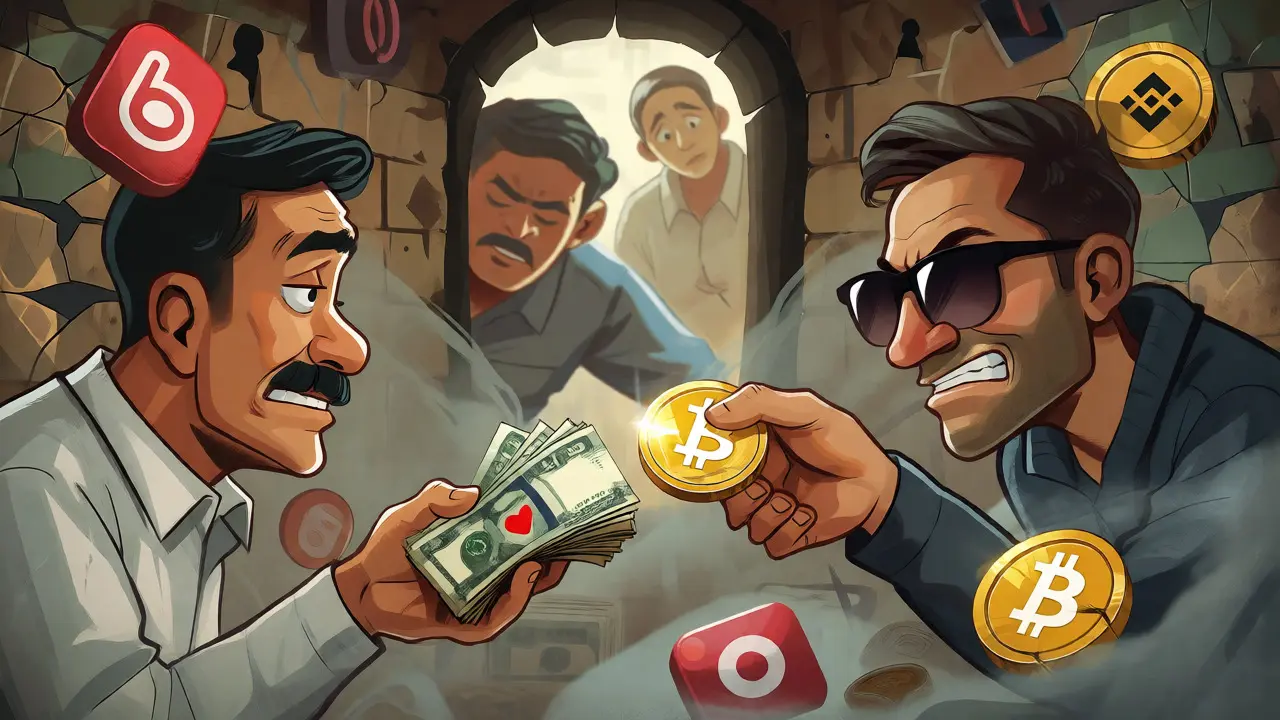
When you can't use a bank transfer directly, how do you buy crypto? Most Bangladeshi traders rely on two methods, both fraught with danger. First, using international credit cards. Banks monitor these transactions closely. If a bank sees frequent transfers to known crypto exchanges, they might flag your account, freeze funds, or even close the relationship. Second, and more common, is using local agents. These individuals hold USD or crypto and exchange it for Bangladeshi Taka (BDT) at agreed rates.
This agent-based system is rife with scams. There is no consumer protection. If an agent runs off with your money after sending you fake transaction receipts, you have little recourse. The police often view these disputes as private civil matters involving illegal activities, meaning they are reluctant to intervene. Furthermore, the spread-the difference between the buy and sell price-can be huge. You might pay 5-10% above the global market rate just to get access to liquidity. That’s an immediate loss before the market even moves.
| Country | Legal Status | Tax Implications | Banking Access | Primary Risk Factor |
|---|---|---|---|---|
| Bangladesh | Banned (Illegal) | Unclear/General Income Tax | Restricted/High Scrutiny | Legal prosecution & Fraud |
| India | Legal but Restricted | 30% Flat Tax + 1% TDS | Available but Monitored | Tax Compliance & Volatility |
| Pakistan | Under Review/Legal Gray | Debated | Limited | Regulatory Uncertainty |
| Sri Lanka | Previously Banned, Now Regulated | Capital Gains Tax | Improving | Market Maturity |
The Trap of "Prohibition Theater"
Experts call the current environment "prohibition theater." The rules are strict on paper, but enforcement is inconsistent. You can download Binance from the App Store in Bangladesh. You can verify your account with a passport. You can trade thousands of dollars. So why is it risky? Because the lack of regulation creates a vacuum where bad actors thrive. When the government cracks down, they don't usually go after the whales trading on Binance; they target the small-time traders using local P2P apps who make noise by trying to cash out into banks.
Consider the case of mining. Grid operators in Chittagong report seeing warehouse landlords quietly retrofitting ventilation systems, hinting at underground mining farms. These operations run outside the grid or hide their consumption. If discovered, the penalties are severe, including seizure of equipment and heavy fines. For the average trader, this signals that the state is actively hunting for energy footprints associated with crypto, adding another layer of surveillance risk.
Currency Depreciation and Capital Flight
There is a macroeconomic angle here that affects every citizen, not just traders. The Bangladeshi Taka has faced significant pressure in recent years. Many citizens turn to stablecoins like USDT (Tether) as a hedge against inflation and currency devaluation. However, buying USDT legally requires foreign exchange reserves, which are tightly controlled. This drives people to the black market, accelerating capital flight. The National Board of Revenue applies the general Income Tax Ordinance of 1984 to crypto gains, creating a paradox: you owe tax on an activity that is technically banned. Failing to declare these gains can lead to audits that expose your entire crypto portfolio to legal scrutiny.
Security and Operational Hazards
Without regulated exchanges, security falls entirely on the user. If you lose your private keys, there is no customer support team to help you recover them. If you send funds to a wrong address, there is no dispute resolution center. In Bangladesh, this problem is amplified because many users store assets in non-custodial wallets to avoid bank tracking, increasing the chance of human error. Additionally, phishing attacks targeting Bengali-speaking users on social media platforms have surged. Scammers promise high returns on "crypto savings plans," mimicking the Ponzi schemes of the past like MTFE, which burned thousands of investors before the crypto era even began.

Future Outlook: No Softening in Sight
As of September 2026, there are no signs that Bangladesh will legalize crypto anytime soon. The government views digital currencies as incompatible with its monetary policy goals. In fact, regulatory frameworks are becoming more restrictive, not less. The trend suggests increased monitoring of offshore platform usage. If you are a Bangladeshi citizen considering entering the market now, you must weigh the potential upside against the reality that you are operating in a jurisdiction where your asset ownership is precarious at best.
Key Takeaways
- Legal Jeopardy: Possession and trading are subject to anti-money laundering laws, with no clear safe harbor for individual traders.
- Banking Friction: Direct bank transfers for crypto are restricted, forcing reliance on high-risk P2P agents or international cards.
- Fraud Exposure: The shift to Telegram and informal networks removes consumer protections, increasing scam risks.
- Tax Paradox: You may owe income tax on gains from an activity deemed illegal by the central bank.
- Enforcement Variability: While bans are strict, enforcement is sporadic, creating a false sense of security that can vanish with a single policy update.
Is it completely illegal to own Bitcoin in Bangladesh?
Technically, the Bangladesh Bank banned the use of cryptocurrency as legal tender and prohibited banks from facilitating transactions. While mere possession isn't always prosecuted, any attempt to convert it to Taka via formal channels or use it in commerce can trigger legal action under anti-money laundering regulations. Most traders operate in a legal gray area with significant risk.
Can I use Binance in Bangladesh?
Yes, you can download and use Binance. However, you cannot deposit BDT directly via bank transfer. You must use Peer-to-Peer (P2P) trading, where you send money to another user via mobile banking or bKash, and they release crypto to you. This method bypasses direct bank-exchange links but carries higher fraud risk.
Do I need to pay tax on crypto profits in Bangladesh?
There is no specific crypto tax code. However, the National Board of Revenue considers crypto gains as income under the general Income Tax Ordinance. If your crypto profits push you into a higher tax bracket or exceed exemption limits, you are theoretically liable for tax, though enforcement on this specific aspect is currently low compared to AML checks.
What happens if my bank freezes my account due to crypto?
If a bank suspects your transactions are related to crypto trading, they may freeze your account pending investigation. You would need to provide proof of the source of funds. Since crypto is not recognized as a legitimate asset class, explaining large inflows/outflows can be difficult and may result in account closure or reporting to the Financial Intelligence Unit.
Are there any legal alternatives for investing in digital assets?
Currently, no domestic crypto exchanges are licensed. Some citizens invest in stocks or gold as safer alternatives. Others use international brokerage accounts that allow exposure to tech stocks or ETFs, avoiding direct crypto ownership complexities within the Bangladeshi regulatory framework.
Dominic Hird
It is fascinating to see how different regions handle the same technology with such divergent philosophies. While we debate regulation here in the US, seeing the sheer operational friction Bangladeshi traders face really puts our own market access into perspective. The shift to shadow markets like Telegram groups creates a wild west scenario that feels both dangerous and resilient. It highlights the human desire for financial autonomy even when the state tries to clamp down hard.
Abby Walker
The United States has clear regulations and consumer protections that these developing nations simply lack. Instead of crying about gray zones, they should adopt proper banking standards instead of relying on chaotic peer-to-peer schemes. Their inability to enforce basic monetary policy reflects poorly on their governance structure overall. We lead the world in financial innovation because we have stable institutions, not because we allow anarchy.
Frances Schnepfleitner
honestly this sounds so stressful i cant imagine trying to buy coffee with bitcoin and worrying about going to jail
the part about agents running off with money is terrifying though no recourse at all just vibes and hope
Manish Pahuja
Keep grinding! The spirit of adoption is alive and well regardless of government bans. People are resourceful and will always find ways to trade value across borders. It is inspiring to see communities adapt so quickly to new tech despite hurdles. Stay strong and keep learning!
Janine John
The comparison with India and Pakistan provides necessary context for understanding Bangladesh's unique position. In India, while taxation is high, the legal framework offers clarity that prevents the kind of arbitrary enforcement seen in Dhaka. This distinction is crucial for investors assessing regional risk profiles. Clarity often outweighs cost in long-term investment strategies.
Charlotte Owen
Simple enough analysis.
Adam Barrett
I think there is a middle ground here where education could help bridge the gap between strict bans and open adoption. Instead of fearing the technology, governments could focus on protecting users from scams through better literacy programs. Empathy towards those seeking financial hedges against inflation might lead to more humane policies. We can learn from each other's mistakes without being punitive.
Samantha Du-Cell
These countries need to stop playing catch-up and start leading. If you cannot manage your own currency stability then do not blame crypto for exposing it. Real power comes from having robust systems that do not crumble under digital pressure. Fix your banks first before banning tools that people actually use.
Jennifer Phipps
Hey everyone! 🌟 Just wanted to add that if you are looking at alternatives, many folks in similar situations look into tokenized gold or stablecoin savings accounts abroad. It’s a great way to hedge without dealing with the direct local banking friction. Also, make sure to check out some global exchanges that offer non-KYC tiers initially so you can test the waters safely! 💡 Don’t forget to secure your private keys properly, hardware wallets are your best friend here. Stay safe out there! 🚀
Tish Dalton
It makes me wonder how much of this is driven by fear of capital flight versus genuine concern for consumer protection.
When people feel their currency is losing value, they naturally seek refuge, and banning that refuge doesn't stop the demand, it just pushes it underground.
We should be asking how to integrate these flows rather than blocking them entirely.
Manoj Ramachandran
Respectfully, I believe the article accurately captures the nuanced reality faced by citizens in emerging economies. The tension between monetary sovereignty and individual financial freedom is indeed complex. One must acknowledge the valid concerns regarding money laundering while also recognizing the economic necessity for hedging instruments. A balanced approach would involve clearer guidelines rather than outright prohibition which often leads to unintended consequences.
Lakshmi Sailaja Devarakonda
Oh please, spare us the dramatic tales of 'legal gray zones' as if we haven't heard every excuse for why a country refuses to modernize its financial infrastructure. It is quite amusing to watch Western analysts dissect the struggles of nations that seem determined to remain in the shadows of progress while claiming moral superiority over their regulatory choices. Perhaps if they focused less on theatrical prohibitions and more on actual economic development, they wouldn't need to rely on underground networks just to preserve their wealth.
Zayda Hayes
Thank you for sharing this insightful piece; it truly sheds light on the intricate challenges faced by traders in Bangladesh.
From my experience working with international fintech compliance, the lack of specific tax codes often leads to greater uncertainty than the ban itself.
It is advisable for individuals to maintain meticulous records of all transactions, regardless of legality, to prepare for any potential future audits.
Collaboration between local authorities and community leaders could potentially mitigate some of the fraud risks inherent in P2P networks.
We should consider how regulatory sandboxes might be adapted for such contexts to foster safer experimentation.