Have you ever wondered why some crypto projects hand out free tokens while others make you work for them? If you are holding EGLD, the native token of the MultiversX network, you have likely heard whispers about the Maiar EarnDrop. Unlike the chaotic "spray and pray" airdrops that flood wallets with useless junk, MultiversX takes a different approach. They reward participation. But what exactly is this program, and how do you actually get your hands on the tokens?
The truth is, there isn't one single "EarnDrop" button you press once and forget. It is a structured ecosystem of incentives designed to keep users active within the Maiar Exchange. This article breaks down how MultiversX distributes value, why they favor staking over passive drops, and what specific steps you need to take to maximize your returns in 2026.
What Is the Maiar EarnDrop Actually?
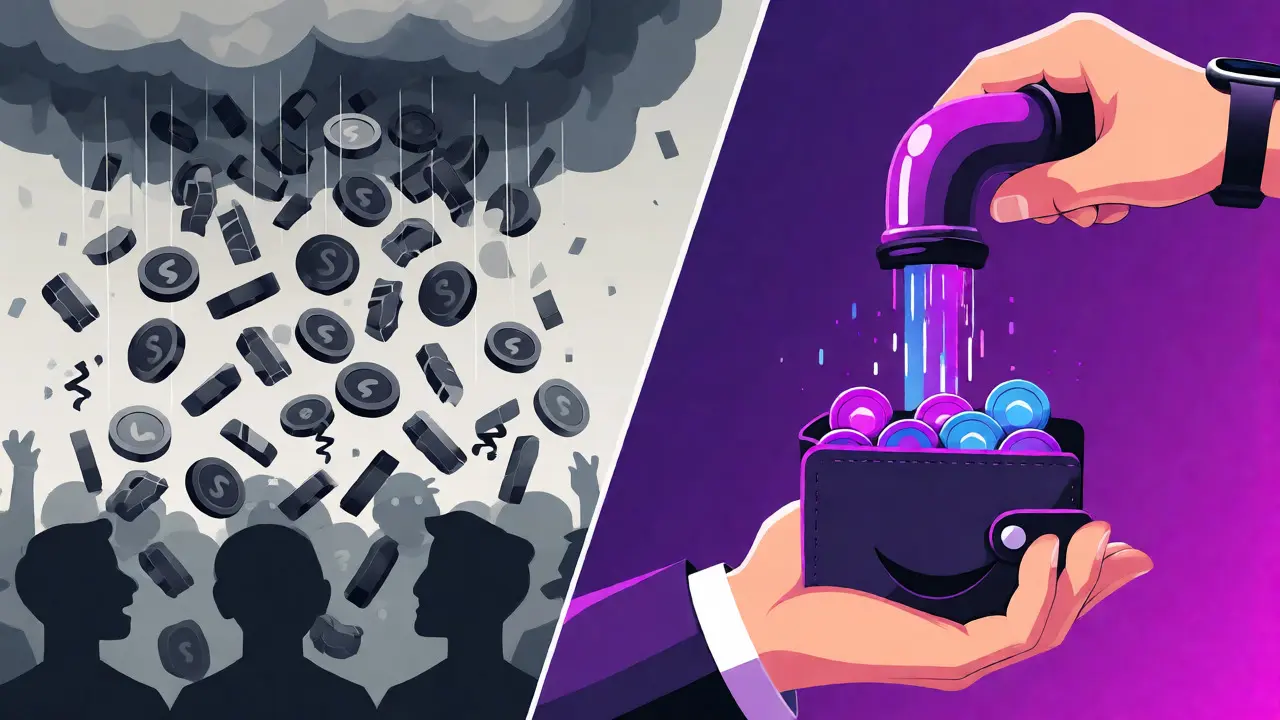
Let's clear up the confusion first. When people search for "Maiar EarnDrop," they are often looking for a specific promotional campaign similar to those run by other blockchains like Arbitrum or Optimism. However, MultiversX has historically leaned into mechanisms like Metabonding and liquidity mining rather than traditional one-off airdrops.
The core philosophy here is simple: don't give tokens to people who will dump them immediately. Give them to people who support the network. The "EarnDrop" concept is essentially an umbrella term for these ongoing reward programs where EGLD holders can earn additional tokens by engaging with decentralized applications (dApps) on the platform.
For instance, when new projects launch on MultiversX, they often allocate a portion of their total supply-typically around 10%-to be distributed among existing stakers. Half goes to those staking LKMEX (the liquid staking token), and the other half goes to EGLD stakers. This isn't automatic; you have to claim it. This requirement filters out bots and ensures that only engaged community members receive the rewards.
Why MultiversX Prefers Structured Rewards Over Random Airdrops
You might ask, "Why not just send everyone free money?" Because random airdrops often fail. Data from previous cycles shows that a significant percentage of airdropped tokens are sold within hours of distribution, crashing the price and hurting long-term investors. MultiversX avoids this by tying rewards to action.
By requiring users to stake EGLD or provide liquidity on the Maiar Exchange, the network ensures that the recipients are already invested in the ecosystem's success. These users are less likely to sell immediately because they are earning yield on their principal investment. This creates a healthier economic loop where demand for EGLD remains stable even as new tokens enter circulation.
Furthermore, the technical architecture supports this efficiency. With its Adaptive State Sharding technology, MultiversX processes transactions at a fraction of a cent-averaging around $0.002 per transaction. This low cost makes it feasible to distribute small amounts of tokens frequently without clogging the network or eating up all the value in gas fees.
How to Participate: Step-by-Step Guide
If you want to qualify for current and future EarnDrop opportunities, you need to set up your wallet correctly. Here is the practical workflow for an average user in Madison or anywhere else in the US:
- Get a Compatible Wallet: Download the xPortal app (formerly Maiar App). This is the official mobile-first wallet for MultiversX.
- Fund Your Wallet: Purchase EGLD from a major exchange like Binance or Coinbase and withdraw it to your xPortal address. Remember, you need a tiny bit of extra EGLD for transaction fees.
- Connect to Maiar Exchange: Use the dApp browser in xPortal to connect to the Maiar Exchange. This is where most DeFi activity happens.
- Stake or Provide Liquidity: Depending on the specific campaign, you may need to stake EGLD directly or pair it with another token (like USDC or MEX) to provide liquidity. Look for pools marked with "Earn" badges.
- Claim Regularly: This is the critical step. Many users forget to hit the "Claim" button. Rewards accumulate smart-contract side, not in your wallet balance automatically. Check your dashboard weekly.
Missing the claim window can sometimes mean forfeiting rewards if the contract resets, so treat claiming as part of your routine maintenance.
Understanding Metabonding vs. Traditional Airdrops
To truly grasp the value proposition, you must understand Metabonding. It is distinct from a standard airdrop. In a standard airdrop, you hold a token, and you get another. In Metabonding, you are effectively bonding your capital to help bootstrap a new project's liquidity.
Here is how the math works for a typical new project launch:
| Feature | Traditional Airdrop | MultiversX Metabonding/EarnDrop |
|---|---|---|
| Requirement | Hold token at snapshot date | Active staking or liquidity provision |
| Distribution Method | Automatic to wallet | User-initiated claim via DEX |
| Target Audience | All holders (including whales) | Active DeFi participants |
| Sell Pressure Risk | High (immediate dumping) | Low (holders are incentivized to stay) |
| Gas Cost Impact | Negligible | Minimal ($0.002 avg per tx) |
This structure benefits developers too. By allocating 5% of supply to EGLD stakers, they gain immediate visibility and credibility. Users see the new token backed by the same community that secures the main chain. It’s a symbiotic relationship rather than a charity giveaway.
The Role of EGLD Tokenomics in Rewards
You cannot discuss EarnDrops without looking at the underlying asset. EGLD has a fixed maximum supply of 31,415,926 coins. As of late 2026, approximately 25.8 million are in circulation. This scarcity drives value, but it also means every new token entering the market via rewards needs to find a buyer.
The initial distribution allocated 25% to public sales and 19% to private sales, leaving a significant chunk for community funds and rewards. This design choice was intentional. By keeping team allocations lower compared to some competitors (though still notable at ~21.5% for founders/advisors combined), the network prioritizes decentralization. When you participate in EarnDrops, you are tapping into the "Rewards and Incentives" pool, which accounts for roughly 7% of the total supply.
Because EGLD is used for governance, staking, and fees, its utility remains high regardless of individual token prices. When you stake EGLD to earn other tokens, you aren't just gambling on a coin flip; you are securing the network. Each validator node rotates shards every 24 hours, preventing collusion and ensuring security. Your participation helps maintain this integrity, and the rewards reflect that contribution.

Pitfalls to Avoid in the Maiar Ecosystem
Even with a robust system, users make mistakes. Here are three common traps to watch out for:
- Ignoring Gas Fees: While cheap, frequent claims add up. If you claim micro-rewards daily, you might spend more in EGLD fees than the reward is worth. Batch your claims.
- Scam Tokens: Not every "new token" on Maiar Exchange is legit. Scammers create fake pairs that look like popular projects. Always verify the contract address through official MultiversX channels before providing liquidity.
- Unbonding Periods: If you are staking EGLD natively, remember there is an unbonding period (usually around 10 epochs) before you can move your funds. Don't lock up money you need for rent next week.
Also, keep an eye on the Secure Proof of Stake (SPoS) consensus mechanism updates. Changes to validator selection algorithms can occasionally affect reward rates slightly, though the protocol aims for stability.
Looking Ahead: What's Next for Community Rewards?
As we move further into 2026, the trend in blockchain is shifting away from massive, speculative airdrops toward sustainable yield models. MultiversX is well-positioned for this shift because their infrastructure is built for speed and low costs. Developers are increasingly using Rust, C, and C++ for smart contracts, creating complex financial products that offer higher yields than simple staking.
If you are serious about maximizing your holdings, diversify your strategy. Keep some EGLD in cold storage for long-term appreciation, stake some for base rewards, and use a portion for active farming on Maiar Exchange. This balanced approach protects your downside while capturing upside during promotional periods.
Stay connected to official announcements. The MultiversX team communicates changes clearly, often detailing upcoming campaigns weeks in advance. Subscribing to their newsletter or following their social media feeds ensures you never miss a claim deadline.
Is the Maiar EarnDrop a one-time event?
No, it is not a single event. The term refers to an ongoing series of incentive programs, including liquidity mining and Metabonding initiatives, where users earn tokens by actively participating in the ecosystem.
Do I need to pay gas fees to claim EarnDrop rewards?
Yes, you need a small amount of EGLD in your wallet to pay for the transaction fee when you click "Claim." However, thanks to MultiversX's sharding technology, these fees are extremely low, typically costing less than $0.01.
Can I lose my EGLD if I participate in EarnDrops?
Your principal EGLD is generally safe when staking or providing liquidity on reputable platforms like Maiar Exchange. However, always check for smart contract audits. Impermanent loss can occur in liquidity pools if the price of paired tokens fluctuates significantly.
What is the difference between LKMEX and EGLD rewards?
LKMEX is a liquid staking derivative. Some campaigns specifically target LKMEX stakers to encourage deeper liquidity. Often, holding both EGLD and LKMEX allows you to capture rewards from multiple streams, maximizing your overall yield.
How often should I check for new EarnDrop opportunities?
Weekly checks are recommended. New projects launch regularly on the MultiversX network, and their associated reward campaigns often have limited time windows for claiming bonuses or early access.

Write a comment