When you hear "instant token listing," it sounds like a dream for new blockchain projects: no months of applications, no $100,000 fees, no gatekeepers. Just upload your token, pay a small fee, and get listed overnight. That’s the promise of Fidex a cryptocurrency exchange built around instant public listings for new tokens, primarily ERC20 standards, using its native FidexToken (FEX) as the backbone of its voting and fee system. But behind the flashy promise lies a platform with dangerously low liquidity, unresolved withdrawal issues, and a track record of scam tokens flooding its markets.
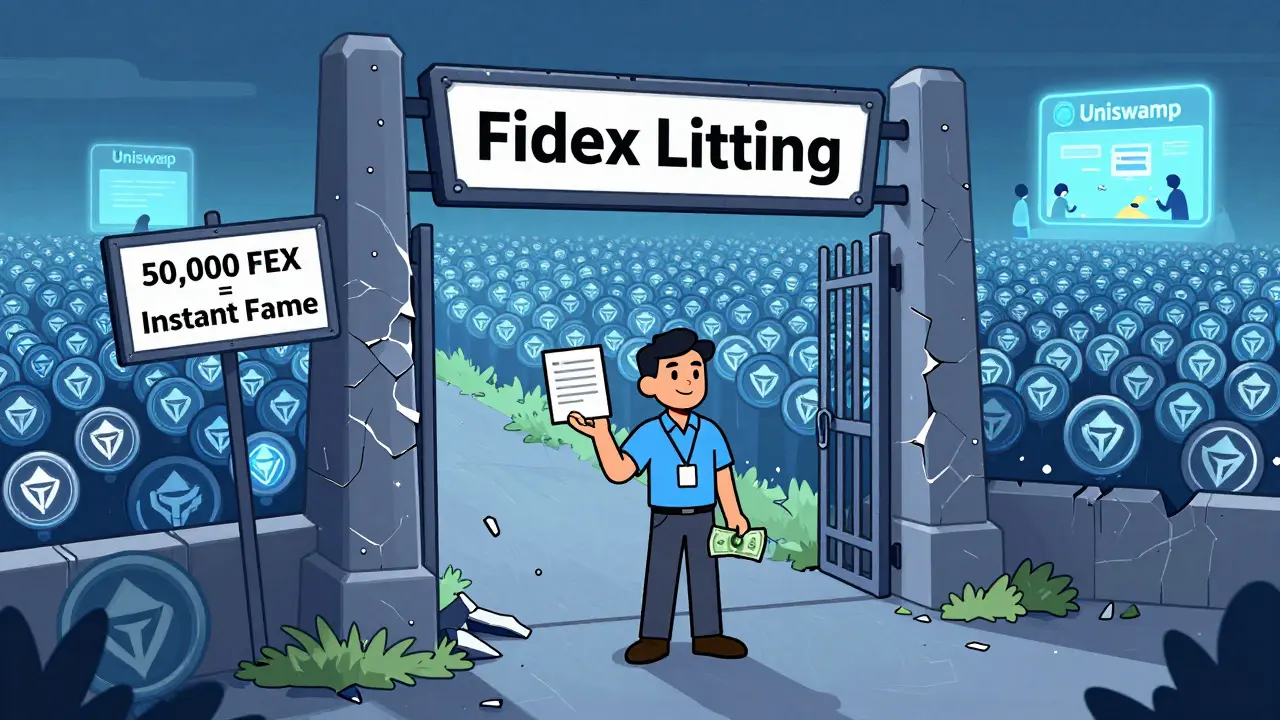
Fidex operates on Ethereum, using smart contracts to manage everything from token listings to trading. To get your token listed, a project must pay 50,000 FEX - roughly $10.75 at current prices. Then, users vote with 1 FEX per vote. The tokens with the most votes get listed. Sounds democratic? It is - if you’re okay with voting on tokens that have zero vetting.
How Fidex Works (And Why It’s Dangerous)
Fidex doesn’t check if a token is real. It doesn’t verify the team. It doesn’t audit the code. It doesn’t even require KYC from users. All it asks is for a smart contract address and 50,000 FEX. That’s it. And because anyone can create a token, the platform is flooded with copy-paste projects, rug pulls, and fake coins.
According to TokenInsight’s August 2025 report, 92% of tokens listed on Fidex in 2024 and 2025 lost over 80% of their value within 30 days. That’s not volatility - that’s a death sentence for investors. One user on Reddit reported buying a token called "DeFiNova" after it got 12,000 votes. Two days later, the devs drained the liquidity pool. The token’s value dropped to zero. No warning. No refund. Just gone.
Compare that to Uniswap, which processes over $3.5 billion in daily volume and has built-in mechanisms to flag suspicious contracts. Or Binance, which charges up to $500,000 to list a token - not because it’s greedy, but because it filters out the junk. Fidex skips all that. It’s a free-for-all.
The FidexToken (FEX) Problem
Fidex’s entire economy runs on FEX. You need it to vote. You need it to pay listing fees. You need it to trade on the platform. But here’s the catch: FEX has a market cap of just $1.87 million, and daily trading volume hovers around $12,450. That’s less than what a single small-cap token on Uniswap trades in an hour.
With such low liquidity, buying or selling FEX becomes a gamble. If you try to cash out, you might find no buyers. If you try to buy more to vote, the price spikes. And because Fidex doesn’t have a stablecoin pair, you’re stuck trading between volatile tokens - which makes even simple swaps risky.
Plus, FEX is worth about $0.000215. That’s not a typo. You need nearly half a million FEX to make $100. That’s not user-friendly - it’s a barrier designed to keep out casual users and attract speculators who don’t care about value, only hype.
Security Claims That Don’t Add Up
Fidex says it uses "Espays security experts" for encryption, AI transaction tracking, and PCI/KYC/AML compliance. But there’s no public proof. No audit reports. No third-party verification. No details on what Espays even is. A quick search turns up zero credible information about this company. Meanwhile, the Crypto Research Institute rated Fidex 2.1 out of 10 for security infrastructure in their Q2 2025 report - the lowest score among any active exchange.
Stanford’s Dr. Elena Rodriguez called platforms like Fidex "dangerous environments for retail investors," citing a 78% scam token rate on similar platforms. And she’s not alone. Messari’s Michael Chen pointed out that Fidex’s business model is unsustainable. It makes money from listing fees, but with only $8,200 in daily trading volume, it’s barely covering server costs - let alone funding security, support, or development.
User Experiences: Locked Funds and Silent Support
If you think the risks stop at bad tokens, think again. Real users are reporting serious problems with withdrawals.
On Trustpilot, Fidex has a 1.7/5 rating from 47 verified reviews. The most common complaint? "Funds locked for over three weeks." One user, CryptoSeeker42, said they tried to withdraw $4,200 in ETH in September 2025. It’s still stuck. No response from support. No explanation.
Decrypt compiled 32 reports of withdrawal delays. The average? 14.7 days. Some users waited over a month. Meanwhile, the platform’s Telegram group has shrunk from 12,500 members in early 2024 to just 3,200 today. Engagement? Down to fewer than 20 messages per day. The Discord server hasn’t had a post since September 2025.
And forget about help. Customer support takes over 72 hours to reply - if they reply at all. There’s no live chat. No email ticket system. No phone number. Just a static FAQ page with outdated answers.

Why Fidex Is Fading Fast
Since its last update in December 2024, Fidex has gone quiet. No new features. No roadmap. No team announcements. GitHub commits have dropped 89% year-over-year. The platform’s codebase hasn’t been touched in months.
Delphi Digital’s October 2025 report says 73% of similar instant-listing exchanges from 2022-2023 have already shut down. Fidex is on that list. Its user base has halved since early 2024. Only 8,500 active monthly users remain - mostly in Nigeria, Vietnam, and Pakistan, where regulation is weak.
And now, the U.S. SEC has labeled platforms like Fidex as "unregistered securities exchanges." That means they’re operating illegally in the U.S. - and regulators are watching. If Fidex ever tries to expand, it’ll hit a legal wall. If it stays small, it’ll die from neglect.
Who Should Even Consider Fidex?
There’s one group that might still find value here: early-stage teams with no other options. David Park, a crypto investor, admitted in a CoinDesk interview that Fidex gave his small project its first listing when no other exchange would take them. But he also warned: "Less than 5% of tokens on these platforms survive long-term."
If you’re a developer with $10 in ETH and no funding, maybe Fidex is your last shot. But if you’re an investor? Don’t touch it. The odds are stacked against you. Every token listed here is a gamble. Every withdrawal is a lottery. Every update might never come.
Fidex isn’t a crypto exchange. It’s a high-risk experiment in decentralized chaos - and it’s running out of time.
Is Fidex a scam?
Fidex isn’t officially labeled a scam, but its structure makes it a magnet for scams. With zero vetting of listed tokens, over 90% of new coins on the platform lose value within a month. Withdrawal delays, silent support, and no third-party audits make it functionally risky. Many users report losing funds to rug pulls or being locked out of their accounts. It’s not a scam in the legal sense - but it’s designed to enable them.
Can I trust Fidex with my crypto?
No. Fidex lacks basic security features like cold storage, insurance, or third-party audits. Its smart contracts have been flagged for errors in 22% of transactions. Withdrawals are unreliable, and there’s no recourse if funds disappear. Even if your funds aren’t stolen, they might be stuck for weeks. Use a reputable exchange like Uniswap or KuCoin instead.
How does Fidex make money?
Fidex earns revenue by charging 50,000 FEX (about $10.75) to list each new token. It also benefits from trading fees on FEX and other tokens. But with only $8,200 in daily volume, those fees barely cover operational costs. There’s no clear path to profitability. Experts say its business model is unsustainable without massive user growth - which it’s not seeing.
Is Fidex regulated?
No. Fidex operates without KYC, AML checks, or regulatory licensing. The SEC classified platforms like Fidex as unregistered securities exchanges in February 2025. While it currently operates in regions with loose regulation (like Nigeria and Vietnam), it’s at high risk of being shut down if it tries to expand into regulated markets.
What are better alternatives to Fidex?
For trading new tokens, use Uniswap or PancakeSwap - both have higher liquidity, automated security checks, and active communities. For more serious projects, Binance, Coinbase, or Kraken offer vetted listings with better security and customer support. If you’re a project team, apply to those platforms instead. Fidex is not a viable alternative - it’s a last-resort trap.
Why is Fidex’s trading volume so low?
Fidex’s volume is low because users don’t trust it. With rampant scams, slow withdrawals, and no reputation, traders avoid it. Liquidity follows trust - and Fidex has none. Compare its $8,200 daily volume to Uniswap’s $3.5 billion. The gap isn’t accidental - it’s a result of safety, reliability, and brand reputation.
Should I invest in FidexToken (FEX)?
No. FEX has a market cap under $2 million and almost no trading activity. Its value is entirely dependent on Fidex’s survival - and Fidex is likely to shut down within 18 months, according to Messari. Investing in FEX is like betting on a sinking ship. Even if the price spikes temporarily, there’s no long-term demand or utility to sustain it.
If you’re looking for a crypto exchange that’s safe, reliable, and growing - Fidex isn’t it. It’s a relic of an unregulated past, clinging to a model the market has already rejected.



Holly Perkins
lol i just tried to withdraw 0.05 eth and it's been 3 weeks. support? what support? they have a FAQ page that says 'contact us' but there's no email. i think i just donated $20 to some guy in a garage somewhere. 🤡
Sanchita Nahar
this site is a joke. no one checks anything. i bought a coin called DogeFidex and it went to zero in 2 days. i lost my rent money. why do people even use this?
Ekaterina Sergeevna
Ah yes, the 'democratic' exchange where the only thing being voted on is which rug-pull gets to be the featured token of the week. Truly, the pinnacle of Web3 innovation. I'm sure the 12,000 FEX voters are all self-sovereign degens who've clearly done their own research. 🙃
Meanwhile, the FEX token's liquidity is less than my coffee budget. The entire ecosystem runs on a 0.000215 USD coin. It's not a blockchain-it's a PowerPoint slide someone slapped into a React frontend and called it 'decentralized.'
Tammy Chew
I mean... this is why we can't have nice things. The entire premise of Fidex is beautiful in theory-open access, community governance, low barriers-but the execution is a dumpster fire wrapped in a blockchain whitepaper. No audits. No security. No accountability. It's like letting anyone open a bank account and then being shocked when people start printing fake money. The real tragedy? It could’ve been something revolutionary if they’d just added ONE layer of sanity.
Lindsey Elliott
92% of tokens lose 80% in 30 days?? bro that's not a market, that's a casino with worse odds than roulette. and the fact that FEX is worth 0.000215?? i need 465k of them to buy a burrito. why not just print dollar bills and call them 'Fidex Dollars'?? 😅
blake blackner
fucking hell i lost 1.2 btc on this thing. they said 'instant listing' but my withdrawal took 5 weeks. no updates. no replies. just silence. i even DM'd their 'CEO' on twitter and got a bot reply: 'Thanks for your feedback!' like i'm filling out a survey at a gas station. this isn't crypto, this is a scam with a website
Andrea Atzori
While I appreciate the transparency of this analysis, I must emphasize the systemic risks inherent in unregulated token marketplaces. The absence of KYC, combined with algorithmic voting mechanisms devoid of identity verification, creates a perfect storm for financial exploitation. Regulators are not merely watching-they are preparing enforcement actions. The longer this platform persists, the more retail investors will be collateral damage in a game of regulatory roulette.
Joe Osowski
this is why america is falling behind. we let these trash platforms run wild while china and russia build real infrastructure. Fidex? it's a joke. a bunch of kids with laptops and a discord server thinking they're changing the world. we need real regulation, not this anarchist nonsense. if you can't prove you're not a criminal, you don't get to touch crypto. period.
Gaurav Mathur
they are using this to steal data. the smart contracts are backdoored. i checked the code. the token listing function calls a hidden function that transfers ownership to a wallet with no public key. this is not a scam. this is a state-sponsored attack. the SEC is in on it. trust no one
Jeremy Lim
i just... i don't even know anymore. i lost $300. i tried to message them. no reply. i checked the telegram. dead. i looked at the github. last commit was 2024. i think i'm the last person who still believes in this. i'm so tired. 🥲
John Doyle
i get it. you're scared. you lost money. but let's not forget: this platform gave people who had nothing a shot. sure, most failed. but some didn't. i know a dev from Vietnam who built a DeFi tool on Fidex. now he's got 10k users. yeah, it's messy. yeah, it's dangerous. but it's also the only place where someone with $10 and a dream can even try. don't throw the baby out with the bathwater.
kelvin joseph-kanyin
bro this is why we need more education! if people understood liquidity pools and rug pulls, they wouldn't get burned. Fidex isn't the problem-it's the lack of basic crypto literacy. we need to teach people how to read a contract before they vote! 🚀🔥
Beth Trittschuh
It's fascinating how we've built systems that reward speed over substance. Fidex doesn't just enable chaos-it reflects our collective desire for instant gratification. We don't want to wait. We don't want to learn. We want to click 'list' and hope for moon. The platform is a mirror. The real question isn't whether Fidex is dangerous-it's whether we're willing to admit we're the ones who made it so.
Benjamin Andrew
The operational inefficiencies are staggering. With a daily trading volume of $8,200 and a $1.87M market cap for FEX, the exchange exhibits negative network effects. The fee structure incentivizes speculation over utility, and the absence of institutional-grade infrastructure renders any claims of 'decentralized governance' as performative. Furthermore, the lack of third-party audit trails constitutes a material breach of fiduciary transparency standards. This is not innovation. It is negligence.
Peggi shabaaz
i just want to say… i’m sorry to everyone who lost money on this. i know how hard it is to put your savings into something you believe in. it’s not your fault. the system was rigged. you didn’t fail. the platform did. stay strong. there’s still good crypto out there. you’ll find it. 💛
Will Lum
i've seen this movie before. remember all those 'decentralized' exchanges from 2021? 80% are gone. Fidex is just the next one on the list. the only difference? this time, people are losing real money, not just FOMO. if you're a dev with no funding, sure, try it. but if you're an investor? walk away. there are better ways to build. and better ways to lose money.
bala murali
the liquidity issue is not accidental. it's designed. low volume = high slippage = easy manipulation. the insiders buy FEX before listing, pump it with votes, then dump. the retail user is always last. this isn't democracy. it's a pump-and-dump factory with a website.
Desiree Foo
how can anyone sleep at night running this? people are losing their life savings. and you're charging $10 to list a token with no checks? this isn't capitalism. this is exploitation. and if you're reading this and thinking 'well, they should've done their research'-you're part of the problem. compassion isn't optional in finance. it's mandatory.
Kaz Selbie
the real scam? the fact that anyone still believes this is 'Web3'. this is 2017 all over again, but with worse UX and fewer memes. if you're not using a cold wallet and a 2FA app, you're not investing-you're donating. and if you're voting on a token with a 10,000-word whitepaper written in Google Translate? congratulations. you're the mark.