Imagine you’re about to buy a rare collectible online. You click 'Buy Now,' but before the seller confirms your purchase, a bot sniffs out your intent, buys the item from the seller for pennies more than you offered, and instantly lists it back to you at a massive markup. You pay the premium, the bot pockets the difference, and you never even knew it happened. This isn’t science fiction; it’s daily life on many blockchains.
This predatory behavior is known as front-running, and it is just one facet of a broader phenomenon called Maximal Extractable Value (MEV). For years, blockchain enthusiasts preached that decentralized networks were fair, transparent playgrounds where code was law. But underneath that shiny surface, an arms race has emerged between sophisticated bots and regular users. These bots don’t hack wallets or steal private keys. Instead, they exploit the very structure of how transactions are processed, turning the public nature of blockchain into a profit engine for the technically privileged.
What Is MEV and Why Does It Matter?
To understand the damage, we first need to define the mechanism. Maximal Extractable Value (MEV) is the maximum value that can be extracted from block production in excess of the standard block reward and gas fees, through including, excluding, or reordering transactions in a block.
The term originally stood for "Miner Extractable Value" during Ethereum’s Proof-of-Work era. When miners had exclusive control over block creation, they could manipulate transaction order to suit themselves. However, after Ethereum transitioned to Proof-of-Stake, the term evolved to "Maximal Extractable Value." This change wasn’t just semantic; it reflected a shift in who holds power. Now, validators-not just miners-can extract this value. The scope expanded further to include sequencers in Layer 2 networks, making MEV a systemic issue across the entire multi-chain ecosystem.
Why should you care if validators make extra money? Because MEV creates negative externalities for everyone else. When bots compete to insert their transactions ahead of yours, they drive up gas prices. This is often referred to as a "MEV tax." You end up paying higher fees not because network congestion is high, but because bots are outbidding each other to sit right next to your transaction. Furthermore, MEV distorts market prices. If a large trade is executed, bots may immediately front-run it, causing slippage that hurts the original trader and reduces liquidity efficiency.
The Mechanics of Front-Running and Sandwich Attacks
Front-running is the most basic form of MEV exploitation. It relies on the transparency of the mempool-the waiting room where all pending transactions sit before being included in a block. Since the mempool is public, anyone can see what others are trying to do.
Here is how a typical front-running attack works:
- Monitoring: A searcher bot scans the mempool for profitable opportunities. It looks for large swaps on Decentralized Exchanges (DEXs) like Uniswap or Curve.
- Identification: The bot spots a user (let’s call them Alice) attempting to swap a significant amount of ETH for USDC. This large order will likely move the price of USDC down slightly due to slippage.
- Execution: The bot immediately submits its own transaction to buy USDC *before* Alice’s transaction. To ensure this happens, the bot pays a higher gas fee than Alice.
- Profit: The validator includes the bot’s transaction first. The bot buys USDC at the pre-trade price. Then, Alice’s transaction executes, pushing the price down. Finally, the bot sells its USDC back at the new, lower price, pocketing the difference.
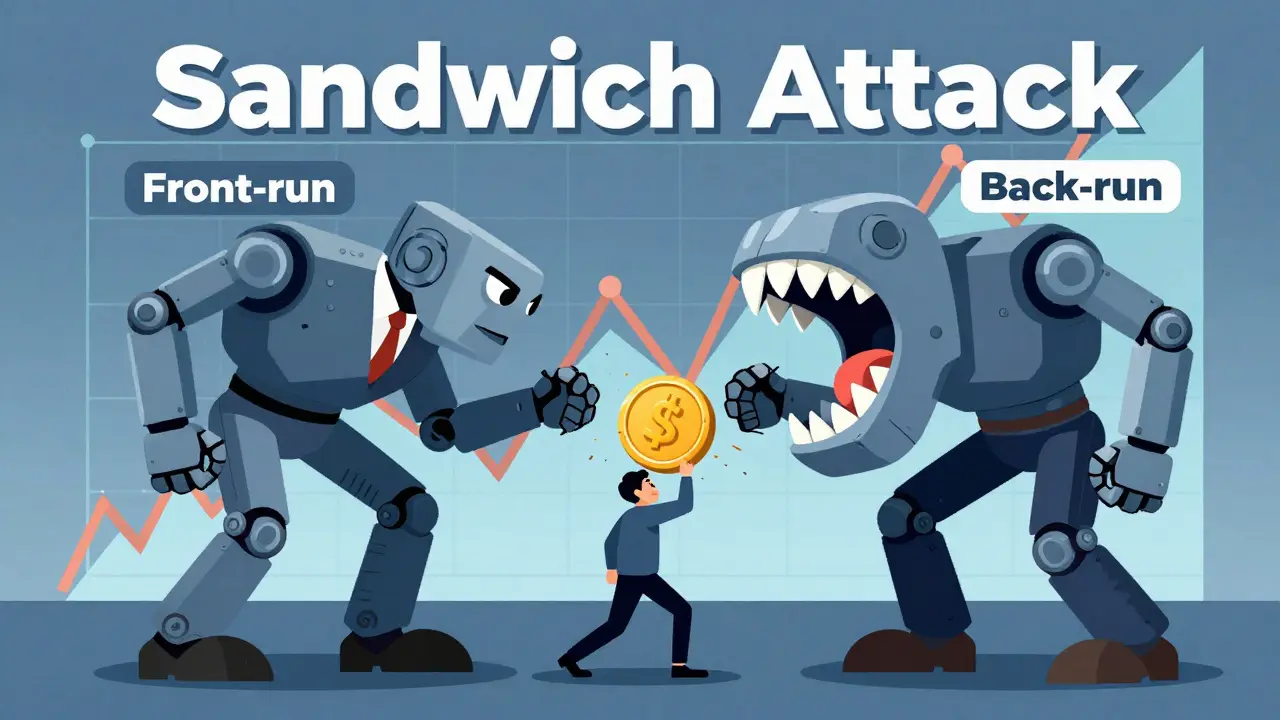
A more aggressive variation is the Sandwich Attack. This strategy combines front-running with backrunning. In a sandwich attack, the bot places a transaction before the victim’s trade (front-run) and another transaction immediately after (back-run). By buying before the victim pushes the price up and selling after the victim pushes the price down, the bot captures the entire price movement created by the victim’s trade. The victim receives worse execution than they expected, while the bot profits risk-free.
| Strategy | Mechanism | Risk Level | Impact on User |
|---|---|---|---|
| Front-Running | Placing tx before target | Medium | Worse entry price |
| Back-Running | Placing tx after target | Low | Minimal direct impact |
| Sandwich Attack | Before and after target | High | Significant slippage loss |
| Liquidation MEV | Early liquidation of loans | Medium | Asset seized prematurely |
The Role of Searchers, Builders, and Validators
MEV extraction is not a solo act; it’s a specialized industry with distinct roles. Understanding these roles helps explain why MEV is so hard to stop.
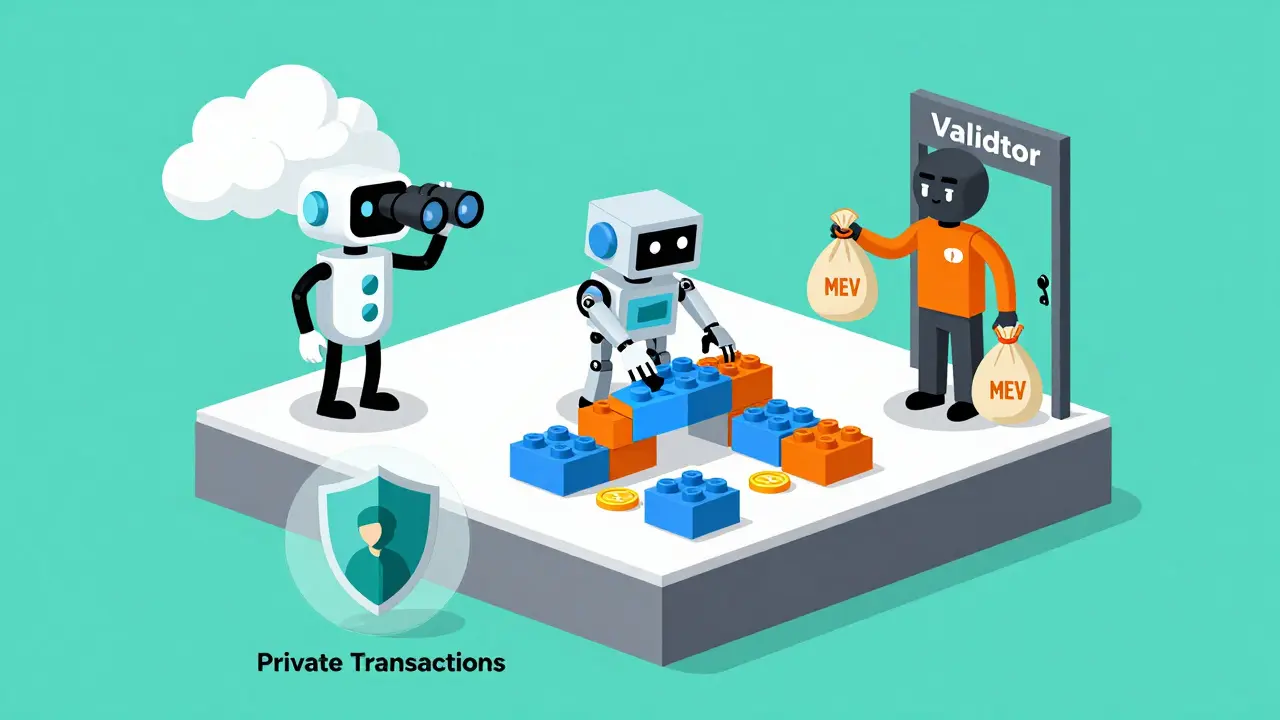
Searchers are the hunters. They run algorithms to scan the mempool for arbitrage opportunities, sandwich targets, or liquidations. They are highly competitive and require low-latency infrastructure to succeed. Many searchers operate as professional firms with significant capital reserves.
Builders act as middlemen. They take transactions from searchers and package them into blocks. Builders optimize the order of transactions to maximize the total value of the block. They use tools like Flashbots' MEV-Boost to bid on block space. Builders don’t necessarily know the content of every transaction; they focus on assembling the most profitable block possible.
Validators are the final gatekeepers. In a Proof-of-Stake system, validators propose blocks. They receive bids from builders and choose the highest-paying bundle. While validators don’t actively hunt for MEV, they benefit directly from it. This alignment of incentives means validators have little motivation to prevent MEV extraction unless forced to do so by protocol design.
Is All MEV Bad? The Debate on Market Efficiency
Not everyone views MEV as purely malicious. Some economists argue that MEV provides essential market-making services. Arbitrageurs, for instance, help keep prices aligned across different exchanges. Without them, the price of ETH on Uniswap might drift significantly from the price on Coinbase, creating inefficiencies.
However, this argument breaks down when MEV becomes predatory. Sandwich attacks do not add value; they extract wealth from uninformed traders. They create a two-tiered system where those with faster computers and better algorithms win, and retail users lose. This undermines the core promise of decentralization: equal access. When the cost of participation rises due to MEV-driven gas wars, ordinary users are priced out, leading to centralization of power among wealthy entities.
How to Protect Yourself from MEV Exploitation
While you cannot eliminate MEV entirely, you can reduce your exposure. Here are practical steps to minimize losses:
- Use Private Transaction Services: Tools like Flashbots Protect or CowSwap allow you to send transactions directly to validators without exposing them to the public mempool. This prevents searchers from seeing your trade before it executes.
- Break Up Large Trades: If you need to swap a large amount of tokens, consider splitting it into smaller chunks. Smaller trades are less attractive to sandwich attackers because the profit margin is thinner.
- Set Slippage Tolerance Carefully: High slippage tolerance makes you vulnerable to front-running. Set it as low as possible while still allowing the trade to execute. This limits how much price movement a bot can exploit against you.
- Use Limit Orders: Instead of market orders, which execute immediately at the best available price, use limit orders. These only execute at your specified price, reducing the window for manipulation.
- Monitor Gas Prices: Avoid sending transactions during peak congestion times if possible. High gas environments attract more bots, increasing the likelihood of MEV extraction.
The Future of MEV and Regulatory Outlook
The landscape of MEV is evolving rapidly. As Layer 2 solutions gain traction, MEV dynamics are shifting. Sequencers on L2s now hold significant power over transaction ordering, raising new concerns about censorship and fairness. Projects are experimenting with fair sequencing services and commit-reveal schemes to mitigate these risks.
Regulators are also taking notice. In some jurisdictions, sandwich attacks may be classified as market manipulation, similar to traditional finance fraud. However, enforcement is difficult due to the pseudonymous nature of blockchain. Until clear legal frameworks emerge, users must rely on technical protections rather than legal recourse.
The ongoing arms race between MEV extractors and developers will continue to shape blockchain technology. New consensus mechanisms, such as single-leaderless consensus, aim to eliminate the ability to reorder transactions altogether. While promising, these solutions are complex and unproven at scale. For now, awareness remains your best defense.
Can I sue someone for sandwich attacking my transaction?
Currently, no. Most blockchain interactions are anonymous, and there is no established legal framework for prosecuting MEV extraction in most countries. While some regulators view it as market manipulation, identifying the attacker and proving intent is extremely difficult. Rely on technical protection methods instead of legal action.
Does Bitcoin suffer from MEV?
Bitcoin experiences minimal MEV compared to Ethereum. Since Bitcoin lacks smart contracts and decentralized exchanges, there are fewer opportunities for complex strategies like sandwich attacks. However, simple front-running of transactions with low fees can still occur, though it is far less profitable and common.
What is the difference between MEV and gas fees?
Gas fees are payments made to validators/miners for processing transactions. MEV is additional value extracted by manipulating transaction order. While gas fees are explicit costs, MEV is often hidden. Users indirectly pay for MEV through higher gas prices caused by bot competition and worse trade execution.
Are all bots bad?
No. Some bots provide beneficial services, such as arbitrageurs who keep prices aligned across exchanges. These bots improve market efficiency. The problem arises with predatory bots that exploit users’ lack of information, such as those executing sandwich attacks. Distinguishing between helpful and harmful bots is challenging for average users.
Will Layer 2 networks solve the MEV problem?
Layer 2s shift the problem rather than solving it. While they reduce congestion on Ethereum mainnet, they introduce sequencers who control transaction ordering. If sequencers are centralized or unregulated, they can engage in MEV extraction themselves. Solutions like fair sequencing protocols are being developed, but widespread adoption is still pending.


Mekz Wheoki
Oh look, another article explaining why 'code is law' is actually 'whoever has the fastest GPU gets to rob you first.' Shocking. I didn't realize we needed a 2000-word essay to tell us that decentralized finance is just centralized theft with extra steps.
Rob Aronson
The nuance here regarding the distinction between arbitrage MEV and predatory sandwich attacks is often overlooked by the casual observer 🧵 Arbitrageurs provide liquidity depth and price discovery efficiency across fragmented order books, which is technically beneficial for market integrity. However, the externalities introduced by searchers engaging in front-running create a negative sum game for retail participants who lack access to private RPC endpoints or Flashbots bundles. The real issue isn't the extraction itself, but the asymmetry of information and infrastructure costs required to compete fairly in the mempool environment 📉
Danna Charris
It is frankly embarrassing how many people still think this system is fair.
Fede Faith
I’ve been using CowSwap for my larger swaps lately because it really does help mitigate those sandwich attacks mentioned in the post. It’s not perfect, but splitting up trades and using limit orders definitely takes the sting out of getting wrecked by bots. If you’re doing anything over $5k on Uniswap mainnet without protection, you’re basically lighting money on fire. Just use the tools available instead of complaining about the gas wars 😅
Josh Dodson
totally agree with fede! i used to lose so much money on slippage until i started breaking my trades into smaller chunks. its annoying but better than losing 2% to a bot instantly. hope everyone stays safe out there! 🙌
Skm Shubham
The entire premise of Proof-of-Stake was supposed to solve these inefficiencies, yet here we are with validators acting as toll collectors for MEV-Boost bundles. It is a systemic failure of incentive design. The argument that MEV provides market efficiency is disingenuous at best; it merely redistributes wealth from uninformed retail users to well-capitalized searchers with superior latency infrastructure. Until we move towards leaderless consensus mechanisms or fully private transaction pools, this parasitic behavior will remain an inherent feature, not a bug, of the current blockchain architecture.
Kwon Bill
In the context of Layer 2 scaling solutions, the centralization risk associated with sequencers becomes even more pronounced. While L2s reduce congestion on Ethereum mainnet, they effectively hand over transaction ordering power to a single entity or a small cartel. This creates a new vector for censorship and MEV extraction that is harder to audit than the public mempool. We need standardized fair sequencing protocols before widespread adoption can be considered truly decentralized.
Suman Patil
Hey guys, let's keep the discussion constructive! 🤝 While the tech can be complex, understanding MEV is crucial for anyone participating in DeFi. It’s not all doom and gloom though-tools like Flashbots Protect are making huge strides in leveling the playing field. Let’s focus on how we can adapt and protect ourselves rather than just criticizing the system. Knowledge is power! 💪
John Doe
I feel like we’re ignoring the human cost here. Imagine putting your life savings into a trade, thinking you’re being smart, only to have a faceless algorithm strip you bare in milliseconds. It’s terrifying. These bots don’t care about your financial goals or your stress levels; they just see numbers. It makes me question if this technology is actually built for people or just for the engineers who understand the backend. The drama of losing money to a bot you never even knew existed is just heartbreaking for everyday users trying to make ends meet.
Kumaran sowkarpet
very true john, its sad how fast things happen :/ i always double check my slippage settings now to avoid getting hurt. stay strong friends! ✨
Mauricio Contreras Loredo
Yeah, sure, blame the bots. But seriously, if you can't afford the gas war, maybe you shouldn't be trading? It's a free market, folks. The bots are just efficient. If regulators step in, they'll probably kill innovation anyway, so we're stuck with this 'fair' system where the rich get richer. Classic.