Imagine finding a platform that offers 800+ trading pairs and leverage up to 100x, only to find out it operates entirely outside the reach of financial regulators. That is the paradox of HitBTC is a Hong Kong-based cryptocurrency exchange founded in 2013 that specializes in high-volume crypto-to-crypto trading. For some, it's a goldmine of liquidity and low fees; for others, it's a cautionary tale about account freezes and silent customer support. If you are looking for a place to park your life savings, you might want to keep reading before hitting that deposit button.
Quick Summary: The Good and The Bad
- Best for: High-frequency traders and bot users who prioritize API speed and low fees over regulatory safety.
- Warning: Frequent reports of withdrawal delays and a lack of official financial regulation.
- Key Strength: Massive selection of 500+ spot pairs and highly competitive futures pricing.
- Key Weakness: Poor customer service ratings and a steep learning curve for beginners.
Who is HitBTC Actually For?
Let's be real: this isn't a platform for someone who just bought their first fraction of a Bitcoin. The interface is clunky, and the layout feels like it was designed for a professional trading floor in 2015. It is built specifically for the "power user." If you know how to program trading bots or need OTC Trading (Over-the-Counter) capabilities for large blocks of assets, this is where the platform shines.
The HitBTC crypto exchange review process reveals a divide. On one side, you have the technical wizards who love the robot-friendly API. On the other, you have everyday users who find themselves trapped in a loop of automated support tickets. If you aren't comfortable managing your own risk and verifying every single step of your KYC (Know Your Customer) process, you'll likely find the experience stressful.
The Cost of Trading: Fees and Tokens
One of the few areas where the platform consistently wins is the price of doing business. They use a tiered fee structure that rewards high-volume traders. For standard spot trading, you're looking at maker fees of 0.12% and taker fees of 0.25%. While that's standard, the real magic happens in the futures market, where fees can drop as low as 0.02%.
To lower these costs further, the platform introduced the HIT Token. By holding this native utility token, you can snag discounts ranging from 3% up to a massive 45%. It's a classic move to incentivize loyalty, but remember that buying a token just to save on fees adds another layer of price risk to your portfolio.
| Feature | Value / Rate | Note |
|---|---|---|
| Spot Maker/Taker Fee | 0.12% / 0.25% | Default tier |
| Futures Trading Fee | 0.02% - 0.05% | Significantly lower than spot |
| Max Leverage (Futures) | 100x | High risk of liquidation |
| Min. Deposit | $1 | Very accessible entry point |
| Liquidation Fee | 0.5% | Applied during forced closures |

Trading Capabilities: From Spot to Futures
If you're hunting for an obscure altcoin, you'll probably find it here. With over 476 different cryptocurrencies and 800+ pairs, the variety is staggering. They don't just stop at simple buying and selling; they offer Margin Trading with up to 10x leverage, allowing you to trade with money you don't actually have (which is a great way to make money fast or lose it even faster).
The futures market is where the heavy hitters hang out. The ability to go long or short with 100x leverage is a powerful tool, but it's a double-edged sword. A tiny price movement in the wrong direction can trigger a liquidation, and at that point, the platform takes a 0.5% liquidation fee. For the average person, this is like playing roulette with a digital screen.
One weird quirk? You can use bank cards, Google Pay, or Apple Pay to get coins, but you can't actually hold fiat currency as a base account balance. You're essentially using an integrated exchanger to swap your cash for crypto, which then lives on the exchange.
The Elephant in the Room: Trust and Regulation
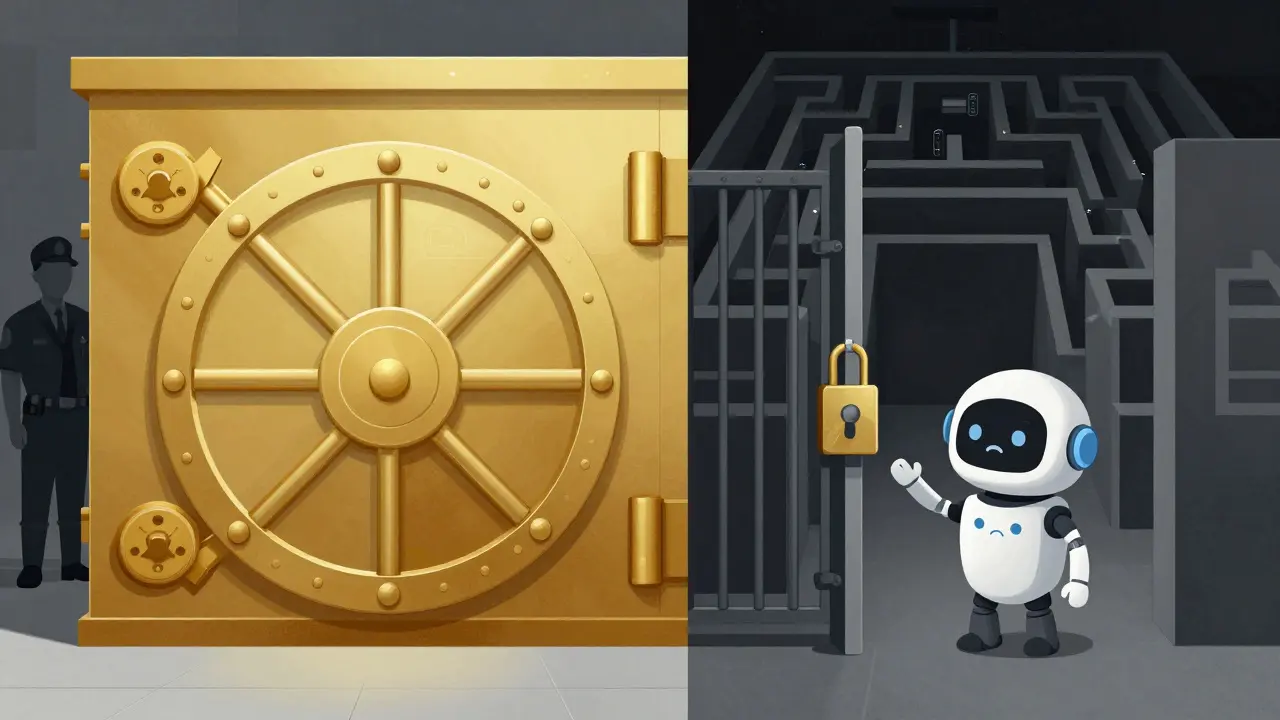
Here is where the review takes a turn. Most top-tier exchanges-think Coinbase or Kraken-spend millions on legal teams to get licensed in different countries. HitBTC doesn't. It operates without regulation from any major financial authority. In the world of finance, "unregulated" is often a synonym for "high risk."
User reviews are a battlefield. On platforms like TrustPilot, the stories are harrowing: accounts frozen without warning, withdrawals that vanish into a black hole, and a customer support team that feels like an AI bot designed to avoid giving actual answers. Some users on G2 have even alleged that the exchange ignores law enforcement requests regarding stolen assets. While some users on BestChange swear by the platform's stability, the sheer volume of complaints regarding fund access is a red flag you can't ignore.
Getting Started: A Practical Guide
If you've decided that the risk is worth the reward, don't just jump in blindly. There is a specific way to handle this platform to minimize your headache.
- Registration: Sign up using a secure email and a strong, unique password. Enable Two-Factor Authentication (2FA) immediately.
- The KYC Hurdle: Do not wait. Complete your KYC Verification the moment you open your account. Many users report that they were allowed to deposit funds, only to have their accounts frozen when they tried to withdraw, with the exchange then demanding KYC documents.
- Deposit Small: Start with a small amount to test the pipes. Ensure your deposits arrive and, more importantly, that you can withdraw a small amount back to your own wallet.
- Use an External Wallet: Never leave large sums of money on an unregulated exchange. Use HitBTC for the trade, then move your profits to a cold wallet.
Final Verdict: Should You Use It?
HitBTC is a technical marvel with a trust problem. Its API is fast, its coin selection is vast, and its fees are some of the lowest in the game. But these perks come at a cost: the loss of regulatory protection. If you are a professional trader who knows how to manage risk and only keeps "trading capital" (money you can afford to lose) on the platform, it's a viable tool.
However, for the rest of us, the lack of transparency and the horror stories regarding withdrawals make it a hard sell. In a market moving toward institutional adoption and strict compliance, staying with an unregulated platform is a gamble. If you value sleep over a 0.01% fee discount, look elsewhere.
Is HitBTC safe for beginners?
Generally, no. The interface is complex, and the lack of regulatory oversight means you don't have the same protections you would find on a licensed exchange. Beginners are better off with platforms that offer more educational resources and clearer safety guarantees.
Why do people complain about withdrawals on HitBTC?
Many users report account freezes triggered by the exchange's internal security audits. Often, these freezes are used as a prompt to force users to complete KYC verification, which can lead to long delays if the support team is slow to respond.
What are the benefits of the HIT token?
The HIT token provides holders with significant discounts on trading fees, ranging from 3% to 45% depending on the amount of tokens held. This makes it very attractive for high-volume traders.
Does HitBTC support fiat currency?
You can use fiat methods like Visa, Google Pay, and Apple Pay to buy cryptocurrencies through their integrated exchanger, but you cannot hold fiat as a base currency in your account. It is primarily a crypto-to-crypto exchange.
How does the leverage work on HitBTC?
HitBTC offers margin trading (up to 10x) and futures trading (up to 100x). This allows you to trade larger positions than your actual balance, but it increases the risk of liquidation. If the market moves against you, the exchange will automatically close your position and charge a 0.5% liquidation fee.

Robert Mosolygo
The lack of regulation is not a "feature" for the brave; it is a calculated systemic failure designed to facilitate the inevitable expropriation of user assets. If you believe that a Hong Kong-based entity with no oversight will suddenly develop a conscience regarding your withdrawals, you are delusional. The patterns are obvious: allow deposits, lure users with high leverage, and then trigger "security audits" as a pretext for liquidity raiding. It is a predatory architecture. Any rational actor would recognize that the low fees are simply the bait in a very large, very digital trap. Truly, the cognitive dissonance required to use this platform is staggering.
Lisa Camp
JUST GET YOUR KYC DONE AND STOP WHINING! If you can't even handle a simple verification process, you have no business trading 100x leverage anyway! Stop being cowards and just play the game!
Doc Coyle
It is simply common sense to avoid these places. People love to gamble, but gambling with a house that can lock the doors whenever they want is just wrong. I don't get why anyone needs 800 pairs. Most of them are junk anyway.
Eric Raines
Exactly, Doc. Everyone thinks they're a genius until their account gets frozen and they realize they're just a number in a database that some guy in a basement can delete. I've seen this a thousand times, it's all the same story, just different coins.
Clair Geary
wow the options are actually kinda wild though! imagine finding some tiny gem and just riding the wave up
definitely keep those funds in a cold wallet like the post says tho keep it safe everyone
Jagdish Sutar
It is interesting to see how different regions perceive risk in the crypto space. In many parts of the world, these types of platforms are the only way to access certain markets, though I always encourage my students to prioritize security over variety.
debashish sahu
I agree with the point about the API. For those of us focusing on automated strategies, the speed is the only thing that truly matters, regardless of where the office is located.
Ellie Drews
Maybe we can all just agree that the platform has its uses for some people and isn't for others. There's no need to be so harsh on those who choose to use it as long as they're aware of the risks.
Hannah Rubia
I would strongly advise all users to maintain a meticulous record of all transactions and communications with the support team. Should a dispute arise, having a comprehensive audit trail is the only plausible method of recourse in an unregulated environment.
Kyle Bush
Who cares about some rules?? 🚀 If you aren't risking it all you aren't even trying!! Make that money and get out 💰💰💰 HitBTC is for the real ones! 🇺🇸🔥
Jennifer L
Oh my goodness... the thought of having my funds vanish into a black hole is simply terrifiying! I can't even imagine the anxiety of waiting for a support ticket that never gets a real answer... truly a nightmarish scenario for any person!!
Tara Aman
Let's keep the energy positive! Just follow the guide in the post and you'll be totally fine. Small deposits are the way to go!
Mike Word
The distinction between using an integrated exchanger and holding fiat is a subtle but important one. It essentially forces the user into the crypto ecosystem immediately upon entry.