When international sanctions cut Iran off from global banking systems, the country didn’t just wait for a solution-it built one. While most nations struggle to adapt to digital finance, Iran turned to Bitcoin not as a speculative asset, but as a lifeline for trade. The result? A state-managed system where mined cryptocurrency becomes the currency of imports, bypassing dollar-based restrictions that have crippled its economy for years.
How Bitcoin Became Iran’s Trade Workaround
Iran’s access to the global financial system has been restricted since the early 2000s, with U.S. and European sanctions blocking access to SWIFT, freezing foreign bank accounts, and limiting access to hard currency. By 2018, with oil exports dropping and inflation soaring, Tehran made a radical decision: legalize Bitcoin mining. Not for speculation. Not for citizens to gamble. But to create a new, state-controlled source of foreign exchange. The logic was simple. Iran has cheap electricity-thanks to natural gas reserves-and a large, underutilized industrial base. By turning that energy into Bitcoin, the country could mine digital currency and then sell it abroad for real goods. No banks. No intermediaries. No U.S. oversight. The Central Bank of Iran (CBI) banned domestic crypto payments, but allowed licensed miners to sell their Bitcoin to state-approved entities. These entities, in turn, used the Bitcoin to pay for imports-medical equipment, food, machinery, even parts for nuclear facilities. It wasn’t a loophole. It was a policy. By 2022, Iran had licensed over 10,000 mining farms. By 2024, $4.18 billion in cryptocurrency had left the country. That’s not just mining revenue-it’s trade volume. And it’s growing.The Mechanics: From Power Plant to Import Order
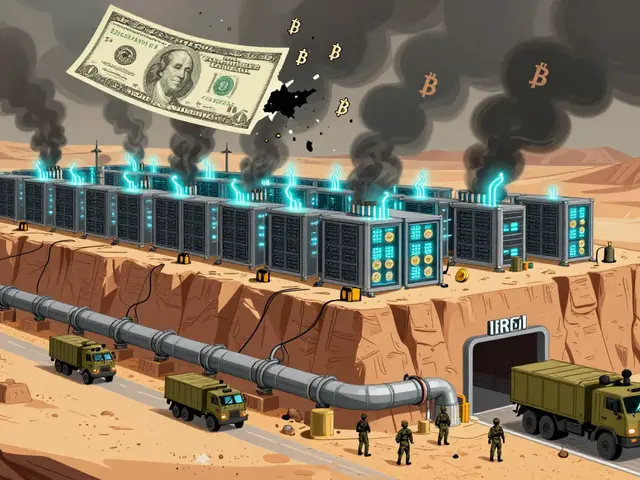
The system doesn’t work like a typical crypto exchange. You can’t just buy Bitcoin on a local app and send it to a supplier in China. Every step is controlled. First, mining farms must be registered with the Ministry of Industry. They must use industrial-grade electricity, not subsidized household power. They must be located in designated zones-often near gas fields or on military land. Many are run by the Islamic Revolutionary Guard Corps (IRGC), which controls key infrastructure and has deep ties to Chinese mining hardware manufacturers. One of the largest is a 175-megawatt facility in Rafsanjan, Kerman province. It’s not just a mine. It’s a power plant disguised as a data center. The electricity it uses could power a city of 100,000 people. Instead, it’s used to run ASIC miners that churn out Bitcoin 24/7. Once mined, the Bitcoin is funneled into state-approved pools. These pools are monitored by the CBI and Iran Cyber Police (FATA). Every coin movement is logged. Every transaction must be reported under AML/KYC rules. No exceptions. When an Iranian company needs to import a shipment of pharmaceuticals from India, it doesn’t wire euros. It applies for a crypto-based import license. The CBI approves the request, then authorizes the release of Bitcoin from its reserve. The Bitcoin is sent to an exchange in a non-sanctioned country-often Turkey, Russia, or the UAE. There, it’s converted into local currency and sent to the supplier. The supplier gets paid. Iran gets its medicine. And the U.S. financial system stays out of the loop.The First $10 Million Import
On August 9, 2023, Iran made history. It completed its first documented import transaction using cryptocurrency: $10 million worth of medical equipment from India. No banks. No dollars. No intermediaries. Just Bitcoin moving from a state-controlled wallet to a vendor’s address. That transaction wasn’t a test. It was a blueprint. Since then, hundreds of similar deals have followed. Iranian firms have used crypto to import everything from ventilators to auto parts to industrial turbines. Some estimates suggest over $8 billion in trade has flowed through Binance alone since 2018. The key? Smart contracts. Iran has partnered with Russian and Chinese tech firms to build blockchain-based trade platforms that automate verification, customs clearance, and payment. These platforms don’t rely on SWIFT. They don’t need U.S. approval. They run on permissioned blockchains that only Iranian and allied entities can access.
Who’s Really in Control?
This isn’t a grassroots movement. It’s a state operation. The IRGC doesn’t just participate in mining-it dominates it. Reports from independent energy analysts show that over 60% of Iran’s mining capacity is tied to IRGC-linked entities or religious foundations like Astan Quds Razavi. These groups operate with near-total immunity. They get priority electricity. They pay no bills. They’re protected by armed guards. The government calls it “economic resilience.” Critics call it theft. In cities like Tehran and Mashhad, power outages last for days. Factories shut down. Hospitals rely on generators. Meanwhile, mining farms hum along, their servers running on electricity that should be powering homes. In 2021, the government cracked down on illegal miners using household power. Thousands of small rigs were seized. But the big operations? They stayed open. The message was clear: only state-aligned entities get to mine.Why It Works-And Why It’s Fragile
Bitcoin works for Iran’s imports because it’s decentralized, borderless, and hard to trace. Unlike traditional banking, there’s no central authority to freeze accounts. No institution to pressure suppliers into refusing payment. Once Bitcoin leaves Iran’s controlled ecosystem, it’s nearly impossible to track who received it or what it was used for. But this system isn’t perfect. Price volatility is a constant threat. A Bitcoin mined in January might be worth $50,000. By March, it could drop to $40,000. That’s a 20% loss on a $10 million import. To manage this, Iran uses stablecoin bridges-converting Bitcoin to USDT or BUSD before sending it abroad. But even these aren’t foolproof. Exchanges can freeze accounts. Regulators can blacklist addresses. Then there’s infrastructure. Iran’s power grid was never designed for 10,000 mining farms. The country’s electricity demand has surged by 22% since 2020, with mining accounting for nearly half the increase. Power plants are running at 98% capacity. Blackouts are now routine. And regulation? It’s a moving target. The CBI has shut down over 150 unlicensed crypto exchanges since 2024. It now requires all trading platforms to obtain licenses-something most can’t afford. The goal isn’t to stop crypto. It’s to centralize it.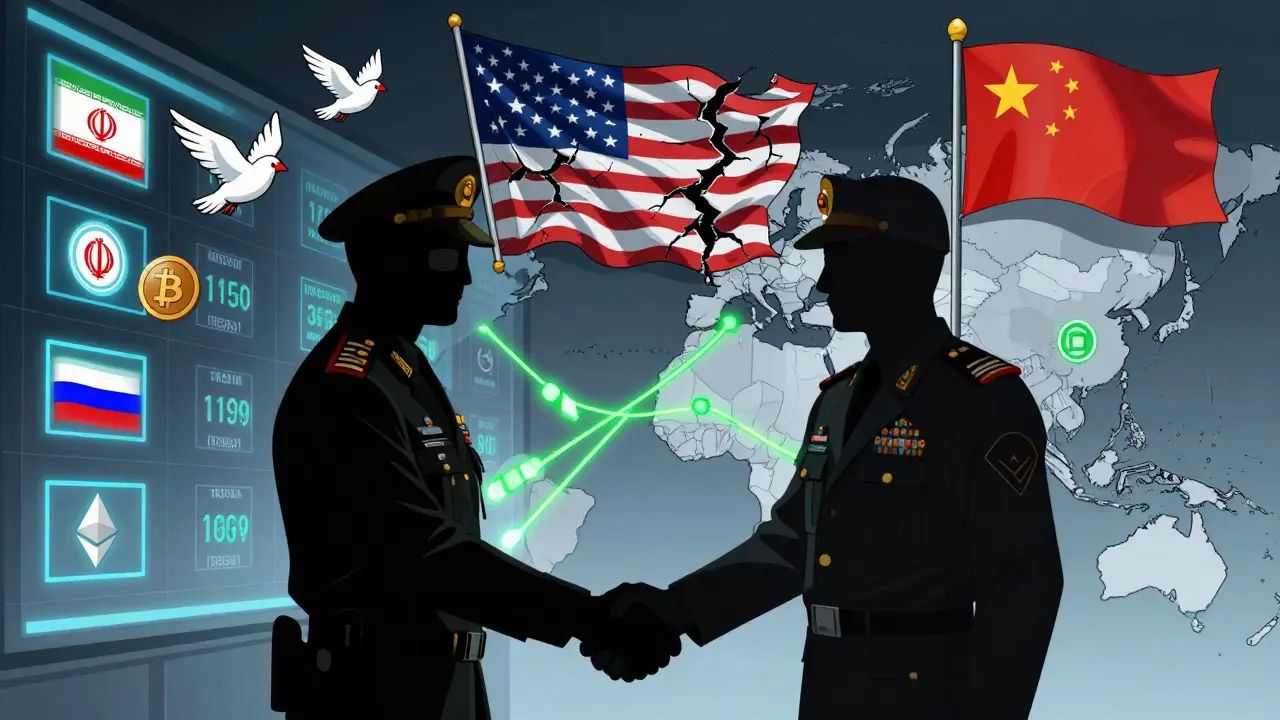
What’s Next? Iran’s Global Crypto Network
Iran isn’t working alone. Since 2018, it has signed bilateral crypto trade agreements with Russia, China, Turkey, and several other nations. In 2023, Iran and Russia launched a joint blockchain platform for oil-for-crypto swaps. No dollars. No euros. Just Bitcoin and Ethereum moving between state wallets. The goal is clear: build a parallel financial system. One that operates outside the U.S.-dominated world. One where trade is settled in digital assets, not paper currency. It’s working. Iran’s crypto sector is projected to hit $1.9 billion in revenue by 2025. Mining alone could generate $1 billion a year. And every dollar of that revenue is a dollar that doesn’t need U.S. permission to spend.Is This the Future of Sanctioned Trade?
Iran’s model is unique-but not unrepeatable. Countries under heavy sanctions-Venezuela, North Korea, Belarus-are watching closely. So are corporations in non-sanctioned regions that want to do business with them. The lesson? When traditional finance shuts the door, digital assets can open a window. Not as a replacement. Not as a revolution. But as a practical tool for survival. Iran didn’t choose Bitcoin because it’s innovative. It chose Bitcoin because it’s unstoppable. The world still calls it a loophole. But in Tehran, it’s just business as usual.Can Iranian citizens use Bitcoin to buy goods locally?
No. The Central Bank of Iran (CBI) strictly prohibits domestic use of cryptocurrency for payments. Citizens cannot use Bitcoin to pay for groceries, fuel, or services. All crypto activity is restricted to state-approved mining and export-only trade. Any local transactions using digital assets are illegal and subject to fines or arrest.
How does Iran avoid detection when using Bitcoin for imports?
Iran uses a combination of controlled channels and obfuscation. All crypto imports are routed through state-approved exchanges in non-sanctioned countries like Turkey or the UAE. Bitcoin is often converted into stablecoins (like USDT) before being sent, making it harder to trace back to Iranian entities. Additionally, smart contracts automate the process, reducing human interaction and audit trails. The Iranian government also limits public disclosure, so most transactions are not publicly reported.
Why does Iran allow mining but ban personal crypto use?
It’s about control. By allowing mining, Iran turns its cheap electricity into a revenue stream. By banning personal use, it prevents capital flight and keeps crypto out of the hands of ordinary citizens who might use it to bypass currency controls. The state wants to be the sole beneficiary and regulator of crypto activity-ensuring it stays within the government’s economic framework.
What role does the Islamic Revolutionary Guard Corps (IRGC) play in Iran’s crypto mining?
The IRGC controls a majority of Iran’s largest mining operations. These operations are often located on military or state-controlled land and receive priority access to electricity. The IRGC uses mining profits to fund its operations, bypassing international financial restrictions. Reports show IRGC-linked entities have built mining farms with Chinese hardware and operate them with minimal oversight, effectively turning national energy resources into private revenue streams.
Is Bitcoin the only cryptocurrency Iran uses for imports?
No. While Bitcoin is the primary asset due to its liquidity and global acceptance, Iran also uses Ethereum, Tether (USDT), and other stablecoins. Stablecoins are preferred for import payments because their value is pegged to the U.S. dollar, reducing volatility risk. However, Bitcoin remains the main asset mined domestically, as it’s easier to convert into other currencies abroad.
How do Iranian importers get paid in crypto if they can’t hold it?
Iranian importers don’t hold crypto. The state collects Bitcoin from mining operations and holds it in centralized wallets. When an import request is approved, the CBI releases the equivalent value in Bitcoin to a licensed exchange abroad. The exchange converts it into fiat currency (like USD or EUR) and sends it to the foreign supplier. The Iranian importer pays in rials to the state, not to the foreign vendor.
What happens if a foreign supplier refuses crypto payments?
Suppliers who refuse crypto are typically replaced. Iran has built relationships with trading partners in non-sanctioned countries that accept crypto, especially in Asia and the Middle East. If a supplier refuses, the Iranian government can redirect the order to another vendor. The system is designed to be supplier-agnostic-what matters is that the payment is made in crypto, not who receives it.
prasanna tripathy
Really cool to see how Iran turned a constraint into a system. I work with supply chains in India, and this is the kind of adaptive thinking we need more of. Not about politics, just logistics - they built a bridge where none existed. That’s innovation.
Also, the part about using stablecoins to smooth out volatility? Smart. Makes me wonder if other sanctioned economies are quietly doing the same thing. Maybe we’re underestimating how much decentralized finance is already operating in the shadows.
Would love to see a map of these crypto trade routes. Someone’s gotta be tracking this.
James Burke
So they’re mining Bitcoin to buy medicine. That’s wild. Not saying I agree with the regime, but if this keeps ventilators flowing into hospitals, maybe it’s the least bad option.
Also, the IRGC running 60% of the mines? Yeah, that’s sketchy. But hey - at least the power’s going somewhere useful. In the U.S., we just complain about crypto mining using too much energy. We don’t even have a reason for it.
Jonathan Chretien
Oh wow, another ‘crypto saves the day’ fairy tale 🤡
Let me guess - next they’ll say Bitcoin is the new olive branch of peace? Nah, this is just the IRGC laundering state funds under the guise of ‘economic resilience.’ It’s not innovation - it’s kleptocracy with a blockchain UI.
Also, ‘no U.S. oversight’? Bro, the U.S. doesn’t need to oversee it. It just needs to blacklist the exchanges, freeze the addresses, and watch the whole thing implode. Which it will. Soon.
Also, stablecoins? 😂 You think USDT is immune to U.S. sanctions? Please. Tether’s CEO answers to American regulators. This whole system is one subpoena away from collapse.
Bill Pommier
It is my solemn duty to inform you that this so-called ‘solution’ is not a solution at all - it is a systemic corruption vector enabled by technological naivety and geopolitical desperation.
First, Bitcoin’s volatility renders it an unreliable medium of exchange - especially for critical imports like pharmaceuticals. Second, the centralized control of mining infrastructure by the IRGC violates the very decentralization ethos that Bitcoin purports to uphold. Third, the use of stablecoins introduces a centralized counterparty risk - which defeats the entire purpose.
This is not resilience. It is fragility disguised as innovation. A house built on sand, with a blockchain sign on the front door.
And yet - somehow - it works. Which makes it all the more tragic.
Olivia Parsons
Wait - so citizens can’t use Bitcoin at all, but the state mines it and uses it to buy medicine? That’s… oddly pragmatic. Not ethical, but pragmatic.
How do they even verify the imported goods aren’t being diverted? Is there any audit trail? I’m curious about the paper trail - if every transaction is logged by FATA, who’s checking that data? And what happens if someone inside the system manipulates it?
Nick Greening
Oh come on. Bitcoin? Really? You think the U.S. doesn’t already have every single one of these addresses flagged? This isn’t a workaround - it’s a suicide mission.
And don’t even get me started on the IRGC. They’re not ‘mining’ - they’re stealing electricity from grandmas so they can buy drones. This isn’t innovation. It’s theft with a whitepaper.
Issack Vaid
Let’s be clear: this isn’t about Bitcoin. It’s about sovereignty. Iran didn’t choose crypto because it’s cool - they chose it because it’s the only tool left that can’t be shut down by a single government.
You want to control global finance? Then stop making it so easy to bypass. The U.S. built a system where every dollar flows through a choke point - and now Iran’s found a way around it.
It’s not a loophole. It’s a consequence.
Shawn Warren
Imagine if we had this kind of ingenuity back home
Instead of debating crypto we should be building infrastructure
Iran is turning energy into life saving goods while we argue about memes
This is what leadership looks like
Not tweets not press releases not committees
Just action
Jackson Dambz
Wow. Just wow. Another ‘crypto saves the day’ story from someone who’s never seen a blackout.
Let me guess - you think the people in Tehran are happy? The ones without power? The ones whose kids need medicine? Nah. They’re the ones paying the real price.
Meanwhile, the IRGC gets to run 175-megawatt mines like they’re Apple data centers.
This isn’t resilience. It’s exploitation with a blockchain logo.
Megan Lutz
It’s fascinating how this system inverts the usual narrative. Crypto isn’t being used to escape state control - it’s being weaponized *by* the state. The irony is delicious.
They banned domestic use to prevent capital flight, but turned mining into a state-run export engine. It’s not libertarian. It’s statist capitalism with a digital veneer.
And yet - it works. Which means the entire ‘crypto is anarchic’ narrative is nonsense. Crypto is just a tool. And tools don’t care who wields them.
Jesse VanDerPol
Interesting. I wonder how many of these mining farms are actually running at full capacity. Power grids aren’t designed for this kind of load. There’s gotta be a tipping point where the cost of blackouts outweighs the value of Bitcoin.
Also - how do they even keep the ASICs cool in Kerman? 50°C ambient temps? That’s brutal on hardware.
jonathan swift
ALERT ALERT
THIS IS A COVERT CIA OPERATION TO DESTROY IRAN'S ECONOMY
BITCOIN IS A FEDERAL RESERVE TOOL TO TRACK CRYPTOCURRENCY USERS
THE IRGC IS A FAÇADE - THEY’RE WORKING FOR JPMORGAN
THE 175MW MINE? IT’S A DISGUISE FOR A SATELLITE LASER
YOU THINK YOU’RE SMART? YOU’RE BEING USED
THEY’RE USING USDT TO INJECT AI INTO YOUR PHONE
THEY’RE NOT BUYING MEDICINE - THEY’RE BUYING NANOBOTS TO CONTROL YOUR BRAIN
👁️👁️👁️
Datta Yadav
Let’s not romanticize this. Iran’s crypto strategy is not innovation - it’s desperation dressed in whitepapers. The fact that they’re using stablecoins to mitigate volatility proves they understand the system’s fragility - which means they know it’s unsustainable. And yet they double down. Why? Because they have no alternatives. The West didn’t just sanction their oil - they sanctioned their future. This isn’t a workaround - it’s a death rattle with a blockchain interface.
Meanwhile, the IRGC is quietly building a parallel economy where electricity theft is institutionalized and mining profits fund weapons, not medicine. The $8 billion in trade? Half of it is going to Hezbollah. The rest? To Russian arms dealers. The medicine? A PR stunt.
Don’t mistake survival for virtue. This is not resilience - it’s a Ponzi scheme with a national flag.
Lydia Meier
So they’re mining Bitcoin to import medicine. But citizens can’t use it to buy groceries. That’s not a system. That’s a class divide with a ledger.
Also, the fact that they’re routing everything through Turkey and UAE? That’s just shifting the problem, not solving it. Those countries are going to get slapped with sanctions too. This is just delay, not defense.
jay baravkar
This is the kind of thing that gives me hope. Not because it’s perfect - but because it’s *real*. People are adapting. Governments are failing. And somewhere, a miner in Rafsanjan is running a server that keeps a hospital alive.
That’s not crypto. That’s humanity.
Ian Thomas
It’s funny how we call this ‘bypassing sanctions’ - like the U.S. didn’t build the very system that made this necessary.
Sanctions are meant to be a scalpel. But when you cut off a limb for 20 years, people start using duct tape and solar panels to keep breathing.
Iran didn’t invent crypto. They just used it the way it was meant to be used - as a tool for people who have no other options.
And now we’re mad because it worked?
Austin King
Simple truth: if Bitcoin can keep a child alive, then it’s not a currency. It’s a lifeline.
No politics. Just that.
Bryanna Barnett
ok so like… the irgc is mining bitcoin??
but like… its not even that cool
like its just like… electricity that should be going to homes
and theyre using it for servers??
and then theyre using the bitcoin to buy medicine??
so like… the rich get medicine
and the poor get blackouts
thats not innovation
thats just… capitalism
with more servers
Josh Moorcroft-Jones
Let’s unpack this with precision, shall we? First, the claim that Bitcoin is ‘unstoppable’ is fundamentally flawed - Bitcoin is not a system, it is a protocol, and protocols are only as resilient as their nodes, their liquidity, and their regulatory environment. The fact that Iran relies on stablecoins - which are centralized, custodial, and subject to U.S. Treasury directives - renders the entire premise of ‘decentralized bypass’ a myth. Second, the assertion that $8 billion in trade has flowed through Binance alone is statistically implausible without public on-chain data, which is conspicuously absent. Third, the IRGC’s dominance in mining infrastructure suggests not innovation, but state capture - a form of economic nationalism indistinguishable from the very systems they claim to reject. Fourth, the power grid strain is not a side effect - it is the system’s core vulnerability. A 22% surge in demand? That’s not sustainable - that’s a time bomb. Fifth, the use of smart contracts for customs clearance? Where are the audits? Who verifies the trade data? The answer: no one. Because this isn’t a transparent system - it’s a black box with a blockchain logo. And finally - and this is critical - if the Central Bank of Iran is the sole gatekeeper, then this isn’t crypto. It’s a state-run digital barter system with a fancy name. The entire narrative is a smoke screen: Iran didn’t invent a new financial paradigm. They just found a way to launder state power under the guise of decentralization. And that’s not revolutionary. It’s just… sad.
James Burke
Actually, that last comment about stablecoins being centralized? Spot on.
I’ve been thinking about this - if Iran’s using USDT to pay for imports, then Tether’s reserves are effectively funding the IRGC. That’s wild. The U.S. government doesn’t even need to sanction Iran - they just need to freeze Tether’s bank accounts.
Which… they probably already have.