Imagine you have a list of 500 transactions and need to prove one of them is real-without downloading all 500. That’s exactly what Merkle Trees let Bitcoin and Ethereum do. They’re not flashy, but without them, your phone wallet wouldn’t work. No full blockchain download. No massive storage. Just a quick proof that your transaction is part of the chain. This isn’t magic. It’s math.
What Is a Merkle Tree?
A Merkle Tree is a binary tree made of hashes. Each leaf node holds the hash of a single piece of data-like a transaction. Each parent node holds the hash of its two children. Keep going up until you reach the top: the Merkle Root. That one hash represents everything below it. Change one transaction? The root changes. That’s the point. It makes tampering obvious.
Here’s how it works in practice. Say you have four transactions: A, B, C, D. You hash each one: Hash(A), Hash(B), Hash(C), Hash(D). Then you pair them up. Hash(Hash(A) + Hash(B)) becomes the parent of A and B. Same for C and D. Then you hash those two results together to get the Merkle Root. If you want to prove transaction B is real, you don’t need A, C, or D. You just need Hash(A), Hash(C+D), and the root. You hash B with A, then combine that with C+D, and see if it matches the root. Done.
This is why Merkle Trees are so efficient. For 500 transactions, you only need about 9 hashes to verify one. For a million? Just 20. That’s the power of logarithmic scaling.
How Bitcoin Uses Merkle Trees
Bitcoin uses Merkle Trees for one thing: proving transactions belong in a block. Every Bitcoin block header includes the Merkle Root. That’s it. No balances. No smart contracts. Just a list of transactions and that one root hash.
This design enables something called Simple Payment Verification (SPV). SPV wallets-like those on your phone-don’t store the whole blockchain. They only download block headers. That’s about 80 bytes per block. To check if your payment made it into a block, you ask a full node for a Merkle Proof. That’s just a short list of sibling hashes leading up to the root. You take your transaction hash, combine it with the provided hashes in order, and recalculate. If the final result matches the Merkle Root in the block header, your transaction is verified.
Bitcoin’s block headers contain six fields: version, previous block hash, Merkle Root, timestamp, difficulty target, and nonce. The Merkle Root is the only one tied to transaction data. That’s why SPV works. It cuts down bandwidth, storage, and processing needs. You don’t need a powerful computer. Just a phone and a reliable node to ask for proofs.
Bitcoin’s approach is minimalist. It’s built for security and simplicity. No extra features. Just payments. And Merkle Trees make that possible at scale.
Ethereum’s More Complex Merkle Trees
Ethereum doesn’t just track payments. It tracks state. Who has how much ETH. What code is in each smart contract. What happened in every transaction. That’s way more than Bitcoin’s list of inputs and outputs.
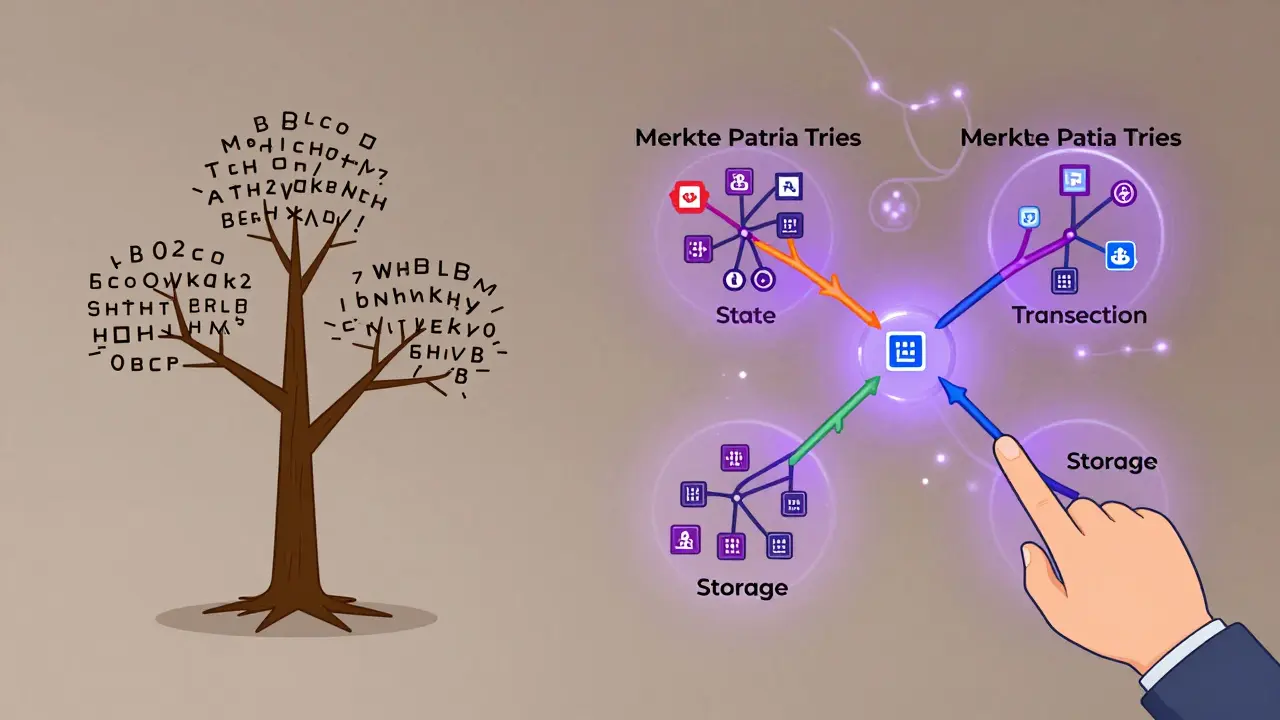
To handle this, Ethereum uses Merkle Patricia Tries-a hybrid structure combining Merkle Trees with Patricia Tries (a type of prefix tree). This isn’t just one tree. It’s three or four, all linked together.
First, there’s the State Trie. It stores every account: balance, nonce, code hash, storage root. Each account is a key-value pair: the address is the key, the account data is the value.
Then there’s the Transaction Trie. Each block has one. It stores all transactions in order, hashed and linked. The root of this trie is included in the block header.
And the Receipt Trie. It holds the outcome of each transaction: gas used, logs, contract addresses created. Also included in the block header.
Finally, each smart contract has its own Storage Trie. That’s where contract data lives-like the balance of a DeFi pool or the state of a game. These are nested under the account’s storage root in the State Trie.
Why so complex? Because Ethereum needs to prove more than just “this transaction happened.” It needs to prove “this contract had this balance at this time.” And it needs to do that fast, even as millions of contracts update every second.
For example, if you want to prove your ETH balance was $1,500 on block 20 million, Ethereum can give you a proof path from your address through the State Trie to the root. You verify it matches the block header. No need to download the entire state.

Bitcoin vs Ethereum: Key Differences
Bitcoin’s Merkle Tree is simple. One tree. One purpose: verify transactions. It’s optimized for speed and low resource use. The average Bitcoin block has about 500 transactions. You need nine hashes to verify one. It’s clean. It’s reliable.
Ethereum’s system is a web of trees. It’s heavier. It needs more storage. More CPU. But it enables things Bitcoin can’t: smart contracts, DeFi apps, NFTs, DAOs. You’re not just verifying a payment-you’re verifying the entire state of a decentralized application.
Here’s a quick comparison:
| Feature | Bitcoin | Ethereum |
|---|---|---|
| Type of Tree | Binary Merkle Tree | Merkle Patricia Trie |
| Primary Purpose | Transaction verification | State, transaction, and receipt verification |
| Number of Trees | One per block | Four per block (State, Transaction, Receipt, Storage) |
| Storage Overhead | Low | High |
| Verification Scope | Transaction inclusion only | Account balance, contract code, event logs |
| Used by SPV Clients | Yes | Partially (state proofs are possible but more complex) |
Bitcoin’s design is like a ledger. Ethereum’s is like a live database. One is for money. The other is for programs.
Why Merkle Trees Matter Beyond Blockchain
Merkle Trees aren’t just for crypto. Git uses them to track code changes. If you’ve ever checked out an old commit, you’re using a Merkle Tree. BitTorrent uses them to verify each file chunk you download from strangers. IPFS does the same for decentralized files.
Even databases use them. If two servers need to sync, they can compare Merkle Roots instead of sending all the data. If the roots match, the data is identical. If not, they only exchange the parts that differ.
This proves the concept isn’t niche. It’s fundamental. A way to verify large datasets with minimal data. That’s why it’s everywhere.
Real-World Use: Airdrops and Smart Contracts
One of the most practical uses of Merkle Trees in Ethereum is token airdrops. Say a project wants to give 100,000 users free tokens. Storing all 100,000 addresses and amounts on-chain would cost thousands of dollars in gas.
Instead, they calculate the Merkle Root of all recipients and amounts. Only that root gets stored on-chain. Each user gets a Merkle Proof showing their address and balance are part of the tree. When they claim their tokens, they submit the proof. The contract recalculates the root using the proof and their data. If it matches the stored root, they get paid.
That’s how you distribute tokens to thousands without paying for thousands of transactions. It’s cheap. It’s secure. And it only works because of Merkle Trees.
The Future: Verkle Trees and Beyond
Merkle Trees have been around since 1988. They’ve carried Bitcoin and Ethereum for over a decade. But they’re not perfect. Proof sizes can still be large. For Ethereum, syncing a new node requires downloading gigabytes of state data.
That’s why Ethereum is moving toward Verkle Trees. They use a different kind of math-vector commitments instead of hash pairs. This shrinks proof sizes dramatically. A Verkle proof for a single account might be under 200 bytes, compared to over 1,000 bytes with Merkle Patricia Tries.
Verkle Trees could make light clients faster, cheaper, and more reliable. They could let phones verify the entire Ethereum state in seconds. That’s the next step: making the network even more accessible.
Bitcoin might not adopt Verkle Trees soon. It doesn’t need them. But Ethereum’s future depends on them.
Why You Should Care
You don’t need to understand how Merkle Trees work to use Bitcoin or Ethereum. But knowing they exist explains why your phone wallet works. Why you can check your balance without syncing the whole chain. Why airdrops are possible. Why decentralized apps don’t crash from too much data.
Merkle Trees are the invisible glue holding blockchain accessibility together. They turn massive, complex systems into something you can use on a $200 phone. That’s not small. It’s revolutionary.
They’re not the flashiest part of crypto. But without them, none of it would be practical.
What is the Merkle Root in a blockchain block?
The Merkle Root is the top hash of a Merkle Tree that represents all transactions in a block. It’s stored in the block header and acts as a digital fingerprint of the entire transaction set. If even one transaction changes, the Merkle Root changes, making tampering obvious.
How do SPV wallets verify transactions without the full blockchain?
SPV wallets download only block headers, which include the Merkle Root. To verify a transaction, they request a Merkle Proof from a full node-a short list of sibling hashes leading from the transaction up to the root. The wallet then hashes the transaction with the provided hashes and checks if the result matches the Merkle Root in the header.
Why does Ethereum use Merkle Patricia Tries instead of simple Merkle Trees?
Ethereum needs to store and verify more than just transactions-it tracks account balances, smart contract code, and transaction receipts. Merkle Patricia Tries allow efficient lookups of key-value pairs (like addresses and balances) and support updates without rebuilding the entire tree. Simple Merkle Trees can’t handle this dynamic state.
Can Merkle Trees be hacked or forged?
No, not if the underlying hash function is secure. Merkle Trees rely on cryptographic hash functions like SHA-256 (Bitcoin) and Keccak-256 (Ethereum). These are designed to be collision-resistant-meaning you can’t find two different inputs that produce the same hash. If someone tries to fake a transaction, the hash won’t match up the tree to the root.
Are Merkle Trees used in other technologies besides blockchain?
Yes. Git uses them to track file changes. BitTorrent and IPFS use them to verify file chunks from multiple peers. Databases use them to sync data efficiently by comparing Merkle Roots instead of transferring entire datasets.
What’s the difference between a Merkle Tree and a Verkle Tree?
Merkle Trees use hash functions to combine nodes, producing relatively large proofs. Verkle Trees use vector commitments-a mathematical technique that allows much smaller proofs. Verkle Trees are more efficient for state-heavy systems like Ethereum and are being adopted to reduce bandwidth and storage needs for light clients.


Write a comment