You’ve probably seen it happen. Bitcoin is cruising along at $60,000. Suddenly, the chart drops like a stone to $58,000 in minutes. You panic and sell. Then, within an hour, the price rockets back up to $61,000, leaving you holding the bag while someone else pockets the profit. That wasn’t bad luck. That was likely a whale trading strategy, specifically designed to trigger your stop-loss before reversing direction.
In the world of cryptocurrency, "whales" aren’t just big fish; they are institutional investors, high-net-worth individuals, or entities that hold enough capital to move markets. Unlike traditional stock markets where order books are opaque, blockchains are transparent. Every transaction is public. This creates a unique opportunity for retail traders: you can see what the big players are doing, often before the price reacts.
But here’s the catch. Just because a whale moves money doesn’t mean they’re buying to push the price up. They might be moving funds between exchanges, engaging in wash trading, or setting traps. Following whales isn’t about blindly copying every large transaction. It’s about understanding intent, reading market structure, and knowing when to join the ride-and when to stay on the shore.
What Actually Defines a Crypto Whale?
Before you start chasing transactions, you need to know who you’re looking at. In the crypto space, there isn’t one universal definition, but most analysts and platforms use specific thresholds.
A common benchmark comes from CoinLedger, which defines a whale as any wallet holding more than 1% of a cryptocurrency’s circulating supply. For Bitcoin (BTC), where roughly 19.7 million coins exist, that means a whale holds over 197,000 BTC. However, for smaller altcoins with lower market caps, the threshold drops significantly. A wallet holding 10,000 ETH might be considered a whale in Ethereum markets, even if that’s less than 1% of total supply.
Why does this matter? Because not all large wallets act the same way. Some are cold storage-long-term holders who rarely move funds. Others are active traders or market makers. According to Coinbase Institutional data from Q4 2023, whales control approximately 13% of Bitcoin’s circulating supply. While that percentage has dropped from 16% in 2021 due to broader retail adoption, their transaction volume still accounts for 38% of total market activity. That means nearly four out of every ten dollars traded involve a whale.
When tracking these entities, focus on two types:
- Accumulators: Whales who slowly buy up assets during dips, often using multiple wallets to hide their footprint.
- Distributors: Whales who sell into strength, offloading holdings when retail FOMO (fear of missing out) drives prices up.
Identifying which type you’re dealing with is the core challenge of whale tracking.
The Mechanics of the Whale Scoop Strategy
If you want to trade like a whale, you first need to understand how they manipulate liquidity. The most famous tactic is the "Whale Scoop." This isn’t a new concept-it’s been used in forex and futures for decades-but it’s particularly effective in crypto due to fragmented liquidity and high leverage usage among retail traders.
Here’s how it works step-by-step:
- Identify Liquidity Pools: Whales look for areas where many retail traders have placed stop-loss orders. These are usually just below support levels in uptrends or above resistance levels in downtrends.
- Trigger the Sweep: The whale executes a large sell order to push the price down sharply, hitting those stop-losses. When stops are triggered, they become market sell orders, adding more downward pressure.
- Accumulate Cheaply: As the price crashes, the whale buys back the asset at a discount, absorbing the panic selling.
- Reverse the Trend: With retail traders now out of the market and the whale holding a large position, they push the price back up, trapping those who sold early.
This pattern typically unfolds within 30 to 60 minutes. If you see a sharp drop followed by a rapid reversal without fundamental news, ask yourself: Who benefited? If the answer is "the people who bought the dip," you’re likely witnessing a whale scoop.
To spot this, monitor volume profiles. A true whale scoop will show a spike in volume during the drop, but the price action will quickly reclaim the lost ground. If the price continues falling after the initial drop, it’s not a scoop-it’s genuine selling pressure.
Essential Tools for Tracking Whale Activity
You can’t track whales effectively with just a price chart. You need on-chain data. Fortunately, several platforms specialize in making blockchain data accessible to retail traders.
| Platform | Cost | Key Feature | Best For |
|---|---|---|---|
| Whale Alert | Free / $29.99/mo (Pro) | Real-time social media alerts for large transactions | Beginners wanting quick notifications |
| Glassnode | $199-$499/mo | Deep on-chain metrics and historical data | Advanced users analyzing long-term trends |
| Arkham Intelligence | Free tier / $299/mo | Entity labeling and portfolio tracking | Identifying specific whale addresses and groups |
| Nansen | $99-$299/mo | Smart Money labels and token flow analysis | DeFi traders tracking wallet interactions |
Whale Alert is the most popular entry point. Founded in 2018, it sends Telegram and Twitter notifications for transactions exceeding set thresholds (e.g., $100,000+). It’s great for awareness but lacks context. A notification saying "1,000 BTC moved to Binance" tells you something happened, but not why.
Glassnode offers deeper insights. Their charts show metrics like "Exchange Net Flow" (whether coins are moving to or from exchanges) and "Whale Accumulation." If you see coins flowing *off* exchanges to private wallets, it’s often a bullish signal indicating long-term holding. If coins flow *onto* exchanges, it may signal impending selling pressure.
Arkham Intelligence stands out for its entity labeling. Instead of seeing random hex strings, you see names like "Binance Hot Wallet" or "MicroStrategy Treasury." This helps distinguish between internal exchange movements (which don’t affect price) and actual market participants.

Decoding Intent: Not All Moves Are Trades
The biggest mistake beginners make is assuming every large transaction impacts the market. In reality, 42% of large transactions are Over-The-Counter (OTC) trades or internal transfers that never hit the public order book (Coinbase Learn, September 2023).
Consider this scenario: You get an alert that 5,000 ETH moved from Wallet A to Wallet B. You assume Wallet B is a whale preparing to dump. But what if Wallet B is a cold storage vault? Or worse, what if both wallets belong to the same institution rebalancing their portfolio?
To decode intent, look for these clues:
- Destination Matters: Movements to known exchange hot wallets (like Binance or Coinbase) suggest potential selling. Movements to unknown, newly created wallets often indicate accumulation or privacy measures.
- Frequency: One-off large moves are suspicious. Regular, smaller deposits into a single address over weeks suggest strategic accumulation.
- Context: Is the market consolidating? Breaking out? Crashing? Whales act differently in each environment. During consolidation, they accumulate. During breakouts, they distribute.
Dr. David Lifchitz, CIO of ExodusPoint Capital Management, warns that 30% of apparent whale accumulation in 2023 was later revealed to be wash trading-where institutions create fake volume to mislead retail traders. Always verify signals with multiple sources.
Risk Management: Protecting Your Capital
Following whales is powerful, but it’s not foolproof. Even professional traders lose money when misreading whale intent. Here’s how to protect yourself:
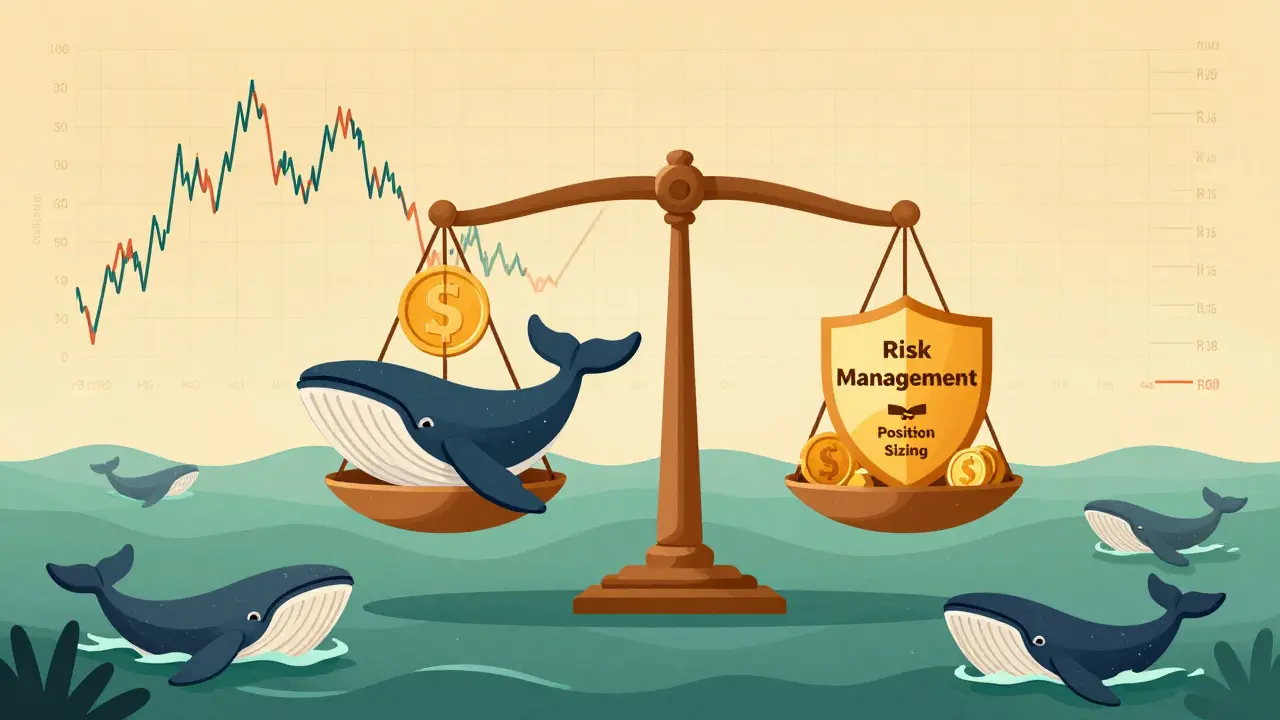
1. Use Stop-Losses Beyond Liquidity Pools Don’t place your stop-loss right below support. Whales know where retail traders put theirs. Place your stop 1.5-2x the Average True Range (ATR) beyond key levels. This reduces the chance of being swept out prematurely.
2. Position Sizing Never risk more than 1-2% of your total capital on a single whale-following trade. Whale strategies often involve high volatility. A 10% loss on a large position can wipe out months of gains.
3. Avoid News Events During major announcements (ETF approvals, regulatory bans, macroeconomic data), whale behavior becomes unpredictable. Prices can gap up or down regardless of on-chain activity. Stay flat until clarity returns.
4. Combine with Technical Analysis Whale tracking shouldn’t replace technical analysis-it should enhance it. Look for confluence. If a whale accumulates near a Fibonacci retracement level and the RSI shows oversold conditions, your probability of success increases significantly. TradingView data shows strategies combining whale indicators with Fibonacci levels achieve a 63% win rate, compared to 52% for whale tracking alone.
Common Pitfalls to Avoid
Even experienced traders fall into traps. Here are the most common ones:
Confirmation Bias You see a whale buy, so you interpret every subsequent price bump as proof you were right. Ignore contradictory evidence. Dr. Carol Alexander of Sussex University notes that retail traders often misidentify normal volatility as whale activity, creating false patterns.
Lagging Data Free tools often have delays. By the time you see a Whale Alert, the price may have already reacted. Paid services like Chainalysis Reactor offer 15-30 second latency, giving you a slight edge. But remember: speed isn’t everything. Context matters more.
Ignoring Market Structure A whale buying in a bear market might be averaging down, not starting a bull run. A whale selling in a bull market might be taking profits, not predicting a crash. Always analyze the broader trend first.
Future Trends: Will Whale Tracking Still Work?
As markets mature, the effectiveness of whale tracking may evolve. Bernstein analysts project that individual whale impact will decrease by 25-30% over the next five years as institutional participation grows and liquidity deepens. Meanwhile, whales are adapting. Arkham Intelligence reported a 45% year-over-year increase in "wallet fragmentation," where large holdings are split across 50+ addresses to avoid detection.
Yet, Pantera Capital argues that whale tracking will remain essential as long as market microstructure creates predictable liquidity pools. The game isn’t disappearing-it’s getting harder. Success will depend on sophistication: using AI-driven intent scoring, combining on-chain data with order book depth, and maintaining strict discipline.
For now, the transparency of blockchain gives you an advantage no other market offers. Use it wisely. Don’t chase noise. Focus on intent. Manage risk. And always remember: the whale doesn’t care about your P&L.
Is following whale trading strategies legal?
Yes, tracking public blockchain data is completely legal. The SEC’s February 2024 guidance confirms that retail traders face no restrictions when using whale tracking data. However, platforms providing this data must comply with market surveillance regulations. Be cautious of services promising insider information or guaranteed profits, as those may violate securities laws.
Can I track whales on Ethereum?
Absolutely. Ethereum’s transparency makes it ideal for whale tracking. Tools like Nansen and Arkham Intelligence label smart money wallets and track DeFi interactions. Look for large ETH movements to/from exchanges, significant stablecoin inflows (indicating buying power), and whale positions in major protocols like Uniswap or Aave.
How do I distinguish between a whale and an exchange wallet?
Use labeled data from platforms like Arkham or Glassnode. Exchange wallets are publicly documented and often have high transaction volumes. Whale wallets are typically fewer in number, hold larger balances for longer periods, and interact with fewer counterparties. If a wallet receives thousands of small deposits daily, it’s likely an exchange. If it makes few, large transfers, it’s likely a whale.
What is the best time frame for whale trading?
Whale scoops and short-term manipulations often play out on 15-minute to 1-hour charts. For longer-term accumulation trends, weekly and monthly charts provide better context. Avoid trading on sub-5-minute charts unless you’re using advanced order book analysis, as noise overwhelms signal at that granularity.
Do whale tracking tools work for altcoins?
They do, but with higher risk. In low-liquidity altcoins, a single whale transaction can cause 30-50% price swings, leading to massive slippage. Correlation between whale moves and price changes drops to 42% for altcoins versus 58% for Bitcoin (Glassnode, Dec 2023). Stick to top 20 coins by market cap for reliable whale tracking results.
Write a comment