When crypto companies look for a home, they don’t just want low fees or fast transactions-they want clarity. And in 2025, Malta is one of the few places on Earth that actually delivers it. Unlike countries where crypto rules change overnight or regulators send mixed signals, Malta built its entire approach around predictable, written laws. It didn’t just react to blockchain-it designed a system for it.
How Malta Became the Blockchain Island
In 2018, Malta passed three landmark laws: the Virtual Financial Assets Act, the Malta Digital Innovation Authority Act, and the Innovative Technology Arrangements and Services Act. These weren’t vague guidelines. They were full legal frameworks that defined what a virtual asset was, how exchanges had to operate, and what compliance looked like. No guesswork. No loopholes. Just rules you could read, understand, and follow. That clarity didn’t come from luck. It came from intention. The Maltese government didn’t wait for crypto to explode. They saw the shift early and moved fast. By the time other EU countries were still debating whether crypto was legal, Malta had already licensed Binance and OKEx. Today, those companies still operate from Valletta-not because it’s cheap, but because they know exactly where they stand.How Taxes Work for Crypto Businesses in Malta
Tax is where most countries lose crypto companies. Either they tax everything like ordinary income, or they tax nothing and look like a haven. Malta walks the middle path-and it works. If you’re holding Bitcoin or Ethereum as an investment and sell it after a year? No capital gains tax. That’s it. Simple. No reporting needed unless you’re trading daily. But if you’re running a crypto exchange, mining operation, or trading firm? Then you’re a business. And businesses pay corporate tax. The headline rate is 35%. But here’s the twist: Malta’s imputation system lets you get most of it back. If your company distributes profits to shareholders, those shareholders get a tax credit. For many qualified entities, the effective tax rate drops to between 0% and 5%. That’s not a loophole-it’s a legal structure built into the tax code. For individuals, the Global Residence Programme offers a flat 15% tax on foreign income brought into Malta, with a minimum annual payment of €15,000. You don’t need to be rich to qualify-you just need to prove you’re not a tax dodger. Provenance matters. If your crypto came from a regulated exchange and you can show the trail, you’re in.Regulation That Works: MFSA and MiCA
The Malta Financial Services Authority (MFSA) doesn’t just issue licenses. It sets expectations. In April 2025, they released a circular specifically for Crypto Asset Service Providers (CASPs) under the EU’s Markets in Crypto-Assets (MiCA) regulation. This wasn’t a surprise-it was the next step in a plan that started in 2018. MiCA isn’t just EU bureaucracy. It’s the first unified crypto rulebook in the world. Malta didn’t fight it. It led it. That means companies licensed in Malta are automatically compliant across the entire EU. No need for separate licenses in Germany, France, or Spain. One license. 27 countries. The MFSA focuses on four things: protecting consumers, keeping markets fair, ensuring financial stability, and making sure CASPs are transparent. No more anonymous wallets on exchanges. No more unverified token launches. If you’re running a platform in Malta, you know exactly what documentation you need, what audits to expect, and how often you’ll be checked.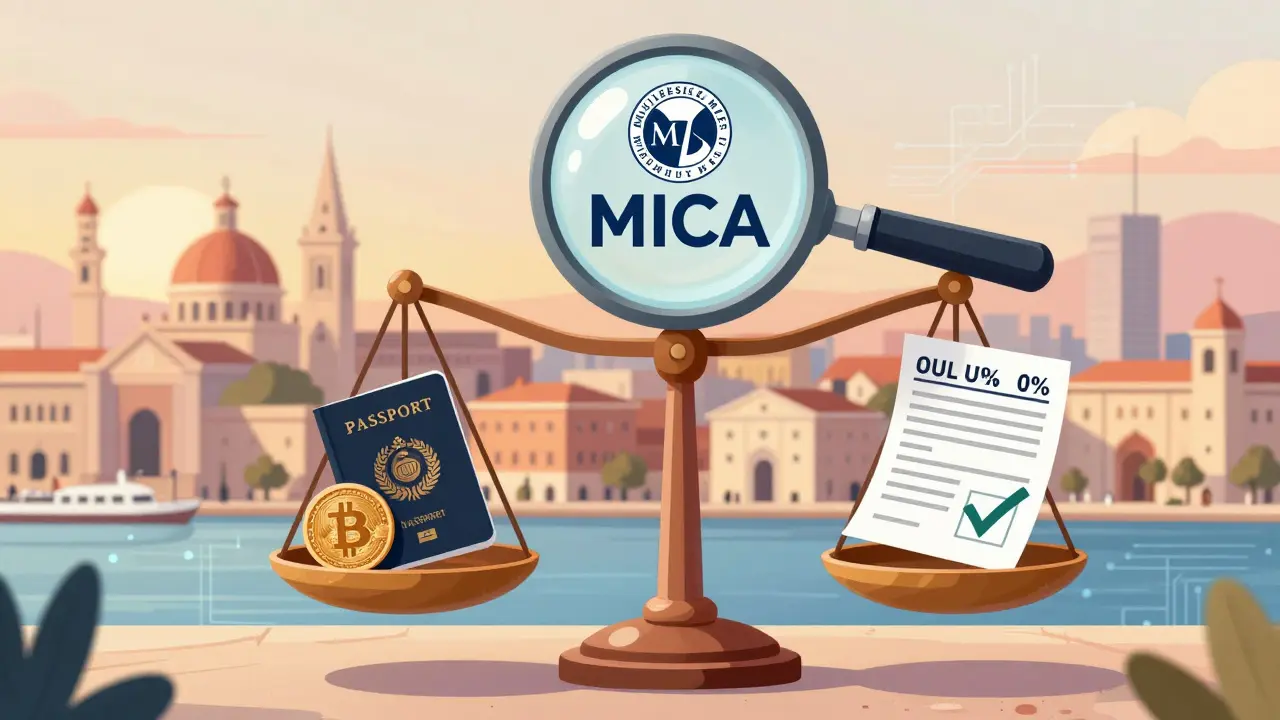
Why Malta Beats Other Crypto Hubs
Estonia? They charge 20% corporate tax and demand €125,000 in capital just to start. Switzerland? Great reputation, but licensing takes 12-18 months and costs over €100,000. Singapore? Tight rules, high compliance costs, and no clear path for tokenized assets. Malta’s advantage isn’t just tax. It’s speed, certainty, and integration. The Virtual Financial Assets (VFA) Framework includes a Financial Instrument Test-a three-step method to classify whether your token is a utility token, security, or something else. No lawyer needed to guess. Just answer three questions. That’s innovation. Plus, Malta’s location matters. It’s in the Mediterranean. Easy access to Europe, North Africa, and the Middle East. No time zone headaches. No language barriers. English is an official language. The legal system is based on British common law. Everything is familiar to Western businesses.Residency, Citizenship, and Long-Term Benefits
If you’re serious about crypto, you don’t just want a business license-you want a life. Malta offers both. The Malta Permanent Residence Programme (MPRP) lets you live in the country indefinitely if you rent property worth €10,000/year or buy property worth €300,000, and make a €30,000 government contribution. You don’t need to live there full-time. Just visit once a year. For those ready to go further, the Citizenship by Naturalisation program allows you to become a Maltese citizen after 12-36 months, depending on your contribution. Crypto wealth qualifies-as long as you can prove it’s clean. The government checks everything: source of funds, background, tax history. But if you pass, you get an EU passport. Visa-free access to 180+ countries. No more worrying about banking access in the U.S. or Asia.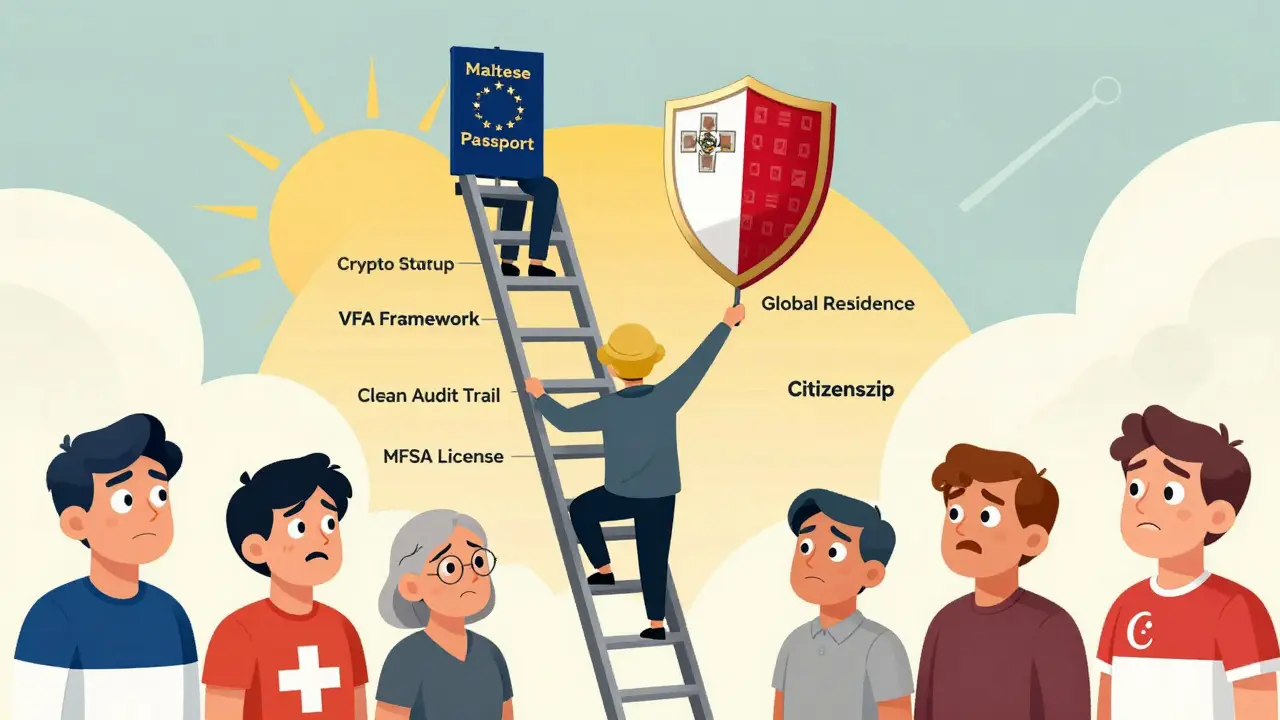
What’s Next for Malta’s Crypto Strategy
Malta isn’t resting. In 2025, they’re finalizing updates to clarify crypto-to-crypto trades. Right now, swapping Bitcoin for Ethereum is legally ambiguous in many places. In Malta, it’s being codified as a non-taxable event if it’s part of portfolio management-not trading. They’re also looking at blockchain for public services. The Maltese government is testing land registry systems on distributed ledgers. The Malta Gaming Authority is using blockchain to verify fairness in online casinos that accept crypto. Universities are adding blockchain degrees. The talent pipeline is growing. And they’re watching global trends. If the U.S. cracks down on DeFi, or the EU tightens AML rules, Malta adjusts-but doesn’t panic. They’ve built a system that can evolve without breaking.Who Should Consider Malta?
If you’re a crypto startup needing a real license, not a shell company-Malta’s for you. If you’re a trader who holds long-term and wants to avoid capital gains tax-Malta’s for you. If you’re an investor tired of banking restrictions and want EU access without living in Zurich or Luxembourg-Malta’s for you. It’s not perfect. Banking relationships are still developing. Some traditional banks remain cautious. But the regulators aren’t. And in crypto, that’s what matters. Malta didn’t become the Blockchain Island by accident. It didn’t happen because they offered free money. It happened because they gave businesses something rarer than tax breaks: confidence.Is Malta still a good place for crypto businesses in 2025?
Yes. Malta remains one of the most stable and clear jurisdictions for crypto businesses in 2025. Its alignment with the EU’s MiCA regulation ensures compliance across Europe, and its tax structure-especially the imputation system-keeps effective corporate rates low. The MFSA provides transparent licensing, and the government continues to refine rules for crypto-to-crypto trades and long-term holdings.
Do I have to pay capital gains tax on crypto in Malta?
No, if you’re holding crypto as an investment and not trading frequently. Malta does not tax capital gains on digital assets held for long-term purposes. However, if you’re actively trading-buying and selling daily with profit intent-those profits are treated as business income and taxed at standard income rates between 15% and 35%.
Can I use cryptocurrency to qualify for Maltese residency or citizenship?
Yes, but only if you can prove the source of your crypto wealth. The Maltese government requires full documentation of transactions, exchange records, and tax history. If your crypto came from a regulated platform and you can show a clean audit trail, it qualifies for the Permanent Residence Programme or Citizenship by Naturalisation. Anonymous wallets or unverifiable funds won’t be accepted.
How does Malta’s tax system compare to Switzerland or Estonia?
Malta’s effective corporate tax rate can drop to 0-5% thanks to its imputation system, while Switzerland’s rates are typically 12-24% and Estonia taxes retained earnings at 20%. Malta also offers a 15% flat tax on foreign income for residents under the Global Residence Programme, which Switzerland doesn’t match. Estonia requires higher capital deposits and lacks Malta’s EU-wide licensing advantage under MiCA.
What’s the difference between a VFA license and a MiCA license in Malta?
Before MiCA, Malta issued Virtual Financial Assets (VFA) licenses under its own laws. Since 2024, new applicants must comply with MiCA, which is now the EU-wide standard. Existing VFA license holders are being transitioned to MiCA-compliant status. So today, a “Malta crypto license” means MiCA-compliant. The VFA framework still guides the process, but MiCA is now the legal foundation.
Can I open a bank account in Malta for my crypto business?
Yes, but it’s not automatic. Traditional banks in Malta are cautious, but several institutions now work with licensed crypto firms. The key is having a full MiCA license from the MFSA, clean documentation, and a solid business plan. Many companies partner with licensed payment institutions or e-money providers as intermediaries while building banking relationships.
Is Malta safe from future crypto crackdowns?
Malta’s EU membership gives it strong legal protection. Any future crackdown would require EU-wide action, not just Maltese. Since Malta helped shape MiCA, it’s unlikely to be targeted. Its focus on transparency, consumer protection, and compliance makes it a model-not a target. The government also actively monitors global trends to adjust policies before risks escalate.

SUMIT RAI
Malta? More like Crypto Disneyland 🎢💸
Andrea Stewart
The imputation system is genius. Most people don't realize you can legally reduce corporate tax to 5% by structuring dividends right. It's not a loophole-it's how the system was designed. If you're running a business, this is the kind of clarity you pay for.
surendra meena
Ive seen this before... the same story every time... Malta this... Malta that... but where are the real jobs? Where are the Maltese people benefiting? Its all foreigners with crypto wallets and luxury villas... the locals still work two jobs just to keep the lights on... this isnt progress... its colonization with blockchain... and dont even get me started on the housing crisis...!!!
Khaitlynn Ashworth
Oh wow, so now we’re supposed to be impressed that a tiny island with 500k people figured out how to not be a total disaster? Congrats, Malta. You didn’t crash the economy. Big whoop. Meanwhile, the rest of the world is trying to actually regulate this stuff instead of turning it into a tax-free carnival. Also, 15% flat tax on foreign income? That’s not a policy, that’s a tax haven with a Mediterranean view. Don’t act like you’re the hero of crypto.
NIKHIL CHHOKAR
You know what’s funny? Everyone talks about Malta’s tax system like it’s some kind of genius innovation. But if you dig deeper, you’ll find that most of the '0-5%' effective rate only applies to companies that distribute profits to shareholders who are non-residents. So it’s not that Malta is fair-it’s that it’s designed to let foreign investors keep their money while the locals pay for infrastructure. And don’t get me started on the citizenship program. You pay $100k and get an EU passport? That’s not integration, that’s passport tourism. And yes, I’m aware this sounds bitter. But I’ve seen what happens when small countries sell their sovereignty to crypto bros.
Mike Pontillo
They just made crypto legal and called it a day. No one cares about regulation if you’re just trying to avoid taxes. This isn’t innovation. It’s tax evasion with a beach view.
Johnny Delirious
Malta’s approach is a masterclass in strategic foresight. By anchoring its regulatory framework to the EU’s MiCA standard, it has positioned itself not as a jurisdiction that merely accommodates innovation-but as a leader in shaping its future. The clarity provided by the VFA framework, combined with the imputation tax system, offers a rare trifecta: legal certainty, fiscal efficiency, and international compliance. This is not luck. This is governance.
Kenneth Mclaren
Let me guess... the MFSA is totally independent, right? And the government didn’t cozy up to Binance behind closed doors? And the 'clean audit trail' requirement? Yeah right. Every single crypto license in Malta has a backdoor. I’ve seen the documents. The real rule is: if you have enough money and a British lawyer, you get in. The rest of us? We get audited into oblivion. This isn’t regulation-it’s a pay-to-play scheme disguised as a legal system. And don’t tell me about MiCA. The EU didn’t write it. Binance helped draft it.
Michelle Slayden
The structural elegance of Malta’s regulatory architecture cannot be overstated. By codifying token classification via the Financial Instrument Test, the jurisdiction eliminates the ambiguity that plagues most other jurisdictions. Furthermore, the imputation system’s design-whereby corporate tax is effectively refunded upon dividend distribution-aligns economic incentives with long-term capital retention. This is not merely policy; it is institutional intelligence.
Vernon Hughes
Malta works because it’s small and English speaking and in Europe. No drama. No bureaucracy. Just rules. Other countries overthink it. They want to control everything. Malta just says here’s the line don’t cross it and you’re good. That’s all you need.
Alison Hall
If you're holding crypto long-term and want to avoid capital gains, Malta is one of the few places that makes sense. The residency program is also way more accessible than people think.
Haritha Kusal
i never thought i'd say this but malta is kinda cool for crypto? like i thought it was just a tourist spot but the way they did the laws is actually smart 😍
Mike Reynolds
I used to think Switzerland was the gold standard for crypto. Then I looked at Malta’s licensing timeline. Got my MiCA license in 4 months. In Zurich? 18 months. And the cost difference? Night and day. It’s not about being the biggest. It’s about being the clearest.
dayna prest
Let’s be real-Malta’s whole thing is that it’s the crypto version of a boutique hotel. Cute, well-decorated, and expensive. Meanwhile, the real innovation is happening in places no one talks about-like Georgia or Dubai. Malta’s just the Instagram influencer of blockchain regulation.
Brooklyn Servin
I work with a crypto firm in Valletta and let me tell you-the MFSA isn’t perfect but they’re the only regulators who actually reply to emails within a week. And yes, the imputation system works. We paid 3% effective tax last year. But here’s the catch: you need to have real operations there. Not just a PO box. We hired 12 locals, rented office space, and built a compliance team. That’s what they want. Not shell companies. If you’re serious, Malta rewards you. If you’re just here to dodge taxes? They’ll shut you down faster than the IRS.
Phil McGinnis
So let me get this straight. A tiny island nation with no natural resources, no military, and a population smaller than Chicago gets to dictate crypto policy across the EU? And we’re supposed to believe this isn’t a Trojan horse for offshore finance? This is how the elite game is played. They create a legal fiction called 'regulation' so they can move money where the rules are weakest. Malta didn’t become the Blockchain Island because it’s smart. It became it because it’s weak. And that’s exactly what the global elite want.
Ian Koerich Maciel
I’ve lived in Malta for 3 years now. I moved here for the crypto license... stayed for the culture. The people are warm, the food is amazing, and yes, the government actually keeps its promises. I had a meeting with the MFSA last month. They gave me a 3-page checklist. I filled it out. They approved it in 11 days. No delays. No hidden fees. No nonsense. I’ve dealt with regulators in 5 countries. This is the first time I didn’t want to scream after a meeting. 🙏
Gavin Hill
You know what’s missing from all this? The human cost. The island’s infrastructure is crumbling. Water shortages. Traffic jams. Housing prices tripled in five years. The government didn’t build a blockchain future. They sold the island’s soul to crypto investors who never set foot here except to file taxes. The laws are clear. But the ethics? Not so much. We talk about clarity in regulation-but what about clarity in consequence?