Trying to move cryptocurrency into a bank account in the Middle East feels like trying to push water through a sieve. You might be able to get some droplets through, but mostly you just end up with a mess and a lot of frustration. For investors and businesses looking at the Gulf Cooperation Council (GCC) region, the rules are not just strict-they are complicated, contradictory, and constantly shifting.
If you think the Middle East is simply "anti-crypto," you are missing the bigger picture. The reality is a patchwork quilt of policies where one country might ban your transaction while its neighbor is actively testing blockchain technology for central banks. This guide breaks down exactly which banks will touch your crypto, which countries have drawn a hard line in the sand, and what this means for your money in 2026.
The Core Problem: Why Banks Say No
To understand the bans, you have to look at why they exist. It is not just about moral objections to Bitcoin or Ethereum. It is about financial stability and control. Regulators in the Gulf are walking a tightrope. On one side, they want to diversify their economies away from oil. On the other side, they are terrified of capital flight, money laundering, and losing control over their national currencies.
Ala'a Kolkaila, a researcher at the Carnegie Endowment for International Peace, describes the regional approach as an 'open but cautious' strategy toward Central Bank Digital Currencies (CBDCs) while maintaining strict controls on private cryptocurrency banking services. In plain English? Governments love the technology if they can control it. They hate it if private companies use it to bypass their oversight.
This creates a specific type of restriction known as a crypto banking ban. This does not always mean you cannot own crypto. It often means your local bank cannot process deposits from exchanges, cannot hold crypto assets, and will likely freeze your account if they see suspicious transfers related to digital assets. The goal is to keep the traditional banking system clean and separate from the volatile world of decentralized finance.
Saudi Arabia: The Managed Restriction Model
Saudi Arabia is the largest economy in the GCC and maintains a 'restricted + managed' regulatory regime where cryptocurrencies are classified as assets but not legal tender.
In Saudi Arabia, the Saudi Arabian Monetary Authority (SAMA) has made its position clear since issuing formal warnings in 2019. Banks and financial institutions are explicitly prohibited from engaging in cryptocurrency transactions unless they obtain specific, rare approval. For the average person or small business, this approval does not exist.
However, there is a twist. While retail banking is closed off to crypto, the government is heavily invested in blockchain infrastructure. Saudi Arabia is an active participant in the mBridge pilot program. This is a multi-country project testing cross-border payments using CBDCs alongside the UAE, China, Thailand, and Hong Kong.
What does this mean for you?
- You cannot walk into Al Rajhi Bank and ask them to buy Bitcoin for you.
- Your bank may flag any transfer coming from a known crypto exchange as high-risk.
- But the underlying technology is being embraced for state-level settlements.
SAMA also operates fintech sandbox programs. These allow controlled experimentation with blockchain tech. This suggests that while today’s doors are locked, the key might be cut soon for compliant, institutional players. But for now, the banking sector remains a no-go zone for direct crypto interaction.
United Arab Emirates: Licensed Tokens Only
The United Arab Emirates takes a different path. Instead of a blanket ban, it uses a licensed token framework where only approved tokens, such as Dirham Payment Tokens, are permitted for payments by financial institutions.
The UAE is often called the most crypto-friendly nation in the Arab world, but that label can be misleading for bankers. The Central Bank of the UAE has conducted interoperability tests for cross-border CBDC transactions since 2019 through Project Aber. They are keen adopters, yes, but only within strict boundaries.
For banks operating in Dubai or Abu Dhabi, the rule is simple: if it is not licensed, it is prohibited. Unlicensed cryptocurrency activities are strictly banned for financial institutions. This means:
- Banks can interact with regulated virtual asset service providers (VASPs) that have licenses from bodies like the Virtual Assets Regulatory Authority (VARA) in Dubai or the Financial Services Regulatory Authority (FSRA) in the DIFC.
- Direct handling of unregulated tokens like standard Bitcoin or Ethereum for payment purposes is generally restricted.
- Cross-border CBDC pilots are encouraged as they enhance financial sovereignty.
This structured approach makes the UAE a hub for institutional crypto business, provided you play by the regulator's rules. Retail users still face hurdles moving funds between personal bank accounts and offshore exchanges, but the ecosystem is far more developed than in neighboring countries.
Qatar: The Hard Line Ban
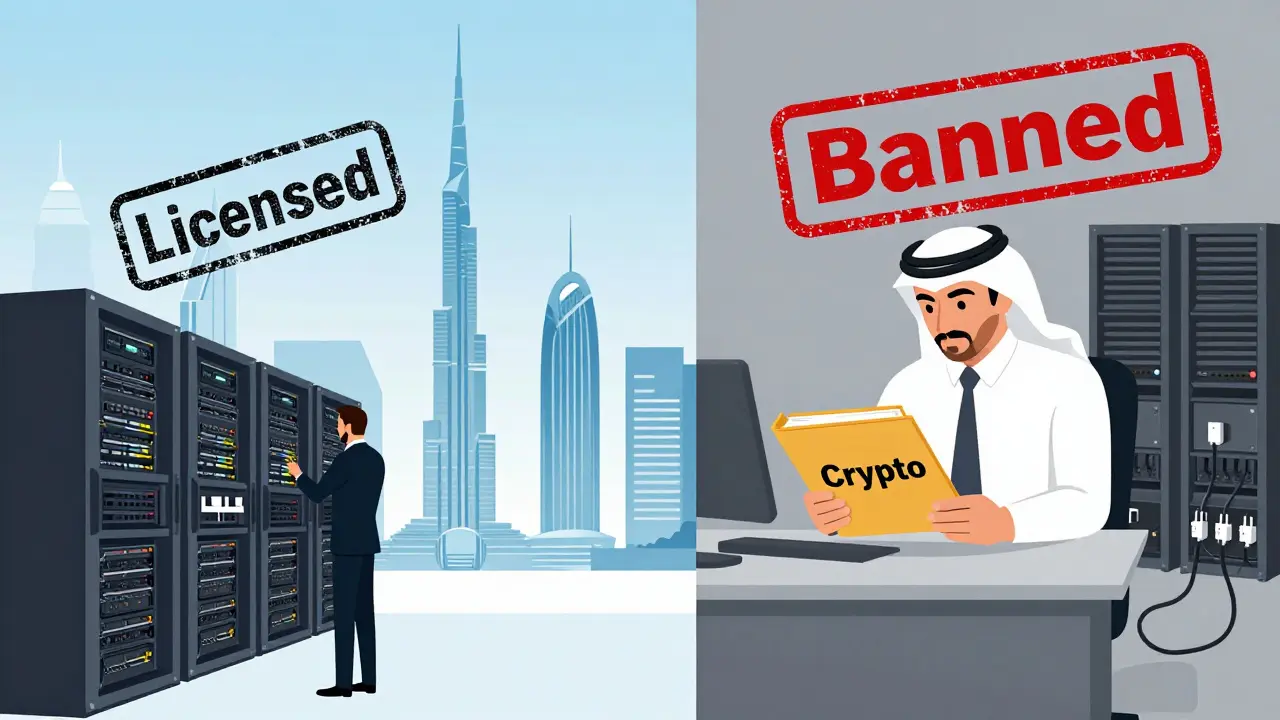
If you are looking for clarity, Qatar offers it-but it is not the clarity you might hope for. Qatar represents the most restrictive end of the spectrum. The Qatar Financial Centre Regulatory Authority (QFCRA) maintains comprehensive bans on cryptocurrency services for all financial institutions.
Here is how the situation evolved:
- 2018: The Central Bank issued initial prohibitions on crypto trading.
- 2020: The QFCRA expanded this to a complete ban on virtual asset services within the Qatar Financial Centre.
- September 2024: A major shift occurred with the introduction of the Digital Asset Regulations 2024.
The 2024 regulations legalized tokenized assets like shares and bonds. However, they explicitly designated cryptocurrencies and stablecoins as 'Excluded Tokens'. This means banks in Qatar are legally barred from touching Bitcoin, Ethereum, USDT, or USDC. The compliance framework for businesses centers on adhering to these prohibitions rather than implementing detailed Anti-Money Laundering (AML) checks for crypto, because the activity itself is banned.
Looking ahead, the Qatar Financial Centre is developing a new digital asset regulatory framework expected to be finalized in Q2 2025. This will cover tokenization and smart contracts, but it is unlikely to open the floodgates for private crypto banking anytime soon. For now, if you bank in Qatar, keep your crypto life completely separate from your banking life.
Kuwait: Aggressive Enforcement
Kuwait aligns closely with Qatar’s conservative stance but adds a layer of aggressive enforcement. The country deliberately excludes itself from crypto markets, maintaining that digital assets are not legal tender.
The most striking example of Kuwait’s commitment to restriction came recently regarding crypto mining. Authorities implemented strict measures against unauthorized mining operations, resulting in a dramatic 55% reduction in local electricity usage associated with crypto mining. This shows that the government is willing to pull the plug-literally-to enforce its bans.
For banking, this translates to zero tolerance. Kuwaiti banks do not engage with crypto entities. There is no sandbox, no pilot program, and no licensed exception. If you try to link a crypto wallet to a Kuwaiti bank account, you risk account closure. The message from regulators is consistent: digital assets are outside the scope of legitimate financial activity.
Bahrain and Oman: The Middle Ground
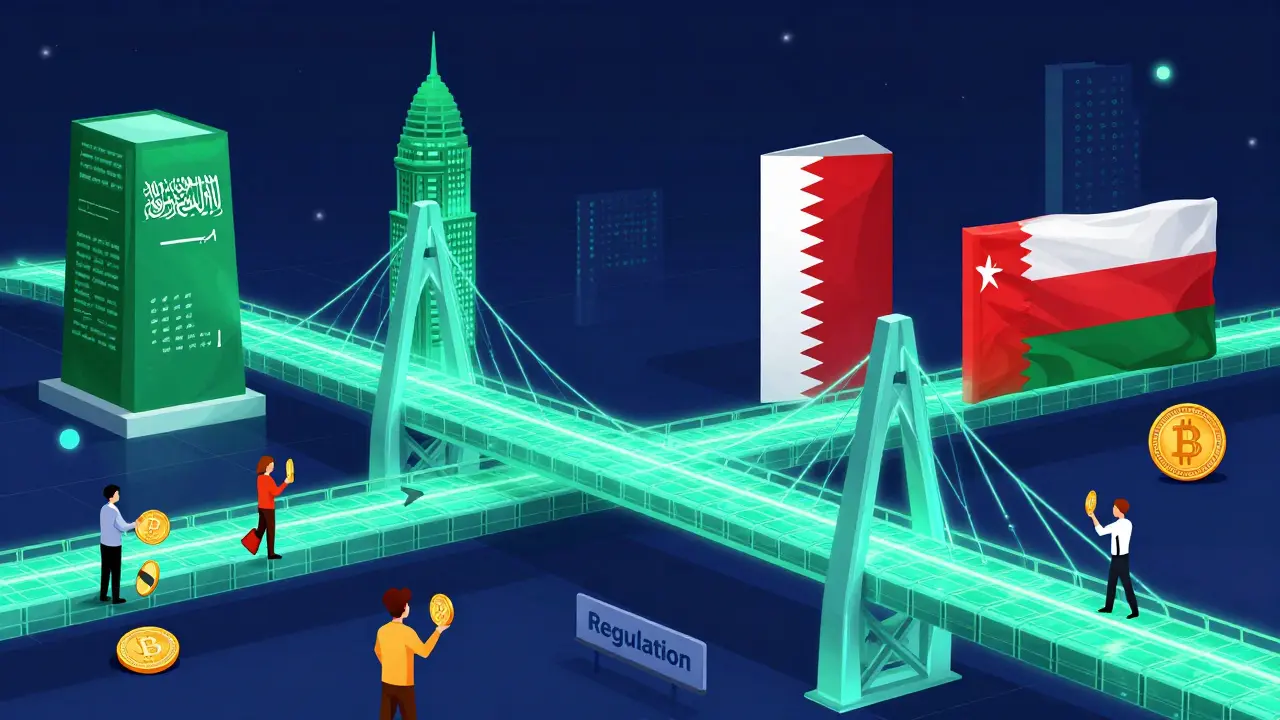
Bahrain and Oman offer slightly more nuance, though neither is fully open.
Bahrain operates under a clear licensing regime through the Central Bank of Bahrain's Crypto-Asset (CRA) module. This determines permitted crypto-asset activities for financial institutions while prohibiting unlicensed operations.
Bahrain has conducted multiple interoperability tests with major global banks like JP Morgan. It also maintains active CBDC piloting programs. This indicates a more permissive approach toward regulated cryptocurrency activities compared to Qatar and Kuwait. If a financial institution in Bahrain gets the right license, it can engage in approved crypto activities. It is a middle ground between prohibition and open access.
Oman follows broader GCC trends. Detailed regulations are still emerging, but Oman participates in regional CBDC pilot programs. The expectation is that Oman will align with structured frameworks that restrict unauthorized banking activities while permitting licensed operations. It is too early to call Oman a crypto haven, but it is watching Bahrain and the UAE closely.
| Country | Banking Status | Key Regulator | Notable Policy |
|---|---|---|---|
| Saudi Arabia | Restricted | SAMA | No direct crypto transactions; active in mBridge CBDC |
| UAE | Licensed Only | Central Bank of UAE / VARA | Only approved tokens allowed; strict licensing for VASPs |
| Qatar | Banned | QFCRA | Cryptos are 'Excluded Tokens'; total ban on services |
| Kuwait | Banned | Central Bank of Kuwait | Aggressive enforcement; mining crackdowns |
| Bahrain | Regulated | Central Bank of Bahrain | CRA module allows licensed activities |
| Oman | Emerging | Central Bank of Oman | Aligning with regional CBDC pilots |
The Role of CBDCs: Why Governments Still Love Blockchain
It seems contradictory that countries ban private crypto but invest millions in blockchain. The answer lies in Central Bank Digital Currencies (CBDCs).
Initiatives like mBridge represent wholesale CBDC development designed for financial institutions to facilitate domestic settlements and cross-border transactions. The UAE, Bahrain, Oman, and Saudi Arabia all maintain active CBDC pilot programs. Their focus is on regional interoperability and real-use scenarios.
These initiatives prove that banking restrictions target private cryptocurrencies, not blockchain technology itself. CBDCs are seen as strategic assets for financial sovereignty. They allow governments to reduce dependency on the US dollar and enhance cross-border payment efficiency without giving up control to decentralized networks. For the average user, this means the infrastructure for digital money is being built, but it will be issued and controlled by the state, not mined by individuals.
Practical Implications for Investors and Businesses
So, what should you do if you live in or do business in the Middle East? The market implications of these banking bans create significant barriers to mainstream adoption. They force cryptocurrency users to operate outside traditional banking systems, limiting liquidity and institutional participation.
Here are three practical takeaways:
- Keep Channels Separate: Do not mix your crypto proceeds with your primary salary account in Qatar or Kuwait. Use dedicated e-wallets or non-bank payment processors where legally possible.
- Watch for Licensing Changes: In the UAE and Bahrain, the landscape is evolving. If you are a business, consult with local legal experts to ensure your partnership with a VASP is fully licensed. Unlicensed operations carry heavy fines.
- Prepare for Standardization: With Qatar finalizing its framework in 2025 and regional CBDC pilots maturing, expect more coordinated regulations. The current chaos may give way to stricter, unified standards that make cross-border crypto movement even harder for unregistered entities.
The future outlook suggests gradual liberalization of banking restrictions as regulatory frameworks mature. However, this liberalization will likely favor institutional players who can meet rigorous KYC and AML requirements. For the retail investor, the era of easy crypto-to-fiat conversion via local banks in the GCC is likely over for the foreseeable future.
Can I deposit Bitcoin directly into my Saudi bank account?
No. SAMA prohibits banks from engaging in cryptocurrency transactions without specific approval, which is rarely granted to retail customers. Direct deposits from exchanges will likely be rejected or flagged.
Is crypto legal in Qatar?
Owning crypto is not explicitly criminalized for individuals, but providing services or trading through financial institutions is banned. The 2024 Digital Asset Regulations classify cryptocurrencies as 'Excluded Tokens,' meaning banks cannot handle them.
Which GCC country is best for crypto businesses?
The UAE is currently the most favorable due to its structured licensing frameworks in Dubai (VARA) and Abu Dhabi (FSRA). Bahrain also offers a regulated environment through its CRA module, making it a viable alternative for licensed operations.
What is the mBridge project?
mBridge is a multi-country pilot program testing cross-border payments using Central Bank Digital Currencies (CBDCs). Participants include Saudi Arabia, the UAE, China, Thailand, and Hong Kong. It aims to improve payment efficiency and reduce reliance on Western financial systems.
Will crypto banking bans be lifted in the future?
Gradual liberalization is expected as regulatory frameworks mature. However, banks will likely remain restricted to interacting only with licensed entities. Complete openness for retail crypto banking is unlikely in the near term due to financial stability concerns.

Jessie Smith
Look, the whole 'sieve' metaphor is cute, but it misses the existential dread of the situation. You are essentially describing a Kafkaesque nightmare where the walls move while you try to walk through them. It's not just frustration; it's a systemic rejection of individual sovereignty by state actors who are terrified of losing their monopoly on value transfer. The irony is palpable when you consider that these same governments are investing billions in blockchain infrastructure for CBDCs. They want the tech without the freedom. It’s like buying a Ferrari and then welding the doors shut so only the dealer can drive it. :/
Linda Hilliard
Oh, please. This analysis is painfully superficial and lacks any real intellectual rigor.
You fail to acknowledge that the regulatory divergence isn't just about 'control'-it’s about macroeconomic stability in petrodollar-dependent economies. SAMA’s stance isn’t arbitrary; it’s a calculated risk mitigation strategy against capital flight during oil price volatility. To suggest otherwise is to display a profound ignorance of Gulf financial architecture. Furthermore, labeling the UAE as 'crypto-friendly' is a gross oversimplification that ignores the draconian compliance costs imposed on VASPs. If you think VARA licenses are easy to get, you’ve never actually tried to navigate the labyrinthine bureaucracy of Dubai International Financial Centre. Typical Western-centric myopia. ;)
Deep Rahman
I have been thinking deeply about this article and the implications it holds for the future of human exchange and trust in digital mediums, and I find myself reflecting on how our ancestors bartered goods under the open sky without such complex layers of institutional oversight that now seem to stifle the very spirit of innovation that drives progress forward in our modern interconnected world where money has become an abstract concept rather than a tangible asset held in one's hand.
The distinction between owning crypto and banking with it is crucial because it highlights the tension between personal liberty and collective security which is a theme that runs through all of history from ancient empires to modern nation states trying to balance the scales of justice and economic growth while preventing the erosion of their own power bases through technological disruption.
Tawny Holmes
SAMA bans retail. Qatar bans everything. Kuwait shuts down mining rigs. Simple.
Drew M
This is absolutely fascinating! 🤩 The way Saudi Arabia is playing the long game with mBridge while keeping retail users locked out is pure chess master energy. ♟️ It’s like they’re building a private club where only the elite institutions can play, and the rest of us are just spectators watching from the stands. 😂 But seriously, the part about Kuwait cutting electricity to mining farms? That is some next-level authoritarian efficiency right there. 🔌💀 Love the breakdown though, really helps clarify why moving funds feels like navigating a minefield. 💣✨
Kristine Lawson
One must observe, however, that the characterization of Qatar’s regulatory environment as merely 'restrictive' fails to capture the nuance of the 2024 Digital Asset Regulations. While cryptocurrencies are indeed classified as 'Excluded Tokens,' the legalization of tokenized assets represents a significant, albeit limited, pivot toward digital integration. It is not a binary choice between total prohibition and unrestricted access; rather, it is a carefully calibrated spectrum of permissible activities. To dismiss this as a 'hard line ban' without acknowledging the specific exceptions for tokenized securities is intellectually lazy and misleading. One should read the primary sources before making sweeping generalizations. ;)
Ella Collinson
The fundamental issue here is the misalignment between decentralized protocols and centralized fiat rails. Banks are legacy systems operating on TCP/IP networks that were never designed for cryptographic verification. When SAMA or QFCRA imposes these bans, they are effectively creating a firewall between the permissionless layer (Layer 1) and the permissioned layer (traditional banking). This creates liquidity fragmentation and increases transaction costs for cross-border settlements. The solution isn't liberalization; it's interoperability via atomic swaps or wrapped assets that bridge the trust gap without exposing banks to direct counterparty risk from volatile altcoins. Until we see widespread adoption of stablecoin-backed bank accounts, this friction will persist.
Eric Braddock
Don't fall for the mBridge propaganda. This is clearly a setup for global surveillance capitalism disguised as 'efficiency.' The Chinese involvement is the smoking gun. They aren't interested in 'cross-border payments'; they're interested in bypassing SWIFT to sanction-proof their own economy while simultaneously tracking every satoshi you move. The 'CBDC' is just a programmable leash. Once your money is digital and controlled by the state, they can turn off your spending ability at the flip of a switch. This isn't regulation; it's pre-crime financial control. Wake up, sheeple. The 'patchwork quilt' is actually a net being woven around your neck. 🕸️👁️
Josephine Finlayson
I appreciate the detailed overview! It is quite helpful to understand the different approaches each country takes. Bahrain seems like a reasonable middle ground for those who need some level of regulatory clarity without the total restrictions seen elsewhere. It is good to see that Oman is also paying attention and likely to follow suit. We should all remain patient and hopeful that these frameworks will continue to evolve in a way that supports both security and innovation. Thank you for sharing this information! :)
Tuan Nguyen
The author’s attempt to simplify the GCC regulatory landscape into digestible bullet points is quaint, but ultimately reductive. The reality is far more toxic for anyone attempting to operate within these jurisdictions. The 'sandbox' programs mentioned are merely testing grounds for compliance algorithms that will eventually be deployed to flag and freeze accounts with terrifying precision. There is no 'middle ground' in Bahrain; there is only a slower path to the same destination: total financial transparency and state oversight. Stop pretending these regimes are 'cautious.' They are predatory. They are waiting for you to slip up. And they will.
Ray Arney
Yeah, I've heard similar stories from friends doing business in Dubai. The licensing process is intense, but if you have the budget for legal counsel, it's doable. Seems like the best bet for most people is to just keep things separate like the article suggests. Not ideal, but better than getting your account frozen.
Andrew Schneider
Wait, wait, wait! 🛑 You’re saying Kuwait literally cut the power to mining farms?! That is absolute madness! 😱 Like, imagine showing up to your office and the lights are out because the government decided your computer was too hot. 🔥🚫 It’s like they’re living in a black-and-white movie where technology is the villain. Meanwhile, the UAE is out here handing out licenses like candy (well, almost). The contrast is wild. 🎢 I feel like I’m reading two different sci-fi novels depending on which border you cross. Is this even the same region?! 🤯💸
Hazel Fruitman
its honestly so unfair how hard they make it for regular ppl to use their own money. i mean sure maybe some bad guys use crypto but most of us just wanna save up or invest without getting flagged by some robot at the bank. its like they dont trust us at all. and the spelling errors in the regulations probably dont help either lol. just let us be free to trade what we want.
Autumn Story
Oh my goodness, this is such a complicated topic!! 😖 I know so many people who are stressed about this stuff. It makes me sad that banks are so rigid. But hey, maybe things will get better soon?? I hope everyone stays safe and doesn't lose their money! Please be careful out there!! ❤️✨
Mark Tuason
It is important to note that the regulatory differences highlight the varying priorities of each central bank. For businesses, consulting local legal experts is indeed the most prudent course of action. The distinction between licensed and unlicensed activities is critical for compliance. Thank you for providing this comprehensive overview.
Nick G
I believe that understanding the cultural context behind these regulations is essential for anyone looking to engage with the Middle Eastern financial landscape. In many of these societies, trust is built through established institutions rather than decentralized networks, which explains the reluctance to embrace unregulated crypto markets. However, I also see the potential for dialogue and gradual change as younger generations become more digitally native. It is a delicate balance between preserving traditional values and embracing technological innovation, and I hope that we can foster an environment where both can coexist harmoniously without compromising financial stability or individual rights.
Nick Wengel
Good summary. The table at the end is useful. I live near Dubai and can confirm the VARA process is strict but clear. Just follow the rules.
Alicia Hull
Can someone explain why SAMA is so hesitant? Is it purely about money laundering, or is there a deeper political reason? I want to understand the root cause better. Please elaborate on the 'capital flight' concern. How significant is it really?
Winston Lacewing
THIS IS A DISASTER FOR FREEDOM!!! 😡🔥 How dare these governments restrict our financial choices?! It’s like they think they own our souls! My heart is breaking for everyone trying to send money home and getting blocked. It’s morally bankrupt! We need to rise up and demand change! Don’t let them silence you! 📢✊💔 #CryptoFreedom #JusticeNow
Melissa Beckwith
I have spent considerable time analyzing the implications of the mBridge project, and it becomes evident that the primary beneficiaries are not the retail investors but rather the institutional players who can navigate the complex web of regulatory requirements and technical integrations required to participate in such high-level pilot programs. The average user is left behind, forced to rely on informal channels or offshore exchanges that carry their own set of risks including lack of recourse in case of fraud or insolvency. This creates a two-tiered financial system where the wealthy and well-connected have access to efficient, low-cost cross-border payment solutions while the rest of the population struggles with high fees and delays. It is a stark reminder of how technology can exacerbate existing inequalities if not implemented with a focus on inclusivity and accessibility for all members of society regardless of their socioeconomic status.