Imagine sending money to a friend or paying for an online service and suddenly facing a prison sentence. In Nepal, this isn't a hypothetical nightmare-it is the reality for anyone engaging with cryptocurrency is a decentralized digital asset that operates outside traditional banking systems. The country enforces one of the strictest bans in Asia, where large transactions can lead to mandatory three-year imprisonment. If you are considering moving funds across borders using Bitcoin or other tokens while connected to Nepali infrastructure, you need to understand exactly where the legal line is drawn.
The Legal Trigger: NPR 10 Million Threshold
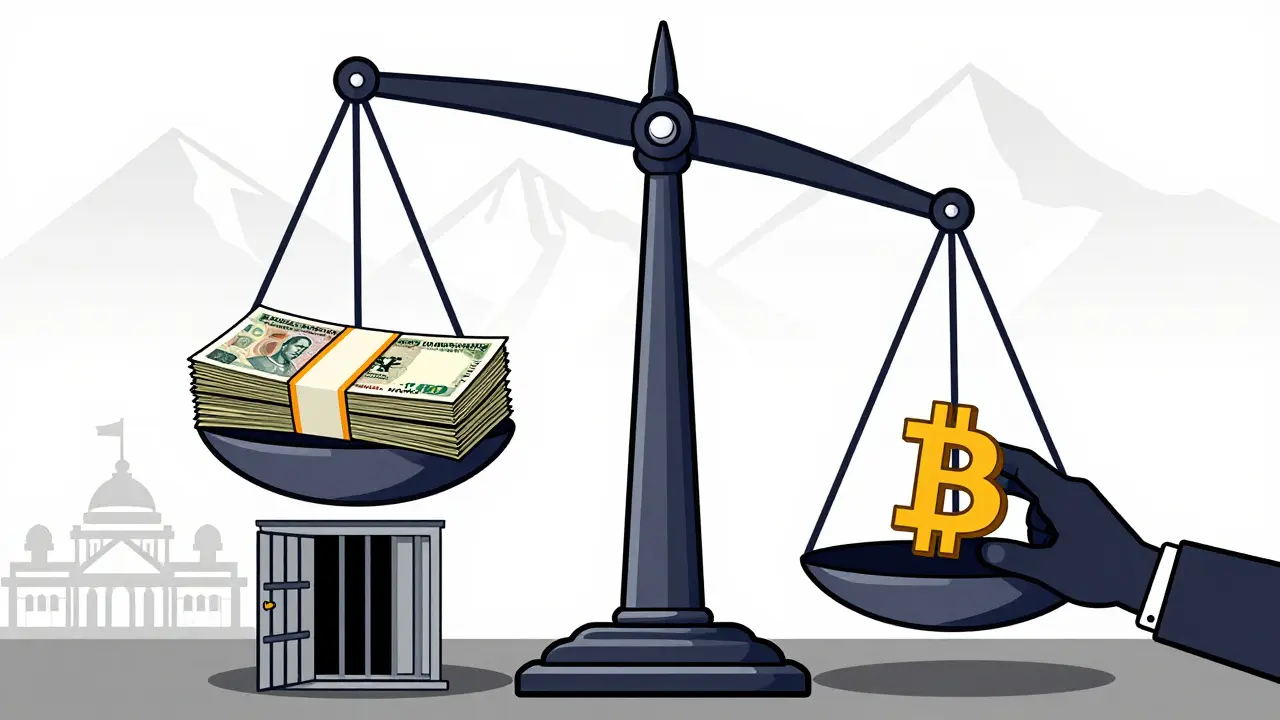
The core of Nepal's enforcement strategy revolves around a specific financial threshold. Under Section 12 of the Foreign Exchange (Regulation) Act, 1962 is the primary legislation governing foreign currency transactions in Nepal., any unauthorized transaction involving ten million Nepalese Rupees (approximately $74,000 USD as of late 2023) triggers severe penalties. This is not a suggestion; it is a mandate for imprisonment lasting up to three years. Additionally, offenders face fines ranging from the amount involved to three times that value, along with the forfeiture of all related assets.
You might think staying below this limit keeps you safe. Unfortunately, the law is applied aggressively. While the three-year jail term specifically targets the 10 million NPR mark, smaller transactions are prosecuted under different statutes. For instance, the Electronic Transaction Act (ETA), 2006 is Nepal's framework for regulating digital signatures and electronic records. allows authorities to charge individuals with cybercrimes for unauthorized digital payments, carrying penalties of up to three years in prison and fines up to NPR 100,000. Even if your transaction is only worth $5,000, you can still face significant legal trouble, including pretrial detention.
Why Is Nepal So Strict?
To understand why the government takes such a hardline stance, you have to look at the economic concerns raised by the Nepal Rastra Bank (NRB) is the central bank of Nepal responsible for monetary policy and financial stability.. The NRB issued its first public notice banning crypto activities on May 24, 2017, citing risks of money laundering and financial instability. They reinforced this directive in January 2018, arguing that cryptocurrencies threaten the national economy by facilitating capital flight.
In 2021 alone, the NRB claimed that cryptocurrency usage led to NPR 2.8 billion ($20.8 million) in unauthorized forex outflows. With remittances making up roughly 23% of Nepal's GDP, the government views any unregulated channel for moving money as a direct threat to national security. Governor Maha Prasad Adhikari has defended the harsh penalties, pointing to 1,247 reported fraud cases totaling NPR 4.3 billion in 2022. From their perspective, the three-year imprisonment clause acts as a necessary deterrent against systemic risk.
How Enforcement Works in Practice
If you are caught, the process moves quickly. The Central Investigation Bureau (CIB) is a specialized police unit in Nepal handling complex crimes including cybercrime. leads most major investigations. Their standard procedure involves immediate forensic seizure of your devices. Police routinely confiscate mobile phones, laptops, and hard drives during raids. They use tools like Cellebrite UFED to extract wallet credentials and blockchain data.
Once seized, your case enters a phased judicial process:
- Immediate Detention: You are presented before a court within 24 hours per Article 89 of the Constitution.
- Investigative Custody: Police can hold you for up to 25 days, or 90 days if money laundering is suspected, while they analyze your blockchain history.
- Charge Sheet Filing: Government attorneys must file charges within 90 days, though delays are common due to the complexity of digital forensics.
A major issue defendants face is how 'transaction value' is calculated. In the 2022 Kalopul case, prosecutors used the Bitcoin price at the time of seizure rather than when the transaction occurred. This volatility can work against you, potentially pushing a transaction above or below the critical 10 million NPR threshold depending on market swings at the moment of arrest.
| Legal Framework | Trigger Condition | Imprisonment Term | Financial Penalty |
|---|---|---|---|
| Foreign Exchange Act, 1962 (Sec 12) | Transaction ≥ NPR 10 Million | Up to 3 Years | 1x to 3x transaction amount + Asset Forfeiture |
| Electronic Transaction Act, 2006 (Sec 86) | Unauthorized Digital Transaction | Up to 3 Years | Up to NPR 100,000 |
| National Penal Code, 2017 (Sec 125) | Crypto-Related Gambling | 3 to 12 Months | Up to NPR 50,000 |
Real-World Consequences: Case Studies
Theoretical laws become terrifying when applied to real people. Consider the case of 'CryptoLoverNP,' who shared his experience on the Nepal Blockchain Forum in early 2023. He was arrested in January 2022 for a $5,000 transaction-well below the 10 million NPR threshold. However, police seized his laptop containing 2.3 BTC (worth $78,000 at the time) and charged him under the Electronic Transaction Act. He spent 18 months in pretrial detention before the case resolved.
Another example involves a father from Kathmandu, whose story circulated on Reddit in March 2023. He received a crypto remittance worth 5.2 million NPR ($38,500). Despite being under the statutory limit for the three-year sentence, the judge cited 'aggravating circumstances' and handed down a two-year prison term. These cases highlight a critical weakness in the system: inconsistent application of the law. One lawyer might argue for leniency based on the amount, while another judge may prioritize the act of holding crypto itself.
Data from Lawbhandari’s 2023 study shows that 83% of prosecuted cases involved full wallet confiscation, regardless of whether the transaction size justified such extreme measures. Furthermore, 63% of cases in 2022 faced overlapping charges under both the NRB Act and the Foreign Exchange Act, creating a 'legal schizophrenia' that leaves defendants confused and vulnerable.

Regional Context: How Nepal Compares
If you travel to neighboring countries, the landscape changes dramatically. India, for instance, implemented a 30% tax on crypto gains in 2022 but explicitly permits trading. China banned mining and transactions but does not criminalize individual holdings. Thailand and Singapore have established robust regulatory frameworks allowing licensed exchanges to operate legally.
Nepal stands apart as one of only 12 countries globally-including Egypt, Iraq, and Qatar-that imposes criminal penalties for cryptocurrency transactions. Its 10 million NPR threshold is actually lower than Bangladesh’s 50 million BDT limit, making Nepal uniquely aggressive in its pursuit of crypto users. This isolation creates a black market where ordinary citizens turn to underground brokers to send remittances, inadvertently exposing themselves to greater risks from scams and unregulated entities.
Future Outlook: Will the Ban Lift?
As of mid-2026, there is no sign of immediate policy reversal. The 2023-24 budget maintained all prohibitions, and the NRB expanded penalties in January 2024 to include 'any technology facilitating crypto transactions.' However, legal challenges are mounting. The Supreme Court is currently reviewing a constitutional challenge (Writ No. 0804/080) arguing that Section 12 violates fundamental rights by imposing criminal penalties for civil economic activities. A ruling is expected soon, which could set a precedent for future prosecutions.
Meanwhile, judges are beginning to apply 'proportionality principles' from the National Human Rights Commission, occasionally reducing sentences for sub-threshold transactions. Industry analysts predict Nepal may eventually follow India’s taxation model by 2025-2026, but until then, the three-year imprisonment threat remains very real. The International Monetary Fund has criticized the policy as 'economically counterproductive,' suggesting that global pressure may eventually force a rethink. Until that happens, however, the risk stays high.
Is it illegal to simply hold cryptocurrency in Nepal?
Yes. While the specific three-year imprisonment clause targets transactions over NPR 10 million, the Nepal Rastra Bank prohibits all cryptocurrency activities, including holding, trading, and mining. Authorities can prosecute holders under the Electronic Transaction Act or Foreign Exchange Act, leading to fines and potential jail time even without a large transaction occurring.
What happens if I receive a small crypto remittance?
Receiving small remittances is risky. Although amounts below NPR 10 million do not trigger the mandatory three-year sentence under the Foreign Exchange Act, they can still be prosecuted under the Electronic Transaction Act. Cases show that individuals receiving sums as low as $5,000 have faced arrest, device seizure, and pretrial detention lasting up to 18 months.
Can I use a VPN to trade crypto safely in Nepal?
No. Using a VPN does not protect you from prosecution. The Central Investigation Bureau uses advanced forensic tools to trace blockchain transactions back to individuals. If your IP address, bank account, or identity is linked to a crypto transaction, you can be charged regardless of whether you used anonymization software. Additionally, bypassing state controls can add further legal complications.
Are there any exceptions for businesses or IT companies?
There are no official exceptions. The Nepal Rastra Bank has directed all financial institutions to prohibit crypto services. While some IT employees use crypto for international payments informally, enterprise adoption is nonexistent and highly illegal. Any business facilitating crypto transactions faces severe penalties, including license revocation and imprisonment for executives.
When will the Supreme Court rule on the constitutionality of the ban?
The Supreme Court is reviewing Writ No. 0804/080, which challenges the legality of criminalizing crypto transactions. As of mid-2026, a final ruling is anticipated in the near future. This decision could significantly impact how lower courts interpret the severity of punishments, potentially introducing more proportionality in sentencing for minor offenses.
Write a comment