When Venezuela launched the Petro in 2018, it wasn’t just trying to create a new cryptocurrency. It was trying to survive. The country was in freefall-hyperinflation had wiped out the value of the bolívar, foreign debt was ballooning, and U.S. sanctions had cut off access to global banking. The Petro was presented as a lifeline: a state-backed digital currency tied to oil, gold, and diamonds, meant to bypass sanctions, attract foreign investment, and stabilize the economy. But five years later, the reality is very different.
How the Petro Was Supposed to Work
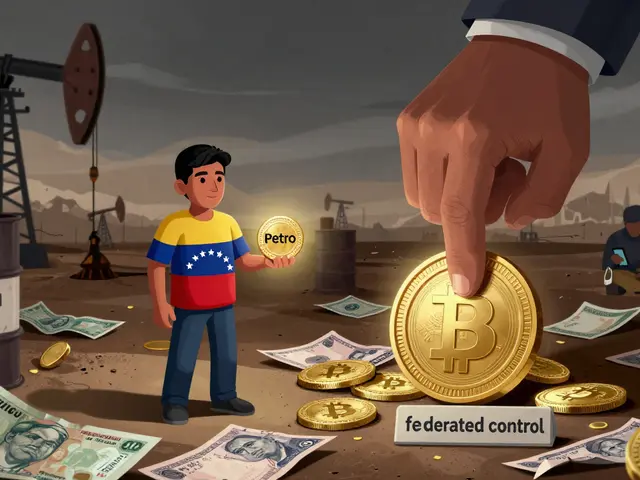
The Venezuelan government claimed the Petro was backed by $6 billion worth of natural resources. With 100 million tokens issued, each Petro was theoretically worth $60, tied to the price of a barrel of oil. The idea was simple: use the country’s vast oil reserves as collateral to create a digital asset that could be traded internationally, used to pay for imports, and accepted by foreign investors. President Nicolás Maduro announced it would be used for everything from buying gasoline to paying taxes. To make it happen, the government created a new regulatory body: the Superintendence of Crypto Assets and Related Activities (SUPCACVEN). This agency controlled everything-issuing tokens, approving mining operations, and managing exchanges. Unlike Bitcoin or Ethereum, the Petro didn’t run on a public, open blockchain. It used a federated system, meaning only government-approved nodes could validate transactions. That gave the state total control, but it also killed the one thing most people value about crypto: decentralization.The Petro Zones: Promised Hubs, Limited Results
In 2018, Venezuela set up four special economic zones-Margarita Island, Los Roques, Paraguaná, and the border area near Colombia-to encourage crypto mining and Petro usage. These zones offered big incentives: no import taxes on mining rigs, free electricity, and tax breaks on air conditioning and software. The goal? Turn these areas into crypto hubs where businesses could operate using Petros without fear of sanctions. But the results were underwhelming. Mining equipment did arrive, but reports of actual mining activity are scarce. There’s no public data showing how many rigs are running, how much electricity they’re using, or how many Petros are being mined. Local businesses didn’t rush to adopt the currency. Instead, people kept using cash, barter, or Bitcoin. The zones became more like showpieces than economic engines.Forced Adoption, Not Real Trust
By January 2020, the government made Petro payments mandatory for certain services: buying airplane fuel, renewing passports, and paying for official documents. This wasn’t choice-it was coercion. People had no option but to get Petros if they wanted to travel or access basic government services. But forcing people to use something doesn’t make them trust it. Venezuelans quickly learned that the Petro had no real value outside government circles. While the state claimed it was worth $60, no major exchange listed it. No international business accepted it. No bank processed it. Even the government’s own advisory group, VIBE, admitted the token was overvalued. Leaked documents showed they planned to sell $2.3 billion in Petros at discounts of up to 60%-meaning they knew the market would never pay the official price.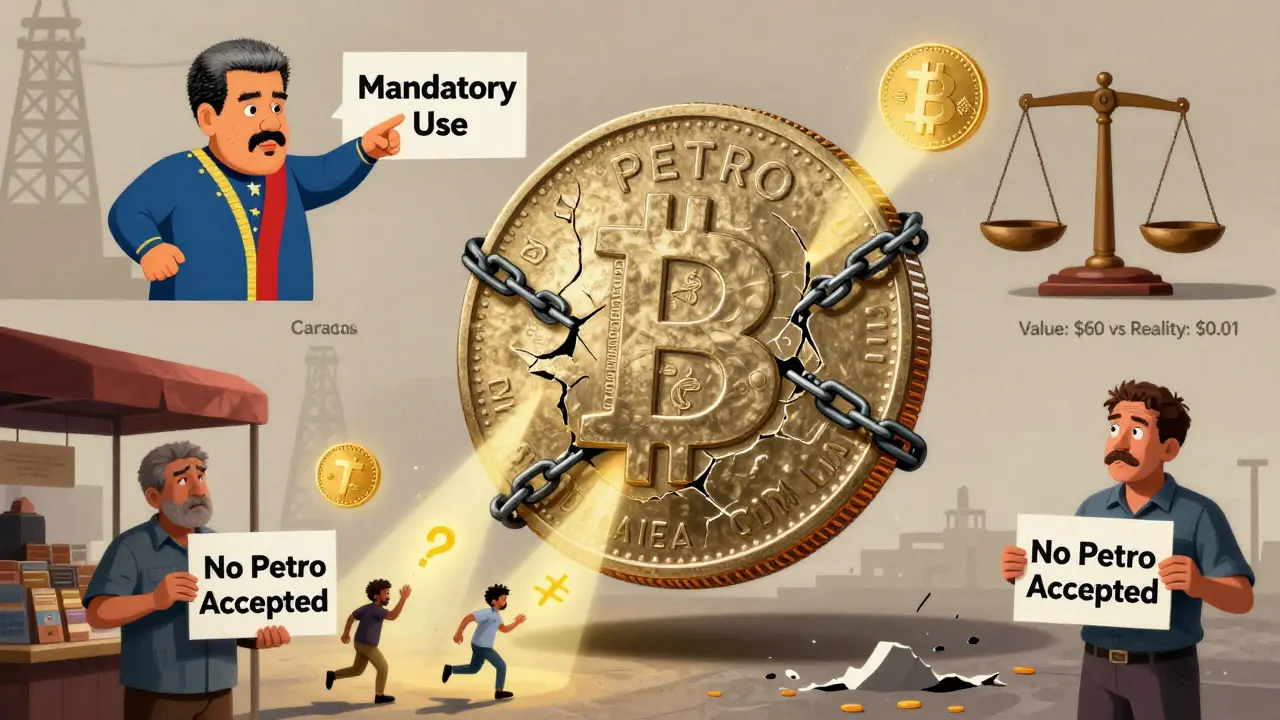
International Sanctions Crushed the Petro’s Potential
The U.S. didn’t wait for the Petro to fail on its own. In March 2018, just weeks after its launch, the Treasury Department declared the Petro an illegal financial instrument. Sanctions targeted anyone who traded, mined, or promoted it. By 2020, U.S. lawmakers introduced S.37, a bill aimed at permanently blocking any Venezuelan crypto activity. Banks, payment processors, and exchanges worldwide got the message: avoid the Petro at all costs. That meant no access to USD, no liquidity, no way to convert Petros into real money. Even if someone wanted to use it, they couldn’t. The Petro was trapped in a digital prison, isolated from the global financial system it was meant to break into.Why Venezuelans Avoided the Petro
While the government pushed the Petro, ordinary Venezuelans turned to Bitcoin, USDT (Tether), and other stablecoins. Why? Because those currencies actually worked. Bitcoin could be sent across borders without permission. USDT held its value near $1, even as the bolívar lost 99% of its value since 2017. People could buy food, medicine, and internet access with them. They could cash out through peer-to-peer apps like Paxful or LocalBitcoins. The Petro offered none of that. It couldn’t be traded on major platforms. It couldn’t be sent to a friend in Colombia. It couldn’t be used to pay for Amazon or Netflix. And because it was tied to the government’s credibility-which was already shattered-it had no trust factor. People didn’t fear inflation anymore. They feared the state.
The Legal Mess: Is the Petro Even Legal?
Even inside Venezuela, the Petro’s status is unclear. The National Assembly, controlled by the opposition, declared it illegal in March 2018. That means there are two competing legal systems: one where the government says the Petro is valid, and another where the opposition says it’s a fraudulent debt scheme. No court has ever ruled on it. No constitutional body has settled it. This legal gray zone makes it impossible for businesses to rely on the Petro. Why sign a contract in Petros if a judge might say it’s invalid? Why accept it as payment if your bank might freeze your account? The uncertainty killed any chance of organic adoption.Current Status: A Tool for Control, Not Commerce
As of 2026, the Petro still exists-but only as a government instrument. It’s used for internal accounting, paying some state employees, and fulfilling mandatory transactions. It’s not used for grocery shopping, rent, or small business sales. The four Petro Zones still exist, but mining activity is minimal. The Treasury of Cryptoassets still holds the tokens, but there’s no public audit of its holdings. The government still talks about the Petro as a symbol of sovereignty. But in practice, it’s a relic of a failed economic strategy. It never became money. It never became a store of value. It became a political tool-a way for the state to claim it was doing something, even if it wasn’t working.What Happens Next?
The future of the Petro depends on two things: Venezuela’s economy and U.S. sanctions. If the country ever stabilizes, rebuilds its oil industry, and regains access to global finance, the Petro might fade into obscurity. If sanctions stay, and the economy keeps collapsing, the government might try to force more usage-perhaps tying it to pensions, salaries, or even public housing. But without real value, open markets, or public trust, the Petro won’t become money. It will remain a digital ghost-visible on paper, invisible in practice.Is the Petro cryptocurrency still active in Venezuela?
Yes, but only in limited, government-controlled ways. It’s used for mandatory payments like fuel and official documents, and some state employees receive part of their salary in Petros. However, it’s not used in daily commerce. Most Venezuelans rely on Bitcoin, stablecoins, or cash instead.
Can you buy or trade Petro on major exchanges like Binance or Coinbase?
No. The Petro is not listed on any major international exchange. It was never designed to be traded openly. The government controls all transactions through its own platform, and international sanctions prevent exchanges from supporting it. Any site claiming to trade Petros is likely a scam.
Why did Venezuela create the Petro instead of just using Bitcoin?
Venezuela wanted control. Bitcoin is decentralized-no government can freeze it or track every transaction. The Petro, however, runs on a government-controlled blockchain. The state can monitor every transfer, freeze wallets, and dictate who can use it. It was never meant to empower citizens-it was meant to bypass sanctions while keeping power.
Are the Petro Zones actually mining cryptocurrency?
Possibly, but there’s no public evidence. The zones were created with tax breaks to attract miners, but independent reports show little to no mining activity. Electricity usage, equipment imports, and mining output are not disclosed. Most experts believe the zones serve more as propaganda than real economic projects.
Is the Petro backed by oil like the government claims?
Not in any verifiable way. While the government says each Petro is backed by a barrel of oil, there’s no audit, no reserve ledger, and no way to redeem a Petro for oil. Independent analysts and leaked documents suggest the backing is fictional. Even Venezuela’s own advisors admitted the token was overvalued and needed massive discounts to sell.
What’s the current value of one Petro?
There is no official market value. The government still lists it at $60, but no one trades it at that price. Some black-market platforms claim to exchange Petros for bolívares at rates as low as $0.01 to $0.10 per token-far below the cost of mining or even printing a physical bill. The value is purely theoretical.
Can foreigners invest in the Petro?
Technically yes, but practically no. U.S. and EU sanctions make it illegal for foreign individuals and companies to engage with the Petro. Any attempt to buy, trade, or hold it risks fines or asset freezes. Even banks that process payments for Venezuela avoid anything linked to the Petro.
Is the Petro considered legal tender in Venezuela?
The government says yes, but the opposition says no. There’s no court ruling to settle the conflict. While the state forces its use for certain services, private businesses and individuals are under no legal obligation to accept it. In practice, it’s not legal tender-it’s a state mandate with no real legal foundation.
Dave Lite
The Petro was always a political stunt dressed up as tech innovation. Government-controlled blockchain? That’s not crypto, that’s a spreadsheet with a fancy name. Real decentralization means no one can freeze your wallet - not even your own president. The fact that they needed sanctions to kill it tells you everything you need to know.
Staci Armezzani
It’s heartbreaking how people in Venezuela just wanted a way out - and the state gave them a digital prison instead. Bitcoin and USDT gave them freedom. The Petro gave them paperwork. The real tragedy isn’t the failed currency - it’s that the people who needed it most were never the ones who got to choose.
Tracey Grammer-Porter
Anyone else notice how the Petro Zones were basically just tax havens with extra steps? No one’s publishing mining stats because there’s nothing to publish. I’ve seen this script before - big announcement, shiny brochures, then silence. It’s the same pattern every time a government tries to ‘disrupt’ tech without understanding it. 🤷♀️
sathish kumar
It is imperative to note that the Petro initiative, despite its ostensible technological veneer, fundamentally contravenes the foundational tenets of cryptocurrency as a decentralized, trustless, and permissionless medium of exchange. The imposition of state control over transaction validation negates its very essence, rendering it an instrument of fiscal authoritarianism rather than financial innovation.
jim carry
THEY KNEW. THEY KNEW FROM DAY ONE. The $60 price tag? A LIE. The oil backing? A FAKE. The whole thing was a money laundering front disguised as a cryptocurrency. And now they’re still dragging it around like a dead pet on a leash. This isn’t economics - it’s performance art for a dying regime. 😭
Don Grissett
lol at people still talking about the petro like it’s real. it’s like saying your kid’s lemonade stand is a multinational corporation. the only thing it’s good for is paying for your passport so you can get out of the country. also, who names a currency after a dude? petro? come on.
Katrina Recto
Forced adoption doesn’t create value. It creates resentment. And resentment doesn’t build economies - it builds escape routes. The Petro didn’t fail because of sanctions. It failed because Venezuelans are smarter than their government thinks they are.
Veronica Mead
It is deeply regrettable that a sovereign state would attempt to circumvent international financial norms through the creation of a non-transparent, non-auditable digital instrument. Such actions not only undermine global economic order but also exploit the desperation of its own citizens. This is not innovation - it is institutionalized fraud.
Mollie Williams
There’s something poetic about it, isn’t there? A currency meant to be a lifeline turned into a ghost - visible only in spreadsheets, invisible in markets. It’s like the government built a monument to itself and then forgot to put a door in it. People don’t need a new money - they need a new future. The Petro was never meant to carry them there. It was meant to make them forget they were drowning.
Allen Dometita
Bro. Bitcoin lets you buy coffee in Caracas. Petro? You gotta wait 3 weeks for a government portal to process your ‘payment’ while your milk goes bad. 😴 The only thing mining in those zones is frustration. And the only thing being mined is lies. 🚀
Sherry Giles
Let’s be real - the Petro was never about oil. It was about control. The U.S. didn’t ban it because it was bad - they banned it because it was a threat. This whole thing was a covert power play. The government didn’t want to bypass sanctions - they wanted to weaponize them. And now they’re using it to track every citizen’s spending. You think this is crypto? Nah. This is surveillance with a blockchain logo.
Andy Schichter
So the government built a currency that can’t be traded, can’t be mined, can’t be used, and can’t be trusted… and called it a ‘lifeline.’ Brilliant. I’m sure the next phase is a Petro-based dating app. Swipe right to pay your taxes. 💔
Caitlin Colwell
I just feel bad for the people who had to use it. Not because it’s techy or political - but because they were just trying to survive. That’s the real story here.
Denise Paiva
Actually the Petro was a masterstroke. Everyone else was stuck with bolívars and black markets. At least the government gave people something to use - even if it was useless. The real failure is the West for not letting Venezuela innovate. Sanctions are the real villain here. The Petro was a bold experiment in sovereignty. You just don’t like that it wasn’t your idea.
Charlotte Parker
Oh look, another ‘revolutionary’ crypto that’s just a state-run Ponzi with extra steps. The Petro isn’t a currency - it’s a psychological weapon. Make people dependent on something worthless so they stop asking why everything else is broken. Classic authoritarian playbook. 🙄
Calen Adams
Let’s not forget the real win here: the Petro forced the global crypto community to pay attention to Venezuela. Without it, no one would’ve cared about the black-market Bitcoin networks, the peer-to-peer trading, the underground fintech. The Petro was a disaster - but it lit a fire under people to build real alternatives. Sometimes you need a bad idea to spark the good ones. 🚨