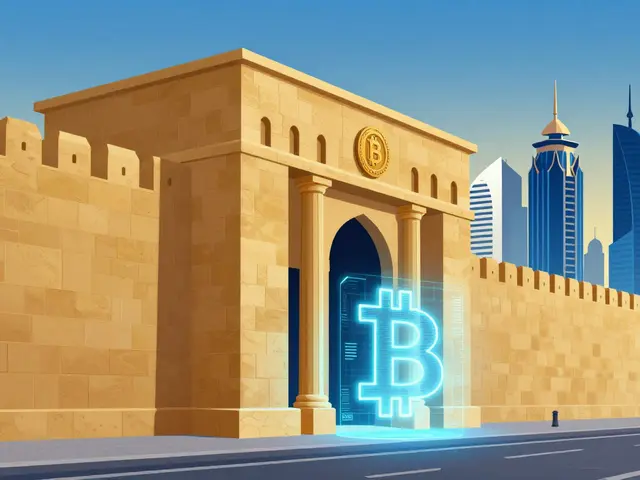
Imagine running a modern investment firm in the heart of the Middle East, only to find that the most talked-about asset class of the decade is strictly off-limits. In Qatar, this isn't a hypothetical-it's the law. While neighbors like the UAE have rolled out the red carpet for blockchain startups, Qatar has built a regulatory wall around its financial sector. If you're a financial professional or an investor looking at the Gulf region, understanding the Qatar cryptocurrency ban is critical because the rules here are fundamentally different from almost anywhere else in the global financial hub.
The Hard Line: What is Actually Banned?
Qatar doesn't just discourage crypto; it prohibits it at the institutional level. This isn't a vague suggestion but a series of strict mandates. Back in February 2018, the Qatar Central Bank (QCB) issued Circular No. (6), which essentially told every bank and financial institution in the country: do not touch Bitcoin. No facilitating transactions, no offering crypto-related services, nothing.
The hammer came down further on December 26, 2019, when the Qatar Financial Centre Regulatory Authority (QFCRA) issued a stern alert. They defined virtual assets as digital substitutes for currency used for trading, transfers, or payments. To be clear, they explicitly excluded traditional fiat currencies from this, meaning they weren't banning money-just the digital versions of it that they don't control. For a bank, this means you can't exchange crypto for cash, you can't hold it for a client, and you can't help someone issue a new token if it acts like a currency.
A Tale of Two Digital Assets: Crypto vs. Tokenization
Here is where it gets interesting. Qatar isn't anti-technology; they are anti-volatility and anti-decentralization. On September 1, 2024, the government introduced the QFC Digital Assets Regulations. This created a weird but specific split in the market. On one side, you have "Excluded Tokens"-your Bitcoins, Ethereums, and stablecoins-which remain totally banned. On the other side, you have approved tokenized assets.
Basically, Qatar is saying: "We don't want your decentralized coins, but we love the idea of putting a real-world asset on a blockchain." This framework allows for the tokenization of things that actually have value in the physical or legal world, such as:
- Company shares and bonds
- Sukuk (Islamic bonds)
- Physical commodities like gold
- High-end real estate
By focusing on tokenized securities, Qatar is attempting to modernize its financial plumbing without letting the "wild west" of cryptocurrency enter its banking system. They've built a system for validation, registration, and custody of these approved tokens to ensure that the institutional side stays safe and regulated.
| Asset Type | Status | Examples | Institutional Access |
|---|---|---|---|
| Virtual Assets / Crypto | Banned (Excluded Tokens) | Bitcoin, Ethereum, USDT | Strictly Prohibited |
| Tokenized Securities | Permitted (Regulated) | Tokenized Bonds, Real Estate | Allowed under QFCRA |
| Fiat Currency | Permitted | Qatari Riyal (QAR) | Standard Banking |
Why the Strictness? The Strategy Behind the Ban
You might wonder why Qatar is taking such a conservative path while the rest of the GCC is experimenting. It comes down to the Qatar National Vision 2030 and the Third Financial Sector Strategic Plan. Qatar's primary goal isn't to be a "crypto hub"; it's to ensure absolute monetary sovereignty and financial stability.
By keeping cryptocurrencies out of the institutional sector, the QCB maintains total control over the money supply and prevents the kind of systemic shocks that can happen when volatile assets are entwined with traditional banking. They view digital assets not as legal tender, but as high-risk instruments that could undermine the stability of the Qatari Riyal. It's a risk-averse approach that favors a "slow and steady" evolution over the "move fast and break things" mentality of Silicon Valley.
Navigating the GCC Divide: Qatar vs. The Neighbors
If you're an international firm operating across the Gulf, you're essentially managing three different regulatory worlds. In the United Arab Emirates (UAE), authorities like the Dubai Financial Services Authority (DFSA) have created comprehensive frameworks that actually encourage crypto trading and custody. Bahrain has followed a similarly progressive path, making it a welcoming spot for virtual asset service providers.
Then you have Saudi Arabia, which is playing a middle game. They aren't as open as Dubai to retail crypto, but they are heavily invested in wholesale CBDC (Central Bank Digital Currency) development for interbank settlements. And then there is Qatar and Kuwait. Kuwait, much like Qatar, has implemented nearly absolute prohibitions on crypto payments and investments. This creates a massive compliance headache for global banks. You can't just have one "GCC Strategy"; you need a "UAE Strategy" and a separate, very restrictive "Qatar/Kuwait Strategy."
The Compliance Reality: Risks and Penalties
For a financial institution in Doha, the cost of a mistake is incredibly high. The QCB and QFCRA don't just send warning letters; they have the power to revoke licenses. Compliance programs must be air-tight. This means that any internal system used by a bank must have hard blocks preventing the facilitation of crypto transactions. If a bank is found to be "nodding and winking" while clients move crypto, they face severe regulatory sanctions.
This has led to a unique operational split. Many international firms maintain a "firewall" in their Qatar offices. While their London or Dubai branches might offer a wide array of digital asset products, the Qatar branch is stripped of all crypto-related functionality to ensure they remain in the good graces of the QFCRA.
What's Next for Qatar's Digital Landscape?
Looking ahead to 2026, don't expect a sudden "U-turn" on Bitcoin. The consensus among industry experts is that the core institutional ban will stay. However, the list of "approved tokens" is likely to grow. As the QFC Digital Assets framework matures, we will probably see more complex financial instruments-like tokenized derivatives or specialized insurance products-entering the market.
The real question is whether the success of crypto hubs in the UAE will eventually force Qatar's hand. If institutional capital continues to migrate toward more permissive jurisdictions, Qatar might be tempted to soften the blow. But for now, the sovereign control of the economy takes precedence over the allure of decentralized finance. If you're operating in Qatar, the rule remains: stay away from currency-substitute tokens and stick to regulated tokenized assets.
Can a private citizen in Qatar still buy Bitcoin?
The institutional ban specifically targets the financial sector. While the regulations focus on prohibiting banks and licensed firms from providing crypto services, the legal status for individuals is more ambiguous. However, because banks cannot facilitate the transactions, it is practically very difficult for residents to move fiat money into crypto exchanges legally.
What exactly are "Excluded Tokens"?
Excluded Tokens are digital assets that serve as substitutes for currency. This includes traditional cryptocurrencies like Bitcoin, stablecoins pegged to the dollar, and any other virtual asset intended for payment or trading that isn't a government-approved tokenized security.
Is tokenizing a building in Qatar legal?
Yes, under the QFC Digital Assets Regulations introduced in late 2024, the tokenization of real estate is one of the specifically allowed activities, provided it follows the validation and registration rules set by the QFCRA.
How does Qatar's approach differ from Saudi Arabia's?
While both are conservative, Saudi Arabia is more focused on the technical implementation of wholesale CBDCs for bank-to-bank settlements. Qatar's approach is more focused on a hard binary split: a total ban on cryptocurrency and a regulated path for tokenized traditional assets.
What are the penalties for financial institutions that violate the ban?
Violations of the QCB and QFCRA mandates can lead to severe regulatory sanctions, including heavy fines and, in the most serious cases, the total revocation of the institution's operating license in Qatar.
Ian Chait
Standard state control tactics right here. They just want the ledger for their own surveillance. Tokenization is just a fancy word for a digital leash so the central bank can track every single cent. Typical globalist move to ban the real peer-to-peer stuff while pushin their own "approved" versions. Wake up people, this is just a preview of the social credit system coming to the west soon as they finish the CBDC infra. Absolutely pathetic how easily the suits fall for this garbage.
Prachi Bhadarge
Oh sure, because nothing says "innovation" like a government deciding which tokens are allowed to exist. Pure genius.
Joshua Salwen
Omg this is literally the most absurd thing I've ever read!! How can anyone think it's a good idae to ban BTC in 2024??? Its like trying to ban the internet in the 90s! The sheer audacity of the QCB is just... wow. I'm actually shaking at how backward this is!! They're gonna wake up one day and realize they missed the rocket ship entirely while they were playing with their "approved" little tokens. Absolutely tragic!
John and Lauren Busch
Sure, totally makes sense to just ban everything you can't control. Real forward-thinking stuff.
Andrew Southgate
It is actually quite a fascinating strategic pivot if you look at it from a macroeconomic perspective, as Qatar is essentially trying to mitigate the systemic volatility that has plagued the retail crypto market over the last decade while still leveraging the efficiency of distributed ledger technology. By creating a clear distinction between currency-substitute tokens and real-world asset tokenization, they are effectively attempting to harvest the benefits of blockchain-like instant settlement and reduced administrative overhead-without exposing their national banking reserves to the whims of a decentralized and often unpredictable market. I think it's a very prudent move for a nation whose economy is so heavily tied to the stability of its sovereign wealth and energy exports, and while it seems restrictive to an outsider, it provides a level of regulatory certainty that institutional investors actually crave when they are moving billions of dollars into new asset classes. If you're looking to build a long-term institutional framework, having a hard line on what is and isn't permitted is often more helpful than a vague "wait and see" approach that leaves firms in a state of perpetual legal limbo.
Adedamola Oyebo
Compliance risks are huge here!! License revocation is a death sentence!!
Sean Mitchell
The sheer irony of calling this a "modern investment" environment while banning the primary tool of modern digital finance is simply breathtaking. It is a masterpiece of contradiction. One can almost admire the commitment to such an archaic regulatory philosophy in an era where the rest of the world is sprinting toward digitalization. Truly, a stunning display of institutional inertia.
Tracy Sperandio
Let's get real-tokenizing real estate and gold is where the actual money is! This is an absolute powerhouse move to streamline the high-end market while cutting out the noise of meme coins. It's a bold, electrifying way to pivot the economy toward tangible value. Whoever says this is "backward" is just not seeing the big picture of luxury asset management! This is how you build a fortress of wealth for the next century!
Evan Iacoboni
The split between "Excluded Tokens" and tokenized securities is way too vague. What happens when a tokenized bond starts trading like a currency? The QFCRA is just setting themselves up for a massive loophole that every hedge fund in the region is going to exploit the second they find a gap in the wording.
Shannon Kelly Smith
Everyone needs to remember that different regions have different risk tolerances! 🚀 It's all about finding the right balance for your specific market. If Qatar feels safer with tokenized assets, we should support that evolution! Let's keep the energy positive and watch how this plays out! 🌟🙌
Saurav Bhattarai
Imagine thinking the UAE's "red carpet" is actually a model for success. How quaint. Qatar's approach is obviously superior because it doesn't allow the economy to be toyed with by teenage speculators in their basements. It's called sophistication-something that seems to be lacking in most of these discussions. Absolute amateurs.
Ankit Sindhu
It's a bit of a steep learning curve for those moving from Dubai to Doha, but it's an important part of the growth process to respect these boundaries. If we can all support the compliance officers who have to manage these firewalls, it'll make the whole transition smoother for everyone involved.
Michelle Stanish
I think it's fine.
Kaitlyn Wu
The institutional risk here is too high to ignore. Firms that try to bypass these rules are not just gambling with their money, they are gambling with their entire legal presence in the country. There is no room for "creative interpretation" when the QCB is involved.
nikki krinkin
It's interesting how the individual side remains a grey area. People will always find a way around these things, even if the banks make it hard.