Imagine handing someone a locked box today, knowing they can’t open it yet. But you also know that in ten years, they’ll have the master key. That is exactly what is happening with Blockchain a decentralized digital ledger technology used for secure transactions and Quantum Computing an emerging field of computing that uses quantum mechanics to process information exponentially faster than classical computers. The race isn't just about speed anymore; it’s about survival. If we don’t act now, every transaction recorded on public ledgers could be exposed once quantum machines become powerful enough.
The "Harvest Now, Decrypt Later" Trap
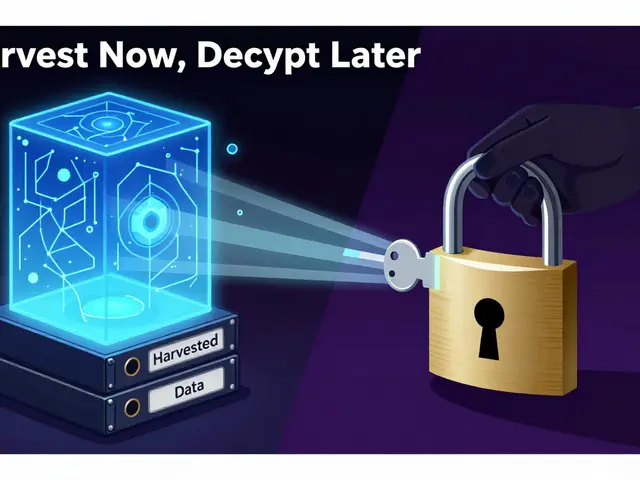
You might think quantum computers are still science fiction, far off in the future. That gives you a false sense of safety. The real danger isn’t waiting for the day a quantum computer breaks your wallet-it’s what hackers are doing right now. This strategy is called Harvest Now, Decrypt Later (HNDL) a cyberattack strategy where adversaries collect encrypted data today to decrypt it later when quantum computers are capable.
Here is how it works. Today, your Bitcoin private keys are secured by math that classical computers can’t solve in a reasonable time. But the public keys and transaction data are visible on the blockchain forever. Malicious actors are already archiving this data. They aren’t trying to break it today. They are storing it, waiting for the moment when a quantum computer runs Shor's Algorithm a quantum algorithm developed by Peter Shor in 1994 that can factor large integers efficiently, breaking RSA and ECC encryption.
A 2025 study by the Federal Reserve Board analysts Jillian Mascelli and Megan Rodden highlighted this as an "active and inescapable data privacy risk." Once that quantum threshold is crossed-often referred to as Q-Day the hypothetical date when quantum computers become powerful enough to break current cryptographic standards-all those harvested records become readable. Your historical financial data, currently safe behind encryption, becomes transparent. For high-value targets like government secrets or corporate trade data, this window of vulnerability starts closing today.
Why Current Encryption Is Vulnerable
To understand the threat, you need to look at the foundation. Most blockchains, including Bitcoin and Ethereum, rely on Elliptic Curve Cryptography (ECC) a type of public-key cryptography based on the algebraic structure of elliptic curves over finite fields. ECC is great because it offers strong security with smaller key sizes compared to older methods like RSA. It relies on the difficulty of solving the discrete logarithm problem.
Classical computers struggle with this math. A supercomputer might take billions of years to crack a 256-bit ECC key. But a quantum computer doesn’t work like a classical one. It uses qubits that exist in multiple states simultaneously thanks to superposition. When you apply Shor’s Algorithm to a sufficiently large quantum processor, that billion-year problem drops to hours or even minutes.
This isn’t theoretical fear-mongering. IBM’s roadmap shows clear progress. Their 2025 Nighthawk hardware handles up to 5,000 quantum gates. By 2029, their Quantum Stling system aims for 100 million gates-a 20,000x jump. While breaking Bitcoin’s ECC would require roughly 10 million physical qubits with extremely low error rates (which Dr. Jay Gambetta from IBM suggests won’t happen before 2040), the trajectory is steep. The gap between "impossible" and "possible" is shrinking faster than most people realize.
The Post-Quantum Cryptography Solution
So, do we throw away blockchain? No. We upgrade the locks. The solution is Post-Quantum Cryptography (PQC) cryptographic algorithms designed to be secure against attacks from both classical and quantum computers. These are new mathematical problems that are hard for both classical and quantum computers to solve.
In August 2024, the National Institute of Standards and Technology (NIST) finalized its PQC standardization project. They selected two main algorithms:
- CRYSTALS-Kyber: Used for general encryption (key encapsulation).
- CRYSTALS-Dilithium: Used for digital signatures.
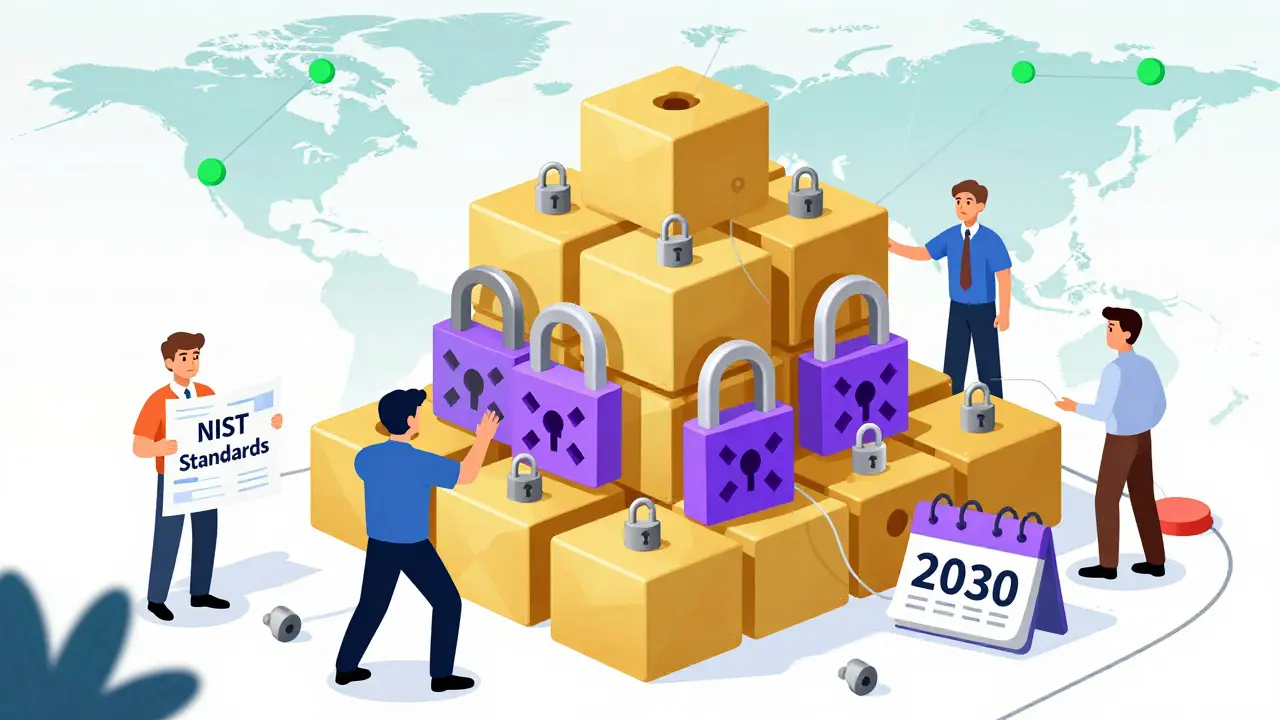
These algorithms rely on lattice-based mathematics. Unlike factoring large numbers, finding short vectors in high-dimensional lattices remains difficult even for quantum processors. However, there is a catch. PQC signatures are larger. CRYSTALS-Dilithium signatures are approximately 2.3 times larger than current ECDSA signatures. This increases "blockchain bloat," meaning more data needs to be stored and transmitted per transaction. For networks like Bitcoin, which prioritize small block sizes, this is a significant engineering hurdle.
Moving Targets: Migration Challenges
Upgrading a centralized server is hard. Upgrading a decentralized network like Ethereum or Bitcoin is a nightmare. There is no CEO to push a button. You need consensus from thousands of nodes worldwide.
Vitalik Buterin, co-founder of Ethereum, estimated in early 2025 that a full migration to quantum-resistant standards could take 5 to 7 years. Why so long? Because you can’t just flip a switch. You need hybrid approaches during the transition to ensure backward compatibility. Wallets must support both old and new key types. Nodes must validate transactions using both legacy and new algorithms until the old ones are phased out completely.
The cost is staggering. Bain & Company’s 2025 analysis estimates migration costs between $50 million and $200 million per major blockchain. This includes development, testing, and community coordination. Meanwhile, user adoption is lagging. A March 2025 survey on r/ethereum showed that while 68% of developers thought the threat was important, only 11% had actually started planning their migration. The knowledge gap is real; Coursera’s quantum-resistant blockchain course had a 42% completion rate among 8,500 enrollees, signaling that many developers find the subject daunting.
| Feature | Traditional (ECC/RSA) | Post-Quantum (PQC) |
|---|---|---|
| Security Basis | Integer Factorization / Discrete Logarithms | Lattice-Based Problems |
| Quantum Resistance | Vulnerable (via Shor's Algorithm) | Resistant |
| Signature Size | Small (~64 bytes for ECDSA) | Large (~2-3 KB for Dilithium) |
| Performance Impact | Low overhead | Higher computational and storage load |
| Standardization Status | Established (since 1990s) | New (NIST finalized Aug 2024) |
Regulatory Pressure and Enterprise Action
While public blockchains debate upgrades, enterprises are being forced to move. The European Union has set strict deadlines: critical infrastructure firms must begin transitioning to PQC by 2026 and complete it by 2030. In the U.S., National Security Memorandum NSM-10 requires federal agencies to migrate by 2035.
This regulatory pressure is creating a two-tier system. Enterprise blockchains, like those built on Hyperledger Fabric, are integrating PQC modules quickly. IBM announced in March 2025 that their enterprise blockchain service would offer quantum-resistant options by Q4 2025. Deloitte’s April 2025 survey found that 78% of European financial institutions had already started quantum migration planning, compared to just 32% in the U.S.
For businesses, the choice is clear. Waiting is not an option. Gartner projects that enterprise blockchain adoption of quantum-resistant features will grow from 5% in 2025 to 65% by 2028. Public blockchains, hampered by governance issues, are expected to reach only 28% adoption by 2030. This divergence means that regulated financial assets may become significantly more secure than retail crypto holdings in the near term.
A New Frontier: Quantum-Native Blockchains
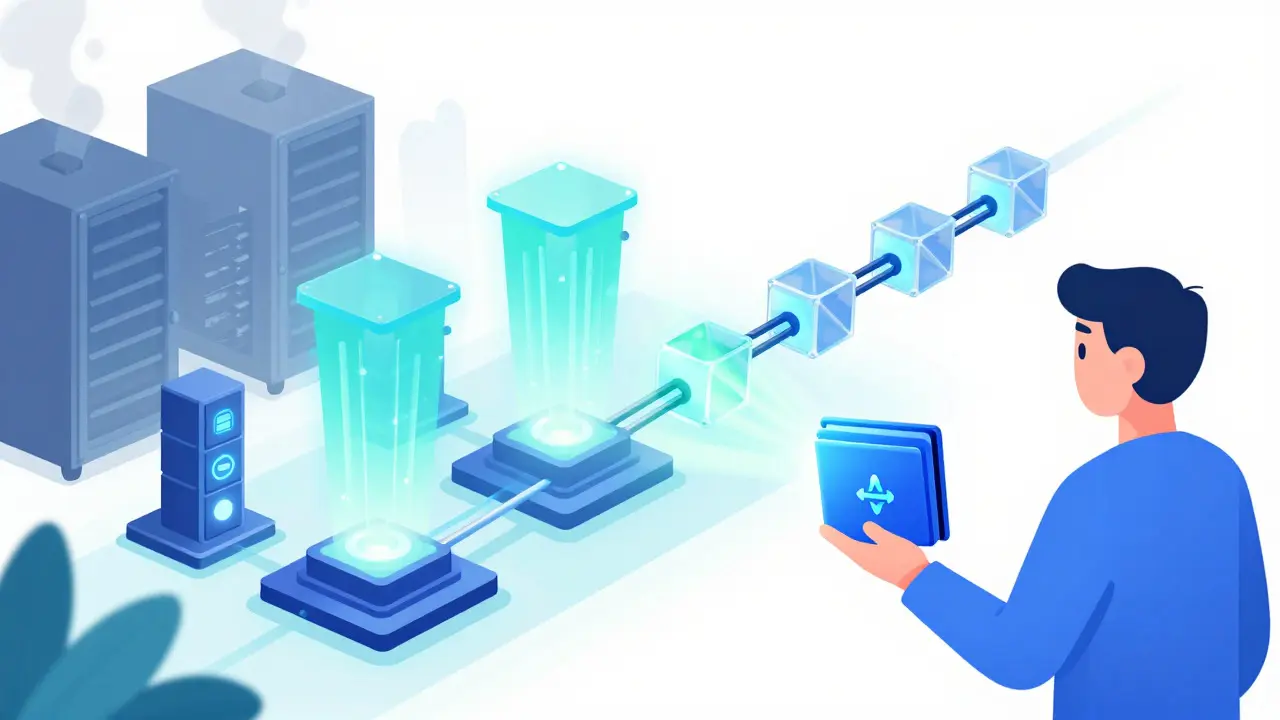
Instead of just patching old systems, some innovators are building entirely new ones. Enter Quantum-Native Blockchains blockchain architectures designed specifically to leverage quantum computing capabilities for consensus and security.
D-Wave Systems tested a prototype in March 2025 across four geographically distributed quantum processors in North America. They introduced "Proof of Quantum Work" (PoQ), a consensus mechanism that requires computations infeasible for classical machines. This approach achieved 75% mining efficiency while maintaining consensus across hundreds of thousands of hashing operations.
The benefits are twofold. First, if the blockchain requires quantum power to mine, it is inherently resistant to classical attacks. Second, it solves the energy crisis. D-Wave’s Dr. Alan Baratz claimed these systems could reduce energy consumption by 99.8% compared to traditional Proof-of-Work. Projects like Quantum Resistant Ledger (QRL) are also exploring these waters, though they remain niche. As of April 2025, QRL had a market cap of $127 million, showing investor interest but limited mainstream adoption.
What Should You Do?
If you hold cryptocurrency, panic isn’t the answer. Dr. Scott Aaronson, Director of UT Austin’s Quantum Information Center, noted in March 2025 that the community has 10 to 15 years before quantum computers pose a direct threat. That is a gift of time.
However, complacency is dangerous. Here is your action plan:
- Move Funds Regularly: Never reuse addresses. Every time you receive funds, send them to a new address. This prevents HNDL attacks because the private key for the old address is never exposed via a signature on-chain.
- Support Quantum-Ready Wallets: Look for wallets that support hybrid key pairs or are actively migrating to PQC standards like CRYSTALS-Dilithium.
- Watch Regulatory News: If you are in business, align with EU and US federal timelines. Start auditing your blockchain integrations now.
- Educate Yourself: Understand the difference between hash function vulnerabilities (addressed by Grover’s algorithm, requiring doubled key lengths) and signature vulnerabilities (addressed by Shor’s algorithm, requiring new algorithms). Both matter.
The future of blockchain isn’t dead; it’s evolving. The companies and individuals who adapt to the quantum era will define the next decade of digital trust. Those who ignore it risk having their digital vaults picked open by history.
When will quantum computers break Bitcoin?
Most experts, including IBM researchers, estimate that breaking Bitcoin's Elliptic Curve Cryptography would require at least 10 million stable physical qubits. Based on current roadmaps, this capability is unlikely to arrive before 2040. However, the "Harvest Now, Decrypt Later" threat exists today, making historical data vulnerable if not protected.
Is my cryptocurrency safe right now?
Yes, for immediate theft. Classical computers cannot break current encryption. However, if you keep funds in an address that has ever signed a transaction publicly, that public key is visible. Hackers can harvest this data to decrypt it later once quantum computers are powerful enough. To mitigate this, always use fresh addresses for receiving funds.
What is Post-Quantum Cryptography (PQC)?
PQC refers to cryptographic algorithms designed to resist attacks from both classical and quantum computers. In August 2024, NIST standardized CRYSTALS-Kyber for encryption and CRYSTALS-Dilithium for digital signatures. These algorithms use lattice-based math, which is difficult for quantum algorithms like Shor's to solve.
How much does it cost to make a blockchain quantum-resistant?
According to Bain & Company's 2025 analysis, migrating a major blockchain to quantum-resistant standards costs between $50 million and $200 million. This covers development, testing, and the complex process of achieving consensus among decentralized networks. The timeline typically spans 5 to 7 years.
Are there any quantum-native blockchains available?
Yes, prototypes and early projects exist. D-Wave demonstrated a quantum blockchain prototype in March 2025 using "Proof of Quantum Work," achieving 75% mining efficiency. Other projects like Quantum Resistant Ledger (QRL) are also active. These systems are designed to be inherently resistant to quantum attacks and potentially more energy-efficient than traditional Proof-of-Work chains.


Write a comment