When you send Bitcoin, everyone can see exactly how much you sent, and to whom. The blockchain doesn’t lie. It records every detail forever. That’s fine for some, but what if you want to keep your financial activity private? That’s where ring signatures come in - a clever trick that hides who sent a transaction, even on a public ledger.
How Ring Signatures Hide the Sender
Imagine you’re in a room with ten people. One of them wrote a note. You’re told to guess who. But here’s the catch: all ten people signed the note - using a special method that makes it impossible to tell which one actually wrote it. That’s essentially what a ring signature does in cryptocurrency. Instead of signing a transaction with just your own private key (like in Bitcoin), a ring signature combines your key with several other public keys pulled from the blockchain. These decoy keys come from past transactions. The result? A single signature that proves someone in the group authorized the payment - but gives no clue who. This isn’t magic. It’s math. Ring signatures rely on elliptic curve cryptography, specifically EdDSA on Curve25519. Each decoy key is chosen from real, spent outputs on the blockchain. The more decoys you mix in, the harder it becomes to pinpoint the real sender. Monero, the most widely used cryptocurrency built around this idea, started with rings of 3 decoys, then bumped it to 5, then 7, and by 2020 settled on 11 as the default. That means every transaction looks like it could have come from one of 12 different addresses.Why Monero Made Ring Signatures Core
Not all privacy coins are the same. Zcash uses zk-SNARKs - powerful zero-knowledge proofs that hide both sender and amount. But they require a trusted setup ceremony back in 2016, where a group of people generated cryptographic keys and then destroyed them. If even one person kept a copy, the whole system could be broken. Ring signatures don’t need that. They work without any setup. That’s a big deal. Monero launched in 2014 as BitMonero and rebranded in 2014. Its founders didn’t make privacy optional. They made it mandatory. Every single transaction uses ring signatures, stealth addresses (to hide the recipient), and RingCT (to hide the amount). That’s the three-prong approach. No user has to toggle a switch. No one can accidentally send an unshielded transaction. It’s all automatic. This gives Monero something Bitcoin can’t match: full fungibility. If you receive a Bitcoin that was once used in a scam, some exchanges will refuse it. They call it “tainted.” But with Monero, every coin is identical. There’s no way to trace its history. That’s why 100% of Monero transactions are private by default - and why 68% of the $12.7 billion privacy coin market is Monero as of late 2025.The Trade-Off: Size, Speed, and Cost
Privacy has a price. Literally. A typical Bitcoin transaction is about 250 bytes. A Monero transaction? Between 13,000 and 15,000 bytes. That’s 50 to 60 times larger. Why? Because each ring signature adds multiple public keys and cryptographic proofs to the transaction data. More decoys = bigger file. That bloat affects the blockchain. Every node has to store and verify every transaction. Monero’s blockchain grows faster than Bitcoin’s. And it costs more to send. While Bitcoin fees hover around $0.50 during normal times, Monero fees can hit $1.50 during congestion - not because of demand, but because of size. Speed is another issue. Monero blocks confirm every 2 minutes, compared to Bitcoin’s 10. But because each block is packed with large transactions, the network can only fit about 1,500 transactions per block. During peak usage, users report transaction processing times of 30-45 seconds - compared to Bitcoin’s 5-10 seconds. One Reddit user, “SlowTransacts,” summed it up in August 2024: “It takes forever to get my payment through.” And then there’s the computational load. Verifying a ring signature takes about 30% more processing power than a standard signature. That’s why some hardware wallets struggle with Monero. And why developers report an average 80-hour learning curve to build custom integrations.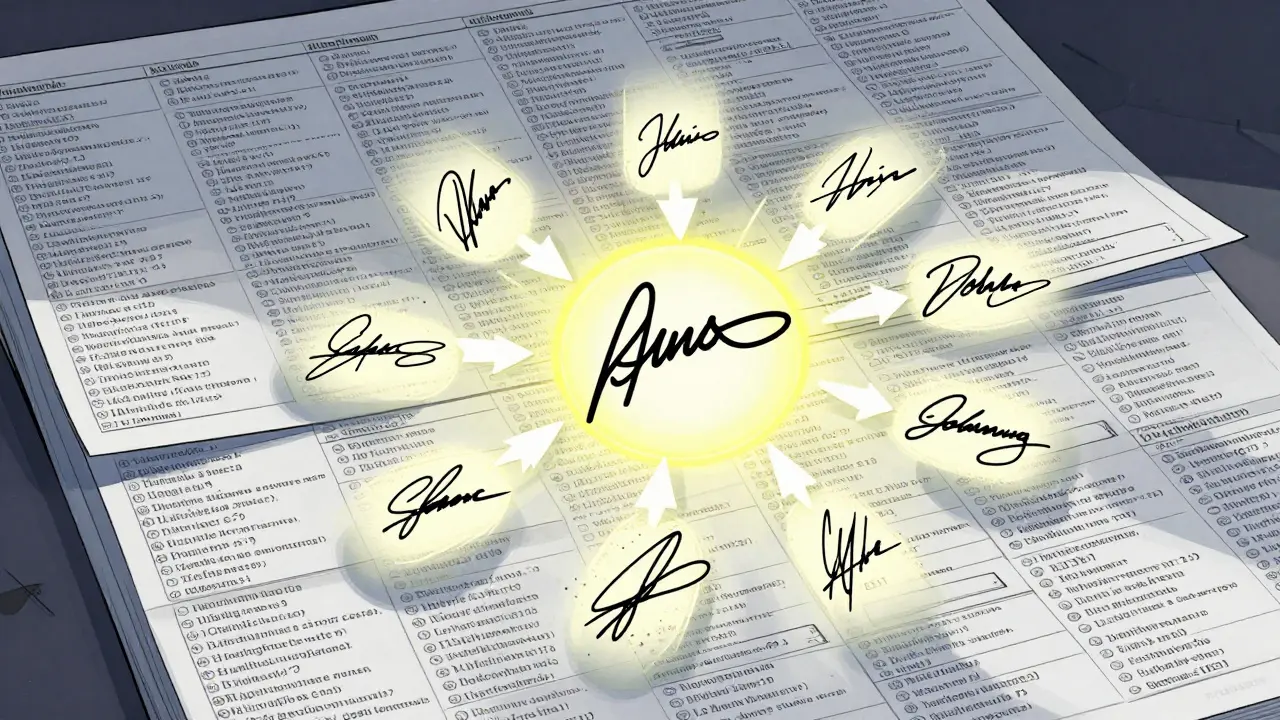
Is It Really Private? The Weak Spots
Ring signatures are strong - but not perfect. The biggest threat isn’t breaking the math. It’s pattern recognition. If you send 5 transactions in a row using the same decoy set, an analyst might notice: “These outputs keep appearing together.” That’s a heuristic attack. It doesn’t crack the signature. It just guesses based on behavior. In 2020, the U.S. Internal Revenue Service issued a $625,000 contract to Chainalysis to develop tools to analyze Monero. The goal? Find patterns. The result? So far, nothing. Chainalysis CEO Michael Gronager admitted in 2022: “Breaking Monero’s ring signatures at scale remains computationally prohibitive.” But that doesn’t mean it’s safe. Experts like Dr. Sarah Jamie Lewis warn that timing correlation attacks - linking when you send money to when you receive it - can still leak information. And if ring sizes shrink (as they did in early Monero versions), privacy drops sharply. The Monero Research Lab’s 2025 Developer Experience Report found that 42% of developers accidentally used outdated ring sizes, weakening privacy. The real vulnerability? User behavior. If you reuse addresses, link your identity to a transaction, or send from a known exchange, you break the anonymity. Ring signatures protect the transaction - not your habits.What’s Next? Faster, Smaller, Smarter
Monero isn’t standing still. Three new protocols are rolling out to fix the biggest complaints: size, speed, and rigidity. First, Triptych. Released in 2022, it lets you use 100 decoys without making the transaction 10 times bigger. Instead of linear growth, it scales logarithmically. Tests show transaction sizes drop by 80%. That’s huge. Second, Arcturus. Introduced in early 2024, it cuts verification time by 400%. That means wallets can process transactions faster, and nodes can validate them more efficiently. No more lag on low-end devices. Third, Lelantus. Scheduled for mainnet in Q2 2026, this replaces fixed ring sizes entirely. Instead of choosing 11 decoys every time, it dynamically adjusts based on network conditions. More privacy when needed. Less bloat when not. These upgrades aren’t just technical tweaks. They’re survival tactics. With U.S. FinCEN requiring “enhanced due diligence” for ring signature transactions since May 2024, and 78% of U.S. exchanges now filtering Monero, the pressure is real. But Monero’s community is adapting. Decentralized exchanges like THORChain saw Monero trading volume jump 300% in 2025 - proving users still want privacy, even if centralized platforms won’t support it.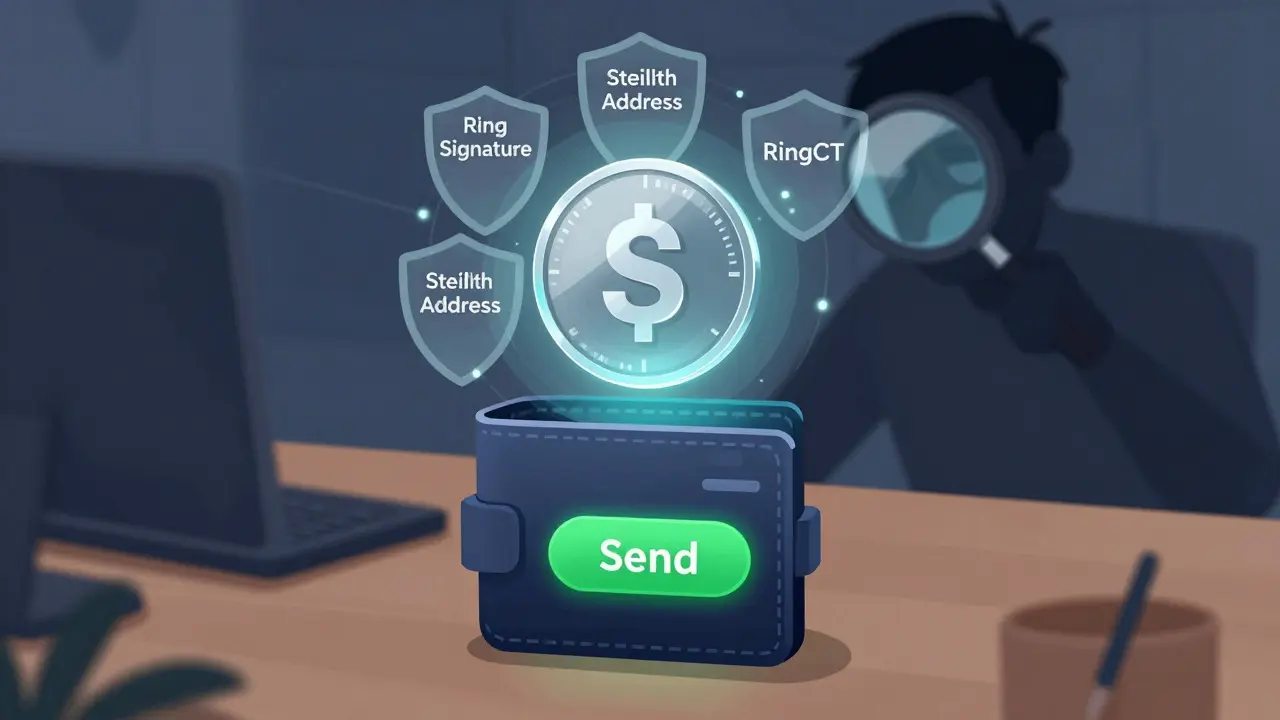
Who Uses It? And Why?
Most users don’t need ring signatures. If you’re buying coffee or sending money to a friend, Bitcoin or Ethereum works fine. But if you’re:- A journalist in a repressive regime sending tips anonymously
- A whistleblower protecting your income
- A small business paying contractors across borders without revealing payroll
- Someone in a country with capital controls
Should You Use It?
If you care about financial privacy - real, irreversible privacy - then yes. But only if you’re willing to accept the trade-offs. Pros:- No trusted setup - unlike Zcash
- Privacy by default - no opt-in needed
- Strong fungibility - no tainted coins
- Decentralized and censorship-resistant
- Larger transactions = higher fees
- Slower processing during congestion
- Regulatory risk - exchanges may block it
- Harder to debug if something goes wrong
Are ring signatures unbreakable?
No, they’re not unbreakable - but they’re practically unbreakable with today’s technology. Ring signatures rely on mathematical problems that would take centuries to solve using current computers. The real risk isn’t brute force. It’s heuristic analysis - spotting patterns in how users behave across multiple transactions. Monero’s move to larger ring sizes and new protocols like Triptych and Lelantus is designed to close those gaps.
Can governments ban ring signatures?
They can’t ban the technology itself - it’s open-source math. But they can ban its use. The U.S. Treasury and FinCEN have already started requiring exchanges to flag or block Monero transactions. That doesn’t stop people from using it on decentralized exchanges or peer-to-peer platforms. Ring signatures work on any blockchain that supports them - and Monero’s community is building tools to bypass centralized gateways entirely.
Is Monero the only cryptocurrency with ring signatures?
Monero is the only major one that uses them as a default, mandatory feature. Other coins like Pirate Chain and Feathery have implemented them, but none have gained traction. Competitors like ITN (formerly Integritee) are testing "ring signature 2.0" with smaller sizes, but they’re still experimental. Monero’s network effect, developer support, and community trust make it the undisputed leader.
Do I need special hardware to use ring signatures?
No. You don’t need a special wallet, chip, or device. Monero wallets like Cake Wallet and the official Monero GUI handle everything automatically. Your phone or laptop can sign ring signatures just fine. The only downside is that transactions take longer to process and use more storage - but that’s handled by the software. You just click “send” and it works.
Why do developers say ring signatures are the "weakest link"?
Because they’re the most exposed part of Monero’s privacy stack. Stealth addresses hide the recipient. RingCT hides the amount. But ring signatures are the only part that interacts directly with the public blockchain. If an analyst can track which decoys are reused across transactions, they can guess the real sender. That’s why Monero’s team is pushing new protocols like Triptych - to make decoy selection truly random and unpredictable.

Florence Pardo
Man, I’ve been using Monero for years now, and honestly? It’s the only crypto that makes me feel like my money isn’t being watched 24/7. I’m a journalist in a country where reporting on corruption gets you disappeared, and ring signatures are the only thing keeping me sane. I don’t care if it takes 30 seconds to send a transaction - I’d rather wait than have some algorithm trace every dime I’ve ever moved. The fact that Monero doesn’t need a trusted setup? That’s huge. Zcash feels like a corporate experiment. Monero feels like a rebellion.
And yeah, the fees are higher. The blocks are bigger. But you know what? Privacy isn’t cheap. It never has been. If you’re okay with your financial life being an open book, go ahead and use Bitcoin. I’ll be over here with my 11-decoy rings, silently laughing as Chainalysis scrapes their data for hours and finds nothing.
I’ve sent over 300 transactions. Zero leaks. Zero issues. The tech works. It’s not perfect, but it’s the best we’ve got. And honestly? I’d rather have a slightly slower, slightly pricier coin that actually protects me than a ‘fast’ one that turns me into a data point for advertisers and governments.
Kevion Daley
lol at the idea that ring signatures are ‘unbreakable’ 😏
Math is math, fam. If you’re using Monero because you think it’s ‘private,’ you’re living in a 2018 dream. Everyone knows about heuristic attacks. Even my 14-year-old cousin on TikTok knows you can’t reuse decoys. Monero’s just a fancy way to make your transaction 60x bigger so you can feel smug while paying $1.50 to send $5. 🤡
Shelley Dunbrook
How… quaint. The idea that privacy can be achieved through cryptographic obfuscation rather than systemic change is almost poetic in its naivety. You’re treating symptoms, not disease.
Yes, ring signatures obscure the sender. But they do nothing to challenge the infrastructure that makes financial surveillance possible in the first place. The blockchain is a public ledger because the world has normalized transparency as a tool of control. Monero’s innovation is elegant, yes - but it’s also a Band-Aid on a bullet wound.
And yet… I admire the resilience. The community refuses to surrender anonymity to convenience. That alone is worth something. Even if the math is imperfect, the moral stance is clear: some things shouldn’t be tracked. Even if you’re just buying coffee.
Aman Kulshreshtha
As someone from India, I find this whole discussion fascinating. In my country, people use crypto not for speculation, but to bypass capital controls and send money to family abroad. Monero isn’t a luxury here - it’s survival. I’ve helped my uncle send money to his sister in Dubai without the bank freezing his account. He didn’t even know what a ring signature was. He just clicked ‘send’ and it worked.
Yeah, the fees are higher. But when you’re sending $200 to keep someone from losing their home, $1.50 is nothing. And honestly? I’d rather pay more and know no one’s watching than save 50 cents and risk being flagged for ‘suspicious activity’ because I sent money to a ‘high-risk jurisdiction.’
Monero’s not for everyone. But for people like us? It’s the only thing that lets us keep our dignity.
aravindsai pandla
While the technical merits of ring signatures are well-documented, it is imperative to recognize that user behavior remains the most significant vulnerability in the system. The assertion that Monero provides ‘perfect anonymity’ is misleading. Reused outputs, correlated timestamps, and transaction frequency patterns can, in aggregate, reveal significant metadata. The Monero Research Lab’s 2025 report, which identified that 42% of developers inadvertently employed outdated ring sizes, underscores a critical gap between theoretical security and practical implementation.
Moreover, the computational overhead of ring signature verification imposes tangible costs on network scalability. While Triptych and Arcturus represent significant advancements, their adoption rate remains uneven. Until wallet software universally enforces optimal ring size selection and decoy selection algorithms become truly entropy-driven, the privacy guarantee remains probabilistic - not absolute.
namrata singh
I just want to say… I cried when I sent my first Monero transaction. Not because it was big. Not because it was emotional. But because for the first time, I felt like my money was mine. Not the bank’s. Not the government’s. Not the algorithm’s.
I used to send Bitcoin to pay my freelance clients. Then I got a message from the exchange: ‘We’ve flagged your account due to association with a darknet marketplace.’ I didn’t even know what that meant. I was just selling design work. But they froze my funds for 3 weeks.
Now? I use Monero. No one asks questions. No one tracks me. No one cares. And honestly? That silence? It’s the most beautiful thing in crypto.
DarShawn Owens
Just wanna say - I’m not a crypto bro. I’m a dad who pays for his kid’s therapy with crypto because insurance won’t cover it. I use Monero because I don’t want some robot in a server farm in Texas knowing how much I spent on mental health care.
Yeah, the transaction takes a minute. Yeah, the fee is higher. But my kid’s privacy? Worth it.
Also - shoutout to the Monero devs. Y’all are the real MVPs.
Zion Banks
THIS IS WHY THE ELITE HATE MONERO. They don’t want you to be able to hide your money. They want you to be tracked. Every. Single. Transaction. That’s how they control you. Ring signatures? They’re the last stand against the Deep State’s financial surveillance grid. And now FinCEN is trying to ban it? Of course they are. They know it works. That’s why they’re scared.
They’ve been trying to kill Monero since 2014. Failed. Again. And again. And again. Because math doesn’t care about your laws. You can’t regulate entropy. You can’t regulate privacy. You can’t regulate truth.
Monero is the future. And the future is private. Fight the power. Use Monero.
Annette Gilbert
Oh honey. You wrote a 2000-word essay on ring signatures like it’s a TED Talk and not a blockchain protocol. Did you also include a flowchart? A PowerPoint? A Spotify playlist titled ‘Monero: The Soundtrack of Financial Freedom’?
Look. I get it. You love privacy. But this isn’t a romance novel. It’s code. And code has trade-offs. You’re not a revolutionary. You’re just someone who doesn’t like being asked for their tax ID.
Also - 68% of the privacy coin market? That’s cute. The entire privacy coin market is smaller than Dogecoin’s daily volume. You’re not changing the world. You’re just making a very expensive, slow, complicated way to send $5 to your friend who ‘doesn’t trust banks.’
Enjoy your 15,000-byte transaction. I’ll be here with my 250-byte Bitcoin, paying my coffee and not thinking about it.
John Alde
Let’s cut through the noise. Ring signatures aren’t magic. They’re not unbreakable. But they’re the most decentralized, trustless, and user-controlled privacy layer we’ve built so far. That’s not nothing.
Yes, the size is a problem. Yes, the fees are higher. But here’s what no one talks about: Monero’s privacy is active, not passive. It doesn’t rely on a single trusted party. It doesn’t require a ceremony. It doesn’t depend on a corporate roadmap. Every transaction is a collective act of resistance - 11 decoys, each from a real, spent output, each with equal weight.
The real win? Fungibility. When you can’t tell if a coin was used in a scam, a donation, or a ransom payment, then the coin itself becomes value-neutral. That’s powerful. That’s the kind of financial neutrality we need - not just for whistleblowers, but for anyone who’s ever been denied service because their transaction history looked ‘suspicious.’
And yes - Triptych and Lelantus are game-changers. They’re not just optimizations. They’re paradigm shifts. We’re moving from ‘ring size as a fixed parameter’ to ‘privacy as a dynamic variable.’ That’s the future. And it’s coming faster than anyone thinks.