You lock up your crypto to earn passive income. You expect steady rewards. Then, without warning, a chunk of your principal vanishes. This is not a hack. It is not a market crash. It is slashing. In the world of Proof-of-Stake (PoS) blockchains, slashing is the protocol’s way of punishing validators who mess up. For you, the staker, it means your returns can turn negative overnight.
Slashing isn't just a theoretical risk. It is a hard-coded economic penalty designed to keep networks secure. When a validator acts dishonestly or fails to stay online, the blockchain confiscates part or all of their staked tokens. Understanding how this works is the difference between earning a healthy annual percentage yield (APY) and losing your investment.
What Is Slashing in Crypto Staking?
At its core, slashing is a security mechanism. Blockchains like Ethereum is a decentralized network that uses staking to secure transactions, Cosmos, and Solana rely on validators to process blocks. To prevent these validators from cheating, the protocol requires them to put "skin in the game." If they misbehave, they lose that skin.
There are two main types of offenses that trigger slashing:
- Dishonesty (Double-Signing): This happens when a validator signs two different blocks at the same height in the blockchain. It’s like trying to spend the same dollar twice. The network views this as an attack. Penalties here are severe because it threatens the integrity of the entire ledger.
- Inactivity (Downtime): Validators must be online to propose and attest to blocks. If your node goes offline for too long, you miss your chance to earn rewards and may face a penalty. While less malicious than double-signing, prolonged downtime suggests negligence.
The key takeaway? Slashing aligns validator incentives with network health. But for you, it introduces a direct financial risk that can erase months of staking profits in seconds.
How Much Can You Lose?
The impact on your staking returns depends entirely on which blockchain you are using. There is no universal rule. Each protocol sets its own slashing parameters.
| Blockchain | Dishonesty Penalty | Downtime Penalty | Typical APY |
|---|---|---|---|
| Ethereum | 1% to 100% (correlated) | Indirect (missed rewards + queue delay) | 3-5% |
| Cosmos Hub | 5% to 10% | 0.1% to 5% | 8-12% |
| Solana | 100% (critical violations) | Minimal/None | 6-8% |
| Cardano | Variable (epoch-based) | Low | 4-5% |
Let’s break down what these numbers mean for your wallet.
Ethereum has some of the most complex slashing rules. A minor infraction might cost you 1 ETH out of your 32 ETH deposit. But if multiple validators fail simultaneously (a correlated failure), the penalty scales exponentially. In extreme cases, a validator can lose 100% of their stake. Since Ethereum offers a modest 3-5% APY, a single significant slash can wipe out years of earnings.
Cosmos-based chains often have higher APYs but also more frequent, smaller slashes. Losing 5% of your stake sounds manageable, but if it happens twice a year, your net return drops drastically. Plus, many Cosmos chains implement "liveness" penalties where you lose rewards during downtime, effectively doubling the hit to your bottom line.
Solana takes a different approach. It focuses heavily on uptime. While critical bugs can lead to total loss, routine downtime rarely triggers heavy financial penalties. However, Solana’s high throughput means hardware requirements are stricter, increasing the risk of technical failure.
Why Do Validators Get Slashed?
Most slashing incidents are not caused by malicious hackers. They are caused by human error and bad infrastructure. If you are running your own node or delegating to a small operator, watch out for these common pitfalls:
- Software Bugs: Validator clients are complex software. Updates can introduce bugs that cause double-signing. For example, in May 2023, dozens of Ethereum validators were slashed due to a bug in their client software that mishandled block proposals.
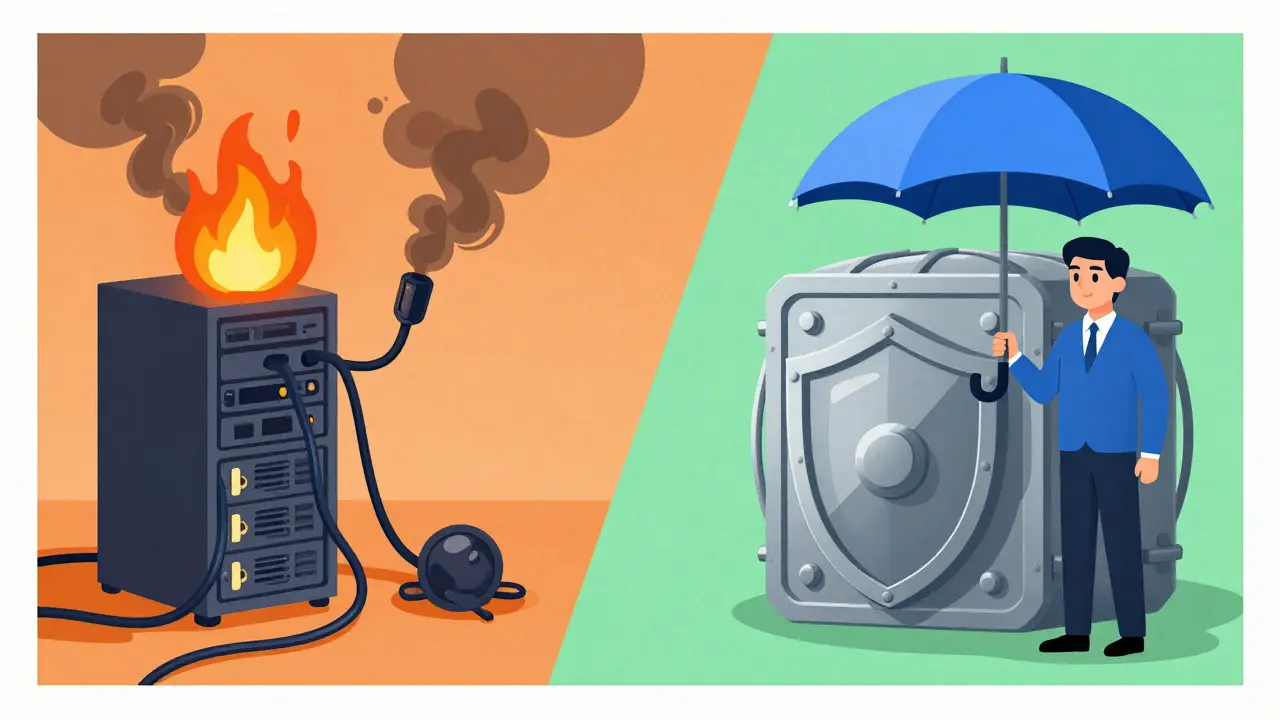
- Poor Hardware Setup: Running a validator on a cheap VPS (Virtual Private Server) with no backup power is a recipe for disaster. Network hiccups, disk failures, or ISP outages can take your node offline long enough to trigger penalties.
- Misconfigured Keys: Using the same signing key across multiple nodes or restoring from an old snapshot incorrectly can lead to conflicting signatures. The network sees this as double-signing and punishes accordingly.
- Lack of Monitoring: If your node goes down and you don’t know it for hours, you’ve already missed rewards. Without real-time alerts via tools like Prometheus or Grafana, you’re flying blind.
Data from community forums shows that nearly 70% of slashing events stem from inadequate infrastructure or configuration errors. It is rarely malice; it is usually negligence.
Self-Hosting vs. Delegating: Who Bears the Risk?
This is the million-dollar question. How does slashing affect you depending on how you stake?
If you self-host: You bear 100% of the risk. If you get slashed, your tokens are gone. However, you also keep 100% of the rewards minus operational costs. This path requires technical expertise, redundant hardware, and constant vigilance. It is suitable only for those willing to invest time in learning Linux administration and network security.
If you delegate to a validator: The validator bears the direct financial hit of the slash. But there is a catch. When a validator is slashed, the penalty is often distributed among all delegators proportional to their stake. So, if Validator X gets slashed by 5%, you lose 5% of your delegated amount. Additionally, a slashed validator loses reputation. Delegators may withdraw funds en masse, causing further instability.
If you use a pooled staking service (like Lido or Coinbase): These services absorb the complexity. They run enterprise-grade infrastructure with redundancies that minimize slashing risk. However, they charge fees (often 10-15% of rewards). You trade potential higher yields for peace of mind. Note that even pools can suffer losses if a major technical failure occurs, though rare.

How to Protect Your Staking Returns
You cannot eliminate slashing risk entirely. But you can manage it. Here is a practical checklist to safeguard your assets:
- Choose Validators Wisely: Look for validators with a long track record of zero slashes. Check their uptime history on explorers like BeaconScan (for Ethereum) or Mintscan (for Cosmos). Avoid new validators with unproven infrastructure.
- Diversify Delegation: Don’t put all your eggs in one basket. Split your stake across 3-5 reputable validators. If one gets slashed, the impact on your total portfolio is diluted.
- Invest in Redundancy (If Self-Hosting): Use dual internet connections, UPS batteries, and redundant storage. Consider geographic distribution if possible. Enterprise setups cost $15,000-$50,000 annually, but retail operators should at least use reliable cloud providers with SLAs.
- Monitor Actively: Set up alerts for node status. Tools like Grafana dashboards can warn you before downtime becomes a penalty event. Quick reaction times matter.
- Consider Insurance: Emerging protocols like Nexus Mutual offer slashing insurance. Premiums range from 0.5% to 2.5% of your staked value annually. While coverage limits apply, it can protect against catastrophic losses.
The Future of Slashing and Staking Economics
Protocols are constantly tweaking slashing parameters to balance security and usability. Ethereum’s upcoming upgrades aim to reduce minimum penalties while increasing punishments for coordinated attacks. The goal is to make slashing precise rather than punitive.
Industry analysts predict that as infrastructure improves, annual slashing rates will drop from the current 0.8-1.2% to under 0.5% by 2026. This means net staking returns could stabilize and potentially increase. However, until then, slashing remains a real cost of doing business in PoS ecosystems.
Remember: high APY often correlates with high risk. A chain offering 12% returns likely has weaker security guarantees or harsher slashing conditions than one offering 4%. Always calculate your expected net return after accounting for potential slashing losses.
Can I get my tokens back after being slashed?
Generally, no. Slashing is irreversible. The tokens are burned or redistributed to other honest validators. Some networks allow you to exit the validator set after a period, but the lost portion is gone forever. This is why prevention is critical.
Does delegation protect me from slashing?
Not completely. While the validator pays the initial penalty, most protocols distribute the loss proportionally among all delegators. If a validator loses 5% of their stake, you also lose 5% of your delegated amount. However, reputable validators have better infrastructure to avoid slashes in the first place.
Which blockchain has the lowest slashing risk?
Cardano and Polkadot generally have lower and more predictable slashing risks compared to Ethereum or Cosmos. Cardano uses a liquid staking model where delegators share rewards and risks smoothly. However, "lowest risk" doesn't mean "no risk." Always research the specific protocol's latest documentation.
How much does slashing insurance cost?
Current market rates for slashing insurance, such as those offered by Nexus Mutual, range from 0.5% to 2.5% of your staked capital per year. Coverage terms vary widely, so read the policy details carefully. Most policies exclude losses due to known software bugs or gross negligence.
Is it worth self-hosting a validator given the slashing risk?
Only if you have the technical skills and resources. Self-hosting allows you to keep 100% of rewards, but you bear full responsibility for uptime and security. For most retail users, delegating to a trusted, established validator or using a pooled staking service is a safer and more cost-effective option.
Write a comment