Imagine upgrading your phone’s software without forcing everyone else to update at the same time. That’s what a soft fork does for blockchain networks. It lets the network get better-faster, safer, more efficient-without splitting the chain or breaking older systems. And the secret? Backward compatibility.
What Makes a Soft Fork Different
Not all blockchain upgrades are the same. Some, called hard forks, change the rules so completely that old software can’t understand the new blocks. That’s how Bitcoin Cash was born: a group of people decided Bitcoin’s rules needed a big change, and when others didn’t agree, the chain split in two. A soft fork is the opposite. It tightens the rules, not loosens them. Think of it like adding a new security check at an airport. Everyone still gets through, but now you have to show your boarding pass in a slightly different way. People who haven’t learned the new rule? They still let you through-they just don’t know why you’re doing it differently. That’s backward compatibility in action. In technical terms, a soft fork introduces stricter validation rules. Any block that follows the new rules also follows the old ones. But the reverse isn’t true. A block made under the old rules might not meet the new standards. That’s why old nodes still accept new blocks-they’re not breaking any rules, just missing out on some extras.How Nodes Stay in Sync Without Upgrading
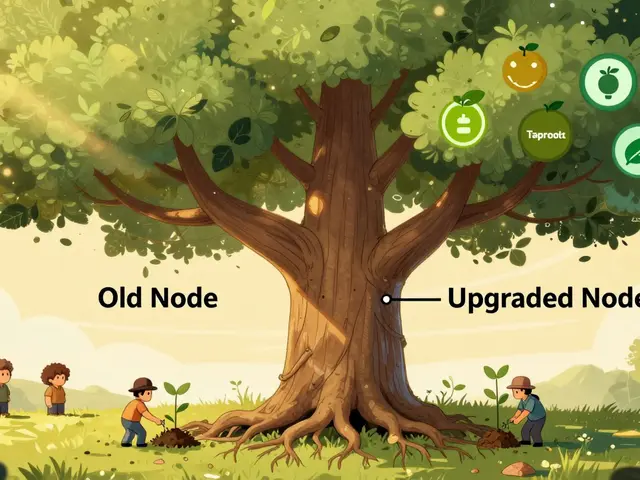
Your Bitcoin wallet or mining node doesn’t need to update the moment a soft fork is announced. If you’re still running version 0.20 of Bitcoin Core and everyone else upgrades to 0.21, your node keeps working. It still validates transactions, adds new blocks to its copy of the blockchain, and broadcasts its own blocks. Here’s how it works: upgraded nodes start creating blocks that follow the new, stricter rules. But because those rules are a subset of the old ones, the blocks are still valid under the old protocol. So your old node looks at the new block and says, “Yep, this checks out.” It doesn’t know about the new features, but it doesn’t reject the block either. The catch? Your old node won’t be able to use the new features. If the soft fork adds a way to send more transactions per block, your node still sees those transactions-but it can’t take advantage of the efficiency. It’s like driving a car with an old GPS. The road still exists. You just don’t get the real-time traffic updates.Why Miners Are the Key to Activation
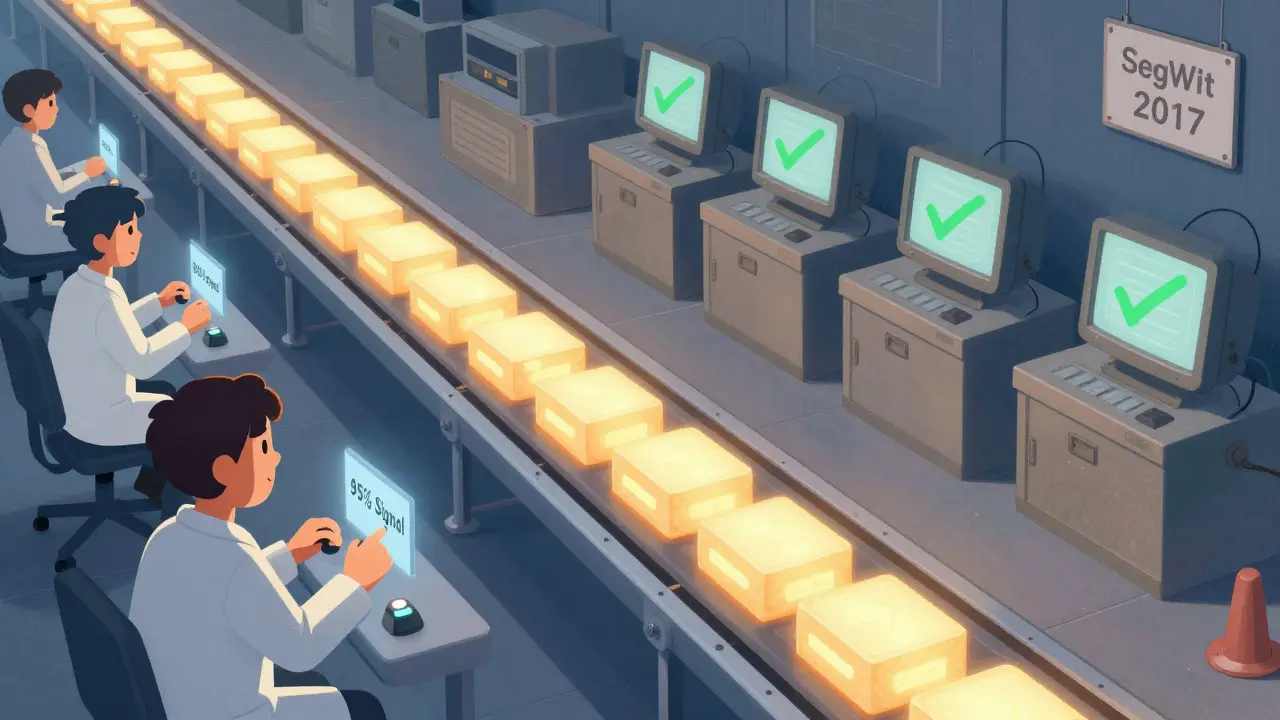
Soft forks don’t activate because users say so. They activate because miners signal support. Miners are the ones who build blocks. If 90% of them start using the new rules, the network slowly shifts over. This is done through a signaling system. Miners include a small piece of data in their blocks that says, “I’m ready for the new rules.” Once a threshold is hit-usually 95% of blocks in a given period-those new rules become active across the entire network. Everyone else can upgrade later. No rush. This gradual rollout is why soft forks are so much safer than hard forks. If something goes wrong, you don’t have two chains fighting over legitimacy. You just roll back the upgrade. No new cryptocurrency is created. No exchanges panic. No users lose money because they didn’t upgrade in time.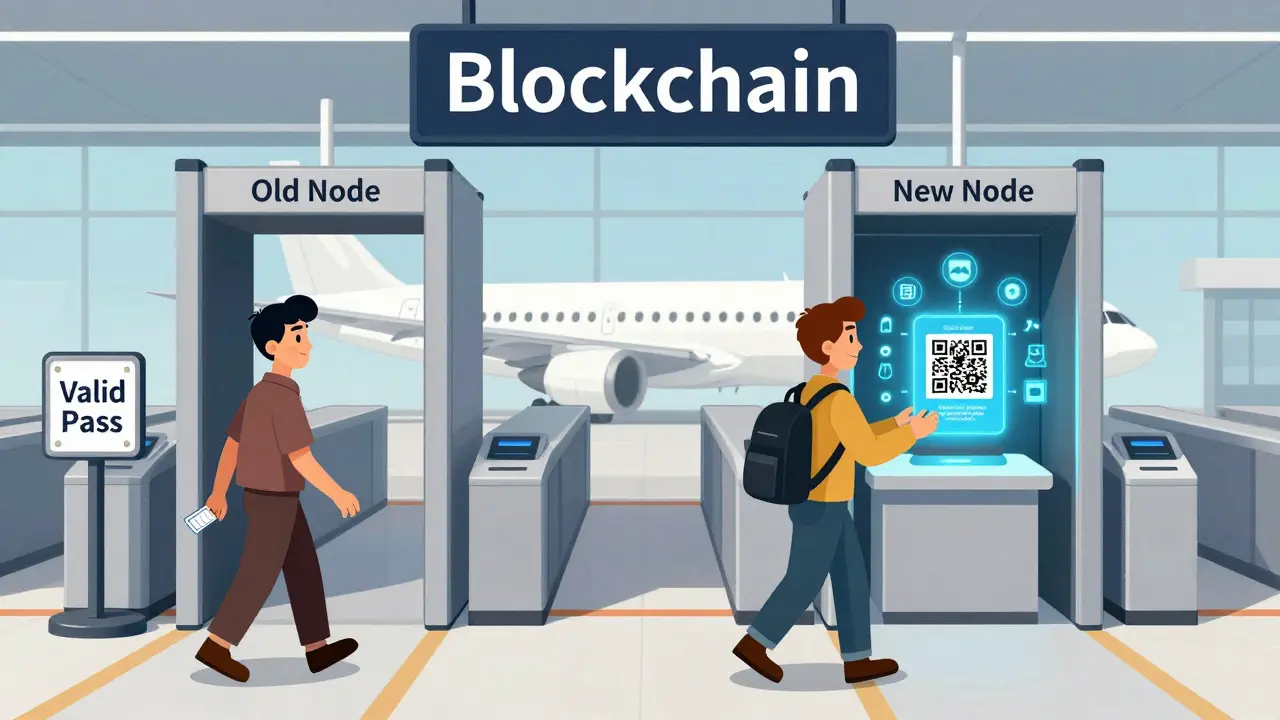
Real Examples: SegWit and P2SH
The most famous soft fork in blockchain history is Bitcoin’s Segregated Witness (SegWit), launched in 2017. Before SegWit, Bitcoin’s block size was capped at 1 MB, causing slow transactions and high fees. Developers couldn’t just increase the block size-that would’ve been a hard fork, and the community was divided. SegWit found a clever workaround. It moved signature data (witness data) out of the main block and into a separate structure. This freed up space without changing the 1 MB limit. Old nodes still saw the block as valid-they just didn’t read the extra data. New nodes could use the freed-up space to fit more transactions. Fees dropped. Lightning Network became possible. And the chain never split. Another early example is Pay-to-Script-Hash (P2SH), introduced in 2012. It let users send Bitcoin to complex scripts-like requiring 2 out of 3 signatures to spend-without forcing everyone to understand those scripts. Old nodes just saw a hash and accepted it. New nodes could verify the full script. It was a quiet revolution in smart contracts, all done with backward compatibility.What Soft Forks Can’t Do
Soft forks are powerful, but they have limits. Because they can only make rules stricter, they can’t:- Change the total Bitcoin supply
- Reduce block time from 10 minutes to 5
- Remove proof-of-work entirely
- Allow transactions that were previously invalid
Why Backward Compatibility Matters for Users
You don’t have to be a miner or a developer to care about soft forks. If you hold Bitcoin, Ethereum, or any other blockchain asset, you benefit from them every day. Imagine if every upgrade forced you to update your wallet, re-sync your node, or risk losing access to your funds. That’s what hard forks often feel like. Soft forks? They’re invisible. Your wallet keeps working. Your exchange keeps depositing coins. Your payments go through. You upgrade when you’re ready-or never, and it’s fine. That stability builds trust. People don’t fear upgrades. They welcome them. That’s why Bitcoin has stayed one chain for over 15 years, even as it’s added features like Taproot, Schnorr signatures, and more. Other networks tried hard forks early on and ended up with fractured communities. Bitcoin didn’t.Soft Forks vs Hard Forks: The Real Difference
| Feature | Soft Fork | Hard Fork |
|---|---|---|
| Rule Change Type | Stricter (subset of old rules) | Broader or different (breaks old rules) |
| Old Nodes Accept New Blocks? | Yes | No |
| New Nodes Accept Old Blocks? | Yes | Yes |
| Network Split Possible? | No | Yes |
| Upgrade Required For All? | No | Yes |
| Creates New Crypto? | No | Often |
| Example | Bitcoin SegWit, P2SH | Bitcoin Cash, Ethereum Classic |
What’s Next for Soft Forks?
Developers are getting smarter about how they deploy soft forks. New signaling methods, like version bits and BIP9, make it easier to coordinate upgrades without chaos. Taproot, activated in 2021, showed how complex upgrades-like enabling better privacy and scripting-can still be done as soft forks. The trend is clear: the most successful blockchains prioritize stability. They don’t chase radical changes. They make small, safe, backward-compatible improvements over time. That’s how you keep millions of users, thousands of nodes, and billions of dollars in value running smoothly. Soft forks aren’t flashy. They don’t make headlines like a hard fork that splits a coin in two. But they’re the quiet engine behind every major upgrade that didn’t break the internet.Can I still use my old Bitcoin wallet after a soft fork?
Yes. Your old wallet will still send and receive Bitcoin. It won’t be able to use new features like Taproot or Schnorr signatures, but your funds are safe. You don’t need to upgrade immediately. Many users never do.
Do soft forks make the blockchain more secure?
Often, yes. Soft forks are used to fix vulnerabilities. For example, BIP66 tightened signature validation rules to prevent a specific type of exploit. By making rules stricter, soft forks reduce the attack surface without disrupting users.
Why don’t all blockchains use soft forks?
Because not every change can be made backward-compatible. If you want to change the block reward, reduce inflation, or switch from proof-of-work to proof-of-stake, you need a hard fork. Soft forks are great for incremental upgrades, not full system overhauls.
What happens if not enough miners signal for a soft fork?
The upgrade doesn’t activate. The network keeps running under the old rules. No harm done. Developers can try again later with better coordination. This is why soft forks are low-risk-they can fail quietly.
Is SegWit still active today?
Yes. SegWit has been active since August 2017. Over 90% of Bitcoin transactions now use SegWit addresses. It’s the foundation for Lightning Network and lower fees. Even wallets that don’t show it still benefit from its efficiency.
Tammy Goodwin
Soft forks are like quietly updating your Wi-Fi password so everyone stays connected but only the cool kids know the new combo. No drama, no chaos. I love how Bitcoin just keeps evolving without screaming at you to upgrade.
It’s why I still use my 2017 wallet and never once panicked when SegWit dropped. My coins? Still there. My peace of mind? Even better.
Shamari Harrison
Really well explained. One thing people miss is that soft forks don’t just preserve compatibility-they preserve trust. When you know an upgrade won’t split your chain or erase your balance, you stop fearing updates and start expecting them.
That’s why Bitcoin’s been around for 15 years and still feels stable. Not because it’s perfect, but because it’s careful.
Roshmi Chatterjee
Wait, so if old nodes don’t understand the new rules, how do they even know the block is valid? I mean, they’re not reading the witness data, right? So what’s the actual signal they’re checking? Just the transaction count? Or is it something deeper like the Merkle root?
I’ve been trying to wrap my head around this since SegWit launched. Would love a deeper dive if anyone’s got a diagram.
Deepu Verma
Man, this is why I love blockchain. It’s not about being flashy-it’s about being reliable. I remember when I first heard about soft forks, I thought, ‘That’s it? Just make the rules tighter?’ But then I realized-yeah, that’s genius.
Think of it like adding seatbelts to cars. You don’t need everyone to buy a new car. You just make the new ones safer, and over time, the old ones get phased out naturally. No explosions. No chaos. Just progress.
SegWit was the quiet hero of Bitcoin. No one cheered, but fees dropped. Lightning happened. And nobody lost a single satoshi.
Hard forks are like moving houses. Soft forks are like adding a new room. You still sleep in the same bed, but now you’ve got a home office.
Also, miners signaling? That’s democracy with proof-of-work. Not every vote counts, but the ones that do matter. And if 95% say ‘yes,’ you don’t need to force anyone. Let them upgrade when they’re ready.
Most people think crypto is about hype. But the real magic? The quiet engineering that keeps it all running. Soft forks are the unsung heroes.
MICHELLE REICHARD
Oh please. ‘Backward compatibility’ is just corporate speak for ‘we didn’t want to do the real work.’ SegWit was a hack. A band-aid on a broken leg. They couldn’t increase block size, so they moved signatures into a corner and called it innovation.
And now we have Taproot? More obfuscation. More complexity. More ‘trust us, we know what we’re doing.’ Meanwhile, regular users still can’t send Bitcoin without a 3rd-party wallet.
This isn’t progress. It’s pretentious engineering theater.
tim ang
So if old nodes accept new blocks, does that mean they’re still mining them? Or are they just passively relaying? I’m a little confused because I thought nodes had to validate everything…
Also, I just upgraded my node and now my electricity bill is higher 😅 but hey, at least I’m helping the network!
Abdulahi Oluwasegun Fagbayi
Soft forks are the quiet genius of blockchain. No fanfare. No drama. Just better code slipping in like a well-timed whisper.
People think progress means loud changes. But real strength? It’s in the quiet adjustments. Like a river carving a canyon-not with a crash, but with persistence.
Bitcoin didn’t survive because it was flashy. It survived because it didn’t break.
And that’s worth more than any hard fork ever could.
Anna Topping
It’s funny how we treat software like it’s sacred. Like if you don’t upgrade immediately, you’re some kind of Luddite. But honestly? I’ve got a Bitcoin wallet from 2015. It still works. I don’t care if it doesn’t do Taproot. My money’s safe. That’s all that matters.
Why do we feel pressured to always be on the bleeding edge? Can’t we just… chill?
Jeffrey Dufoe
So soft fork = better rules. Old nodes still work. Miners decide. Got it. Simple. I like it. No confusing stuff. Just makes sense.
katie gibson
Okay but what if the miners are corrupt?? Like what if they’re all in cahoots with the devs and the ‘95%’ is just a rigged vote??
Also, SegWit was a scam. I read it on a forum. Someone said it was a backdoor for the NSA. And now my wallet’s been ‘slow’ since 2017. Coincidence? I think NOT.
Also, why do they always say ‘old nodes still work’? That’s just gaslighting. My node feels lonely now. It’s like it’s been abandoned. 😭
Ashok Sharma
Soft fork is an intelligent approach to blockchain evolution. It ensures network stability while allowing innovation. Miner signaling provides a decentralized consensus mechanism without forcing immediate adoption. This method is suitable for long-term sustainability of any blockchain system.
Well explained article. Thank you.
Margaret Roberts
Who benefits from soft forks? Not me. Not the average user. The miners. The devs. The big wallets.
Meanwhile, I’m stuck with a wallet that can’t do anything fancy because ‘it’s backward compatible.’
And yet somehow, they say this is ‘user-friendly’? No. It’s user-exploitative. You’re told you don’t need to upgrade… but you’re also told you’re missing out.
It’s psychological manipulation dressed up as engineering.
And don’t get me started on Taproot. ‘Privacy’? More like ‘more ways for the government to track you if they want to.’
They always say ‘no chain split.’ But what about the split in trust? That’s the real fork.
Jonny Lindva
Love this breakdown. Soft forks are like getting a free update on your phone that makes it faster but doesn’t delete your photos.
People act like hard forks are ‘bold’ and soft forks are ‘boring.’ Nah. Boring is good. Boring means your money doesn’t vanish because someone decided to make a new coin.
Bitcoin’s secret sauce? It’s not the tech. It’s the patience.
Harshal Parmar
Let me tell you something-soft forks are the reason I still believe in Bitcoin. I remember when I first got into crypto, I thought every upgrade had to be a revolution. I wanted to see the blockchain change overnight. Big blocks. Faster transactions. New tokens.
But then I saw how SegWit rolled out. No panic. No drama. Just quiet improvement. I watched my transaction fees drop from $10 to $0.50 over a few months. No one even announced it. It just… happened.
And now? I don’t even check if my node is updated. I trust the system. I trust that the people building this aren’t trying to rip me off-they’re trying to make it better, slowly, safely.
Compare that to other chains that fork every six months. They’re loud. They’re flashy. They have Twitter memes and celebrity endorsements.
But their chains are fragile. Their users are scared.
Bitcoin? It’s the quiet guy in the corner who shows up every day, does the work, and never asks for applause.
That’s why I’m still here. Not because it’s perfect. But because it’s patient.
And honestly? In a world that’s always screaming, that’s the most revolutionary thing of all.
Darrell Cole
Soft forks are a deception. The entire premise relies on the assumption that miners are neutral actors. But miners are profit-driven entities. They don’t care about decentralization. They care about fees and subsidies.
When 95% of miners signal, it’s not consensus-it’s cartel behavior. The rest of the network is forced to accept changes they didn’t consent to. That’s not democracy. That’s oligarchy with hash power.
And let’s not pretend old nodes are ‘safe.’ They’re just blind. They’re validating blocks they don’t understand. That’s not backward compatibility. That’s systemic ignorance.
True decentralization requires everyone to upgrade. Anything less is a lie wrapped in technical jargon.
Matthew Kelly
Soft forks = the blockchain version of ‘I’ll just add a new feature without breaking anything.’ 😅
And honestly? I’m here for it. My node runs on a Raspberry Pi from 2018. Still works. Still syncing. Still validating. No drama. No panic. Just chill updates.
Thanks for reminding me why I love this space. 🙌
Clark Dilworth
Technically, soft forks exploit the UTXO set’s validation semantics by enforcing stricter script validation rules while preserving the canonical block structure. The key insight is that the new consensus rules are a subset of the old, enabling non-upgraded nodes to maintain chain validity through legacy verification paths.
Miner signaling via version bits enables a soft fork activation mechanism that’s both non-disruptive and cryptoeconomically secure, leveraging the Nash equilibrium of hash power alignment.
SegWit’s implementation via BIP141 was a masterclass in backward-compatible innovation-separating witness data from the transaction payload while maintaining Merkle root integrity.
Taproot’s Schnorr aggregation and script tree encapsulation further demonstrate the elegance of soft fork design: enhanced functionality without altering the base layer’s economic rules.
Barbara Rousseau-Osborn
Soft forks? More like soft control. They tell you you don’t need to upgrade… but then they make the old way feel outdated. Like, ‘Hey, your wallet still works… but everyone else is using Taproot and you’re just… stuck.’
And don’t even get me started on how miners get to decide what’s ‘good’ for the network. Who elected them? The blockchain isn’t a monarchy.
And why is everyone acting like SegWit was some miracle? It just made fees drop because it created a new fee market. Classic supply and demand. Not magic.
They’re gaslighting you into thinking you’re safe while they quietly change the rules. And you’re thanking them for it. 🙄