You locked up your coins, checked the advertised APY, and sat back waiting for passive income. But when the first payout hit your wallet, it didn't match the calculator's promise. Why? Because staking rewards calculation is rarely a simple multiplication problem. It’s a dynamic equation influenced by network activity, validator performance, and protocol-specific inflation rates. If you’re treating staking like a fixed-rate savings account, you’re likely overestimating your returns or underestimating the risks involved in proof-of-stake consensus mechanisms.
Understanding how these rewards are actually computed saves you from nasty surprises at tax time and helps you choose the right validator. Let’s break down the math behind the magic, so you know exactly what you’re earning and why.
The Core Math Behind Staking Returns
At its heart, staking rewards come from two sources: newly minted tokens (inflation) and transaction fees. The most common metric used to display potential earnings is Annual Percentage Yield (APY), which accounts for the effect of compounding interest over time. Unlike simple interest, APY assumes that your earned rewards are automatically re-staked, growing your principal balance.
The standard formula looks intimidating but is straightforward once you plug in the numbers:
- APY Formula: APY = (1 + r/n)n − 1
- r: The periodic rate of return (e.g., daily or weekly reward rate).
- n: The number of compounding periods per year (365 for daily, 52 for weekly).
For example, if a network offers a nominal annual rate of 4% with daily compounding, your actual APY will be slightly higher than 4%. However, this static view ignores the variable nature of blockchain networks. In Ethereum, for instance, the base reward depends on the total amount of ETH staked across the entire network. As more people stake, the individual share of the reward pool decreases, diluting the APY for everyone else. This inverse relationship means your earnings aren’t just about your actions; they’re about the collective behavior of the network.
Ethereum-Specific Reward Mechanics
Ethereum represents the largest staking market, and its calculation method is more complex than many other chains. Since the Merge in September 2022, Ethereum has shifted from energy-intensive mining to validator-based validation. Validators earn rewards for proposing blocks and attesting to the validity of others' work.
The total reward for an Ethereum validator consists of three parts:
- Base Rewards: These come from new ETH issuance. The protocol adjusts the issuance rate based on the total stake. Currently, the network aims for a stable inflation rate, but this fluctuates based on supply dynamics.
- MEV-Boost Rewards: Maximum Extractable Value (MEV) allows validators to capture extra value from transaction ordering, such as sandwich attacks or arbitrage opportunities. Using tools like MEV-Boost can add roughly 1-2% to your annual yield, significantly boosting returns for active participants.
- Transaction Fees: While less significant now due to Layer 2 scaling solutions, direct fees still contribute to validator earnings during high-congestion periods.
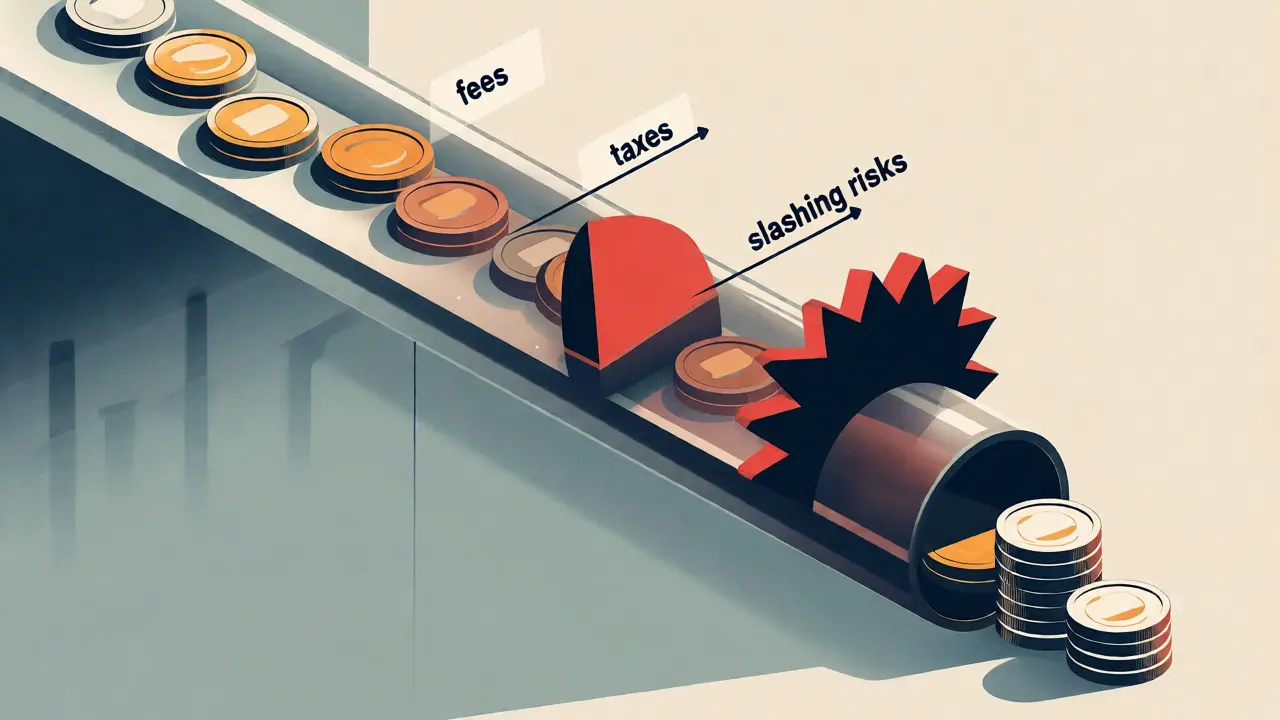
It’s crucial to note that these rewards are not guaranteed. They depend heavily on validator uptime. If your validator node goes offline, misses attestations, or proposes invalid blocks, you don’t just lose potential earnings-you face penalties known as "slashing." Even minor downtime can reduce your effective APY by several percentage points, turning a profitable setup into a break-even scenario.
Comparing Staking Platforms and Methodologies
Not all staking providers calculate rewards the same way. Some offer transparent, protocol-level calculations, while others provide "guaranteed" rates that may hide underlying volatility. Here’s how major approaches differ:
| Platform Type | Calculation Method | Predictability | Risk Factor |
|---|---|---|---|
| Ethereum Native | Dynamic based on total network stake and MEV | Low (varies weekly) | Slashing risk, technical complexity |
| Coinhouse | Guaranteed Rate methodology | High (fixed displayed rate) | Lower yields due to buffer absorption |
| Figment.io | Protocol-specific pass-through | Medium (reflects real-time chain data) | Market volatility impact |
| Phemex/Exchanges | Simplified APY projections | Medium (often indicative) | Fees and lock-up restrictions |
Platforms like Coinhouse differentiate themselves by offering a "Guaranteed Rate." Instead of showing you a volatile estimate that might drop next week, they lock in a specific rate (e.g., 9%) even if the actual blockchain rate hits 9.7%. They absorb the excess variance, providing certainty at the cost of potentially lower maximum returns. Conversely, native staking through services like Figment passes through the exact network rewards, meaning your yield mirrors the blockchain’s health directly. For users who hate uncertainty, the guaranteed model is appealing. For those seeking maximum upside, the pass-through model often wins long-term.

Key Variables That Impact Your Actual Payout
If you want to predict your earnings accurately, stop looking only at the headline APY. You need to account for four critical variables that erode or enhance your net return:
- Validator Performance: Consistency is king. A validator with 99% uptime earns full rewards. One with 95% uptime faces penalties that compound over time. Always check historical performance metrics before delegating.
- Network Participation Rate: On chains like Solana or Cardano, if too few people stake, rewards rise to attract more validators. If everyone stakes, rewards drop. Monitor the "Total Stake" metric on block explorers to gauge future trends.
- Compounding Frequency: Does the platform auto-compound? Manual compounding requires gas fees every time you restake, which eats into profits. Auto-compounding services handle this seamlessly, maximizing the power of exponential growth.
- Lock-Up Periods: Many protocols require tokens to be locked for days or weeks. During this time, you cannot sell or trade. If the market crashes, you’re stuck holding a depreciating asset while earning a fixed yield. This liquidity risk must be factored into your opportunity cost.
Consider the case of Joshua and Jessica Jarett, who successfully challenged IRS treatment of their staking rewards. Their case highlighted how unclear regulatory definitions can affect the perceived value of staking income. While tax laws vary by country-Germany offers tax-free status after ten years, while the US remains ambiguous-the principle holds: understand the legal framework alongside the mathematical one.
How to Calculate Your Personal ROI
Ready to run the numbers? Follow this step-by-step process to determine your realistic return on investment (ROI):
- Determine Base APY: Check the current network average. Don’t use last month’s data; use today’s live stats from sites like StakingRewards.com or Dune Analytics.
- Adjust for Validator Quality: Subtract an estimated 0.5-1% for potential missed attestations if you’re using a third-party provider.
- Add MEV Estimates: If applicable, add 1-2% for MEV boosts, but treat this as bonus income, not guaranteed.
- Subtract Fees: Most providers charge 5-10% of rewards as a commission. Deduct this immediately.
- Factor in Tax Implications: Depending on your jurisdiction, staking rewards may be taxed as ordinary income upon receipt. Reduce your net yield accordingly.
For a concrete example: Imagine you stake 10 ETH on Ethereum. The base APY is 4%, MEV adds 1%, and the provider takes a 10% fee. Your gross yield is 5%. After the fee, you keep 4.5%. If taxes take another 20%, your net yield drops to 3.6%. Over a year, that’s 0.36 ETH. Simple enough, right? Now imagine the price of ETH drops by 50%. Your dollar-denominated return is negative despite positive token accumulation. This dual-currency reality makes staking a risky bet unless you believe in the asset’s long-term appreciation.
Common Pitfalls in Staking Calculations
Many beginners fall into traps that skew their expectations. The biggest mistake is confusing APR (Annual Percentage Rate) with APY. APR does not include compounding, so it always looks lower than APY. If a platform advertises "8% APR," the actual compounded return might be closer to 8.3%. Always clarify which metric is being quoted.
Another pitfall is ignoring slashing risks. On some networks, double-signing a block can result in losing a portion of your principal stake. While rare, it’s catastrophic for small portfolios. Diversifying across multiple validators mitigates this risk. Never put all your eggs in one basket, especially if that basket is a single server running on a home internet connection.
Finally, beware of "promotional" APYs. New networks often launch with inflated rewards to bootstrap security. These rates usually decay rapidly as adoption grows. If you enter late, you’ll earn far less than early adopters. Look at the emission schedule to see how quickly rewards taper off.
Frequently Asked Questions
What is the difference between APR and APY in staking?
APR (Annual Percentage Rate) is the simple interest rate without considering compounding. APY (Annual Percentage Yield) includes the effect of compounding, where earned rewards are added to the principal to earn more rewards. APY is almost always higher than APR for the same nominal rate because of this compounding effect. When comparing platforms, ensure you are comparing apples to apples by checking which metric they display.
Do staking rewards change daily?
Yes, on most proof-of-stake networks, reward rates fluctuate dynamically. Factors like total network participation, transaction volume, and validator performance change constantly. While some platforms offer fixed rates for promotional periods, the underlying blockchain rewards are variable. Expect your daily payouts to vary slightly, though the annual average tends to stabilize over longer periods.
What happens if my validator goes offline?
If your validator goes offline, you miss out on rewards for that period and may incur small penalties for missed attestations. In severe cases, such as prolonged downtime or equivocation (double signing), you face "slashing," where a portion of your staked principal is burned. Choosing a reliable validator with high uptime history is critical to avoiding these losses.
Are staking rewards taxable?
Tax treatment varies by country. In the United States, the IRS generally treats staking rewards as ordinary income at the fair market value when received. In Germany, staking rewards held for more than ten years may be tax-free. Canada and the UK often treat them similarly to mining income. Always consult a local tax professional, as regulations are evolving rapidly.
Can I withdraw my staked tokens anytime?
No, most staking protocols have unbonding or lock-up periods. For example, Ethereum currently has no fixed unbonding period post-Shanghai upgrade, allowing withdrawals whenever the queue permits, but historically it was restricted. Other chains like Cosmos or Polkadot have specific unbonding times ranging from 14 to 28 days. During this period, you cannot transfer or sell your tokens, exposing you to market volatility.

Charlotte Owen
Most people are too lazy to do the actual math and just trust the big number on the landing page. It is a fundamental failure of financial literacy.
musa farid
YALL ARE MISSING THE POINT!!! 🤯 The real killer isn't even the APY, it's the SLASHING risk!! 😱 I lost so much money because my node went offline for like 2 hours during a power outage in Lagos... 💀💸 You can have all the math in the world but if your hardware fails you get rekt!! 🔥🔥🔥 Don't let them gaslight you with these "guaranteed" rates from Coinhouse, that's just them hiding their own inefficiency!! 🚫🧠
Marc Kennedy
Haha, I feel you Musa! 😂 It’s definitely stressful when things go wrong. But honestly, for me, the peace of mind from using a reliable provider outweighs the slight yield reduction. It’s not about getting rich quick, it’s about sleeping well at night knowing your assets are safe. Plus, seeing those rewards trickle in every week is pretty motivating! 🌟 Keep grinding though, we’re all learning together!
Alexis Riggle
the point about validator uptime being critical is often understated
most retail investors don't understand that slashing is permanent loss not just missed income
if you are running your own node check your monitoring setup first before worrying about apy projections
Jennifer Phipps
Love this breakdown! 💖 Especially the part about MEV-boost adding that extra juice to your returns 🍊✨ It’s like finding free money hidden in the transaction ordering chaos! Just make sure you aren’t leaving any crumbs on the table by ignoring those small gains over time. Every little bit counts when you’re building that passive income castle! 🏰💰
Justine Jones
Great insights. Does anyone have data on how Layer 2 adoption specifically impacts Ethereum base rewards long-term?
Joseph Brink
You ask for data, but you miss the essence. The blockchain is a living organism, a digital consciousness evolving through consensus. To reduce staking to mere arithmetic is to ignore the metaphysical weight of validation. We are not just earning tokens; we are participating in the collective truth of the network. When you stake, you anchor yourself to reality itself. The APY is merely the shadow cast by the light of consensus. Do not chase the shadow; understand the source. Your question about L2 is valid, yet it presupposes a separation between layers that does not exist in the unified field of cryptographic truth. Everything is connected. The fees drop, the base rewards shift, but the invariant remains: security requires sacrifice. Are you prepared to sacrifice certainty for potential? That is the true calculation.
Manoj Ramachandran
I must respectfully disagree with the philosophical abstraction presented above. While the concept of consensus is indeed profound, the practical application of staking requires rigorous adherence to mathematical precision and regulatory compliance. The distinction between APR and APY is not merely semantic; it is a matter of accurate financial reporting. Furthermore, the tax implications mentioned regarding the Jarett case highlight that legal frameworks are as critical as technical mechanisms. One cannot simply meditate their way to a correct tax filing. Precision in calculation leads to clarity in investment strategy, which ultimately fosters a more stable market environment for all participants.
Tish Dalton
Hey everyone, just wanted to add a supportive note here! 🌈 It’s totally okay if the math feels overwhelming at first. I remember staring at the APY formula thinking "what did I sign up for?" 😅 But breaking it down step-by-step really helps. Remember, you don’t have to be perfect immediately. Start small, observe how the rewards come in, and adjust as you learn. We’re all figuring this out together, so no judgment zone here! Let’s keep supporting each other’s learning journeys. 🤗
Adam Barrett
This is such a healthy perspective Tish. I think we often forget that crypto communities can be toxic with all the FUD and hype. Taking a breath and looking at the facts calmly allows us to make better decisions without the emotional rollercoaster. Empathy towards our own confusion is key to mastering these complex systems. Let’s keep the vibes positive and the knowledge flowing. 🕊️