Imagine sending a hundred micropayments to a friend for coffee, games, or streaming music - each one instant, zero fee, and completely private. Now imagine none of those transactions ever hit the blockchain. That’s what state channels do. They let two or more people trade value off-chain, while still being as secure as if they were on it. But here’s the catch: state channel security doesn’t come from miners or validators. It comes from you.
How State Channels Work (Without Trusting Anyone)
State channels aren’t magic. They’re built on simple, brutal math. Two people lock up funds in a multisignature smart contract on the blockchain - say, 1 ETH each. That’s the starting point. After that, they can send signed updates back and forth, like a game of tennis with cryptographic balls. Each update shows the new balance. Each one invalidates the last. No one else needs to know. No one else needs to confirm. The blockchain only steps in if something goes wrong. This is different from rollups or sidechains. Rollups batch transactions and prove them on-chain. Sidechains have their own validators. State channels skip all that. The only thing you trust is the other person - and the rules built into the contract. If your friend tries to cheat by submitting an old balance, the system gives you a window to prove they’re lying. And if you do, they lose their deposit. That’s the whole security model: economic punishment, not consensus.The Three Rules of State Channel Security
If you’re using a state channel - whether it’s Lightning Network for Bitcoin or Raiden for Ethereum - there are three non-negotiable rules. Break any one, and you lose money.- Keep the latest state safe. Every time you update the channel, you get a new signed message with the updated balance. If you lose that file, or your device crashes, and your partner submits an older version, you can’t prove what the real balance was. Your funds are gone.
- Watch the blockchain. You need to monitor the blockchain for any attempt by your partner to close the channel. If they try to settle an outdated state, you have to respond before the dispute window closes - usually 200 blocks on Ethereum (about 40 minutes), or 144 blocks on Bitcoin (roughly 24 hours).
- Respond in time. Even if you’re watching, you have to act. If you’re on vacation, your phone dies, or your node goes offline, and someone submits a fake state, you can’t recover your funds. There’s no customer support. No refund. Just cryptography.
What Happens When You Don’t Watch?
In 2022, a group of users lost $18,400 across 37 Lightning Network channels because they were away for a few days and didn’t monitor their channels. One person, u/LightningUser99, posted on BitcoinTalk about losing 0.05 BTC after a 72-hour trip. They didn’t realize their node had disconnected. The other party closed the channel with an old balance. By the time they got back online, it was too late. This isn’t rare. A 2023 study by DappRadar found that 62% of negative reviews of state channel apps mentioned "security anxiety" - not because the tech was broken, but because users felt constantly on guard. You’re not just trusting the system. You’re trusting your own discipline. That’s why watchtowers exist.
Watchtowers: The Safety Net You Didn’t Ask For
A watchtower is a third-party service that monitors your state channels for you. You pay a small fee - maybe a few cents per month - and they keep an eye on the blockchain. If someone tries to cheat, they alert you instantly. You don’t need to be online. You don’t need to run a node. You just need to trust the watchtower not to collude with your channel partner. Lightning Network has 12 major watchtower providers as of 2023. They protect 38% of active channels. Raiden Network users can use tools like "Raiden Monitor," a free open-source app with over 1,800 GitHub stars. Users report a 90% drop in stress after setting one up. But here’s the twist: watchtowers aren’t perfect. They’re not custodial, so they can’t steal your funds. But if they go offline, or get hacked, or just stop operating, you’re back to square one. Some experts call them "trust-minimized," not trustless. You’re still relying on someone else - just not for the money. For the alert.Why State Channels Beat Other Layer 2 Solutions - and Why They Lose
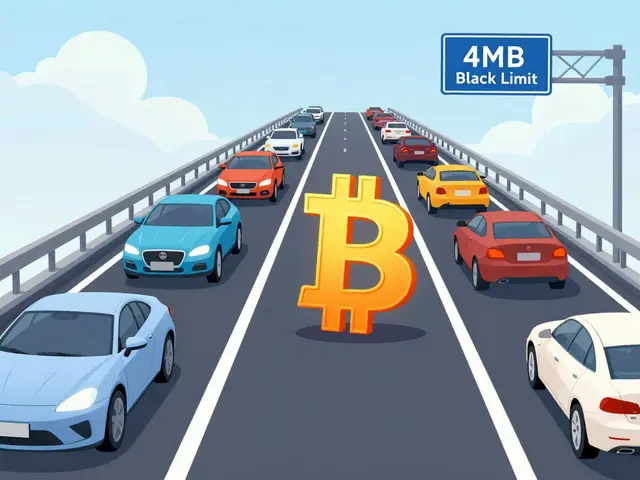
State channels are the fastest and most private Layer 2 option. Transactions settle in milliseconds. No one else sees them. No one can front-run you. That’s why they dominate gaming and micropayments - where speed and privacy matter more than open access. But they fail where you need more than two people, or where you can’t predict who you’ll transact with. If you’re swapping tokens on a DeFi protocol, you can’t open a state channel with every possible counterparty. That’s why rollups - like Optimism or Arbitrum - dominate DeFi. They let anyone join. They inherit Ethereum’s full security. You don’t need to watch. You just need to wait a week for fraud proofs to settle. State channels are like a private handshake between two people. Rollups are like a public courtroom. One is fast and quiet. The other is slow but open to everyone.The Hidden Risk: Developer Errors
Most security failures aren’t user mistakes. They’re code mistakes. A 2023 ConsenSys survey of 286 blockchain developers found that 43% of state channel implementations had flaws in how they handled state revocation. One common error: forgetting to sign the latest state update. Another: letting users close a channel without validating that the submitted state was the most recent one. A single bug in signature validation can let a malicious actor drain funds without triggering a dispute. Bitcoin’s Lightning Network has some of the best documentation - rated 4.2 out of 5 by DevProtocol. Ethereum’s frameworks? 3.7. Many developers say the documentation on dispute resolution is vague or incomplete. That’s dangerous. You can’t secure something you don’t fully understand.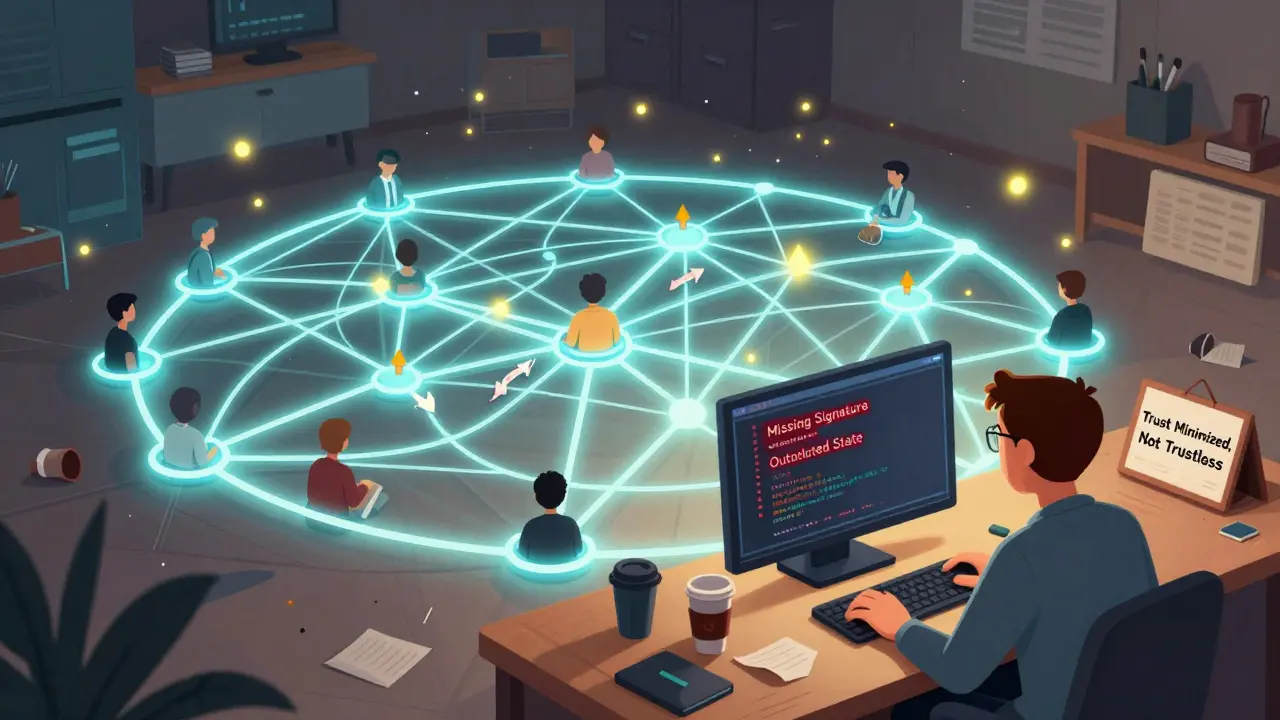
Who Uses State Channels - and Why
The average Lightning Network user is a tech-savvy individual. A 2023 University of Cambridge study found 89% had advanced blockchain knowledge. They’re not casual users. They’re people who run nodes, understand private keys, and accept the responsibility. Enterprises? Most avoid them. A Deloitte survey in early 2023 showed 78% of financial institutions say state channels can’t meet audit requirements. You can’t prove what happened in a private channel unless you have logs - and logs mean centralization. That’s why state channels are stuck in niches: gaming, tipping, IoT micropayments, and peer-to-peer services.The Future: Can State Channels Scale?
The Ethereum Foundation and Stanford researchers are working on "generalized state channels" - networks where multiple channels connect like a web. Think of it as a mesh of private lanes that still feed into a public highway. Projects like Perun, funded by the Ethereum Foundation, are testing this. The goal: keep the speed and privacy, but let users transact with people they’ve never opened a channel with. It’s early. But if it works, state channels could move beyond "two people trading" to "a network of trust." Until then, they remain a powerful tool - but only if you treat them like a loaded gun.What You Should Do Right Now
If you’re using a state channel:- Back up your latest state file. Store it in two places - encrypted.
- Set up a watchtower. Even a free one. Don’t rely on being online 24/7.
- Check your channel’s dispute window. Know how long you have to respond.
- Don’t leave funds in a channel you haven’t used in 30 days. Close it.
- If you’re building one - test your fraud proof logic. Break it. See if it fails.
Can state channels be hacked?
State channels themselves can’t be hacked in the traditional sense - there’s no central server to break into. But the security depends on users and developers. If a user loses their latest state file, or a developer writes a flawed contract, funds can be stolen. Most losses come from human error, not code exploits.
Do I need to run a node to use a state channel?
No, you don’t. Many wallets like Phoenix (for Lightning) or Raiden Wallet handle the node for you. But if you don’t run your own node, you’re relying on someone else’s infrastructure. That’s fine for casual use, but for maximum security, running your own node gives you full control over monitoring and state management.
What’s the difference between Lightning Network and Raiden Network?
Lightning Network is for Bitcoin. Raiden Network is for Ethereum. Both use state channels, but they’re built on different blockchains with different rules. Lightning uses Hash Time-Locked Contracts (HTLCs) with 24-hour dispute windows. Raiden uses Ethereum’s smart contracts with 40-minute windows. Lightning is more mature and has higher adoption. Raiden is more flexible for complex applications like gaming or DeFi.
Why aren’t state channels used more in DeFi?
Because DeFi needs open access. You can’t open a state channel with every possible liquidity provider or token pair. Rollups handle that better - they let anyone interact with a contract without pre-established relationships. State channels are great for bilateral, repeated interactions. DeFi is about one-off, public, dynamic trades.
Are state channels safe for long-term storage?
No. They’re designed for active, frequent transactions. Leaving funds in a state channel for months without activity increases the risk of losing your latest state or missing a dispute window. For long-term storage, use on-chain wallets or cold storage. State channels are for spending, not saving.
What happens if my channel partner disappears?
If your partner goes offline and doesn’t respond, you can still close the channel by submitting the last signed state you have. But if that state is outdated, and you don’t have the latest one, you’ll lose funds. That’s why backing up your state and using watchtowers is critical. You can’t force someone to respond - the system only enforces what’s provable.
Can I use state channels with multiple people?
Traditional state channels are bilateral - two people only. But newer projects like Perun are testing multi-party channels where three or more users can transact together. These are still experimental and not widely available. For now, if you need to pay multiple people, you’ll need multiple channels.


Rachel Stone
So basically you're trusting your phone not to die. Got it.
Gurpreet Singh
This reminds me of how we used to keep ledgers in my village in Punjab - written on paper, passed hand to hand. No blockchain needed, just trust and memory. Now we’ve made it fancy with crypto and panic.
Jeremy Dayde
I spent three days hiking in the Rockies last month and came back to find my Lightning channel drained because my phone battery died and I forgot to set up a watchtower I swear I read about it but I thought it was optional like those pop-up ads that say "you might win a free iPhone" turns out it was real and I lost 0.03 BTC and now I feel like a fool but also kind of proud I was brave enough to try this stuff at all
Elizabeth Jones
The fundamental tension here isn't technological-it's existential. We have built systems that offload responsibility onto individuals while masquerading as decentralized. State channels demand discipline, attention, and emotional labor from users who are not trained to be security engineers. The system doesn't fail; the human condition does. And yet we call this innovation.
Freddy Wiryadi
watchtowers are like having a friend who checks your mail when you’re on vacation 😅 i use the free one from lndhub and honestly it’s been a game changer no more nightmares about my phone dying while i’m at the gym 🏋️♂️
Raymond Pute
Look I’m sorry but calling this "trustless" is just marketing fluff. You’re trusting your phone. You’re trusting your backup. You’re trusting some random server in a data center in Frankfurt that might be owned by a guy named Klaus who also runs a vape shop. This isn’t blockchain. This is just a very expensive version of Venmo with extra steps and no customer service.
Parth Makwana
The architectural elegance of state channels lies in their minimal attack surface: no consensus, no validators, no bloated state roots. The security model is purely game-theoretic-Nash equilibrium enforced via penalty mechanisms. Yet, the operational burden is disproportionately high. This is the paradox of Layer 2: maximum efficiency, minimum user-friendliness.
Elle M
Americans think they can outsource responsibility to tech and call it freedom. Meanwhile, in India, people still remember how to keep a ledger. You don't need a watchtower if you have discipline. This isn't a tech problem. It's a cultural one.
Crystal Underwood
You people are so naive. Watchtowers are just honeypots for the NSA. They collect your channel states, your transaction history, your IP, your sleep schedule. The blockchain doesn't track you. The watchtower does. You think you're safe? You're just being quietly cataloged. And when the Fed starts banning crypto, guess who gets targeted first? The ones who trusted the "free" service.
Jack Petty
State channels are a scam. They're the crypto version of pyramid schemes where you're the last guy holding the bag when the node crashes. The devs know this. They just don't care. They get paid in tokens. You get paid in regret.
Meenal Sharma
The assumption that users can reliably monitor blockchain activity is a bourgeois illusion. In societies where electricity is unstable, or smartphones are shared, or literacy is low, this model collapses. The Western tech elite imposes its assumptions on global users as if universality were inherent rather than imposed.
christal Rodriguez
If you need a watchtower, you shouldn't be using state channels.
Tressie Trezza
I just use Phoenix wallet and forget about it. I’ve never lost money. Maybe I’m lucky. Or maybe I just don’t overthink it. Sometimes the simplest thing is the right thing.
Calvin Tucker
The real failure of state channels is not technical-it’s epistemological. We have outsourced our understanding of value to systems we do not comprehend. We treat cryptographic guarantees as if they were moral ones. They are not. The blockchain does not care about your intent. Only your signature.
Mark Ganim
I’ve been running a Lightning node for 18 months. I’ve had 3 disputes. All resolved. I set up alerts. I back up my state to a YubiKey. I use a watchtower. I monitor my channel balance every morning like it’s my daily coffee. And yes, it’s exhausting. But I’ve never lost a satoshi. This isn’t magic. It’s maintenance. Like changing your oil. Or flossing. Or paying taxes. You don’t get to skip it and then cry when things break.
mary irons
I think all this is just a way for rich guys to feel smart while they lose money. I saw a guy on Twitter say he lost 0.5 BTC because he was on a cruise. Bro. You were on a cruise. You didn’t think your phone might not work? That’s not a tech problem. That’s a life problem.
Nickole Fennell
I almost cried when I lost $1,200 because my laptop crashed during a thunderstorm. I didn’t even have a backup. I thought I was being tech-savvy. Turns out I was just naive. Now I keep my state files on a USB stick taped to my fridge with a Post-it that says DO NOT THROW THIS OUT. I’m not proud. But I’m alive.
Brianne Hurley
I’m so tired of people acting like this is some kind of revolutionary breakthrough. It’s just a glorified IOU system with extra steps and zero accountability. You want to send someone money? Just Venmo them. Or Cash App. Or hell, hand them cash. Stop pretending crypto is about freedom when it’s just about making people feel guilty for forgetting to press a button.
Richard Kemp
i used to run a node but i got tired of it so now i use a wallet that does it for me and i just close channels if i dont use em for a while. its not perfect but its good enough for me. i dont need to be a sysadmin to send a few bucks to my buddy for coffee lol