Imagine trying to buy a coffee in Damascus with Bitcoin while your bank account is frozen by a policy that no longer exists. That was the reality for many until recently. In July 2025, the U.S. government flipped the script on Syria and Cuba, two nations long defined by financial isolation. One side saw walls come down; the other saw them reinforced. If you are trading crypto or moving money across borders, these changes aren't just news-they are operational hazards or opportunities depending on where your wallet sits.
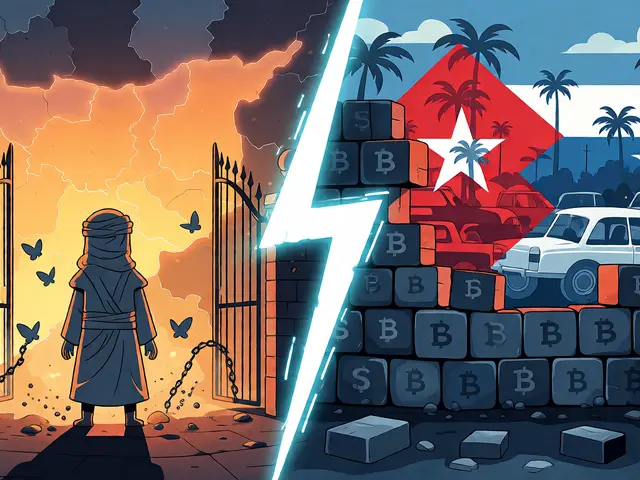
The shift wasn't subtle. On June 30, 2025, President Trump signed Executive Order 14312. It revoked six executive orders dating back to 2004. This effectively ended the broad embargo that had choked Syria’s economy for two decades. Simultaneously, National Security Presidential Memorandum 5 (NSPM-5) tightened the screws on Cuba. For crypto users, this created a bizarre landscape: one market suddenly accessible but legally murky, and another strictly policed with zero tolerance for digital workarounds.
What Changed in Syria?
Before July 2025, doing business with Syria meant navigating a minefield of prohibitions. You couldn’t export services, invest, or even easily wire money without special licenses. The Office of Foreign Assets Control (OFAC is the U.S. Treasury department agency responsible for administering and enforcing economic and trade sanctions) listed almost every major Syrian institution as blocked.
Then came the delisting. OFAC removed all Syrian financial institutions from the Specially Designated Nationals (SDN) List. This included the Central Bank of Syria. Suddenly, U.S. banks could establish correspondent relationships with Syrian counterparts. For crypto traders, this lowered the barrier to entry. Exchanges like Binance reported increased accessibility for users in the region. But here is the catch: lifting sanctions doesn’t mean legal clarity. Syria still has no specific laws permitting or forbidding cryptocurrency. It exists in a gray zone, governed only by general Anti-Money Laundering (AML) and Combating the Financing of Terrorism (CFT) frameworks.
| Feature | Syria | Cuba |
|---|---|---|
| Primary Legal Basis | Executive Order 14312 (Revoked prior EOs) | Cuba Assets Control Regime (CACR) + NSPM-5 |
| Broad Embargo Status | Lifted (Targeted sanctions remain) | Active and Strengthened |
| Crypto Legality | Undefined / Gray Area | Restricted via CACR enforcement |
| Banking Access | Correspondent banking permitted | Severely restricted for U.S. persons |
| Key Risk Factor | Compliance ambiguity & AML checks | Aggressive OFAC enforcement & fines |
The Cuban Reality Check
If Syria got a reprieve, Cuba got a reminder. The administration didn’t just maintain existing sanctions; they doubled down. NSPM-5 reversed Biden-era relaxations, bringing back hardline travel and financial restrictions. The goal? To ensure that digital assets don’t become a loophole for evading the embargo.
Enforcement is real, not theoretical. Take the case of Key Holding, LLC. This Delaware-based logistics company paid $608,825 in a settlement with OFAC in July 2025. Why? Their subsidiary managed freight shipments from Colombia to Cuba. They didn’t use crypto, but the principle applies: if you touch the Cuban economy, you face penalties. Now imagine doing that with a stablecoin transaction that leaves an immutable trail on a blockchain. The risk isn’t just financial loss; it’s legal liability.
The CACR applies to non-U.S. subsidiaries of U.S. persons too. So, if your tech startup in Miami has a branch in Panama that accepts Bitcoin from a Havana-based client, you might be in violation. Many crypto firms assume "decentralized" means "unregulated." In Cuba’s case, that assumption could cost you hundreds of thousands of dollars.
Navigating the Crypto Gray Zone in Syria
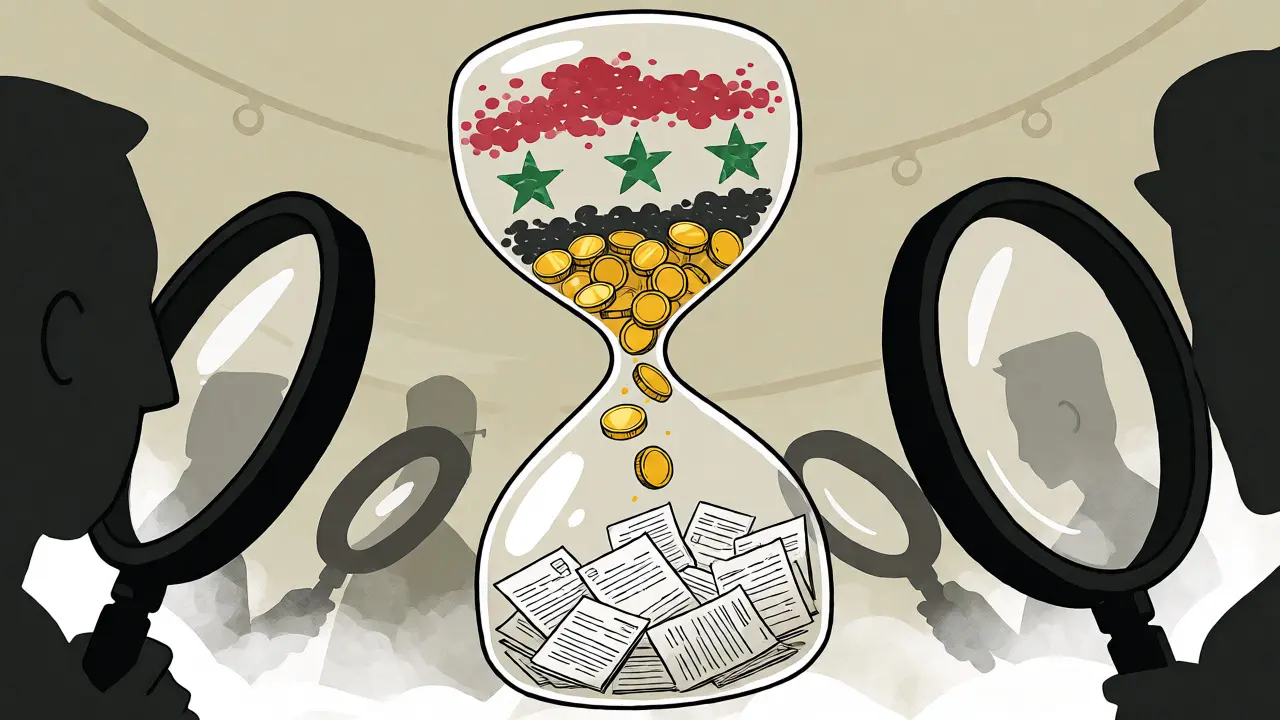
So, can you trade freely in Syria now? Technically, yes. Practically, it’s complicated. Since there are no specific crypto laws, businesses must rely on existing AML/CFT rules. International banks remain cautious. Even though the broad ban is gone, enhanced due diligence requirements persist. Banks want proof that no sanctioned individuals-like members of the Assad family or those involved in the captagon drug trade-are behind the transactions.
This friction slows things down. Payments might get delayed or rejected because a compliance officer sees "Syria" and hits pause. To bypass this, some fintech companies have turned to infrastructure solutions. Lightspark, for example, offers tools like Grid Switch. This leverages domestic real-time payment systems and uses the Lightning Network as a settlement layer. It allows cross-border fiat transfers without exposing the user directly to volatile crypto markets. It’s a clever workaround for regulated entities that want speed without regulatory headaches.
Who Is Still Blocked?
Don’t mistake the broad lift for total freedom. Targeted sanctions remain active. The Assad family is still designated. Anyone linked to serious human rights abuses or threats to regional stability stays on the SDN list. Also, the illicit captagon trade-a massive source of revenue during the war-is under strict watch.
In early July 2025, Secretary of State Marco Rubio announced the revocation of the Foreign Terrorist Organization (FTO) designation for Hay’at Tahrir al-Sham (HTS), formerly known as Al-Nusrah Front. This followed HTS’s dissolution and commitments by Syrian President Ahmed al-Sharaa to counter terrorism. While this opens doors for certain sectors, it doesn’t clear everyone. You still need to screen your counterparties against updated lists. Relying on outdated data is a quick way to trigger a freeze.
Practical Steps for Traders and Businesses
If you are operating in this space, here is how you stay safe:
- Update Your Screening Tools: Ensure your compliance software reflects the July 2025 changes. Old lists will flag legitimate Syrian partners as risks, causing unnecessary delays.
- Document Everything: In the absence of clear crypto laws in Syria, paper trails matter. Keep records of who you traded with, why, and how funds moved. This helps if regulators ask questions later.
- Watch the Subsidiaries: For Cuba-related dealings, remember that U.S. ownership extends globally. Check the ultimate beneficial owners of any entity you interact with.
- Consider Fiat Bridges: Using platforms that settle in fiat via crypto rails (like Lightspark’s model) can reduce exposure to direct crypto regulation while gaining efficiency.
The Bigger Picture: Iran and Russia Context
These changes don’t happen in a vacuum. While Syria relaxed, Iran faced maximum pressure under NSPM-2. After Iran stopped cooperating with the International Atomic Energy Agency (IAEA), OFAC sanctioned networks smuggling Iranian oil disguised as Iraqi oil. This includes ship-to-ship transfers and fake documentation. Cryptocurrency is increasingly used in these evasion schemes, prompting stricter monitoring of digital flows in the Middle East.
Meanwhile, the EU extended its Russia sanctions regime, showing that Western coordination remains tight despite internal disagreements. The message to crypto users is clear: geopolitical shifts create new corridors and new walls. Staying informed about specific executive orders matters more than ever.
Is cryptocurrency legal in Syria now?
There is no specific law banning or permitting cryptocurrency in Syria. It operates in a legal gray area. However, general Anti-Money Laundering (AML) and Counter-Terrorism Financing (CFT) laws apply. Users should exercise caution and maintain thorough transaction records.
Can U.S. citizens trade crypto with people in Syria?
Yes, broadly speaking, following the revocation of comprehensive sanctions in July 2025. However, targeted sanctions remain against specific individuals and entities (e.g., Assad family members). You must conduct enhanced due diligence to ensure your counterparty is not on the current SDN list.
How do sanctions affect crypto transactions in Cuba?
Cuba remains under strict sanctions via the Cuba Assets Control Regime (CACR). U.S. persons and their foreign subsidiaries are prohibited from most financial transactions with Cuba, including those involving digital assets. Violations can result in significant fines, as seen in recent OFAC enforcement actions.
Did the U.S. lift all sanctions on Syria?
No. The broad embargo was lifted via Executive Order 14312, but targeted sanctions remain. These include restrictions on the Assad family, former regime officials, and individuals involved in the captagon trade or human rights abuses. The FTO designation for HTS was also revoked, but individual designations may vary.
What is the risk of using crypto to evade Cuba sanctions?
High. OFAC actively monitors digital asset flows for sanctions evasion. Because blockchain transactions are transparent, authorities can trace funds. Recent settlements show that even unintentional violations lead to substantial penalties. Using crypto does not exempt you from the CACR.
Write a comment