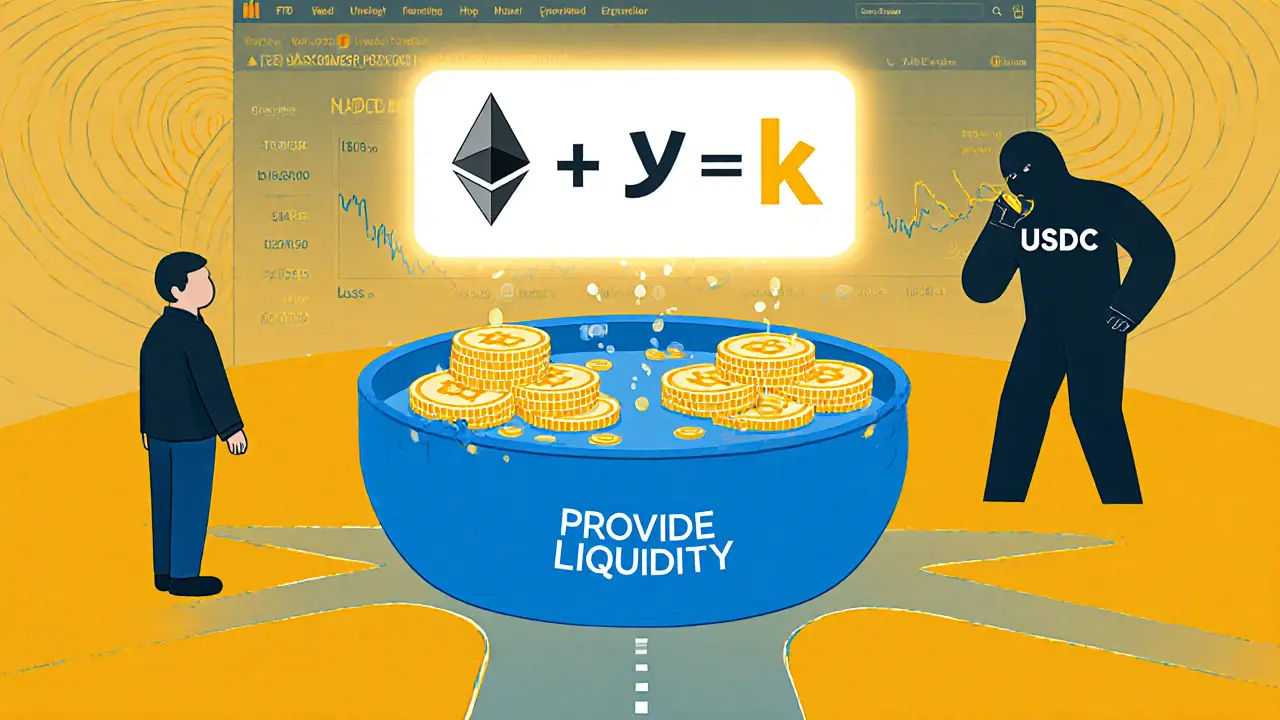
AMM Risk: What You Need to Know Before Trading on Decentralized Exchanges
When you trade on a decentralized exchange like Uniswap or SushiSwap, you're not dealing with a traditional order book—you're interacting with an automated market maker, a smart contract system that sets prices using mathematical formulas instead of human traders. This is the backbone of DeFi, but it comes with hidden dangers that even experienced users miss. Unlike centralized exchanges, AMMs don’t match buyers and sellers. Instead, they use pools of tokens to create liquidity, and those pools are vulnerable to price swings, bad actors, and technical flaws.
One of the biggest risks is impermanent loss, what happens when the value of two tokens in a liquidity pool changes relative to each other, causing you to lose money compared to just holding them. It’s called "impermanent" because if prices return to their original levels, the loss disappears—but most of the time, they don’t. Then there’s slippage, the difference between the price you expect and the price you actually get when trading large amounts. On low-liquidity pairs, slippage can be 10%, 20%, even more. That’s not a bug—it’s how AMMs work.
And it’s not just about price changes. Many AMMs run on chains with weak security or unvetted token pairs. You might think you’re swapping ETH for a new token, but if that token has no real demand, no audit, and a dev who can drain the pool, you’re just funding a scam. The DeFi liquidity, the pool of tokens locked in smart contracts to enable trading, isn’t protected by banks or insurance. If the code breaks, or someone exploits a flaw, your funds vanish with no recourse.
Some users think staking in AMMs is like earning interest in a bank. It’s not. You’re not earning interest—you’re taking on market risk, smart contract risk, and token risk all at once. And while platforms advertise high APYs, they rarely warn you that those yields often come from newly minted tokens that crash as soon as early investors cash out. The same posts you’ll see below show how fake tokens, zero-liquidity pools, and unregulated DEXes are still out there—like LongBit, AnimeSwap, or CFL365—pretending to be real DeFi projects.
What you’ll find here aren’t theory-heavy guides. These are real cases: traders who lost money on low-volume pairs, liquidity providers who got wiped out by a 90% token dump, and users who thought they were earning rewards but were actually funding a rug pull. You’ll see how Upbit and TradeOgre got shut down for ignoring compliance, and why even well-known protocols like KyberSwap Classic or RadioShack RADS have tiny liquidity and zero safety nets. This isn’t about hype. It’s about survival.
If you’re using an AMM today, you’re already exposed to these risks. The question isn’t whether they exist—it’s whether you know how to spot them before it’s too late.