Remember when sending a simple digital payment felt like booking a first-class flight? In the early days of blockchain, especially on networks like Ethereum is the second-largest cryptocurrency platform that supports smart contracts and decentralized applications, users often paid more in network fees than the actual value they were transferring. It was absurd, frustrating, and it kept everyday people out of the ecosystem. But fast forward to mid-2026, and that story has flipped completely.
We are standing at a turning point where blockchain transaction fees are no longer a barrier-they are becoming a competitive advantage. The cost to move money or data across these networks has dropped so drastically that for many use cases, it’s cheaper than using your credit card processor. If you’ve been waiting for crypto to become practical for daily life, the era of high fees is officially behind us. Here is what is driving this change, where we stand today, and what you can expect as we look toward 2030.
The Great Fee Drop: From Dollars to Fractions of a Cent
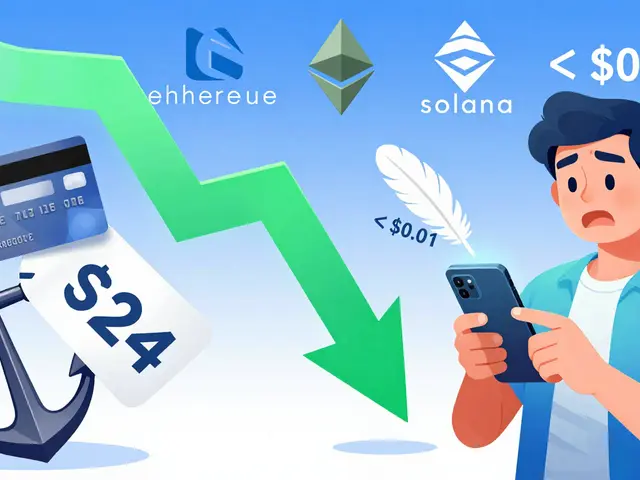
To understand how far we’ve come, you have to look at the numbers. Back in 2021, during the peak of the NFT boom, an average transaction on Ethereum could cost around $24. That was before you even accounted for slippage or exchange spreads. Today, thanks to massive upgrades in network architecture, that same type of activity often costs less than one cent.
This isn’t just a temporary dip; it’s a structural shift. The a16z Crypto is a leading venture capital firm specializing in blockchain and cryptocurrency investments reported in their State of Crypto 2025 analysis that monthly adjusted stablecoin transaction volume hit $1.25 trillion by September 2025. You don’t get that kind of volume if every transaction costs a dollar. The system simply wouldn’t scale. Instead, we are seeing a flood of micro-transactions that were previously economically impossible.
Why did this happen? It boils down to two main factors: better technology and more efficient markets. Networks like Solana is a high-performance blockchain platform known for its speed and low transaction costs have maintained consistently low fees as a core part of their identity. Meanwhile, Ethereum didn’t sit idle. It evolved. By moving heavy computational work off the main network, it cleared congestion and brought prices down for everyone else.
Layer-2 Solutions: The Secret Weapon Against High Gas
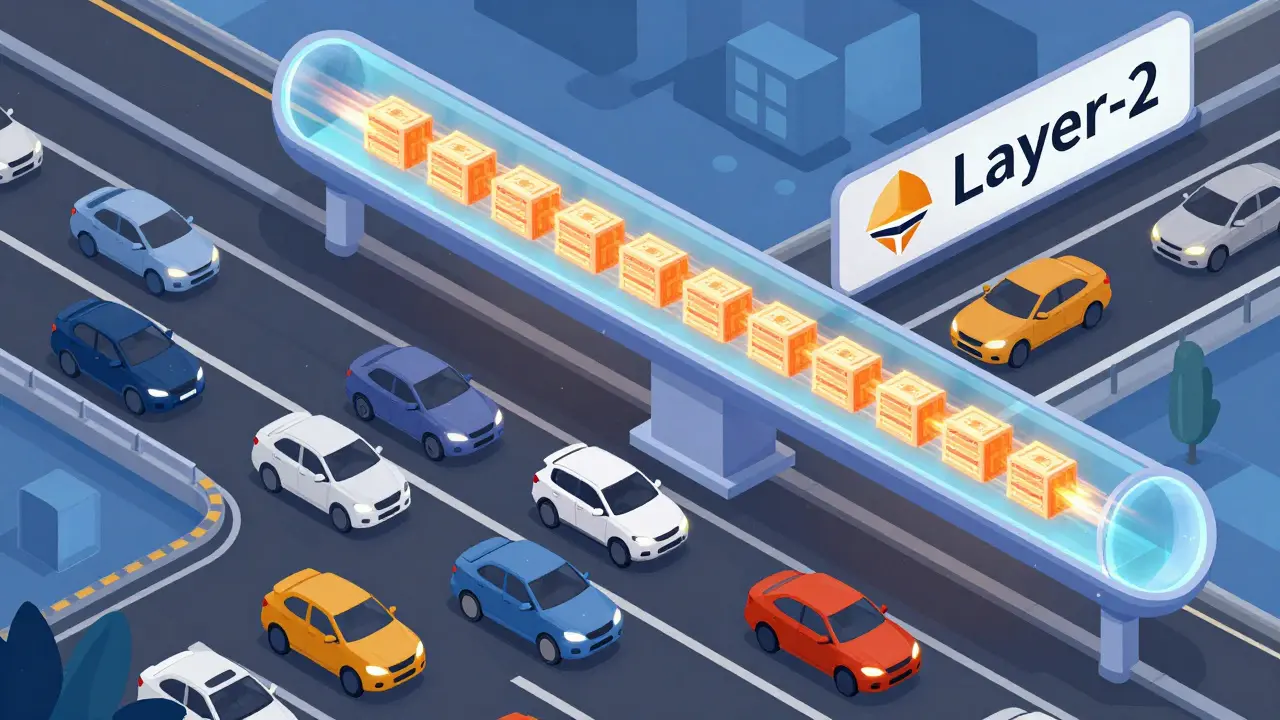
If you’re trying to figure out why Ethereum fees crashed, the answer lies in something called Layer-2 (L2) solutions. Think of the main Ethereum network as a busy highway. When traffic jams up, tolls go up. Layer-2s are like building new express lanes above the highway. They process thousands of transactions quickly and cheaply, then bundle them together and submit them to the main highway all at once.
This approach has been incredibly effective. Major L2 platforms like Arbitrum, Base, and Optimism now handle the bulk of economic activity on the Ethereum ecosystem. According to industry data, average transaction costs on these layers have plummeted from those painful $24 highs to sub-cent levels. For a user, this means you can swap tokens, buy an NFT, or interact with a DeFi app without holding your breath over the gas price.
But it’s not just about being cheap; it’s about being predictable. One of the biggest complaints in the past was fee volatility. You’d plan a transaction, check the price, and by the time you clicked confirm, the fee had doubled. With L2s, the variance is minimal. This stability is crucial for businesses that need to calculate margins accurately. You can’t run a subscription service if your processing fees swing wildly every hour.
Cross-Border Payments: Beating the Traditional Banks
Let’s talk about real-world impact. Where do blockchain fees shine brightest? Cross-border payments. Traditional banking systems are slow, opaque, and expensive. A typical international wire transfer takes 3 to 5 business days and eats up 2% to 7% of your money in hidden fees, foreign exchange spreads, and intermediary charges.
Blockchain flips this script. Settlement happens in under three minutes. And because there are no middlemen taking a cut at every hop, the total cost is a fraction of traditional methods. BVNK’s 2025 guide on blockchain in cross-border payments highlights that while exact costs depend on volume and conversion spreads, the savings are substantial. For remittances sent to developing nations, this difference between a 5% bank fee and a near-zero blockchain fee can mean the difference between poverty and stability for families.
The market is responding. The global cross-border payments market is projected to reach $290 trillion by 2030. A significant chunk of that flow is shifting onto blockchains. Stablecoins-cryptocurrencies pegged to fiat currencies like the US Dollar-are leading this charge. Projections suggest stablecoins could capture 20% of the global cross-border payments market by 2030, up from single digits just a few years ago. This adoption is driven entirely by the economics: faster, cheaper, and transparent.
| Feature | Traditional Bank Wire | Blockchain (Layer-2/Stablecoins) |
|---|---|---|
| Settlement Time | 3-5 Business Days | Under 3 Minutes |
| Average Cost | 2% - 7% | < 1% (often fractions of a cent) |
| Intermediaries | Multiple (Correspondent Banks) | None (Peer-to-Peer) |
| Transparency | Low (Hidden FX Spreads) | High (On-Chain Visible) |
Technological Drivers: ZK-Rollups and Protocol Upgrades
It’s not just Layer-2s doing the heavy lifting. Under the hood, fundamental protocol changes are making blockchains more efficient. On Ethereum, the implementation of EIP-4844, also known as proto-danksharding, was a game-changer. It introduced a new type of transaction specifically designed for rollups, allowing them to post data to the main chain much more cheaply. This upgrade alone slashed costs for users of apps built on top of Ethereum.
Another major player is Zero-Knowledge (ZK) technology. ZK-proofs allow the network to verify a transaction is valid without revealing the underlying data or requiring the entire network to re-process the calculation. This saves immense amounts of computing power. We are already seeing ZK systems integrated into compliance tools and even mainstream web services. Google’s recent integration of ZK identity systems shows this tech is bleeding out of crypto and into general tech infrastructure.
For privacy-focused chains like Zcash, the growth in shielded pool supply indicates that users are finding ways to transact privately without sacrificing efficiency. New protocols like Railgun, which processed over $200 million in monthly flows in 2025, demonstrate that private transactions can be scalable and affordable. As these technologies mature, we will see fewer trade-offs between security, privacy, and cost.

Regulation and the Institutional Wave
You can’t talk about the future of fees without mentioning regulation. For years, uncertainty held back big players. But in 2025, things started to clarify. The SEC and CFTC announced a coordinated approach to digital asset regulation in September 2025. While some rules might introduce compliance costs, they also bring legitimacy.
Institutions love predictability. When regulatory frameworks cap certain transaction fees or standardize disclosures, it makes it easier for banks and corporations to integrate blockchain rails. We saw this with the lifting of sanctions on Tornado Cash in Q2 2025, signaling a nuanced approach to privacy tools. As institutional interest surges-evidenced by the massive adoption of crypto ETFs and tokenized real-world assets-the demand for reliable, low-cost settlement layers grows.
However, keep an eye on consumer protection laws. Some proposed regulations aim to cap transaction fees for retail users or limit daily transaction amounts for new customers. While intended to protect consumers, these caps could force providers to innovate further in efficiency to maintain profitability. The net effect? Likely continued pressure to drive fees down, as inefficiency becomes legally risky.
What to Expect Between Now and 2030
So, where does this leave us? The trajectory is clear. Fees will continue to drop, but the nature of "fees" might change. We may see a shift from per-transaction micropayments to bundled subscription models for enterprise users. Imagine paying a flat monthly rate for unlimited low-value transactions, similar to how SMS bundles worked before data took over.
For individual users, the experience will become invisible. You won’t think about "gas" or "network fees." Your wallet will automatically route transactions through the cheapest available path, whether that’s Solana, an Ethereum L2, or a sidechain. Bridging technologies like LayerZero and Circle’s Cross-Chain Transfer Protocol are already making cross-chain movements seamless and cheap, removing the friction of choosing the right network.
By 2030, blockchain transaction fees will likely be negligible for most everyday interactions. The focus will shift from minimizing costs to maximizing utility-using those saved resources for better security, higher privacy standards, or richer application features. The barrier to entry is gone. The only question left is: what will you build now that it’s free?
Will blockchain transaction fees ever go to zero?
True zero fees are unlikely because validators and nodes need compensation for their energy and hardware costs. However, fees are approaching "near-zero" for users. Through Layer-2 batching and subsidies, end-users often pay fractions of a cent, making the cost effectively negligible for daily transactions.
How do Layer-2 solutions reduce Ethereum fees?
Layer-2 solutions process transactions off the main Ethereum chain and then bundle them into a single proof submitted to the mainnet. This reduces the computational load on the primary network, allowing thousands of transactions to share the cost of one mainnet block, drastically lowering individual fees.
Are blockchain payments safer than traditional bank transfers?
Blockchain offers cryptographic security and immutability, meaning transactions cannot be altered once confirmed. However, safety also depends on user behavior. Unlike banks, there is no central authority to reverse fraudulent transactions if you send funds to the wrong address. Using reputable wallets and verifying addresses is crucial.
What is the role of stablecoins in reducing transaction costs?
Stablecoins provide price stability, eliminating the risk of currency fluctuation during transfers. Because they operate on efficient blockchain networks, they bypass traditional banking intermediaries and foreign exchange spreads, resulting in significantly lower total costs for cross-border payments.
How will regulation affect blockchain fees in the future?
Regulation may introduce compliance costs for service providers, but it also brings institutional adoption. Clear rules encourage banks and large companies to use blockchain infrastructure, increasing network usage and efficiency. Some regulations may also cap consumer fees, forcing providers to optimize their operations further.

Write a comment