Remember when running a mining rig meant paying your electricity bill with Bitcoin profits? Those days are largely behind us. The crypto world has shifted gears, moving away from energy-hungry mining farms toward a cleaner, more efficient model called Proof of Stake. It is a consensus mechanism where validators secure the network by locking up their own tokens rather than solving complex mathematical puzzles. As we look at the landscape in 2025, this isn't just a technical tweak; it’s the backbone of the industry. With over $716 billion locked into the sector, Proof of Stake dominates the market, offering you a chance to earn passive income simply by holding and staking your assets.
You might be wondering why this matters to you. If you’re holding crypto, leaving it sitting in a wallet is like keeping cash under a mattress. Staking lets that money work for you. But not all staking opportunities are created equal. Some coins offer high rewards but come with high risks, while others provide stability but lower returns. In this guide, we’ll break down the top Proof of Stake cryptocurrencies in 2025, helping you decide where to park your funds for the best balance of reward, security, and accessibility.
Quick Summary: Key Takeaways
- Ethereum (ETH) remains the king of security and adoption, though its staking APR is modest at around 2.48%.
- Solana (SOL) offers a sweet spot with high speed, low fees, and attractive 7.58% staking rewards.
- Polkadot (DOT) and Cosmos (ATOM) lead in raw percentage yields, appealing to those seeking higher returns.
- Cardano (ADA) provides a user-friendly entry point with no lock-up periods and reasonable 4.96% rewards.
- Always consider the real yield, factoring in inflation and token dilution, not just the advertised APR.
Why Proof of Stake Dominates 2025
To understand which coins to pick, you first need to grasp why Proof of Stake won the battle against Proof of Work. The shift began in earnest after Ethereum transitioned to Proof of Stake in September 2022, an event known as "The Merge." This move slashed Ethereum’s energy consumption by nearly 99.95%, proving that blockchain networks could scale without burning fossil fuels.
In 2025, this efficiency is no longer just an environmental talking point; it’s an economic driver. Validators don’t need expensive ASIC miners or GPUs. They just need internet connectivity and the native token. This lowers the barrier to entry for securing the network, distributing power more broadly. For you, the investor, this means the ecosystem is more resilient. There are fewer single points of failure compared to the centralized mining pools of the past. Plus, regulatory bodies globally have warmed up to PoS because it doesn’t attract the same scrutiny regarding energy waste as Proof of Work does.
The Heavyweights: Ethereum and Solana
When people talk about staking, two names always dominate the conversation: Ethereum and Solana. They represent two different philosophies on how blockchain should work.
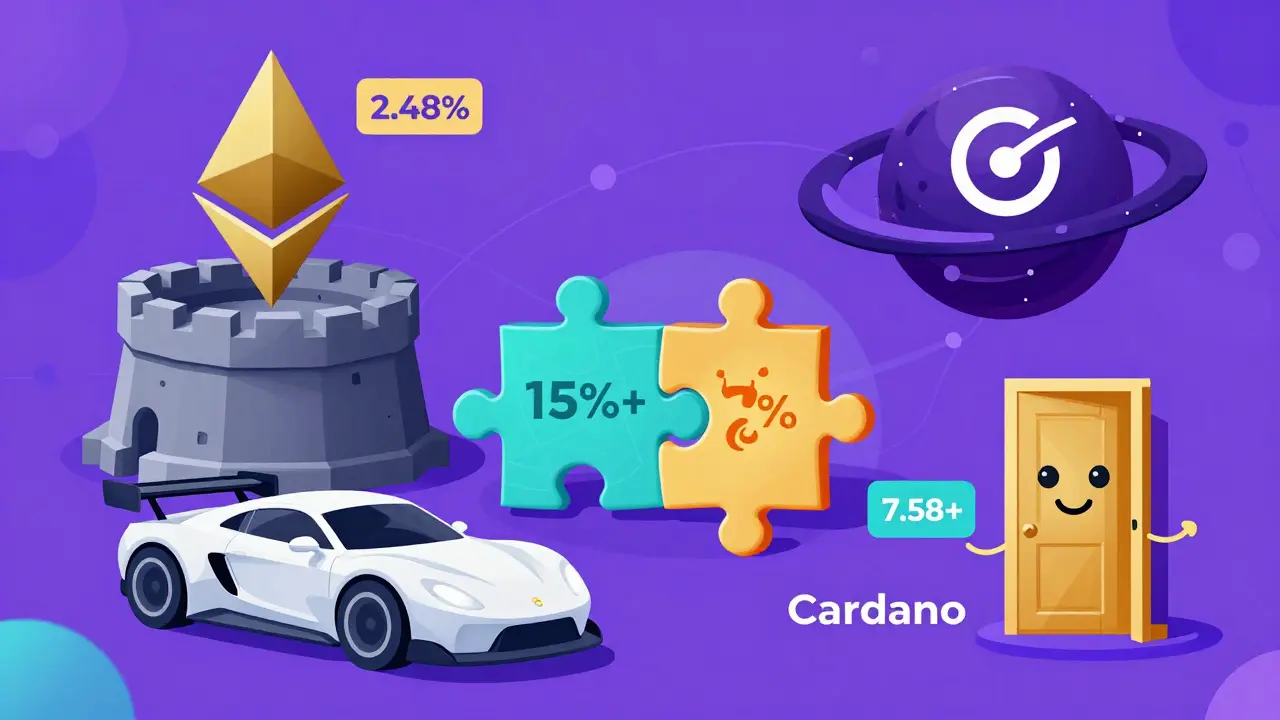
Ethereum (ETH) is the leading smart contract platform with the largest developer ecosystem and institutional adoption. In 2025, Ethereum commands a massive market capitalization of roughly $518 billion. Its strength lies in its security. With over 17.8 million ETH staked, it is arguably the most secure decentralized network in existence. However, security comes at a cost. The annual percentage rate (APR) for staking Ethereum hovers around 2.48%. While that might seem low compared to other coins, remember that Ethereum is deflationary during busy periods due to fee burns. You aren’t just earning interest; you’re participating in a network that destroys supply. Also, direct validation requires a hefty 32 ETH deposit (worth over $138,000 at current prices), forcing most retail users to rely on staking pools or liquid staking derivatives like Lido or Rocket Pool.
Solana (SOL) is a high-performance blockchain known for fast transaction speeds and low costs. Solana takes a different approach. It prioritizes speed and throughput. In 2025, Solana boasts a market cap of $125 billion and offers a much more attractive 7.58% staking APR. What makes Solana particularly appealing for everyday investors is the low barrier to entry. You only need 0.01 SOL to start staking. This means even if you hold just $2 worth of Solana, you can participate. The trade-off? Solana has historically faced network stability issues. While improvements in 2024 and 2025 have significantly reduced outages, the risk of temporary downtime remains a factor to consider when delegating your stakes.
High Yield Contenders: Polkadot, Cosmos, and Avalanche
If Ethereum’s 2.48% feels too conservative and Solana’s volatility keeps you up at night, there are mid-tier chains offering robust yields through innovative architectures.
Polkadot (DOT) is an interoperability protocol that connects specialized blockchains via parachains. Polkadot stands out in 2025 with the highest staking rewards among major established chains at 15.31% APR. This high yield reflects the network’s design: it encourages widespread participation to secure its relay chain. However, you must lock up a minimum of 350 DOT to run a validator, though delegation allows smaller holders to stake with less. The key here is understanding that high APR often correlates with higher inflation. Always check the net yield after accounting for new token issuance.
Cosmos (ATOM) is an ecosystem of interconnected blockchains using the Inter-Blockchain Communication protocol. Cosmos offers an exceptional 25.17% APR, making it one of the highest-yielding options in the top tier. This is driven by its modular architecture, where many applications build their own zones within the Cosmos ecosystem. The catch? Technical complexity. Managing ATOM stakes can be tricky, and the value of the token has been volatile. High rewards here are a compensation for both inflation and the technical effort required to maintain the network.
Avalanche (AVAX) is a scalable platform using subnet architecture for customizable blockchains. Avalanche sits comfortably in the middle with a 9.51% APR. Its unique selling point is the Subnet technology, which allows enterprises to build custom blockchains that still interact with the main AVAX chain. With a market cap of $13 billion, it offers a solid balance of growth potential and steady rewards. Note that direct validation requires 2,000 AVAX, so most users will delegate to trusted validators.
The User-Friendly Option: Cardano
Cardano (ADA) is a research-driven blockchain emphasizing peer-reviewed development and formal verification. Cardano appeals to those who prefer stability and simplicity over flashy features. In 2025, it offers a 4.96% staking reward. What sets Cardano apart is its user experience. Unlike Ethereum or Solana, Cardano has no lock-up period for delegated staking. You can unstake your ADA at any time, usually within a few epochs (days). The minimum requirement is just 2 ADA as a refundable deposit. This flexibility makes it ideal for beginners who want exposure to staking without worrying about liquidity constraints.
Critics often argue that Cardano’s development pace is slower than competitors. However, supporters point to its rigorous academic approach, which has resulted in a highly stable network with zero major security breaches since launch. For long-term holders who prioritize safety and ease of use, Cardano remains a compelling choice.
| Cryptocurrency | Staking APR | Min. Deposit (Direct) | Key Advantage | Main Risk |
|---|---|---|---|---|
| Ethereum (ETH) | 2.48% | 32 ETH | Highest Security & Adoption | Low Yields, High Entry Cost |
| Solana (SOL) | 7.58% | 0.01 SOL | Speed & Low Fees | Network Stability History |
| Cardano (ADA) | 4.96% | 2 ADA (Refundable) | No Lock-up Period | Slower Development Pace |
| Avalanche (AVAX) | 9.51% | 2,000 AVAX | Subnet Flexibility | Complex Validator Setup |
| Polkadot (DOT) | 15.31% | 350 DOT | Interoperability Focus | High Inflation Impact |
| Cosmos (ATOM) | 25.17% | Varies | Highest Yield | Technical Complexity |
Understanding Real Yield vs. Advertised APR
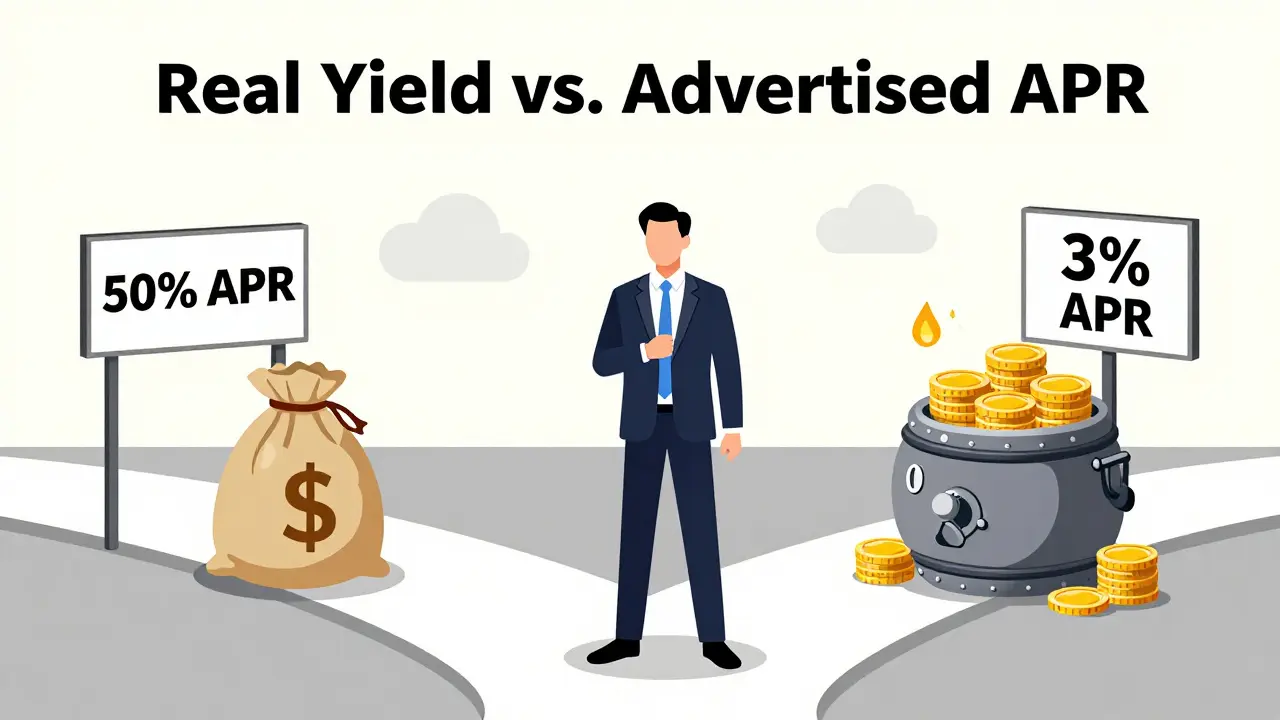
Here is where most new stakers get tricked. A coin advertising 20% APR sounds better than one at 3%, right? Not necessarily. You need to calculate the real yield. Many PoS networks are inflationary, meaning they mint new tokens to pay validators. If a network inflates by 10% annually and pays you 10% in rewards, your actual purchasing power hasn’t increased-it’s stayed flat.
Koinly’s 2025 analysis emphasizes that you must look beyond the headline number. Ask yourself: Is the token price appreciating? Is the network burning fees? Ethereum’s real yield is often higher than its APR suggests because its deflationary pressure increases the value of each ETH held. Conversely, some newer projects with 50% APR may see their token price drop by 40% in a year, resulting in a net loss. Always diversify your staking portfolio across networks with different monetary policies to mitigate this risk.
How to Start Staking in 2025
Getting started is easier than ever. You generally have three paths:
- Exchange Staking: Platforms like Coinbase, Binance, or Kraken allow you to stake directly from your account. This is the easiest method but offers the least control. You rely on the exchange to act as your validator.
- Self-Custody Wallets: Using wallets like Ledger, Trezor, or MetaMask, you can delegate your tokens to specific validators. This gives you more security and control over who secures the network. Most major wallets now have built-in staking interfaces.
- Liquid Staking: For Ethereum specifically, you can swap your ETH for liquid staking tokens (like stETH). This allows you to earn staking rewards while still being able to trade or use your assets in DeFi protocols. This adds complexity and smart contract risk, so proceed with caution.
Whichever route you choose, never delegate your entire holdings to a single validator. Spread your stakes across multiple nodes to avoid slashing penalties if one validator misbehaves or goes offline.
Is staking Proof of Stake cryptocurrencies safe?
Staking is generally safer than leaving funds on a centralized exchange, but it carries risks. These include smart contract vulnerabilities, validator slashing (where you lose part of your stake if the validator acts maliciously), and market volatility. Always research the security track record of the network and the validator you choose.
Can I lose my money while staking?
Yes. If the cryptocurrency's price drops significantly, the value of your staked assets decreases. Additionally, if you use a validator that gets slashed due to poor performance or malicious activity, you may lose a portion of your staked tokens. However, reputable networks have mechanisms to minimize these losses.
What is the difference between staking and lending?
Staking involves locking your tokens to help secure a blockchain network and earn rewards issued by the protocol itself. Lending involves borrowing out your crypto to other users or institutions and earning interest from their repayments. Staking is integral to the network's operation, while lending is a financial service built on top of it.
Do I need to pay taxes on staking rewards?
In most jurisdictions, including the US and EU, staking rewards are considered taxable income at the time you receive them. You are responsible for reporting the fair market value of the rewards on the date they were credited to your wallet. Consult a tax professional for advice specific to your situation.
Which Proof of Stake coin is best for beginners?
Cardano (ADA) and Solana (SOL) are often recommended for beginners due to their low minimum staking requirements and user-friendly interfaces. Cardano offers the advantage of no lock-up periods, allowing you to unstake easily, while Solana provides a good balance of speed and yield.
Write a comment