There’s no single rule for cryptocurrency in the United States. If you’re running a crypto business, trading heavily, or just holding digital assets, where you live matters more than you think. In 2026, 47 states have their own rules - some welcoming, others punishing. This isn’t just paperwork. It’s about whether your business survives, how fast you can move money, and even if you can get a bank account at all.
Why State Rules Matter More Than Federal Ones
The federal government still hasn’t settled on a clear policy for crypto. Yes, the GENIUS Act passed in September 2025, but it doesn’t override state laws. It just sets a floor - minimum standards that states can build on, not replace. That means if you’re in New York, you’re playing by rules written in 2015. If you’re in Wyoming, you’re operating under a system designed in 2018 to attract crypto firms. There’s no national playbook. You have to know your state.
Take this real example: A crypto startup in Brooklyn spent $187,000 on compliance for a year and made zero revenue. They moved to Wyoming. Within 18 months, their transaction volume tripled. Why? Because one state makes it a nightmare, and another makes it a launchpad.
New York: The Hardest State to Operate In
New York’s BitLicense is the gold standard for strictness - and the nightmare for startups. Created in 2015 by the Department of Financial Services (NYDFS), it’s not just a registration. It’s a full license with five major requirements:
- $5,000 application fee
- $2 million minimum net capital
- Detailed business plan and risk assessment
- 80% of digital assets stored in NYDFS-approved cold wallets
- Biometric access controls for all custody systems
As of September 2025, only 37 companies had active BitLicenses out of 104 applications. The average approval time? 14.3 months. Annual compliance costs? Around $350,000 per company. That’s not a tax. That’s a barrier to entry.
And it’s not just the cost. New York requires onsite inspections. You need to prove your cybersecurity meets Regulation 500.00 - the same standard banks use. One crypto exchange in Queens told regulators they used a third-party custodian. The response? “We still need to audit your internal controls.”
Consumer complaints take 217 days to resolve on average. That’s over seven months. Compare that to California, where disputes are settled in under 30 days. No wonder companies like Coinbase and Circle moved their headquarters out of New York. The state isn’t stopping crypto - it’s just making sure only the biggest players can afford to stay.
Wyoming: The Crypto-Friendly State
Wyoming didn’t just make crypto rules. It rewrote the banking system. In 2018, it created Special Purpose Depository Institutions (SPDIs) - state-chartered banks that can hold crypto as assets. These aren’t just crypto exchanges. They’re full banks with FDIC insurance, check-writing, and lending.
Companies like Kraken Bank and Avanti Financial Group operate under this model. In 2024, SPDIs processed $12.7 billion in crypto transactions. That’s not a drop in the bucket - it’s a growing financial infrastructure.
Here’s what makes Wyoming different:
- No state income tax - ever
- No capital requirements for non-bank crypto firms under $35,000 in annual volume
- Clear legal status: crypto is property, not a security
- SPDIs require $25 million in capital, but offer full banking services
Since 2020, Wyoming has captured 63% of all new crypto banking jobs in the U.S. That’s not luck. It’s policy. The state even passed a law saying crypto transactions don’t count as “money transmission” under state law - removing a huge regulatory hurdle.
And it’s working. A 2025 report from the Wyoming Economic Development Association showed crypto-related activity contributed $427 million to the state’s revenue - 7.3% of its total income. New York, with 10 times the population, made $189 million - just 0.8% of its revenue.
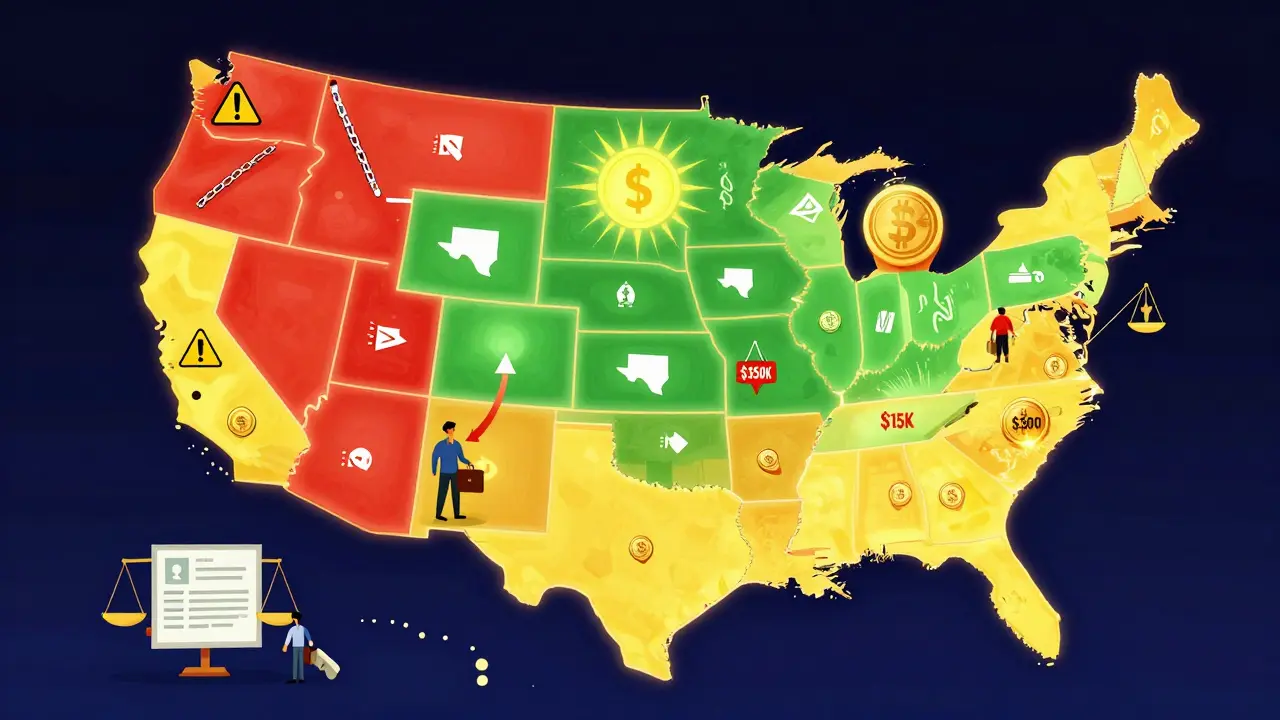
California: The Middle Ground
California doesn’t try to be Wyoming or New York. It tries to be practical. Under the California Financing Law (effective January 1, 2023), any business handling over $500,000 in crypto annually must register with the Department of Financial Protection and Innovation (DFPI). That’s it.
There’s no $2 million capital requirement. No biometric locks. No onsite exams. Just a simple form, a $500 fee, and proof of a cybersecurity plan. The registration process takes 45 to 60 days.
As of Q3 2025, 142 crypto businesses were registered. That’s more than any other state except maybe Texas. And California’s enforcement is targeted: 17 actions in two years, mostly against scams, not legitimate firms.
Users benefit too. Dispute resolution time? 38% faster than the national average. Customer satisfaction? 4.2 out of 5 for exchanges operating mainly in California. That’s higher than New York’s 2.8.
California’s approach is simple: regulate the big players, leave the small ones alone. It’s not perfect - but it’s working.
Other Key States: What You Need to Know
Not every state has a headline-grabbing law. But if you’re operating across state lines, you can’t ignore them.
Texas
Texas doesn’t require a license. Instead, crypto firms must file a simple notice with the Department of Banking. They need a basic cybersecurity plan and must report suspicious activity. No bonding. No capital. No exams. The state’s Finance Code Chapter 152 treats crypto like a commodity - not money. That’s a big deal for traders.
Louisiana
Louisiana’s law (enacted in 2022) is one of the most user-friendly for small operators. If you handle less than $35,000 in crypto per year, you’re exempt. No registration. No fees. Just keep records. For freelancers or small businesses accepting crypto payments, this is a gift.
Arizona
Arizona’s “regulatory sandbox” lets crypto firms test new products without full licensing. 34% faster startup growth compared to non-sandbox states. Companies like Circle and Coinbase have used it to pilot new stablecoin features. It’s not permanent, but it’s a fast track to market.
Massachusetts
Massachusetts is one of the toughest. Secretary of the Commonwealth William Galvin called the state-by-state system a “recipe for disaster.” The state has frozen 12 crypto firms since 2023 and recovered $2.1 billion in scam funds. But it’s also driving businesses out. One exchange moved its entire operation to Nevada after being told it needed a $500,000 bond - something no other state requires.

Costs and Hidden Barriers
It’s not just about licenses. It’s about what they cost.
| State | Annual Cost | Key Requirement |
|---|---|---|
| New York | $350,000 | BitLicense, cold storage, biometrics |
| California | $85,000 | Registration, transaction monitoring |
| Wyoming | $42,000 | SPDI charter or simple registration |
| Texas | $15,000 | Notice filing, cybersecurity plan |
| Massachusetts | $250,000+ | $500,000 bonding requirement |
Multi-state operators spend an average of $287,000 per year just on state compliance. That’s not R&D. That’s not marketing. That’s lawyers, auditors, and software just to stay legal.
And it gets worse. Sixty-three percent of firms operating in more than two states say they struggle with conflicting definitions. Is crypto a security? A commodity? A currency? New York says one thing. Wyoming says another. The SEC says something else. You’re stuck in the middle.
What This Means for You
If you’re a user: Your rights depend on where you live. If you’re in New York and your exchange freezes your funds, you’re looking at a 7-month wait. In California? You’ll likely get an answer in 30 days.
If you’re a business: Don’t assume you can operate everywhere. You need a state-by-state compliance plan. The cost of ignoring this? Fines, shutdowns, or worse - being forced to move.
If you’re a developer or founder: Location is strategy. Found a team? Don’t set up shop in New York unless you have $1 million in capital. Want to scale fast? Go to Wyoming. Need a big market? California’s your best bet.
The federal government may eventually step in. But right now, the states are the real regulators. And they’re not waiting.
What’s Coming Next?
The GENIUS Act is just the beginning. Twenty-two states are already suing over it, claiming federal overreach. Meanwhile, 14 states are drafting laws to align with federal rules. Eleven - including Massachusetts and Connecticut - are doubling down on their own powers.
By 2027, experts predict one of two outcomes: either Washington takes full control - or it officially recognizes state authority as part of a federal-state partnership. Until then, the patchwork stays.
For now, your best move? Know your state. Understand your risks. And don’t assume what’s true in one place is true everywhere.
Do I need a license to hold cryptocurrency as an individual?
No. Individual crypto holders don’t need any license in any state. State regulations only apply to businesses that transmit, store, or exchange crypto - not people who buy, hold, or sell for personal use.
Can I operate a crypto business from home?
It depends. In Texas, Wyoming, and Louisiana, yes - as long as you stay under the volume thresholds. In New York or Massachusetts, no. You’ll need a physical office, bonded employees, and state-approved security systems. Home-based operations are almost never allowed in strict states.
What happens if I ignore state crypto laws?
You risk fines, asset seizures, or criminal charges. In 2024, New York fined a crypto firm $12 million for operating without a BitLicense. California shut down 17 unregistered platforms. Massachusetts froze bank accounts linked to unlicensed exchanges. Ignoring state rules isn’t a gray area - it’s a legal trap.
Which states are the safest for crypto startups?
Wyoming, Texas, and California are the top three. Wyoming offers banking access and low costs. Texas has minimal reporting. California balances regulation with market size. Arizona’s sandbox is great for testing new products. Avoid New York, Massachusetts, and Connecticut unless you’re well-funded.
Do I need to pay taxes differently based on my state?
Crypto tax rules are federal, but state income taxes vary. Wyoming and Texas have no state income tax - so crypto gains are tax-free at the state level. California taxes crypto gains at up to 13.3%. New York taxes at 10.9%. Your state determines your tax bill, not the federal government.
Is crypto legal in all 50 states?
Yes. No state has banned owning or using cryptocurrency. But 47 states regulate businesses that handle crypto. So while you can hold Bitcoin in Alabama, you can’t run a crypto exchange there without following state rules - if they have any.

Patty Atima
Wyoming just won the crypto game. No cap.
Ernestine La Baronne Orange
Let me tell you something-this whole state-by-state mess is a disaster waiting to happen. New York’s rules are brutal, sure-but have you seen what happens when you let Wyoming run wild? No oversight, no accountability, just crypto bros with ATMs in the desert. And now they’re calling it ‘banking’? Please. This isn’t innovation, it’s a regulatory free-for-all. Someone’s gonna get burned, and it won’t be the billionaires. It’ll be the grandma who trusted ‘Kraken Bank’ with her retirement. And then? The feds will swoop in, shut everything down, and we’ll be back to square one. Except now, no one trusts anything. Great job, America.
Tony Weaver
California’s ‘practical’ approach is a joke. Registering with DFPI? That’s like saying ‘I’m not a criminal’ by filling out a form at the DMV. Meanwhile, the state’s top 5 crypto firms are all owned by hedge funds that don’t even live there. They’re using California as a tax loophole and a PR front. And you call that ‘balanced regulation’? It’s performance art for venture capitalists. Wyoming’s the only one doing it right-by not pretending to regulate at all. Let the market decide. That’s capitalism. This? This is regulatory theater with extra steps.
Lauren J. Walter
So… Texas just says ‘hi’ and moves on? No bond? No audit? No ‘prove you’re not a scammer’ paperwork? That’s not a regulatory framework. That’s a nap. I love it.
Taylor Holloman.
I get why people love Wyoming. But let’s not pretend it’s all sunshine and stablecoins. The SPDI model works because it’s built on a tiny population with zero political pressure. Try scaling that to a state with 20 million people. The moment you get a real financial crisis-someone’s crypto wallet gets hacked, a bank fails, a stablecoin depegs-Wyoming’s ‘light-touch’ approach looks less like innovation and more like negligence. And when that happens? The feds don’t care about your ‘property’ classification. They’ll come in with a sledgehammer. Wyoming’s not a model-it’s a test balloon. And balloons eventually pop.
Carol Lueneburg
YESSSS 😍 Wyoming is the future!!! I just moved my LLC there and my heart hasn’t stopped singing since 🎶💸 No taxes, no drama, just pure crypto vibes. If you’re still stuck in NY or CA, please come visit. I’ll buy you a margarita and show you how freedom feels. 🌵✨
Lucy de Gruchy
You think this is about regulation? It’s about control. New York’s BitLicense? A Trojan horse. Every ‘compliance’ requirement is a backdoor for surveillance. Biometric access controls? Cold storage audits? That’s not security-that’s identity tracking disguised as consumer protection. And Wyoming? A distraction. They’re not helping crypto-they’re luring it into a legal void so the feds can later claim ‘chaos’ and justify federal takeover. This isn’t state vs federal. It’s a slow-motion power grab. And you’re all just cheering for the wrong side.
Christopher Hoar
Bro Wyoming has no income tax so like… why would anyone not move there? I’m not even in crypto and I’m thinking about relocating. Like, I can just sit in my van in the desert and mine Bitcoin and not pay taxes?? Sign me up. Also, New York’s $350k compliance cost? That’s just a tax on being poor. No wonder all the startups leave. They’re not running from crypto-they’re running from New York.
Zachary N
For anyone thinking about starting a crypto business, please don’t just read this guide-you need to talk to actual lawyers in each state. The differences aren’t just numbers. They’re legal interpretations. For example: California says ‘registration’ means you’re not a money transmitter. But the IRS? They still classify crypto as property. So you’re stuck between state paperwork and federal taxation. And if you’re cross-state? You’re now playing 3D chess with compliance. I’ve helped 12 startups navigate this. The ones who survived? They didn’t pick a state. They picked a law firm. And they budgeted for 3 years of legal fees before touching a single coin.
john peter
One must ask: Is this not a manifestation of the American federal experiment’s decay? The Constitution envisioned a union, not a patchwork of competing sovereignties. The GENIUS Act was a step toward coherence, yet the states, in their parochial vanity, cling to their regulatory fiefdoms. This is not governance-it is feudalism with Wi-Fi. The individual, the honest actor, is caught in the gears of bureaucratic fragmentation. The market, left to its own devices, would have harmonized long ago. But no-we must have 47 different definitions of ‘property,’ each with its own clerks, its own fees, its own rituals. This is not innovation. This is institutional decay dressed in blockchain.
Tobias Wriedt
People don’t get it. Crypto isn’t about money. It’s about freedom. And New York? They’re trying to turn Bitcoin into a bank account. Wyoming? They’re letting it be what it was meant to be: unchained. If you’re still scared of decentralized systems… maybe you should stick to your 401(k) and your credit card rewards. 🤷♂️
Prakash Patel
Interesting how everyone ignores that 80% of crypto activity in Wyoming is from out-of-state entities. It’s not a ‘crypto haven’-it’s a tax shelter with a fancy name. They’re not building infrastructure. They’re just exporting regulation. Meanwhile, real communities in Texas and California are building actual services, hiring locals, and paying taxes. Wyoming’s just a mailbox with a bank charter. Don’t romanticize a loophole.
Marc Morgan
Wyoming’s SPDI is genius. But let’s be real-no one’s going to move to Wyoming to run a crypto business unless they’re already rich. The real winners? The ones who set up in Texas. No license. No capital. Just a website, a server, and a PayPal account. I know a guy who runs a $2M/month exchange from his garage in Austin. He files a 3-page form once a year. He’s not a ‘bank.’ He’s not a ‘business.’ He’s just… there. And the state doesn’t care. That’s the real crypto future: not banks, not licenses, just people doing stuff without asking permission.
Brenda White
wait so if i just sell like 1000$ worth of btc to my friend in cali and he pays me in cash… im fine?? no registration?? no tax?? like… is this legal??
Zachary N
Yes. Under California law, if you’re not a business and you’re not regularly exchanging crypto for fiat (i.e., you’re not a dealer), then it’s treated as a personal sale. No registration. No reporting. But-here’s the catch-you still owe federal capital gains tax. The state doesn’t care. The IRS does. And they’re getting way better at tracking on-chain activity. So if you’re selling crypto to friends… keep receipts. Because one day, you’ll get a 1099 from Coinbase that says ‘$8,000 in proceeds.’ And then you’ll have to explain why you didn’t report it. Don’t get cute. The feds aren’t playing.
Elizabeth Kurtz
As someone who moved from Lagos to Austin last year, I can say this: America’s crypto patchwork is wild-but it’s also beautiful. In Nigeria, you need a license just to hold BTC. Here? You can buy, sell, hold, and send without anyone asking. Wyoming, Texas, California-they’re all different. But they’re all free. That’s the real story. Not the numbers. Not the fees. The freedom. Even if it’s messy. Even if it’s confusing. It’s still better than being told what you can and can’t own. 🇳🇬→🇺🇸
Kira Dreamland
I’m a freelance graphic designer and I get paid in ETH. I live in Oregon. No one’s ever asked me for a license. I just file my taxes like normal. I think people make this way more complicated than it needs to be. If you’re not running a business, just… don’t overthink it.
shreya gupta
It is ironic that while the United States is divided on cryptocurrency regulation, India has banned all crypto exchanges. Perhaps the U.S. model, despite its chaos, is superior. But one must question: Is this regulatory fragmentation not a form of economic colonialism, where states compete for corporate capital by offering deregulation? The result is not liberty, but a race to the bottom. And who pays? The consumers, the workers, the small businesses caught in the crossfire.
Shreya Baid
While the legal landscape is fragmented, the underlying truth remains: cryptocurrency is not a state issue-it is a human issue. Individuals, regardless of geography, deserve the right to transact, store value, and participate in financial innovation without permission. The regulatory chaos reflects not a failure of governance, but a failure of imagination. We are building the financial future of the 21st century, yet we cling to 20th-century frameworks. The states are not the problem. The problem is that we have not yet dared to reimagine what a truly decentralized, global financial system could look like. Let us not mistake state-level experimentation for the endgame. It is merely the beginning.
Anastasia Thyroff
I just want to hold my Bitcoin and cry