You might have heard that Bitcoin is just digital gold-a store of value with limited programmability. That was the standard narrative for years. But a new wave of innovation is changing that story, and it’s not coming from Ethereum or Solana. It’s coming from inside Bitcoin’s own script language. Enter the Cat Protocol, identified by its ticker OPCAT. This isn’t just another meme coin; it’s the first CAT20 token deployed on Fractal Bitcoin, a scaling solution that brings smart contract capabilities to the Bitcoin ecosystem without relying on off-chain indexers.
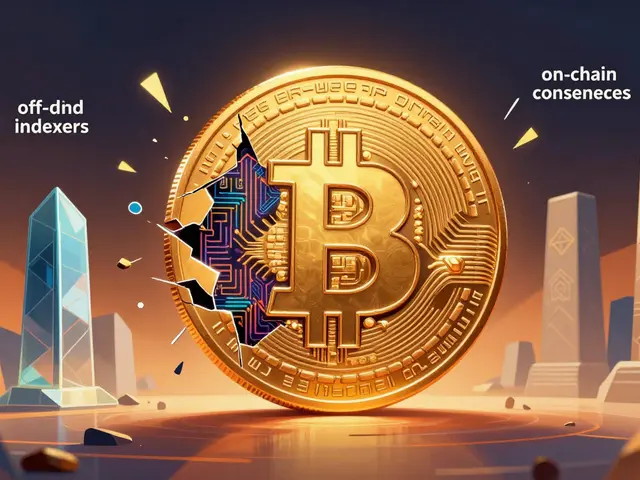
If you’re confused about how tokens work on Bitcoin when the base layer doesn’t natively support complex smart contracts like Ethereum does, you’re not alone. Traditional solutions like BRC-20 rely heavily on external indexers-third-party services that track transactions to determine who owns what. This creates a centralization risk. If the indexer goes down or makes an error, your asset tracking breaks. The Cat Protocol solves this by using a re-enabled opcode called OP_CAT. It allows the Bitcoin network itself, via miners, to validate token rules directly on Layer 1. No middlemen. No trust required. Just pure Bitcoin security backing your tokens.
The Core Innovation: OP_CAT and Covenants
To understand why OPCAT matters, you need to look under the hood at OP_CAT. This is an operation code in Bitcoin Script that concatenates two data fragments on the stack into a larger element. Sounds simple, right? It actually packs a punch. Originally disabled in 2010 due to security concerns, the community has recently revived interest in OP_CAT because it enables recursive covenants. These covenants allow scripts to enforce rules on future transactions, which is essential for creating stateful tokens on a UTXO-based blockchain like Bitcoin.
The Cat Protocol leverages this mechanism to manage token mints and transfers. Unlike other protocols that require you to trust an indexer to tell you if you have enough balance to send a transaction, Cat Protocol ensures that every rule is guaranteed by the Bitcoin consensus. When you try to mint more tokens than allowed, the network rejects the transaction immediately. There’s no waiting for an indexer to catch up or disagree. This design choice significantly reduces the attack surface and aligns token security with the underlying Proof of Work security of Bitcoin.
Fractal Bitcoin: The Scaling Solution
You can’t run high-frequency DeFi applications on the main Bitcoin chain without clogging it up. That’s where Fractal Bitcoin comes in. It’s a Bitcoin-compatible blockchain designed specifically for scaling Bitcoin transactions. Think of it as a sidechain or a Layer 2 solution that maintains compatibility with Bitcoin’s consensus mechanisms but offers higher throughput. OPCAT was created as the first CAT20 token on this network, serving as a proof-of-concept for decentralized finance (DeFi) on Bitcoin.
By deploying on Fractal Bitcoin, OPCAT benefits from faster block times and lower fees while still inheriting the security guarantees of the parent chain. This setup allows developers to build automated market makers (AMMs), lending platforms, and staking protocols that feel familiar to anyone who has used Uniswap or Aave, but with the robustness of Bitcoin’s architecture. The goal here isn’t to replace Ethereum but to bring Bitcoin’s massive liquidity and security into the world of programmable money.
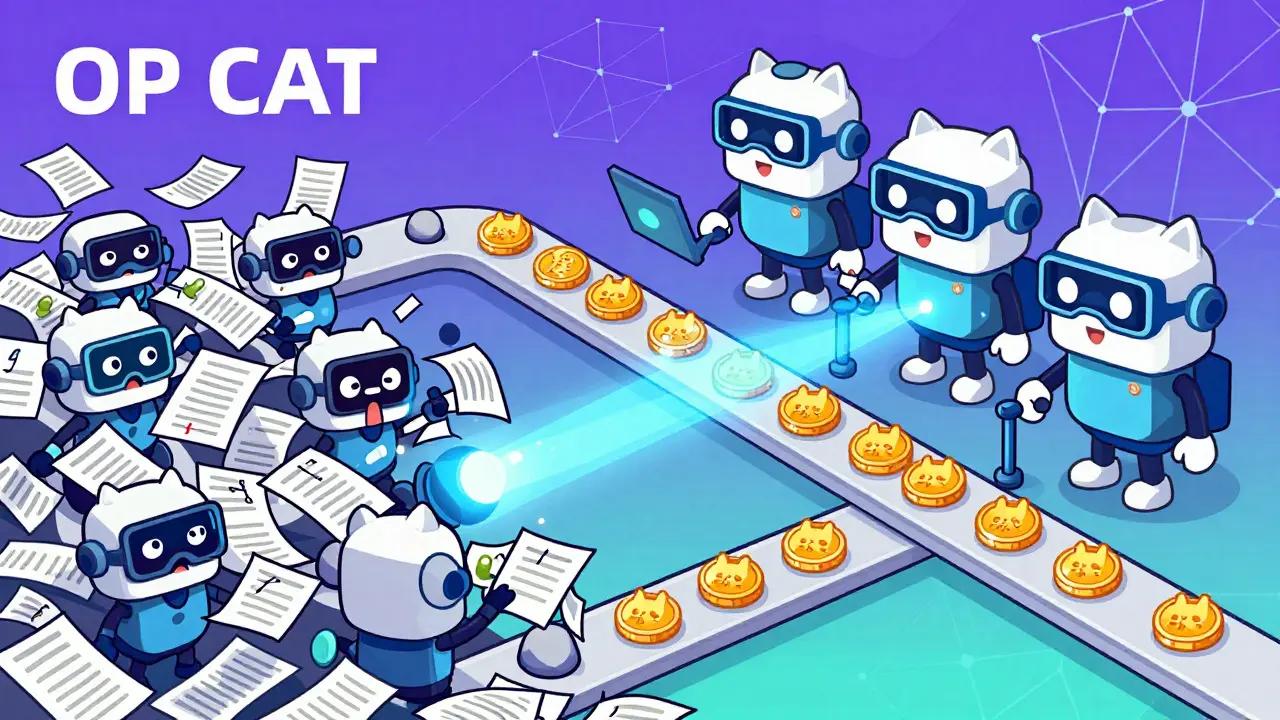
CAT20 vs. Other Bitcoin Standards
The crypto space is littered with failed attempts to create fungible tokens on Bitcoin. You’ve got Omni Layer, Counterparty, and the recent boom in Ordinals and BRC-20. Each has its flaws. BRC-20, for instance, is popular but fragile. It relies entirely on indexers to parse JSON data embedded in witness fields. If different indexers disagree on the history, you get conflicting balances. This fragmentation causes real headaches for exchanges and wallets.
| Feature | BRC-20 | Ordinals | Cat Protocol (OPCAT) |
|---|---|---|---|
| Validation Method | Off-chain Indexer | Off-chain Indexer | On-chain Consensus (Miner Validated) |
| Smart Contract Support | Limited | Limited | Full (via Covenants) |
| Security Risk | Indexer Centralization | Indexer Centralization | Low (Native Bitcoin Security) |
| Over-minting Prevention | Soft Rule (Indexer enforced) | N/A | Hard Rule (Network enforced) |
The table above highlights why many developers are watching the Cat Protocol closely. By moving validation on-chain, it eliminates the single point of failure inherent in indexer-based systems. While BRC-20 tokens exploded in popularity due to ease of creation, they lacked the technical rigor needed for serious financial applications. OPCAT aims to bridge that gap by offering a standardized, secure, and scalable foundation for Bitcoin-native assets.
Tokenomics and Market Status
As of mid-2026, OPCAT has a fixed maximum supply of 21 million tokens, mirroring Bitcoin’s scarcity model. The circulating supply matches the total supply, meaning all tokens have been minted. This deflationary structure appeals to investors looking for scarce assets within the Bitcoin ecosystem.
Market data shows some volatility and fragmentation. Prices vary significantly across exchanges, ranging from roughly $0.013 to $0.20 depending on the platform and trading pair. This discrepancy often reflects low liquidity rather than fundamental differences in value. Major exchanges like Binance, Crypto.com, and Gate.com list the token, but trading volumes remain modest compared to top-tier cryptocurrencies. With a market capitalization hovering around $4 million on some trackers and under $1 million on others, OPCAT is still in its early adoption phase.
Despite the small market cap, the presence of OPCAT on multiple major exchanges signals growing interest. It’s ranked between position 1,400 and 5,400 in global crypto rankings, depending on the source. For speculators, this low ranking represents potential upside if the Cat Protocol gains wider traction. For skeptics, it indicates a niche product that hasn’t yet captured mainstream attention.
Use Cases and Future Potential
So, what can you actually do with OPCAT today? Currently, it serves primarily as a governance and utility token for the Fractal Bitcoin ecosystem. However, the broader CAT protocol supports both fungible (CAT20) and non-fungible (CAT721) tokens. This means we could see NFTs on Bitcoin that don’t rely on external metadata servers, as well as stablecoins and yield-bearing assets.
The protocol also supports cross-chain interoperability. Assets can be bridged between different blockchains without trusting a centralized custodian. Imagine moving Bitcoin-backed assets to Ethereum or vice versa seamlessly, verified by SPV (Simplified Payment Verification). This feature makes lightweight clients, like mobile wallets, much more powerful because they can verify token authenticity independently without downloading the entire blockchain.
Looking ahead, the success of OPCAT depends on two things: the broader adoption of OP_CAT on the main Bitcoin network and the growth of the Fractal Bitcoin user base. If Bitcoin developers continue to enable advanced scripting features, protocols like Cat could become the standard for building DeFi on Bitcoin. Right now, it’s a promising experiment, but one that challenges the status quo of how we think about token issuance on the world’s oldest blockchain.
Frequently Asked Questions
Is OPCAT a meme coin?
While it started as a memecoin implementation, OPCAT is technically a functional DeFi token built on the CAT20 standard. Its value proposition lies in its underlying technology-the miner-validated Cat Protocol-rather than just social hype. However, like most early-stage tokens, price action is still heavily influenced by speculation.
How is OPCAT different from BRC-20 tokens?
The key difference is validation. BRC-20 tokens rely on off-chain indexers to track ownership, which introduces centralization risks and potential inconsistencies. OPCAT uses the OP_CAT opcode to enforce token rules directly on the blockchain via Bitcoin consensus, making it more secure and trustless.
Where can I buy OPCAT?
OPCAT is listed on several major cryptocurrency exchanges, including Binance, Crypto.com, Gate.io, Poloniex, and others. Always check current liquidity and trading pairs before purchasing, as prices can vary significantly between platforms due to lower volume.
What is Fractal Bitcoin?
Fractal Bitcoin is a scaling solution compatible with the Bitcoin network. It allows for faster transactions and lower fees while maintaining security ties to Bitcoin. OPCAT was the first CAT20 token deployed on this network, serving as a testbed for Bitcoin-native DeFi applications.
Does OPCAT have a fixed supply?
Yes, OPCAT has a hard-capped maximum supply of 21 million tokens. All tokens have already been minted, meaning there is no inflation from new emissions. This scarcity model is similar to Bitcoin’s own monetary policy.
Aaliyah Simpson
Great, another Bitcoin derivative that probably just dumps on retail. I bet the OP_CAT thing is just a fancy way to keep miners in control while we get rugged.
Jarnail Singh
Finally someone acknowledges that India has some of the smartest minds working on blockchain scalability but let's be real here 🤓 the US always takes credit for innovation when it comes to crypto 😎 honestly OPCAT is cool but Fractal Bitcoin needs more Indian devs contributing to the core repo or else its just another western project 💪🏽
Ashwini Chaskar
i feel like everyone is so obsessed with tech specs they forget the human element of money... its not just about validation methods its about trust and community which feels lacking here...
Sam Ariafar
The reliance on indexers for BRC-20 was a moral failing of the early adopters who prioritized speed over security. We have a duty to build systems that are ethically sound and technically robust. OPCAT represents that necessary correction.
Ian Munro
Clean architecture. On-chain validation is the only way forward for serious DeFi.
J Shepherd
Love seeing covenant-based solutions gain traction. The UX friction from indexer latency has been a massive barrier to entry for non-technical users. By shifting validation to consensus, you're effectively removing the 'trust me bro' layer entirely. Keep building! 🚀
Alan Hawkins
I think the comparison table is really helpful for people trying to understand why this matters. It’s clear that moving away from off-chain dependencies reduces risk significantly.
Steve Sulley
but dont u think its ironic? bitcoin was supposed to be peer to peer cash not a settlement layer for tokens that need covenants to work?? we are just reinventing altcoins on top of btc again lol its all circular man
Linda Jevne
There is something profoundly poetic about reviving an opcode from 2010 to unlock new possibilities. It reminds us that technology is cyclical and that wisdom often lies in looking back before leaping forward. The narrative of 'digital gold' evolving into 'programmable money' is a fascinating cultural shift.
Rajni Mathur
Look at those price discrepancies!! 📉 $0.013 vs $0.20 is insane volatility. This screams low liquidity and potential manipulation. Don't get too attached to the tech if the market structure is broken. 🧐💸
Nadia Christian
This is exactly what America needs!!! More innovation coming out of our ecosystem!!! Go USA!!! 🇺🇸🇺🇸🇺🇸 Love to see it!!!
Martha Packard
You claim it's secure because miners validate it, but miners are profit-driven entities. If validating CAT20 transactions becomes less profitable than other things, do they stop? The ontology of 'security' here is shaky at best. You're trading one centralization (indexers) for another (miner economics).
Trista Dennis
Oh wow, finally a token that doesn't require me to trust a guy named Dave running a server in his basement. Groundbreaking stuff. Truly revolutionary. I'm sure it will change everything.
Carey Thornton
It’s absolutely majestic how they resurrected OP_CAT. Like a phoenix rising from the ashes of bad security decisions. It’s beautiful, terrifying, and utterly magnificent. The sheer audacity of re-enabling a disabled opcode is poetry in code.
Ashwin Bhandurge
Hey team! Really digging the direction here. Remember that every line of code is a step towards financial freedom for billions. Stay motivated, stay focused, and keep pushing the boundaries! You've got this! 💪🔥
Teresa Watson
ugh i hate how complicated this is getting. why cant we just use ethereum if we want smart contracts?? this whole fractal thing feels like extra work for no reason. im tired of learning new standards every week.
jeffry jones
Good overview. For anyone jumping in, check the AMM liquidity pools first. High slippage can eat your gains fast.
Melanie Armijo
It makes me wonder if we are creating a new form of digital feudalism where those who understand the opcodes rule over those who simply hold the keys. Is this liberation or just a new hierarchy?
Jane yuan
Security through obscurity failed. Security through complexity might too. But if it works, it works.
Rebecca Springer
I appreciate the respectful tone of the article. It explains complex concepts without being condescending. As someone from a different cultural background, I find the emphasis on global interoperability very appealing.