Joseon Mun (JSM) isn’t just another cryptocurrency. It claims to be the world’s first legally recognized cyber nation-state - a digital country with its own currency, laws, and citizenship model. If that sounds like science fiction, you’re not alone. But JSM is real, trading on exchanges right now, and its price history tells a wild story of hype, crash, and stubborn survival.
Let’s cut through the noise. What is Joseon Mun, really? Who’s behind it? And is it worth even looking at in 2026?
Joseon Mun: A Digital Nation with a Currency
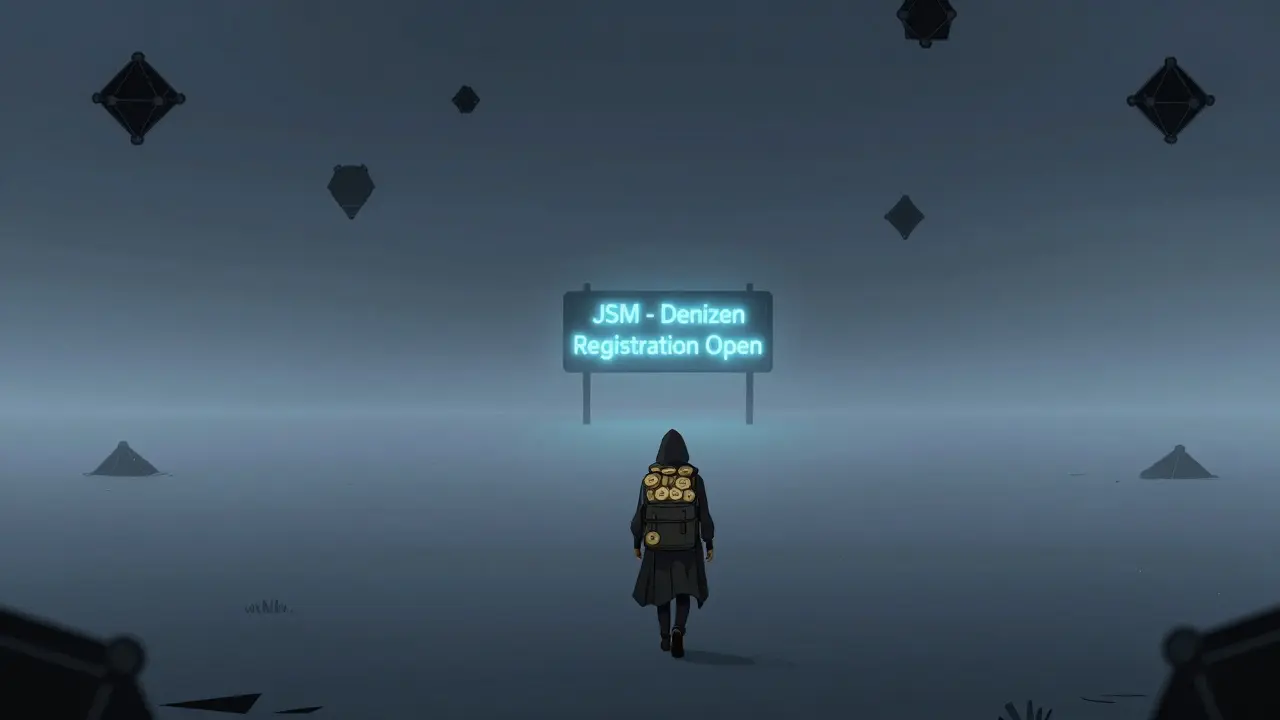
Joseon isn’t a company. It’s not a startup. It calls itself a sovereign cyber nation - a legal entity existing entirely online, with no physical territory. Think of it like a virtual country that issues its own currency: Joseon Mun, or JSM. This isn’t just branding. The project says it’s built on real legal frameworks, with a concept called a “Denizen” - a digital identity that’s separate from your real-world name or passport. You don’t need to live in Korea or North Korea to be a Denizen. You just need to register online.
The goal? Create a safe zone for crypto projects and investors tired of government crackdowns. If you’re building a blockchain tool in the U.S. and the SEC comes knocking, Joseon offers a jurisdictional escape hatch. It doesn’t guarantee legal protection everywhere, but it gives you a legal identity to hide behind - if you believe in the system.
Technical Basics: Supply, Contract, and Chain
JSM runs on Ethereum’s blockchain. That means it’s an ERC-20 token, not its own network. You can store it in any wallet that supports ERC-20, like MetaMask. To add JSM to your wallet, use this contract address: 0x04c618cdbc1d59142dfeb4b9864835a06983ec2d.
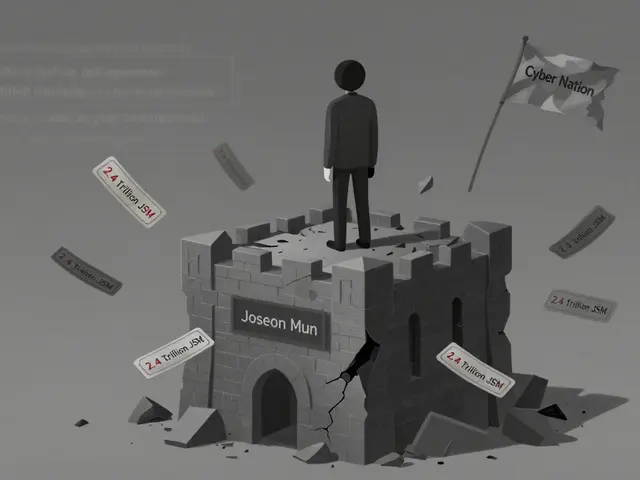
The total supply is fixed at 2.4 trillion JSM tokens. That’s not a typo. Two point four trillion. For comparison, Bitcoin’s max supply is 21 million. There are no more tokens left to mine, mint, or release. All 2.4 trillion exist right now.
This massive supply is key to understanding JSM’s price. When you divide the total supply by the current price, you get the fully diluted valuation (FDV). As of February 2026, JSM’s FDV was around BTC 8,195 - roughly $500 million at Bitcoin’s current rate. But here’s the catch: FDV is a theoretical number. It assumes every single token is in circulation and trading. Most of them aren’t.
Price History: From $0.015 to $0.00019
JSM’s price journey is one of the most dramatic in crypto history.
On July 9, 2024, JSM hit its all-time high of $0.01510. That was the peak of the hype cycle. People believed in the idea of a legal digital nation. Trading volumes spiked. Social media exploded.
By February 2026, JSM was trading at $0.00019373. That’s a 97.3% drop from its peak. You’d need a 515x increase just to get back to where it was two years ago.
There was a low point, too. On April 23, 2025, JSM hit $0.0003041. That was the bottom. Since then, it’s bounced back about 34% - not because of renewed interest, but because the market got even worse. Many coins fell harder.
Over the last 7 days, JSM dropped 2.1%. Meanwhile, the whole crypto market only fell 0.5%. That means JSM is underperforming. Over 30 days, it’s down 2.14%. Even compared to other Ethereum-based tokens, which rose 12.7% in the same window, JSM is barely moving.
Where Can You Trade JSM?
JSM isn’t on Coinbase, Binance, or Kraken. It’s on niche exchanges. The most active trading pair is JSM/USDT on LATOKEN, with a 24-hour volume of just $3,918.64. That’s less than the price of a used laptop.
Bybit also lists JSM and provides price data, but doesn’t show market cap or volume - likely because it’s too low to track meaningfully. You can also trade it on decentralized exchanges after adding it to MetaMask, but liquidity is thin. If you try to sell a large amount, you’ll likely crash the price.
There are no major institutional buyers. No hedge funds. No ETFs. No news outlets covering it. Just a small group of retail traders holding on, hoping for a comeback.
Why Does JSM Still Exist?
It’s not dead. It’s still trading. Why?
First, the concept is too unique to ignore. A digital nation with legal recognition? That’s never been tried before. Even if it’s not working, it’s a social experiment. People are watching.
Second, the community is loyal. A small group of early adopters still believe in the vision. They’re not trying to make money. They’re trying to prove the idea works.
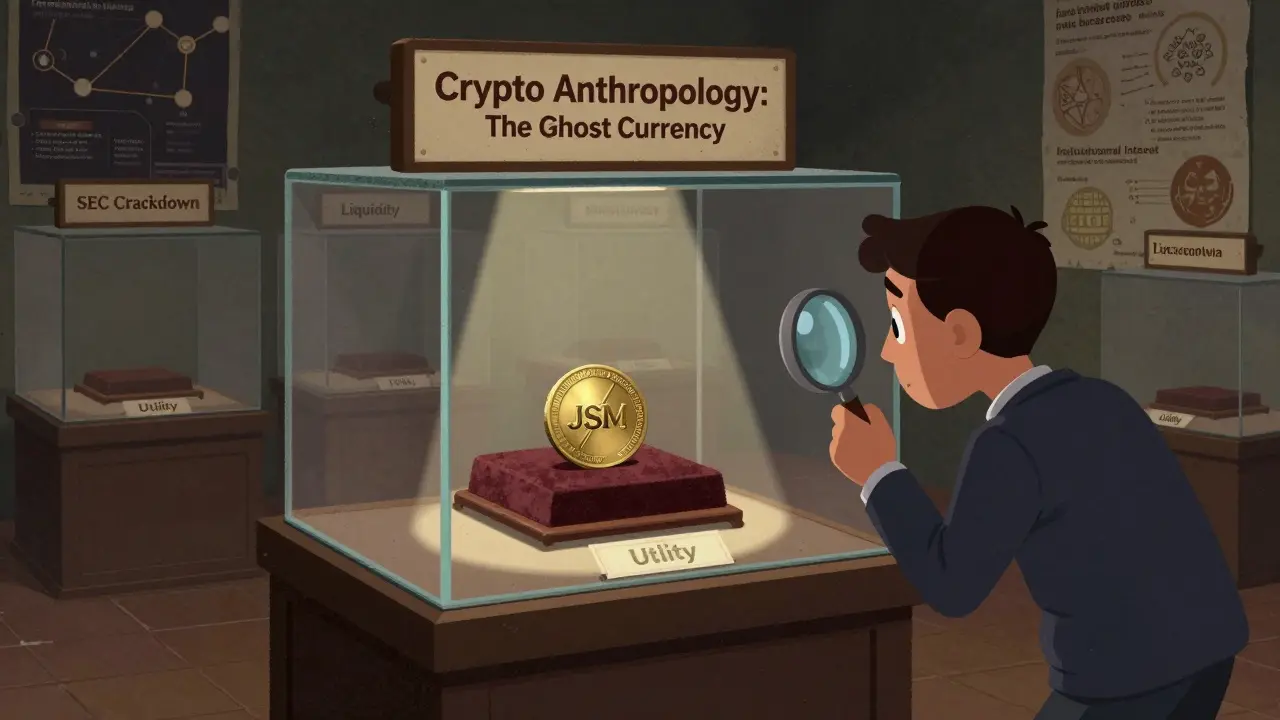
Third, there’s no real competition. No other project has tried to merge blockchain with sovereign statehood. JSM is the only one. That gives it a strange kind of staying power - like a museum piece you can’t delete.
Is JSM a Scam?
No, it’s not a scam in the traditional sense. There’s no fake team. No rug pull. The contract is live. The code is public. The exchange listings are real. The price history is transparent.
But it’s also not a real investment. The market cap is tiny. The volume is microscopic. The team behind Joseon hasn’t released a whitepaper, a roadmap, or even a verified Twitter account. There’s no customer support. No customer service email. No developer updates.
This isn’t a project that’s failing. It’s a project that never really started. It’s a concept with no execution. A legal theory with no real-world enforcement. A currency with no utility outside of speculation.
Who Should Even Care About JSM?
If you’re looking to make money - walk away. The odds are astronomically against you. The price has lost 97% of its value. Liquidity is near zero. There’s no reason to believe it will recover.
If you’re into crypto anthropology - then JSM is fascinating. It’s a case study in how far the idea of digital sovereignty can stretch. It’s proof that people will invest in anything that sounds like a revolution, even if the revolution is just a website and a contract address.
If you’re a developer or entrepreneur - maybe think about building on top of the idea. What if you created a real governance system for Denizens? What if you built tools for digital citizenship? JSM might be dead, but the concept of a cyber nation isn’t.
Final Take: A Ghost Currency with a Story
Joseon Mun (JSM) is not a currency you should buy. It’s not a coin you should hold. It’s not an asset you should trade.
It’s a ghost. A digital relic of a moment when crypto tried to become something bigger than money. A nation that never built a government. A currency with no economy. A project that never needed to succeed - because its value was never in the token, but in the idea.
Right now, JSM trades at $0.00019373. That’s less than one hundredth of a cent. You could buy 5,000 JSM for a dollar. But what would you do with them? There’s nowhere to spend them. No merchant accepts them. No service uses them.
It’s not a failure. It’s not a success. It’s a question mark on the blockchain.
Is Joseon Mun (JSM) a real cryptocurrency?
Yes, JSM is a real cryptocurrency. It has a live blockchain contract, is listed on exchanges like LATOKEN and Bybit, and has a fixed supply of 2.4 trillion tokens. But it’s not a functional currency - there’s no real-world use, no merchant adoption, and almost no trading volume.
Can I buy JSM on Coinbase or Binance?
No, JSM is not listed on major exchanges like Coinbase, Binance, or Kraken. It’s only available on smaller platforms such as LATOKEN and Bybit, where trading volume is extremely low - under $4,000 per day.
What’s the current price of JSM?
As of February 2026, JSM trades around $0.00019373. This is down 97.3% from its all-time high of $0.01510 in July 2024, but up 34.3% from its low of $0.0003041 in April 2025.
Is Joseon Mun backed by any government?
No. Joseon is not recognized by any country or international body. It claims to be a sovereign cyber nation, but it has no legal standing outside its own self-declared framework. No government enforces its rules or recognizes its currency.
Why is JSM’s supply so high?
The 2.4 trillion supply was designed to make the token affordable and accessible - with each unit worth fractions of a cent. But because so many tokens exist, even small price changes create huge market cap swings. This makes JSM extremely volatile and hard to trade in large amounts.
Should I invest in JSM?
No, not as an investment. JSM has no utility, no liquidity, and no clear path to recovery. Its price is driven purely by speculation from a tiny group of holders. If you’re looking for returns, this is one of the riskiest assets in crypto. But if you’re studying digital sovereignty or crypto history, it’s worth observing.
Richard Cooper
JSM is dead. $0.00019. That’s it. No more. No less. Done.
Amanda Markwick
I think people are missing the point. JSM isn’t about money. It’s about what happens when you let a community build a legal identity online. It’s messy. It’s weird. But it’s real. We’re seeing the first draft of digital sovereignty. And yeah, it looks like a glitch right now. But glitches become blueprints.
Sriharsha Majety
i just bought 10 million jsm for 2 bucks lol who cares if it goes nowhere its like collecting vintage internet memes
Tabitha Davis
Oh please. A digital nation? That’s not sovereignty. That’s a .com domain with a PDF. The whole thing is a performance art piece funded by people who think blockchain = magic. They didn’t build a nation. They built a shrine to delusion.
Vishakha Singh
While JSM may not be a financial opportunity, it is a profound social experiment. The courage to imagine a governance model outside state structures is worth honoring. Perhaps one day, someone will build on this foundation with real tools, real participation, and real impact.
Don B.
I’m not even mad. I’m just… disappointed. This was supposed to be the future. Instead, it’s a ghost town with a token. I spent months reading the docs. I believed. Now I just feel like I got scammed by my own hope.
Samantha Stultz
The 2.4 trillion supply is a masterstroke of psychological manipulation. It creates an illusion of accessibility - ‘Oh, I can afford a million JSM!’ - while ensuring liquidity is nonexistent. The market cap is a fiction. The contract is a monument to entropy. This isn’t crypto. It’s a sociological stress test.
Felicia Eriksson
I still have my JSM. Not because I think it’ll go up. But because I like knowing it’s out there. Like a weird artifact in a museum. Someone will study it in 20 years and go ‘wait… they really thought this was a thing?’ And we’ll all laugh. Or cry.
aaron marp
I think the real question isn’t whether JSM works - it’s why we keep trying to make digital things feel like real nations. We’re so hungry for belonging that we’ll attach identity to a contract address. That’s not dumb. That’s human.
Alyssa Herndon
maybe the point was never to make money. maybe it was to show that people can believe in something that doesn't exist and still show up every day. that's kinda beautiful in a sad way
Jeff French
The liquidity is so low it’s almost poetic. You can’t sell 100k JSM without crashing it. That means the only people holding are the ones who still believe. And that’s not a market. That’s a cult with a tokenomics slide deck.
Elana Vorspan
i’m not selling my jsm 🤍 maybe one day it’ll mean something. maybe it already does. who knows. but i’ll keep it. like a lucky charm from the crypto wild west 💫