Imagine a Virtual Private Network that doesn't just hide your IP address but claims to be bulletproof against future supercomputers. That is the pitch behind KelVPN, a service built on blockchain technology that uses its native cryptocurrency, KEL, for payments and governance. It sounds like science fiction, but it’s a real project in the crypto space. The big question isn’t just how it works, but whether it actually delivers on its bold promises of anonymity and security.
If you are looking for a quick answer: KelVPN is a decentralized VPN (dVPN) created by the Cellframe Network. Unlike traditional VPNs run by companies like NordVPN or ExpressVPN, KelVPN relies on a network of distributed nodes. You pay for access using KEL tokens. Its main selling point is "quantum resistance," meaning it uses encryption methods designed to withstand attacks from future quantum computers. However, as we will see, there are significant risks and red flags you need to know before buying any tokens or relying on this for serious privacy.
How KelVPN Works: The Decentralized Model
To understand KelVPN, you first have to unlearn how standard VPNs work. When you use a traditional VPN, you connect to a server owned by a company. That company technically has the ability to see your traffic, even if they claim not to log it. You are trusting them with your data.
KelVPN flips this model. It operates on a peer-to-peer network where individual users or operators run nodes. These nodes serve two purposes:
- Blockchain Validation: They help secure the underlying blockchain ledger.
- VPN Access Points: They act as the servers you connect to for internet browsing.
When you connect, the software finds the nearest node to minimize lag. Because the network is distributed, no single entity controls the entire infrastructure. Theoretically, this makes it much harder for anyone to shut down the service or monitor all user activity. The connection is encrypted using a proprietary protocol called DAP SDK, which wraps data in standard HTTP protocols to bypass firewalls while maintaining encryption.
The catch? Performance can be inconsistent. Since nodes are run by volunteers or small operators rather than enterprise-grade data centers, speeds vary wildly depending on who is running the node you connect to. While the project claims support for high-bandwidth activities like 8K streaming, independent speed tests are scarce, and user reports often cite latency issues compared to centralized giants.
The Big Hype: Quantum-Resistant Security
This is where KelVPN tries to stand out from other dVPNs like Mysterium Network or Sentinel. The project claims to be "quantum-safe." But what does that mean for you?
Quantum computers are theoretical machines that could one day break current encryption standards (like RSA) in seconds. This is a known threat in cybersecurity circles, often referred to as "Q-Day." Most experts believe practical quantum computers capable of breaking encryption are still 10 to 15 years away. However, intelligence agencies and tech giants are already preparing for this shift.
KelVPN implements post-quantum cryptography algorithms specifically chosen for their resilience:
- CRYSTALS-Dilithium: Used for digital signatures to ensure data integrity.
- Kyber 512: Used for secure key exchange between your device and the node.
These algorithms were selected by the National Institute of Standards and Technology (NIST) as candidates for future standardization. By implementing them now, KelVPN argues it is future-proofing your privacy. Is this necessary today? Probably not. Is it a unique feature? Yes. Almost no other consumer VPN offers this level of cryptographic foresight.
KEL Tokenomics: Supply, Utility, and Risks
You cannot use KelVPN without the KEL token. It is an ERC-20 token on the Ethereum blockchain, though it also interacts with other chains via the Cellframe ecosystem. Here are the hard numbers you need to know:
| Attribute | Value / Detail |
|---|---|
| Total Supply | 100,000,000 KEL (Fixed) |
| Primary Use | Paying for VPN subscriptions |
| Secondary Use | Staking for rewards and governance voting |
| Network | Ethereum (ERC-20), BNB Chain |
| Contract Address | 0xda6a3876ad460194cd7ba28062d838c98ee2fd1d |
The utility seems straightforward: buy KEL, pay for VPN. But look closer at the contract permissions. Security analysis firms like GoPlus have flagged that the contract creator retains administrative privileges. This means the developers can potentially pause trading, change fees, or mint new tokens. For a project preaching decentralization and trustlessness, this centralization risk is a major red flag. If you hold KEL, you are trusting the team not to abuse these powers.
Market performance has been rough. The token has seen extreme volatility, dropping over 99% from its all-time high. Trading volume is low, often averaging less than $15,000 daily across exchanges. This illiquidity means you might struggle to sell large amounts without crashing the price further.
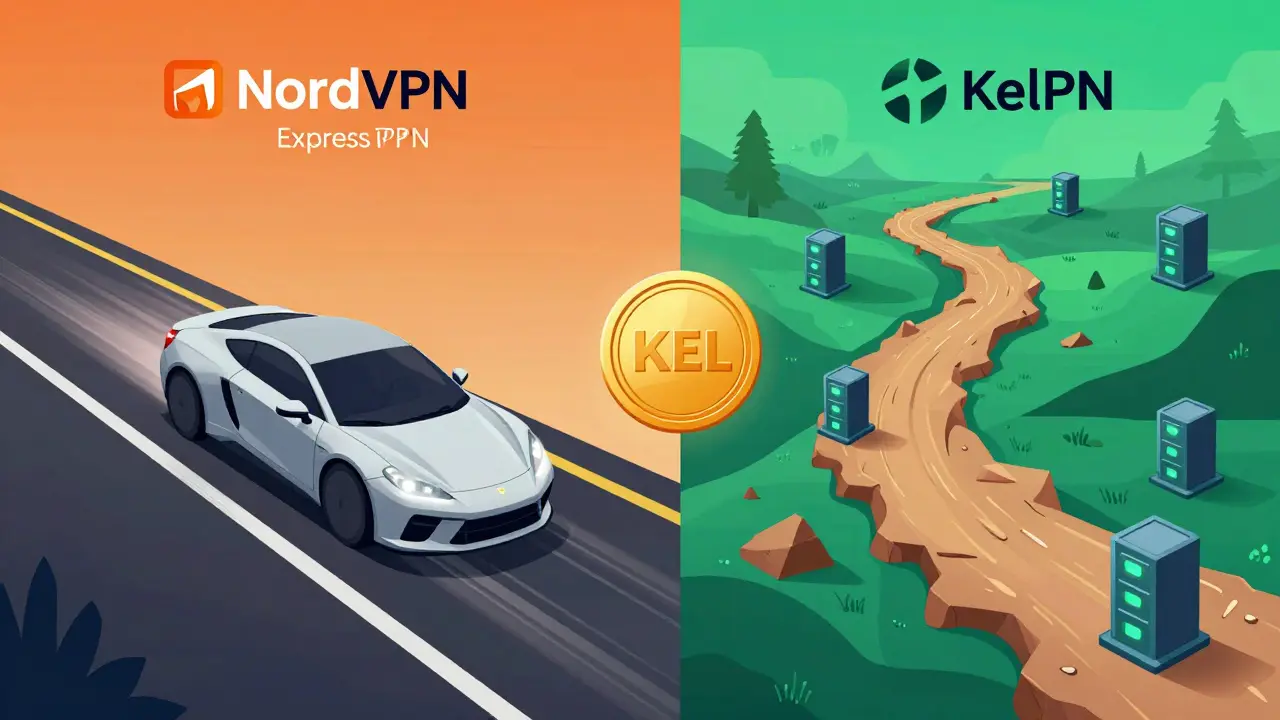
KelVPN vs. Traditional VPNs: The Trade-Offs
Should you switch from NordVPN or Surfshark to KelVPN? Let’s compare them directly.
| Feature | KelVPN (Decentralized) | NordVPN/ExpressVPN (Centralized) |
|---|---|---|
| Privacy Model | No single owner; theoretically zero logs by design. | Company-owned; relies on "no-log" policy promises. |
| Speed & Reliability | Inconsistent; depends on node operator quality. | Highly optimized; dedicated high-speed servers. |
| Payment Method | Cryptocurrency (KEL tokens). | Credit card, PayPal, Bitcoin, etc. |
| Security Tech | Quantum-resistant algorithms (Dilithium/Kyber). | Standard AES-256 encryption. |
| User Base | Niche; limited active wallets (<500 reported). | Millions of global users. |
Traditional VPNs win on convenience, speed, and customer support. KelVPN wins on ideological purity regarding censorship resistance and forward-looking encryption. If you are a journalist in a heavily censored country or a privacy purist worried about government surveillance five years from now, KelVPN has appeal. If you just want to stream Netflix without buffering or hide your location while shopping online, a traditional VPN is likely a better experience.
Red Flags and Community Sentiment
We need to talk about the elephant in the room: adoption. Despite launching in 2019, KelVPN remains a micro-project in a massive market. The global VPN market is worth billions, yet KelVPN holds less than 0.01% share. Why?
- Complexity: Setting up KelVPN requires managing crypto wallets, buying tokens on decentralized exchanges, and understanding gas fees. This barrier keeps out 99% of average users.
- Lack of Transparency: There are very few public reviews on platforms like Trustpilot. Reddit discussions are sparse and often highlight difficulties finding reliable information about who runs the nodes.
- Regulatory Risk: Privacy-enhancing technologies are under scrutiny. The EU’s Anti-Money Laundering Directive targets services that obscure user identities. KelVPN’s architecture could face legal challenges in regulated markets.
- Token Value Erosion: With the price down nearly 99% from highs, early investors have lost most of their capital. This discourages new node operators from joining, which degrades the network quality-a vicious cycle.
Experts are divided. Some cybersecurity researchers praise the early adoption of NIST-recommended post-quantum standards. Others, like analysts at Gartner, warn that projects combining niche blockchain tech with unproven demand have a 92% failure rate within three years. As of mid-2026, KelVPN is still alive, but it is surviving on the fringes, not thriving in the mainstream.
Is KelVPN Right for You?
Here is the bottom line. If you are a crypto enthusiast who wants to experiment with decentralized infrastructure and believes in the long-term threat of quantum computing, KelVPN is a fascinating case study. You might stake some KEL tokens hoping for a rebound or use the service to test its waters.
However, do not bet your financial future on KEL tokens based on hype alone. The liquidity is thin, and the centralization risks in the smart contract are real. And if you need a reliable, fast VPN for daily work or streaming, stick with established providers. KelVPN is a niche tool for a specific type of user-the paranoid, the technical, and the ideologically driven. For everyone else, the friction outweighs the benefits.
Where can I buy KEL tokens?
KEL is primarily traded on decentralized exchanges (DEXs) like Uniswap and PancakeSwap. It is not currently listed on major centralized exchanges like Coinbase or Binance. You will need an Ethereum or BNB Chain wallet (like MetaMask) and ETH or BNB to swap for KEL.
Is KelVPN truly anonymous?
Technically, yes, because no central server stores your logs. However, the node operator you connect to could theoretically see your traffic if they choose to log it. The system relies on the honesty and security practices of distributed node operators, which is a trust assumption inherent in all P2P networks.
What is the maximum supply of KEL?
The total supply of KEL tokens is fixed at 100,000,000. No new tokens can be created unless the contract administrators use their privileged keys to mint more, which would be a violation of the stated tokenomics.
Does KelVPN work on iOS and Android?
Yes, KelVPN provides applications for both iOS and Android, as well as desktop versions for Windows, macOS, and Linux. However, mobile app store availability can sometimes be restricted due to Apple and Google's policies on VPN apps.
Why is the KEL token price so volatile?
Low trading volume and low market capitalization make KEL highly susceptible to price swings. A relatively small buy or sell order can move the price significantly. Additionally, the lack of widespread adoption means the price is driven more by speculation than by actual usage of the VPN service.
Crystal Davis
Let's be real for a second because the hype machine is working overtime on this one. You have a decentralized network run by random nodes that claims to be quantum resistant but can't even guarantee basic streaming speeds? It is laughable. The tokenomics are a disaster with the admin keys still held by the devs which basically means it is not decentralized at all just a central point of failure wrapped in crypto jargon. Nobody should touch KEL with a ten foot pole until they prove they can actually deliver consistent bandwidth without crashing. It is just another rug pull waiting to happen dressed up in NIST algorithm names.
Barclay Chantel
The sheer audacity to market 'quantum resistance' as a selling point when practical quantum computers are likely fifteen years away is breathtakingly pretentious. It reminds me of those early 2000s dot-com companies promising teleportation before they had figured out how to send an email reliably. The average user does not care about CRYSTALS-Dilithium signatures; they care if Netflix buffers. This project is built on a foundation of academic buzzwords rather than engineering reality. It is elitist nonsense designed to trick people who think they understand cryptography but really just want free money from token appreciation.
Miss Masquer
I have been following the evolution of decentralized networks for quite some time now and while the concept of using post-quantum cryptography is undeniably fascinating from a theoretical standpoint, the practical implementation details seem to be lacking in transparency regarding node operator incentives and quality control mechanisms which ultimately leads to a fragmented user experience that fails to meet the expectations of mainstream adoption in today's fast-paced digital landscape where reliability is paramount above all else.
Diana Morris
stop buying shitcoins that do nothing. buy gold or index funds. your money is gone.
Dianne Wright
i feel so drained reading this article because everyone is pretending like this is a legitimate security solution when it is clearly just a cash grab for the founders who are sitting on minting privileges while retail investors get left holding the bag of worthless tokens that will never recover from their all time high losses
Joshua Alcover
One must consider the ontological implications of entrusting one's digital sovereignty to a protocol that retains administrative backdoors under the guise of decentralization. The epistemological crisis here is profound; we are asked to believe in trustlessness while simultaneously trusting a centralized entity with god-mode permissions over the contract code. This dichotomy reveals a fundamental flaw in the philosophical underpinnings of the Cellframe Network's architecture which prioritizes speculative utility over genuine cryptographic integrity and national security standards.
Christina Pearce
I appreciate the detailed breakdown of the technical specs especially the part about Kyber 512 being used for key exchange. It makes sense why they are targeting privacy advocates who are worried about future threats. I wonder if there are any independent audits available for the DAP SDK since that seems like a critical component for bypassing firewalls securely without exposing user data to potential man-in-the-middle attacks during transmission.
trisya hazriyana
the irony is palpable isn't it. a 'decentralized' vpn controlled by admins who can pause trading whenever they feel like it. typical crypto bro move. no thanks i'll stick to my wired connection and hope the NSA doesn't break RSA tomorrow.
Eric Grosso
honestly the speed issues are gonna kill this thing faster than any quantum computer ever could. nobody wants a vpn that drops every 5 minutes just to save you from a threat that doesnt exist yet. also the contract address looks sus af.
Debbie Lewis
I see what you're saying about the red flags. It's pretty wild that they keep the admin rights. Makes me nervous to put any money into something like that.
Edith Mair
You are missing the bigger picture here. While the current performance is lackluster, the strategic value of having a quantum-resistant infrastructure ready before Q-Day arrives cannot be overstated. Organizations that need long-term data confidentiality for government or military contracts will eventually pay a premium for this specific capability regardless of current latency issues. The illiquidity is temporary due to low adoption but the technology stack is genuinely ahead of its time compared to legacy AES-256 providers.