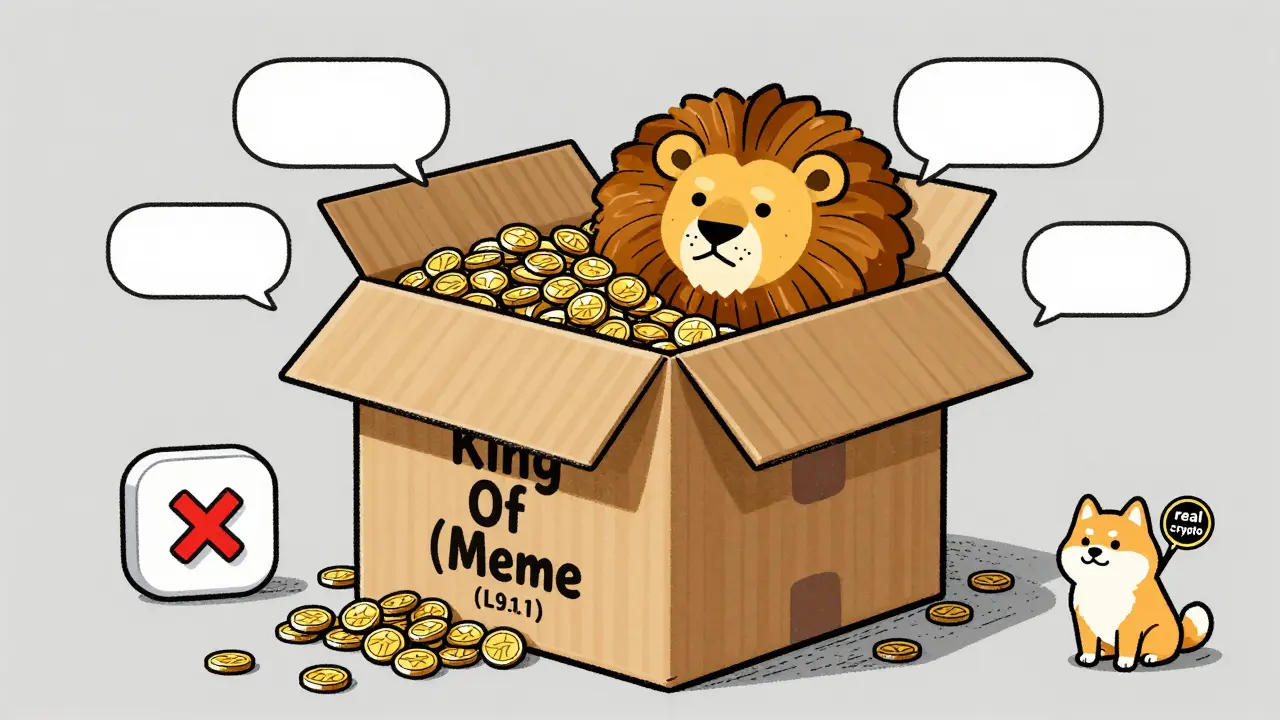
King Of Meme (LION) isn’t just another meme coin. It’s one of the most obscure, low-liquidity, and poorly documented tokens floating around in the crypto space - and yet, it still has people buying it. If you’ve seen ads on Telegram or Twitter calling it "The Alpha Predator" or "The King of all Meme Coins," you’re not alone. But here’s the reality: King Of Meme (LION) has almost no substance behind the flashy marketing.
Launched in early 2025, LION claims to be the successor to Dogecoin, Shiba Inu, and Pepe. It says it "overcomes the limitations" of those coins. But what limitations? No one says. No whitepaper exists. No GitHub repo. No team. Just a token address and a bunch of social media posts.
The total supply? 109.1 trillion LION tokens. All of them are in circulation. That means zero tokens are locked, reserved, or set aside for future development. That’s unusual. Most coins hold back some supply for team incentives or ecosystem growth. LION gave away everything - which sounds generous until you realize it also means zero incentive for anyone to build anything.
It runs on Ethereum as an ERC-20 token. That’s the only technical detail anyone can confirm. The contract address is public, and you can track it on blockchain explorers. But beyond that? Nothing. No smart contract audits. No security checks. No updates. Just a static address with a few thousand wallets holding it.
How much is LION worth? (Spoiler: Almost nothing)
Price data for LION is all over the place. CoinMarketCap says it’s worth $0.00000000129 (1.29e-9 USD). Bybit lists it at $0.000000001432. TradeSanta says $0.00000001. That’s a 7x difference between platforms. Why? Because there’s almost no trading happening.
The 24-hour trading volume? On CoinMarketCap, it’s $0. On TradeSanta, it’s $56. That’s not a market. That’s a flicker. For comparison, Dogecoin trades over $1.2 billion in a single day. LION’s entire market cap? Around $140,000 - less than what some startups raise in a seed round.
That means if you buy 10 billion LION tokens, you’re spending less than $100. But you’re not buying $100 worth of value. You’re buying a digital receipt with no use case. You can’t pay for anything with it. You can’t stake it. You can’t earn interest on it. It doesn’t run any app. It doesn’t power any platform.
Where can you buy LION?
Only a handful of exchanges list it: Bitget, Bybit, and Phantom. That’s it. No Coinbase. No Binance. Not even KuCoin. That’s a red flag. Major exchanges don’t list tokens with zero volume, no team, and no utility. They avoid them because they’re risky - and they’re often scams.
Bitget promotes LION as having "innovative technology" and "unique use cases." But if you dig into their page, they don’t explain what those are. They just say you can "trade it," "convert it," or "earn through Learn2Earn programs." That’s not innovation. That’s a marketing gimmick.
And those "Learn2Earn" programs? They’re just ways to get new people to buy LION by teaching them how to trade it. It’s like a pyramid where the lesson is: "Buy more so you can earn more." No real product. No real service. Just more people buying from each other.
Why does LION even exist?
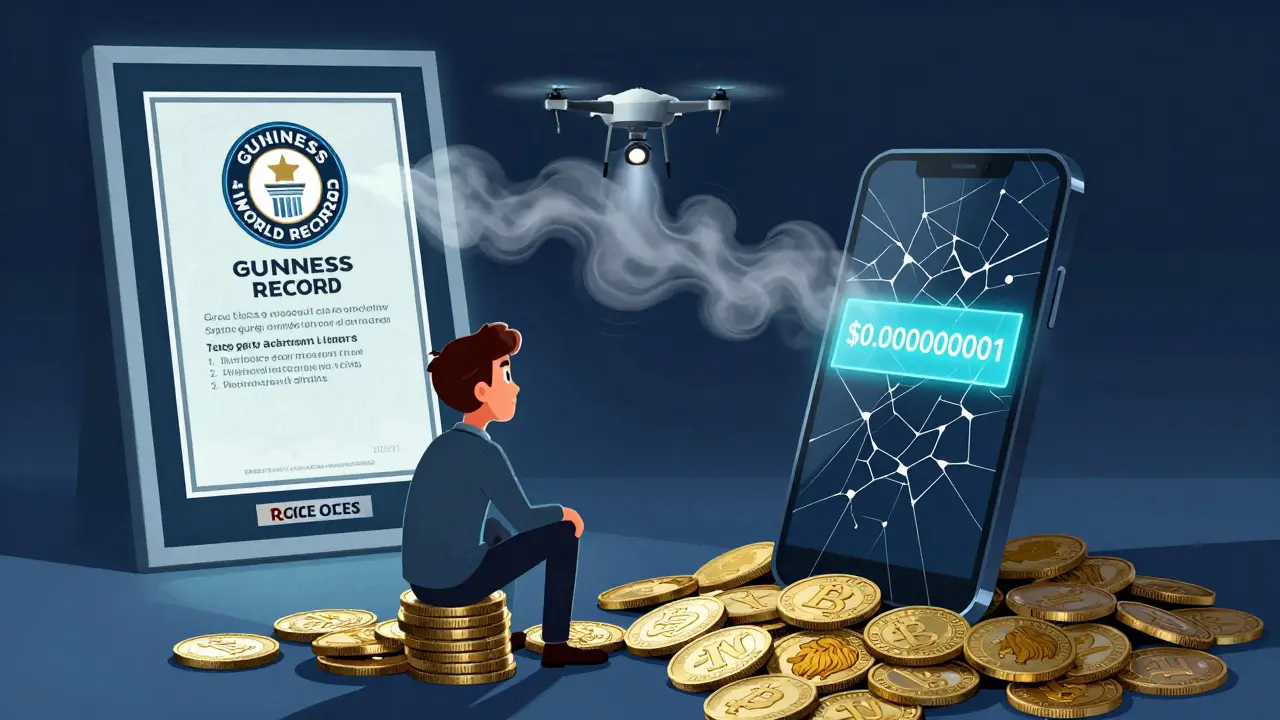
LION’s whole story is built on hype, not hardware. It claims to hold the "Guinness World Record for the largest aerial display of a cryptocurrency made by drones." If that’s true - and no one has verified it - then that’s its biggest achievement. A drone show. Not a product. Not a network. Not a community. Just a few hundred drones spelling out "LION" in the sky.
Compare that to Dogecoin. It started as a joke, yes - but it became a real payment system. People use it to tip content creators. Some online stores accept it. It has a working blockchain, active developers, and a loyal user base. LION? It has a Telegram group with 12,000 members. Most of them are bots or bots pretending to be humans.
The project doesn’t even have a roadmap. No quarterly updates. No team announcements. No technical blog. Nothing. It’s a token with a name, a logo, and a bunch of ads.
Who’s holding LION?
CoinMarketCap says there are 7,420 holders. That sounds like a lot - until you realize that’s less than the number of people who own a single Bitcoin. And most of those holders? They bought it when the price was higher. Now they’re stuck. They can’t sell without crashing the price.
There’s no community. No developers. No governance. No voting. No upgrades. No future. Just people hoping the price goes up so they can cash out before it collapses.
And here’s the scary part: CoinCarp - a crypto research site - explicitly warns users to "Beware of scams!" when dealing with LION. That’s not a minor caution. That’s a red alert. With tokens this small, fake websites, phishing links, and rug pulls are common. You could buy LION from the wrong site and lose everything.
How does LION compare to other meme coins?
Let’s put it in perspective:
| Coin | Market Cap | 24h Volume | Exchanges Listed | Active Development |
|---|---|---|---|---|
| King Of Meme (LION) | $142,700 | $0 - $56 | 3 | No |
| Dogecoin (DOGE) | $14.5 Billion | $1.2 Billion | 50+ | Yes |
| Shiba Inu (SHIB) | $9.2 Billion | $450 Million | 40+ | Yes |
| Pepe (PEPE) | $1.7 Billion | $320 Million | 30+ | Yes |
| Bonk (BONK) | $850 Million | $180 Million | 25+ | Yes |
LION doesn’t just lose. It gets crushed. It’s not even in the same league. It’s not a challenger. It’s a footnote.
Is LION a scam?
It’s not officially labeled a scam. But it ticks every box for one:
- No team or anonymous team (common in scams)
- No utility or real-world use
- Extremely low liquidity
- Only listed on small, obscure exchanges
- Marketing over substance
- Warnings from reputable crypto sites
- Price manipulation possible with tiny volume
Scams don’t always look like fraud. Sometimes they look like a meme coin with a big slogan and a drone show. LION is one of those.
Should you invest in LION?
If you’re looking for a serious investment? No.
If you’re okay with gambling $50 on a coin that has less than 1% chance of ever being worth $1? Maybe. But don’t call it investing. Call it gambling.
Most meme coins die within 12 months. The ones that survive? They have teams, roadmaps, and real users. LION has none of that. It’s a ghost coin - visible on charts, but invisible in reality.
People buy it because they think it’s the next Dogecoin. But Dogecoin had a culture. A community. A reason to exist. LION has a slogan and a drone.
And that’s not enough.
Is King Of Meme (LION) a real cryptocurrency?
LION is technically a cryptocurrency because it exists on the Ethereum blockchain as an ERC-20 token. But "real" in crypto means more than just existing - it means having utility, community, and development. LION has none of those. It’s a token with no purpose, no team, and no future. It’s a digital placeholder with no value beyond speculation.
Can I make money trading LION?
You might make money - but only if you’re lucky or fast. With trading volumes under $100 per day, even small buys or sells can swing the price 20-50%. That’s not a market - it’s a rigged game. Most people who buy LION end up losing money because there’s no one to sell to when the price drops. The few who profit are usually the original sellers who dumped their tokens early.
Why is LION so cheap?
LION’s price is so low because there are 109.1 trillion tokens in existence. Even if the market cap were $1 billion, each token would still be worth less than a penny. Its value isn’t based on demand - it’s based on hype. And hype fades fast. No one needs LION. No one uses it. So its price stays near zero.
Is LION listed on major exchanges like Binance or Coinbase?
No. LION is only listed on a few small, low-traffic exchanges: Bitget, Bybit, and Phantom. Major exchanges avoid it because of its lack of transparency, zero volume, and high scam risk. If a coin isn’t on Binance or Coinbase, it’s usually not worth serious attention.
What happened to the drone world record?
The project claims to hold a Guinness World Record for the largest drone display of a cryptocurrency logo. But there’s no official proof - no Guinness press release, no video verification, no news coverage from credible outlets. It’s likely a marketing stunt with no real validation. Even if it happened, it doesn’t give LION any value. A drone show doesn’t make a currency.
Should I buy LION because it’s cheap?
No. A low price doesn’t mean a good investment. You can buy 10 billion LION tokens for less than $10 - but that doesn’t mean you’re getting $10 of value. You’re buying a digital piece of paper with no backing. Cheap doesn’t mean cheap in value - it means cheap because no one wants it.
Is LION safe to hold in my wallet?
Holding LION in your wallet isn’t dangerous - as long as you use a secure wallet like MetaMask and never share your private keys. But the risk isn’t in the wallet. It’s in the token itself. If the project gets abandoned or a rug pull happens, your LION tokens could become worthless overnight. There’s no safety net.
If you’re new to crypto, stick with coins that have real teams, real users, and real track records. LION isn’t the next big thing. It’s the next forgotten thing.
Write a comment