Moola Market Yield Calculator
Deposit Earnings
Borrowing Requirements
Results
Moola Market isn’t another flashy crypto coin trying to ride the next meme wave. It’s a working DeFi lending protocol built entirely on the Celo blockchain, and its native token, MOO, is the engine that keeps it running. If you’ve heard of Aave or Compound on Ethereum, Moola Market is their smaller, mobile-first cousin-designed not for Wall Street traders, but for people in Latin America, Africa, and other regions where smartphones are the main gateway to finance.
What Exactly Is Moola Market?
Moola Market is a decentralized lending and borrowing platform. That means you can deposit crypto like cUSD (Celo Dollar), cEUR, or CELO and earn interest-similar to a savings account, but without a bank. Borrowers can take out loans by locking up more crypto as collateral. The interest they pay goes straight to depositors. There’s no middleman. No credit check. Just smart contracts doing the work.
Unlike Ethereum-based platforms where gas fees can spike to $50 during busy times, Moola Market runs on Celo, which keeps transaction costs under $0.01. Transactions confirm in about 5 seconds. That’s not just faster-it’s usable for people with unstable internet or low-end phones.
The MOO Token: Governance, Not Just a Currency
The MOO token isn’t meant to be a speculative asset. Its real job is governance. Holders can vote on changes to the protocol: adjusting interest rates, adding new assets, or even changing collateral requirements. It’s a way for the community to steer the project.
There are exactly 100 million MOO tokens in total. But here’s the catch: only a fraction are circulating. As of November 2025, the circulating supply is far below that, and the token trades around $0.001505. That’s down over 99.95% from its all-time high of $3.33 in early 2022. The market cap sits at roughly $120,000. That’s tiny compared to Aave’s $1.87 billion or Compound’s $2.34 billion.
Why does this matter? Because low market cap and low trading volume mean low liquidity. If you try to sell a large amount of MOO, you’ll likely crash the price. Most holders aren’t day traders-they’re long-term supporters of Celo’s mission: financial inclusion.
How It Works: Lending, Borrowing, and Flash Loans
Here’s how you use Moola Market:
- Set up a Celo-compatible wallet like Valora or MetaMask with the Celo network added.
- Buy some cUSD, CELO, or cEUR from a Celo-friendly exchange.
- Deposit your crypto into Moola Market’s web app.
- Start earning interest-currently around 4-5% APY on cUSD deposits.
Borrowers need to lock up at least 150% of what they want to borrow. So if you want $100 in cUSD, you need to put up $150 in CELO or another supported asset. If the value of your collateral drops too much, your position gets liquidated to protect lenders.
Moola also supports flash loans-zero-collateral loans that must be repaid within the same transaction. These are used by advanced users for arbitrage or to jump between DeFi platforms. But they’re not for beginners.

Why Celo? The Mobile-First Edge
Celo’s real innovation isn’t just low fees. It’s phone number-based wallets. You don’t need to copy-paste a 42-character crypto address. You can log in with your phone number. That’s huge in places where people don’t have email, IDs, or bank accounts-but they do have mobile phones.
According to Celo’s own data, 68% of Moola Market users come from Latin America. Another 22% are from Africa. Most are under 35. They’re not crypto degens. They’re small business owners, farmers, teachers-people who need access to credit and savings tools without a traditional bank.
This focus gives Moola Market a niche. On Ethereum, you’re competing with giants. On Celo, you’re the only game in town for mobile-first DeFi. That’s why it exists.
The Downsides: Liquidity, Risk, and Isolation
But here’s the hard truth: Moola Market is fragile.
With only $120,000 in market cap and daily trading volume under $10, it’s not liquid. You can’t move large amounts without affecting the price. The total value locked (TVL) in the protocol is unknown, but it’s a fraction of what Ethereum DeFi projects hold.
It’s also single-chain. If Celo has a bug, a hack, or loses adoption, Moola Market goes down with it. Security audits have been done, but no public names or dates are listed. That’s a red flag for cautious users.
Users report mixed experiences. Some praise the low fees and steady yields. Others complain about slow withdrawals during network congestion and poor customer support. The official Discord has 3,200 members, but only 50-100 messages a day-most are technical questions, not trading talk.
Trustpilot gives it 2.3 out of 5 stars. One user wrote: “I couldn’t withdraw my cUSD for three days.” That’s not normal for a well-funded DeFi protocol.
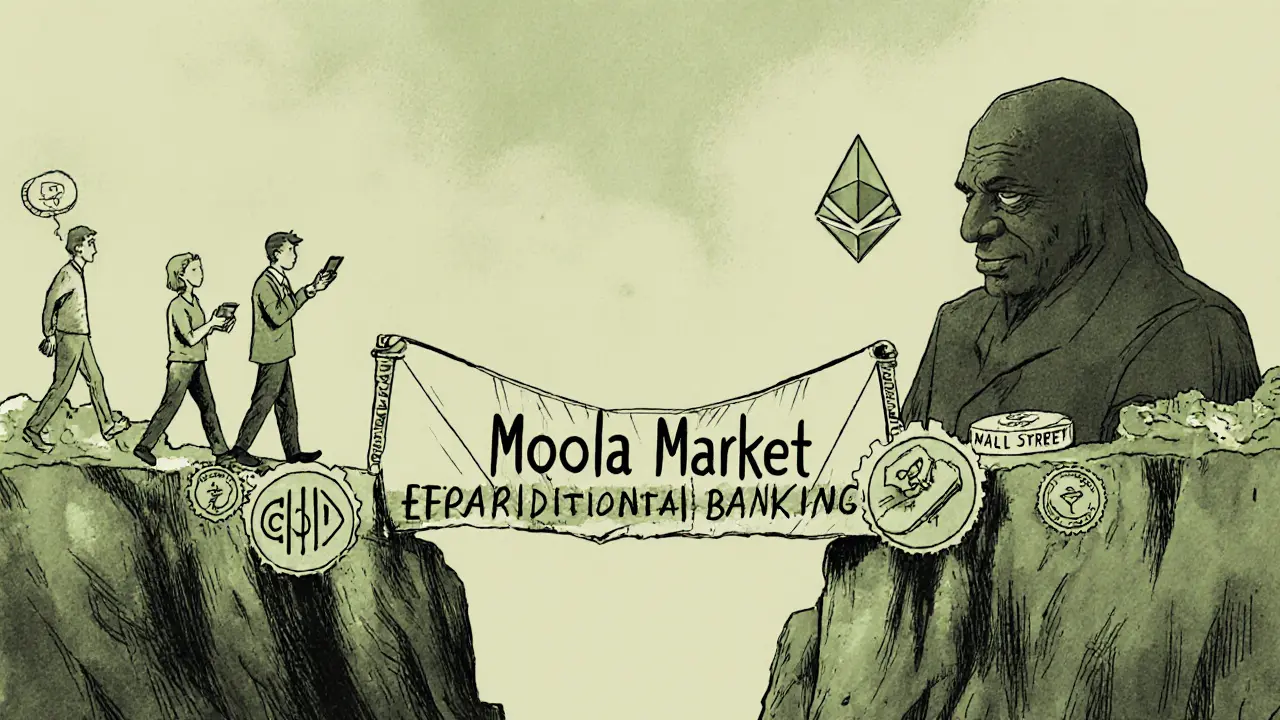
Is Moola Market Worth It?
If you’re in Latin America or Africa and want to earn yield on your cUSD without paying $10 in gas fees-yes, Moola Market is worth trying.
If you’re looking to get rich off MOO token speculation-no. The token’s value has collapsed. It’s not a pump-and-dump coin. It’s a governance token for a niche protocol with limited adoption.
If you’re a DeFi enthusiast who believes in financial inclusion and wants to support a project that actually serves real people-not just investors-then Moola Market is one of the few protocols doing that.
It’s not going to replace Ethereum. It’s not going to hit $1 per MOO again. But it’s doing something rare: making decentralized finance usable for people who’ve been left out.
What’s Next for Moola Market?
The latest update, v2.3.1, rolled out in October 2025, cut gas costs for deposits by 18%. That’s good. But the roadmap mentions potential cross-chain expansion by mid-2026. That’s a big if. The protocol has almost no treasury funds. Without funding, that upgrade might never happen.
Celo’s recent partnership with the World Food Programme to deliver humanitarian aid via stablecoins could be a game-changer. If aid recipients start using cUSD and want to earn yield, Moola Market is the natural place to put it.
But analysts are skeptical. Delphi Digital’s November 2025 report says single-chain DeFi protocols “face existential challenges unless they achieve critical mass.” Moola Market hasn’t reached that yet.
Right now, it’s a quiet, under-the-radar project. No hype. No influencers. Just smart contracts and a small group of users trying to build something real.

Derayne Stegall
OMG this is actually kinda beautiful 😭 Like... real people using crypto to save and borrow without getting ripped off? I didn't think this still existed. Moola Market is the quiet hero we don't talk about enough.
Astor Digital
I lived in Colombia for a year and saw this in action. People using Valora to send money home, earn interest on cUSD while waiting for harvest season... it's not glamorous but it's life-changing. Most DeFi projects are just gambling dens. This? This is infrastructure.
Shanell Nelly
Just wanted to say thank you for writing this so clearly! I'm a teacher in rural Georgia and I've been trying to explain DeFi to my students without making it sound like a pyramid scheme. Moola Market is the perfect example of tech serving real needs. Also, 4-5% APY on cUSD? That's better than my local credit union!
Aayansh Singh
This is a joke right? $120k market cap? You call this DeFi? This isn't innovation it's a graveyard for failed experiments. Celo is a dead chain, MOO is a ghost token, and anyone holding it is either delusional or scammed. If you're not on Ethereum or Solana you're not playing the game. This isn't financial inclusion it's financial irrelevance.
Rebecca Amy
moola market?? sounds like a grocery store in a bad dream 🤡
Darren Jones
I've been using Moola for over a year now. I deposit cUSD every payday. I've earned $18 in interest so far-tiny, but real. No fees. No delays. No drama. The interface is clunky, sure, but it works. And when I had a question, someone in the Discord actually replied within 12 hours. That's more than I can say for most DeFi platforms.
Kathleen Bauer
i mean... i get why ppl think it's dead but like... have u seen the number of people in niger using valora? they dont care about market cap. they care about not getting robbed by moneylenders. MOO might be worth 0.0015 but the impact? that's priceless. 🤍
Carol Rice
This isn't a crypto project-it's a revolution in slow motion. People are building financial dignity with $0.01 transactions and phone numbers instead of bank accounts. And some clown on Reddit is crying because the token didn't moon? 🤬 The real moonshot is a farmer in Kenya earning 5% on his savings without needing a passport. Moola isn't failing-it's winning on a different scoreboard.
Laura Lauwereins
So... it's basically the DeFi equivalent of a community garden? Cute. I'm sure the 3,200 Discord members are thrilled to be part of this tiny, quiet experiment. Meanwhile, the rest of us are out here making actual returns. 🤷♀️
Gaurang Kulkarni
Low liquidity low TVL no treasury no audits no future no team no roadmap no nothing just a relic of 2021 hype wrapped in feel good stories about africa and latin america everyone knows this is a dead project the only people still here are either scammers or people too naive to realize they lost everything
garrett goggin
You think this is about financial inclusion? Nah. This is a front. Celo was bought by some shadowy group linked to the Fed’s digital dollar pilot. They’re testing how to push stablecoins into developing nations so they can track every transaction. MOO isn’t a token-it’s a surveillance tool. The low price? That’s the bait. Wait till they force adoption through aid programs. You’ll thank them... right before your wallet gets frozen.
jesani amit
I'm from Mumbai and I've been using Moola to send money to my sister in Bihar. She doesn't have a bank account but she has a phone. Every month I send her cUSD, she converts it to local cash via a local agent, and she saves a little each week. It's not glamorous but it's real. And the fees? Less than the cost of a bus ticket. That's worth more than any meme coin ever will be.
Peter Rossiter
Moola Market? Heard of it. Never used it. Sounds like a side project that got left in the garage. Celo’s not dead but it’s on life support. MOO? Just a ticker symbol with no liquidity. If you want yield go to Aave. If you want to feel good about helping people go volunteer at a food bank. Don’t confuse charity with investing
Mike Gransky
I’ve been following Celo since 2020. Moola Market isn’t flashy, but it’s one of the few DeFi projects that actually measures success by how many people it helps-not how many investors it attracts. The fact that it’s quiet is a feature, not a bug. The louder the hype, the faster the crash. This? This is sustainable. It doesn’t need to be big to matter.