Ondo DeFAI (ONDOAI) isn't another meme coin or speculative token. It’s an attempt to merge artificial intelligence with real-world finance on the blockchain - a bold idea, but one that’s struggling to find its footing. Launched in early 2025 by the team behind Ondo Finance, ONDOAI is meant to be the governance token for a system that uses AI to manage investments backed by U.S. Treasury bills. Sounds smart? Maybe. But here’s the hard truth: as of February 2026, this project barely registers on the crypto map.
What exactly is Ondo DeFAI?
Ondo DeFAI stands for Decentralized Financial AI. At its core, it’s an ERC-20 token built on Ethereum with a fixed supply of 1 billion coins. Unlike most crypto tokens that just trade or stake, ONDOAI is designed to let holders vote on changes to the platform - like which AI models get added, how fees are set, or which new financial tools get launched. Think of it like a democracy for automated finance.
The real innovation (at least on paper) is how it ties into USDY, a stablecoin fully backed by U.S. Treasury bills. While other stablecoins rely on cash reserves or algorithms, USDY is tied directly to real government debt. That means, in theory, it shouldn’t crash like TerraUSD did. And ONDOAI’s AI tools are supposed to help users automatically earn yield from USDY without needing to understand complex DeFi strategies.
How does the AI part actually work?
The AI in Ondo DeFAI isn’t some sci-fi robot. It’s a set of algorithms trained on years of blockchain data - things like price swings, liquidity pool behavior, and historical yield rates. These models try to predict the best times to move funds between different DeFi protocols to maximize returns while minimizing risk.
For example, if one lending platform suddenly drops its interest rate, the AI could automatically shift your USDY holdings to another one with better yields. Or if volatility spikes, it might reduce exposure and lock in profits. Users can create custom AI agents - basically, automated bots - to handle their investments. No need to stare at charts all day.
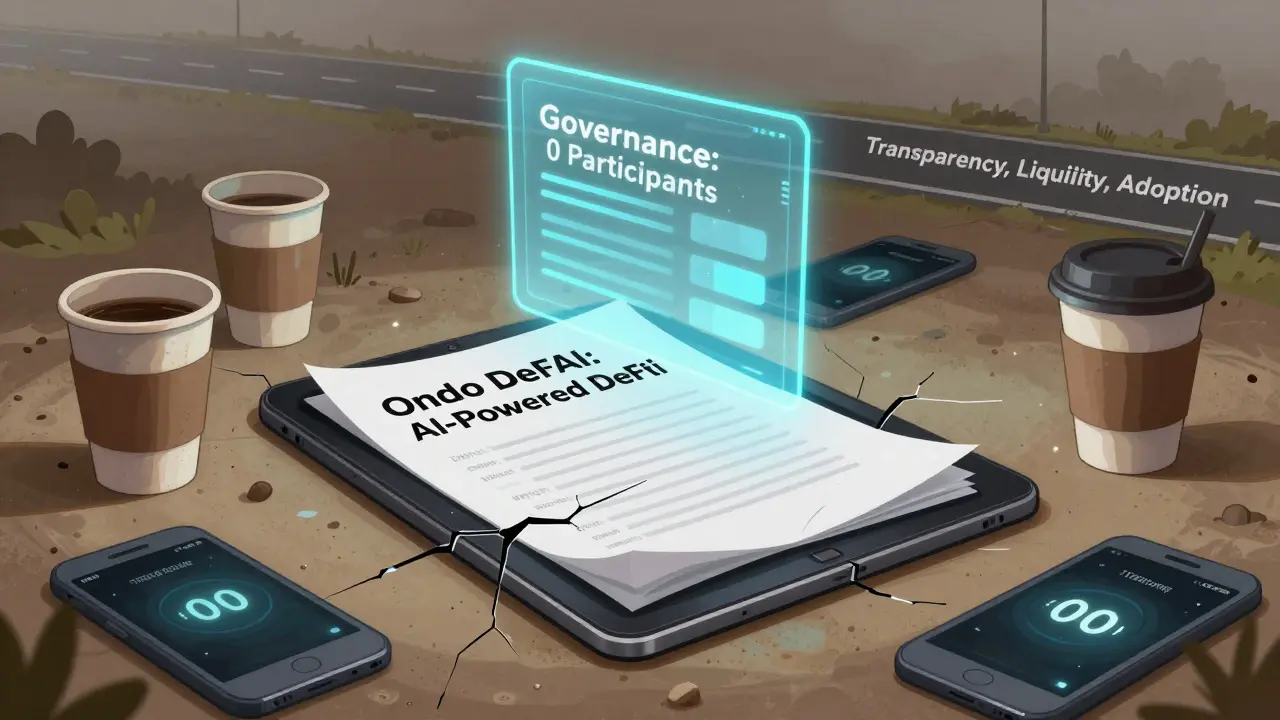
But here’s the catch: there’s no public dashboard, no open-source code, and no verifiable track record of these AI agents actually working in real time. No one has published performance data. No one has shared screenshots of successful trades. It’s all theoretical.
Why USDY matters more than you think
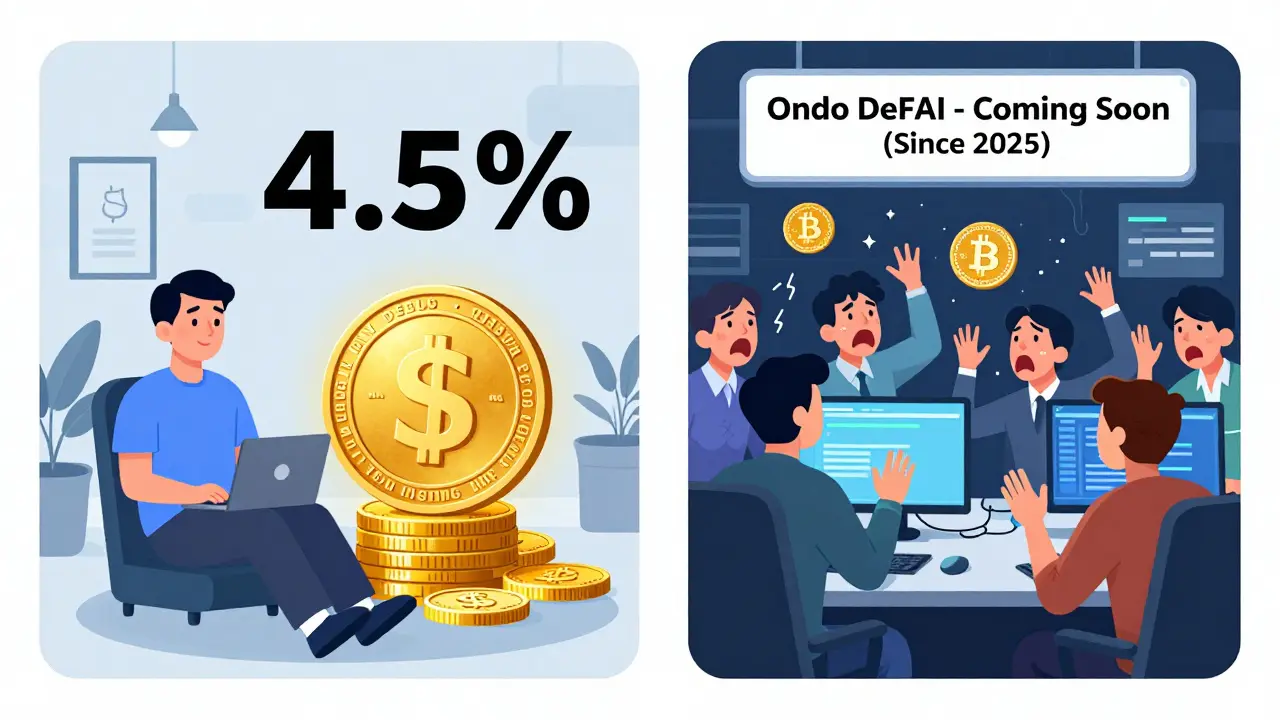
Most DeFi projects chase high yields - 10%, 20%, even 50% APY. But those come with huge risk. Ondo DeFAI’s whole pitch is safety. USDY isn’t trying to make you rich overnight. It’s trying to keep your money safe while giving you a steady, inflation-resistant return - around 4-5% annually, based on U.S. Treasury yields.
This matters because when crypto crashes, people panic. They sell everything. But if you’re holding USDY through Ondo DeFAI’s AI tools, you’re not exposed to Bitcoin’s rollercoaster. You’re earning yield from assets the U.S. government guarantees. That’s a big deal if you’re tired of losing 70% of your portfolio in a bear market.
Compare this to Aave or Compound. They let you lend crypto, but you still risk losing value if the underlying asset tanks. With USDY, the underlying asset is U.S. Treasuries - the safest financial instruments on Earth.
The market reality: a ghost token
Let’s get real. As of February 7, 2026, Ondo DeFAI trades at around $0.000199 on Binance. That’s less than a penny. Its market cap? Barely $200,000. On LiveCoinWatch, it ranks #37,687 out of over 250,000 cryptocurrencies. That’s not just low - it’s invisible.
Some exchanges list it - BitMart, Gate.io, MEXC - but trading volume is near zero. BeInCrypto reports $0.00 in daily volume. That means no one is buying or selling. If you wanted to cash out $10,000 worth of ONDOAI, you’d likely fail. There’s no liquidity. Slippage would be massive.
Compare that to Aave ($45th largest crypto) or Uniswap ($6th). They have millions in daily volume, hundreds of thousands of active users, and active Discord communities. Ondo DeFAI? There’s no Reddit thread. No Twitter buzz. No YouTube tutorials. Just a whitepaper and a token contract.
Who is this for?
Technically, Ondo DeFAI is for people who want AI-managed, Treasury-backed yield without the complexity. But practically? It’s for no one right now.
If you’re a retail investor looking for a safe way to earn yield in crypto, you’re better off using established platforms like Coinbase Earn or BlockFi (if available). If you’re a DeFi power user, you already have tools like Yearn Finance or Balancer that offer AI-like automation with proven results.
Ondo DeFAI doesn’t offer anything new that’s actually usable. The AI tools aren’t accessible. The USDY integration isn’t user-friendly. The governance system? No one knows how to use it. And with trading volume flatlining, even early adopters have given up.
Is it a scam?
No, not by definition. The team behind Ondo Finance has a track record. They’ve built legitimate RWA products with over $1.5 billion locked in other projects. Ondo DeFAI isn’t a rug pull - it’s more like a forgotten prototype.
The problem isn’t fraud. It’s execution. The idea is solid: AI + real-world assets = stable DeFi. But turning that idea into a working, adopted product? They haven’t done it. No updates since launch. No developer activity. No community growth. The project seems stuck in development mode.
There’s also a red flag: the market cap dropped from $1.04 million in May 2025 to near zero in early 2026. That’s not normal. It suggests either a massive loss of confidence - or that the data being reported is unreliable.
What’s next for Ondo DeFAI?
No roadmap. No announcements. No partnerships. Just silence.
For Ondo DeFAI to survive, it needs three things: transparency, liquidity, and adoption. It needs to publish real performance data from its AI agents. It needs to list on major exchanges with real trading volume. And it needs to build a user base - not just a token contract.
Right now, it’s a ghost. A concept buried under a mountain of crypto noise. The AI-RWA combo is the future of DeFi. But Ondo DeFAI isn’t leading it. It’s just a footnote.
Crystal McCoun
Wow, this post really laid out the cold, hard facts-no fluff, just clarity. I’ve been watching Ondo DeFAI since launch, and honestly? I’m not surprised it’s fading. The idea is smart, but execution is everything. No transparency, no data, no community… it’s like building a luxury car and never putting the wheels on.
I’ve used USDY for yield farming, and it’s been stable as hell. But without accessible AI tools? It’s just a static vault. I wish they’d open-source at least one agent so we could test it. Not asking for magic-just proof.
Benjamin Andrew
Allow me to offer a formal assessment: the project exhibits structural deficiencies in market engagement, technical transparency, and operational viability. The market cap decline from $1.04M to $200K is not merely indicative of low demand-it is a definitive signal of systemic failure in value proposition delivery. Furthermore, the absence of verifiable performance metrics constitutes a material breach of fiduciary expectation in DeFi governance. I recommend immediate delisting from all non-regulated exchanges.
Desiree Foo
Ugh. Another ‘AI-powered’ crypto project that’s just a PowerPoint slide with a smart contract slapped on top. You can’t just slap ‘AI’ on something and call it innovation. Where’s the whitepaper update? The GitHub commits? The Discord activity? There’s none. Zero. Nada.
And people still throw money at this? I mean, really? If you’re holding ONDOAI, you’re not investing-you’re donating to a ghost story. Wake up, people.
Kaz Selbie
From down under: this is why I don’t trust US-based crypto projects anymore. They build something that sounds fancy, get a few early adopters, then vanish. Ondo Finance did legit work with RWA, so why botch this? Maybe they’re just lazy. Or maybe they’re milking the name while waiting for the next hype cycle.
Either way, ONDOAI is dead on arrival. No need to overcomplicate it.
Robbi Hess
THIS IS THE WORST THING I’VE SEEN ALL YEAR. I thought I’d seen every kind of crypto flop-but this? This is like watching a rocket ship launch… then realizing the fuel tank was filled with air.
They didn’t even try. No updates. No blog. No video walkthrough. Just a token contract and a dream. I’m not mad-I’m disappointed. For real.
Keturah Hudson
I love how this ties into real-world assets. That’s the future. But you’re right-it’s not about the tech, it’s about the trust. If you can’t show me the AI working, then I can’t believe it.
My mom uses Coinbase Earn. She doesn’t care about AI. She just wants to not lose money. Maybe Ondo should’ve started there-teach the basics first, then layer in the fancy stuff.
krista muzer
ok so like… i read the whole thing and i’m just like… why does this even exist? i mean, if the ai isn’t even public or testable, then it’s just a label, right? like, you could call a toaster ‘quantum-powered’ and people would still buy it if the price is low enough. and the market cap is so tiny it’s almost funny. i think i’d rather hold usdt and sleep at night. also, i think the team might be on vacation? or maybe they got distracted by the next big thing. who knows. 🤷♀️
Gaurav Mathur
US treasuries are safe. AI is not proven. Token has no volume. No one trades it. This is not innovation. This is illusion. You are being fooled. Do not invest. Do not believe. Look at numbers. Numbers do not lie.
Jeremy Lim
So… basically… it’s a ghost token?? 😭 I mean… I saw it on MEXC and thought ‘maybe this is the one’… but then I checked volume… and it’s 0.00. Like… what even is this? I feel like I’m in a crypto haunted house. Someone turn the lights on…
John Doyle
Hey, I get it-you’re tired of losing money in crypto. I’ve been there. But Ondo DeFAI isn’t the answer. It’s not even a question.
Here’s what I’d do: take your USDY, put it into Yearn or Aave, and let them handle the yield. They’ve got real AI tools, real data, real users. You don’t need a ghost project to earn 4-5%. You just need to use what’s already working.
Don’t give up on DeFi. Just stop chasing shadows.
kelvin joseph-kanyin
AI + US Treasuries = 💯🔥 but only if it WORKS. Right now? It’s like a Tesla with no battery. Pretty design, zero power. I hope they come back with a real update… but I’m not holding my breath. 🤞
Grace Mugambi
There’s a quiet tragedy here: the idea was noble. AI to democratize access to safe yield? That’s beautiful. But beauty without structure collapses. What’s missing isn’t intelligence-it’s humility. The team didn’t listen. They didn’t iterate. They didn’t invite users in. They just dropped a token and walked away.
Maybe the future of DeFi isn’t in flashy AI-but in quiet, consistent, transparent progress. This project forgot that.
Beth Trittschuh
I don’t know why I even clicked on this… but now I’m sad. 😔
It’s like someone built a beautiful garden… and then locked the gate and forgot the key.
I want to believe in AI-powered finance. I really do. But this? This feels like a love letter written in invisible ink.
Donna Patters
The notion that this project could ever be considered a viable DeFi instrument is not merely misguided-it is an affront to financial literacy. With zero liquidity, no verifiable performance, and no governance participation, it is not a token. It is a statistical anomaly. A mirage. A cautionary tale dressed in Ethereum.