You have probably noticed the term OpenServ popping up in your feed lately. It sits right at the intersection of two massive trends: artificial intelligence and decentralized finance. But what exactly is this thing? Is it just another speculative coin, or does it actually do something?
OpenServ (ticker: SERV) is a cryptocurrency that powers an AI infrastructure platform. Think of it as the fuel for a machine that lets developers build, launch, and run "AI-native" startups. The token isn't just a store of value; it is used to pay fees, reward developers who create AI agents, and unlock premium features within a cross-chain ecosystem running on Ethereum and Base.
How Does the OpenServ Ecosystem Work?
To understand why you would want SERV, you need to look at what it connects. The project describes itself as an "end-to-end solution" for AI agents. In simple terms, it creates a unified environment where different AI programs can talk to each other, collaborate, and automate complex workflows across various domains.
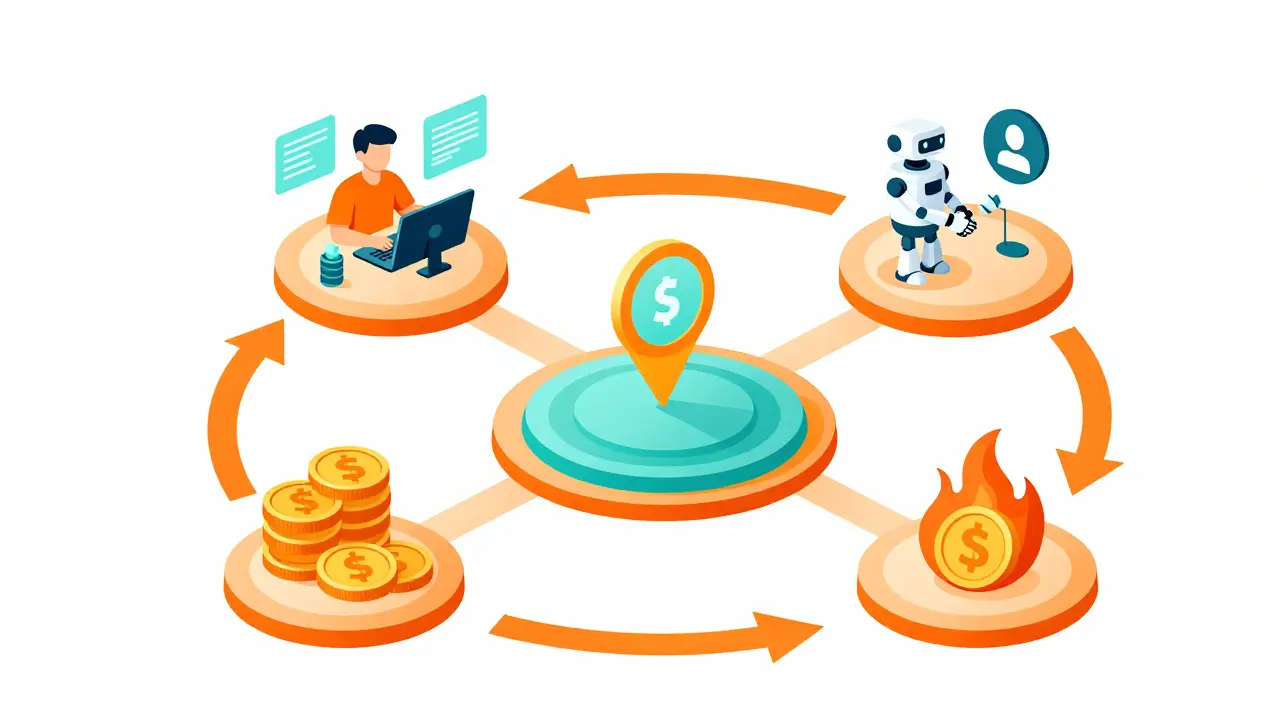
The token acts as the central economic layer. Here is how that plays out in practice:
- Paying Fees: When you use the platform to deploy an agent or access data, you pay in SERV.
- Incentivizing Builders: Developers earn rewards in SERV when they create useful agents or products that others use.
- Governance: Holders can vote on system updates and resource allocation, giving them a say in the future direction of the protocol.
- Burns: Certain actions generate token burns, which reduces the total supply over time, theoretically supporting scarcity.
This creates a closed-loop economy. Every product or agent created through OpenServ interacts with $SERV. If the platform gains traction and more people start using these AI tools, the demand for the token to pay for those services should logically increase.
Tokenomics: Supply, Distribution, and Vesting
One of the first things any serious investor checks is the supply schedule. You want to know if there is a risk of massive inflation dumping coins on the market. Fortunately, OpenServ has a fixed cap.
| Metric | Value |
|---|---|
| Total Supply | 1,000,000,000 SERV |
| Circulating Supply | ~770,000,000 SERV |
| Max Supply | 1,000,000,000 SERV |
| Networks | Ethereum, Base |
The total supply is capped at one billion tokens. This means no new coins can be minted indefinitely. However, not all of them are in circulation yet. According to data from Tokenomics.com and CryptoRank, about 41% of the supply was unlocked at the Token Generation Event (TGE) in late 2024. The rest follows a three-year emission schedule. Roughly 42.67% is released in Year 1, with smaller amounts unlocking in Years 2 and 3.
As of August 2026, approximately 770 million SERV tokens are circulating. This implies that a significant portion of the initial vesting has already occurred. The remaining supply is likely held by the team, investors, or the ecosystem fund, subject to further cliffs and linear vesting periods. Keep an eye on these unlock dates, as they can sometimes cause short-term price pressure if large holders decide to sell.
Price History and Market Performance
If you look at the charts, you will see that SERV is anything but boring. Like many mid-cap AI tokens, it experiences significant volatility. Let's look at the numbers from the past year.
In early 2025, the token traded around $0.04. By August 2025, it had climbed to nearly $0.07. However, the crypto winter chill hit hard in January 2026, dragging the price down to roughly $0.017 according to Kraken data. Since then, it has been recovering. By mid-July 2026, reports from CoinGecko and CryptoRank showed prices hovering between $0.038 and $0.046.
As of early August 2026, the market capitalization sits between $30 million and $35 million. This places OpenServ in the mid-cap range, ranking somewhere between #565 and #587 among all cryptocurrencies. Daily trading volume fluctuates significantly, ranging from $200,000 on quiet days to nearly $2 million during active periods. This liquidity is decent for its size, meaning you can generally enter or exit positions without moving the needle too much, provided you aren't trading millions of dollars at once.
Where Can You Buy SERV?
Accessibility matters. You cannot trade a coin if you cannot find it. Currently, SERV is available on both centralized and decentralized exchanges.
For decentralized trading, Uniswap V3 on the Ethereum network is the most active venue. You will typically swap ETH for SERV here. There is also liquidity on Aerodrome Slipstream 3. If you prefer centralized exchanges (CEX), LBank is currently the primary hub, offering a SERV/USDT pair with substantial daily volume. Other platforms like Coinbase and Crypto.com list the price for tracking purposes, but actual trading pairs may be limited or region-dependent. Always double-check the current listing status on your preferred exchange before attempting a trade.

Risks and What to Watch Out For
No investment is without risk, and OpenServ has its share of red flags you should consider before putting money down.
- Anonymity of Leadership: Unlike some projects with famous founders, OpenServ operates largely as a developer-led protocol. Major trackers do not list prominent public figures or a clear legal entity behind the scenes. While decentralization is a goal, lack of transparency can make accountability difficult if things go wrong.
- Volatility: As noted, the price swung from $0.017 to $0.07 in a matter of months. A 30% drop in a week is not uncommon in this sector. Are you prepared for that kind of rollercoaster?
- Audit Status: There is a noticeable lack of publicly cited third-party security audits in the major aggregators. While the smart contracts run on established networks like Ethereum and Base, independent verification of code quality is crucial for trust. Without seeing those audit reports, you are relying on the community to spot bugs.
- Competitive Landscape: The AI-crypto space is crowded. Projects like Render, Fetch.ai, and Bittensor are already household names. OpenServ needs to prove its unique value proposition-specifically its cross-domain agent collaboration-to gain real adoption beyond speculators.
Is OpenServ Worth Your Attention?
So, where does this leave us? OpenServ is a legitimate project with a clear utility narrative. It ties the token directly to the usage of an AI infrastructure layer, which is a sound economic model in theory. The capped supply and burn mechanisms add deflationary pressure that could benefit long-term holders if adoption grows.
However, it remains a mid-cap asset with high volatility and some gaps in public transparency regarding its leadership and security audits. If you believe in the thesis that AI agents will need a decentralized coordination layer, SERV offers exposure to that idea. Just remember to do your own due diligence, check the latest vesting schedules, and never invest more than you can afford to lose.
What blockchain is OpenServ built on?
OpenServ (SERV) is deployed on multiple EVM-compatible networks. Specifically, it has contract addresses on Ethereum and Base, allowing users to interact with the token on both Layer 1 and Layer 2 solutions.
Is SERV a good investment for beginners?
SERV is considered a mid-cap asset with high volatility. For beginners, it carries higher risk compared to top-tier coins like Bitcoin or Ethereum. It is best suited for investors who understand smart contract risks and are comfortable with significant price swings.
Who founded OpenServ?
Public records and major crypto aggregators do not prominently feature named individual founders or a specific corporate legal entity for OpenServ. It is presented primarily as a developer-led protocol, which is common in decentralized projects but adds a layer of anonymity risk.
How does the SERV token burn mechanism work?
The official documentation states that certain interactions within the OpenServ ecosystem generate token burns. This means a portion of the SERV used for fees or specific actions is permanently removed from circulation, reducing the total supply over time.
Where can I buy SERV tokens today?
You can trade SERV on decentralized exchanges like Uniswap V3 (on Ethereum) and on centralized exchanges such as LBank. Always verify current liquidity and listing status on your preferred platform before trading.

Joshua Hofford
Look, I know everyone is skeptical about another AI token, but honestly? The utility here actually makes sense.
Most of these projects are just vaporware with a whitepaper, but OpenServ seems to be building the actual plumbing for autonomous agents. If you think about it, we are heading toward a world where your digital assistants need to pay each other for services. That's what SERV does. It's not just hype; it's infrastructure.
I've been watching the development activity on GitHub, and they are shipping code consistently. That gives me hope that this isn't just a pump-and-dump scheme. We need more projects like this that focus on real-world application rather than just meme culture. Keep building, devs!
Marcia Albert
I mean, it’s kinda wild how fast this space moves. One minute it’s $0.04, next thing you know it’s dipping to $0.017 and making everyone panic. But hey, volatility is the name of the game, right? I’m just vibing with the idea of AI agents collaborating. Sounds like sci-fi coming true.
Emma Smith
the narrative is compelling yet one must question the underlying epistemology of trust in such decentralized structures. who watches the watchers when there is no central authority? the lack of named founders creates a void where speculation thrives over substance. i find myself pondering if the burn mechanism is truly deflationary or merely a psychological trick to induce scarcity anxiety among holders. the interplay between ai agents and token economics suggests a complex symbiosis that may not be fully understood by the average participant. we are essentially betting on the efficiency of algorithms governed by opaque entities. fascinatingly precarious.
Ed Mitchell
One must consider the possibility that this entire ecosystem is a sophisticated honeypot designed to extract liquidity from unsuspecting retail investors while the anonymous operators quietly consolidate their holdings. The absence of public leadership is not a feature; it is a glaring red flag indicative of potential malfeasance. Furthermore, the reliance on unverified smart contracts suggests a deliberate avoidance of accountability. One should remain vigilant against the subtle manipulation of market sentiment through coordinated social media campaigns. The volatility observed is likely engineered to trigger stop-loss orders at strategic intervals. Proceed with extreme caution, as the house always wins in such opaque arrangements.
Michael Mostyn
The theoretical framework presented here raises several interesting questions regarding the scalability of decentralized AI coordination. Specifically, how does the protocol handle consensus mechanisms when multiple agents require simultaneous access to limited computational resources? The tokenomics suggest a deflationary pressure, yet the emission schedule indicates significant inflationary periods ahead. This dichotomy warrants careful analysis before committing capital. Additionally, the cross-chain functionality introduces additional layers of complexity that could potentially expose users to bridge vulnerabilities. A rigorous examination of the technical documentation would be prudent for any serious investor.
Erica Johnson
Sure, it sounds fancy, but let's be real for a second. Most of these 'AI' tokens are just rebranded memecoins with extra steps. :/ I've seen this movie before. They promise the moon, deliver a pebble, and then rug pull. Until I see a third-party audit from a reputable firm, I'm keeping my money in stablecoins. Don't get FOMO'd into buying the top because some influencer tweeted about it. Stay safe out there. ;)
Ken G
it feels wrong to invest in something so hidden. where are the faces behind this project. why do we have to trust faceless coders with our money. the whole system seems corrupt and rigged against the little guy. big tech is probably pulling the strings from the shadows. we should stick to gold or cash instead of playing this dangerous game. morality matters more than profit in the end
Phil Babb
You guys are missing the forest for the trees!!! Look at the community growth! Look at the developer activity! This is huge!!! 🚀🚀🚀
I’ve been in crypto since 2013, and I can tell you this has legs. The fact that they are burning tokens means they care about long-term value. Don’t listen to the haters! They’re just jealous because they didn’t buy early enough! Get in now before it’s too late!!! 💪💪💪
Dominic Greco
Wake up sheeple! 🐑 This is all part of the grand plan to digitize your soul and sell your data to the highest bidder. 😈 The AI agents aren't helping you; they're harvesting your attention span. SERV is just the currency for your digital enslavement. 📉📉📉 Trust no one. Burn your wallets. Go back to the stone age. 🔥🔥🔥
Sean Rowland
Contrarily, the assertion that anonymity equates to risk is fundamentally flawed within the context of decentralized protocols. One might argue that the removal of human bias and ego-driven decision-making enhances the integrity of the system. Furthermore, the notion that audits provide absolute security is a comforting illusion, given the history of audited projects failing spectacularly. The true metric of success lies in the organic adoption of the agent marketplace, which remains independent of founder identity. Thus, the focus should shift from speculative governance concerns to tangible utility metrics.
Sus Sawyer
hey folks! just wanted to drop a quick tip for those looking to dive in. make sure u check the contract address twice before swapping on uniswap! there are lots of fake tokens out there trying to scam newbies. also, dont go all in at once. dollar cost averaging is ur best friend here. the tech is cool, but always protect yerself first! stay safe and happy trading! 🌟
Joy Kwant
I feel like nobody is listening to the emotional toll this takes on people. Watching your portfolio swing 30% in a week is exhausting. It drains your energy and makes you anxious all the time. Why do we keep participating in this toxic cycle? We need more compassion in this space, not just charts and numbers. My heart hurts for everyone losing sleep over this.
amy miranda
This article is utterly superficial and fails to address the fundamental flaws in the project’s architecture. The author presents a sanitized version of reality that ignores the predatory nature of venture capital involvement in crypto. It is disappointing to see such lazy journalism pass off as due diligence. Readers deserve better than this glossy brochure disguised as an analysis. Truly pathetic.