Imagine you're a digital artist working on a massive 3D animation. Your computer is powerful, but when you hit 'render,' your system freezes for twelve hours, and you can't do anything else. Or maybe you're an AI developer trying to train a model, but the big cloud providers are charging you a fortune and have long waiting lists. This is where Render Network is a decentralized, peer-to-peer network of connected graphics processing units (GPUs) that lets people rent out their idle computing power. Also known as the Render project, it basically turns the world's unused GPU power into a giant, shared supercomputer.
At its core, Render is about efficiency. Millions of high-end GPUs sit idle in gaming rigs and workstations around the globe. On the other side, creators and AI researchers are desperate for that same power. By using blockchain technology, Render connects these two groups, allowing artists to get their work done faster and GPU owners to make some extra money.
How the Render Network Actually Works
The system operates like a marketplace for compute. If you have a powerful GPU and aren't using it, you can become a node operator. You contribute your hardware to the network, and in return, you get paid in RENDER tokens . On the flip side, a creator who needs to render a complex motion graphics project pays tokens to the network to access that power.
To make this work, Render uses OctaneRender , a professional-grade rendering software created by OTOY. This ensures that the work being done is high-quality and follows industry standards. The network doesn't just blindly send data; it uses cryptographic techniques and smart contracts to verify that the work was actually completed correctly before any payment is released. This prevents bad actors from pretending to render a project and just taking the money.
The Shift from Ethereum to Solana
Early on, Render was built as an ERC-20 token on Ethereum. While Ethereum is secure, it's often slow and expensive when it comes to transaction fees-something that is a nightmare for a network that needs to process thousands of small rendering jobs. In late 2023, after a community vote, the network migrated to the Solana blockchain .
This wasn't just a technical change; it was a strategic move. Solana's high speed and tiny fees make it far more practical for a decentralized physical infrastructure network. During this move, the original RNDR token evolved into the RENDER token (the SPL version on Solana), though some users chose to keep their assets on Ethereum. This migration allowed the network to scale and handle the massive surge in demand coming from the AI sector.
Tokenomics: The Burn-and-Mint Equilibrium
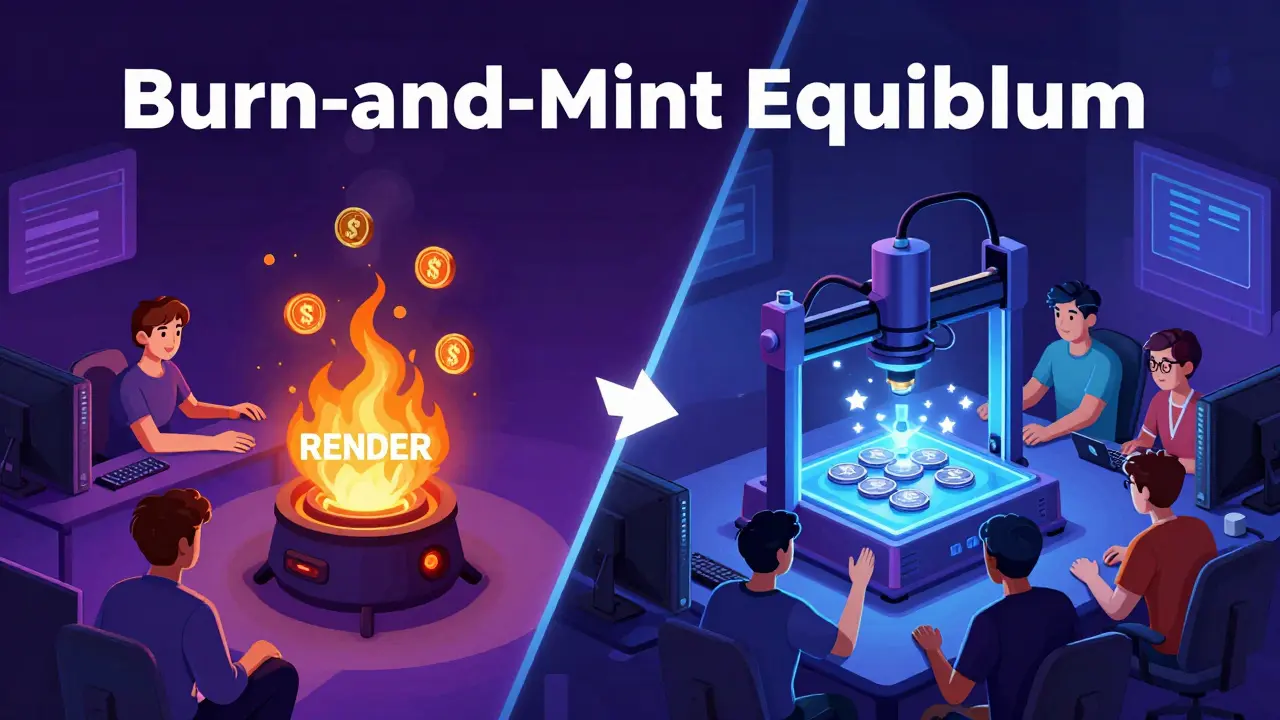
Render doesn't just print tokens randomly. It uses a clever system called the Burn-and-Mint Equilibrium (BME). This is designed to keep the token's value stable and linked to actual usage. Here is how the cycle works:
- The Burn: When a creator wants to render a project, they pay in USD-equivalent value using RENDER tokens. About 95% of those tokens are "burned" (permanently destroyed), which reduces the total supply and creates deflationary pressure.
- The Mint: To reward the people actually providing the hardware, the network "mints" new tokens. These are distributed to node operators based on how many jobs they finished and how often their GPU was online.
- The Foundation: The remaining 5% of the burned tokens go to the Render Network Foundation to keep the project evolving.
This means if the network is booming-say, because every AI company on earth needs more GPUs-more tokens are burned and more are minted as rewards, creating a self-balancing economy based on real-world demand rather than just speculation.
| Feature | Render Network (Decentralized) | AWS/Google Cloud (Centralized) |
|---|---|---|
| Cost | Typically lower (uses idle resources) | Higher (corporate overhead) |
| Accessibility | Open to anyone with a GPU | Controlled by the provider |
| Governance | Community-driven (RNPs) | Unilateral corporate decisions |
| Hardware Source | Distributed global nodes | Massive centralized data centers |
Why AI is Driving Render's Growth
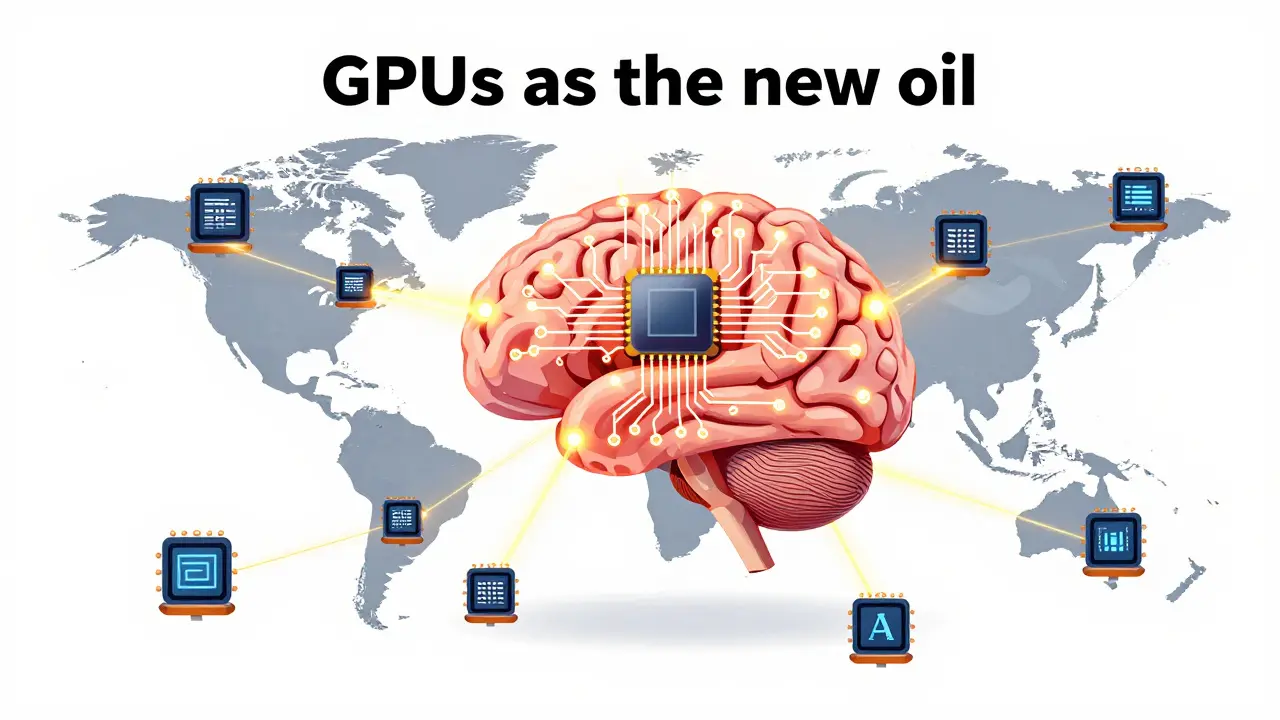
While Render started with digital artists and visual effects, the rise of generative AI changed everything. Training a Large Language Model or an image generator requires an insane amount of GPU power. In 2023, the RENDER token saw a massive price jump-over 1,000% in some cases-because the world realized that GPUs are the "new oil."
Centralized providers like Nvidia and Amazon are often sold out or prohibitively expensive for smaller developers. Render provides a relief valve. By tapping into a distributed network of GPUs, AI startups can find the compute they need without waiting for a corporate contract. This positions Render as a key player in the DePIN (Decentralized Physical Infrastructure Networks) sector, where blockchain is used to manage real-world physical assets.
Who Can Use Render?
The network isn't just for one type of person. It serves several different "jobs" depending on who is logging in:
- 3D Artists & Animators: People working on movies, game assets, or architectural visualizations who need to turn their 3D scenes into final images quickly.
- AI Developers: Those who need raw compute for model training or inference tasks.
- GPU Owners: Gamers or tech enthusiasts who want to earn passive income from their hardware while they sleep.
- Metaverse Builders: Developers creating complex virtual worlds that require high-fidelity rendering to feel immersive.
Governance and the Future
Render isn't run by a single CEO making all the calls. It uses a governance model centered around the Render Network Foundation. If someone has an idea to improve the network, they can submit a Render Network Proposal (RNP). Token holders then vote on these proposals, meaning the people who actually use the network have a say in how it evolves.
Looking forward, Render's success depends on the continued demand for compute. As we move toward a world filled with AI-generated video and more complex virtual reality, the need for GPUs will only grow. By turning a fragmented group of home computers into a cohesive, professional-grade network, Render is attempting to democratize the most valuable resource in the modern digital economy: processing power.
Is RENDER the same as RNDR?
Essentially, yes, but they live on different blockchains. RNDR was the original token on Ethereum. RENDER is the updated version on Solana. Most users migrated to RENDER to take advantage of faster speeds and lower fees, but the original RNDR still exists.
How do I earn RENDER tokens?
You can earn tokens by becoming a Node Operator. This involves providing your GPU power to the network and completing rendering jobs. You are rewarded based on the amount of work you process and your overall uptime (how often your machine is available).
Do I need a supercomputer to join the network?
No, but you do need a capable GPU. The network is designed for high-end graphics cards. The more powerful your hardware, the more jobs you can handle and the more you can potentially earn.
What happens to the tokens when a job is paid for?
Under the Burn-and-Mint Equilibrium model, 95% of the tokens used to pay for a rendering job are burned, meaning they are removed from the total supply. The other 5% goes to the Render Network Foundation.
Is Render only for 3D art?
It started that way, but it has expanded. While OctaneRender is used for 3D art and visual effects, the network's raw compute power is now heavily used for AI model training and inference.
Tony Gurley-Ward
The notion of a shared supercomputer is a kaleidoscopic dream of digital communalism. Why rely on a monolith when we can dance in a distributed web of silicon? It's an elegant rebellion against the corporate silos that keep our creativity in chains.
Kathleen Bergin
It is just a way to rent computers.
Eric Raines
Everyone acts like this is new, but I've been explaining the concept of distributed computing since before half of you had internet. It's basic logic. The real tragedy is how people just blindly follow the hype without understanding the actual latency issues involved in peer-to-peer rendering. It's honestly exhausting watching everyone pretend this is some magic bullet when the bottleneck is still the network speed.
Gary Lingrel
just another way for big tech to hide their tracks while we pay the electricity bill 🙄 total scam if you think about it
Jennifer Taylor
They want our GPUs so they can run their secret AI models. Once they have enough of our power they won't need us anymore. Wake up people
Mike Krasner
who cares about the ethics anyway just make money
Gloris Young
Really cool way to help artists. Love seeing the community grow!
Jagdish Sutar
This technology could be a game-changer for students in India who have great skills but can't afford expensive hardware. It opens up so many doors for global collaboration!
Alex Hunter
It's worth noting that the transition to Solana was a massive pivot. For those just starting, focusing on the DePIN aspect is key. It's not just about art; it's about the physical infrastructure of the internet evolving into something more decentralized.
Liz Ariza
Such a brilliant shift in perspective! 🌟 The way this empowers the little guy is just wonderful. Keep pushing those boundaries! ✨
Yvette P
Oh, absolutely, because nothing says 'decentralization' like migrating to a high-throughput L1 with its own unique set of centralization vectors, right? Let's talk about the actual TFLOPS per watt efficiency here, because if you're running a 3060 in a humid basement in Ohio, your hash rate is basically a joke compared to the hyperscalers who are just pretending to be 'distributed' for the marketing. It's an adorable attempt at disruptive innovation, really, but until the BME model actually accounts for the massive energy overhead of the verification layer, it's just a fancy way to burn tokens while pretending to be an AI powerhouse. I've seen these cycles before in the early cloud days and it always ends with the most efficient nodes winning anyway, rendering the 'peer-to-peer' dream a quaint fairy tale for people who like shiny tokens more than actual computing architecture.
Guy Bianco
The integration of OctaneRender is a sophisticated choice for ensuring quality standards. It is a commendable effort to bring professional tools to a decentralized audience. :)
Keith Garcia
The sheer audacity of suggesting that home gaming rigs could compete with enterprise-grade H100 clusters is almost poetic in its naivety. 💅 One simply does not conflate 'idle GPU power' with actual scalable compute architecture. It's a quaint little experiment for the masses, I suppose. 🙄
Caiaphas Konkol
The migration to Solana was obviously a move to escape the visibility of the Ethereum mainnet. They want the speed, sure, but the opacity of some of these high-speed chains is where the real games are played.
Tara Aman
I'm totally on board with this! We should all try to support these kinds of networks to break the monopoly of the big cloud giants!
Jennifer L
I am truly touched by the visiion of artists supporting each other across the globe. It is a most nobility endeavor indeed! I hope everyone finds peace and prosperitry in this new digital era!
Pardon my excitement, but the potential for harmony here is just overwhelming!
Sarah Ingrams
sounds like a helpful tool for people who struggle with hardware costs
Hannah Rubia
It is my professional opinion that the Burn-and-Mint Equilibrium provides a necessary stabilization mechanism for the token economy. I would be happy to elaborate on the mathematical underpinnings of deflationary pressure if anyone requires further clarification.
Clair Geary
This is such a vibrant way to look at the future of work! I wonder how the latency affects the real time collaboration though it still seems like a total win for the indie creators
Charlie Queen
Love this! 🚀 Bringing people together through tech is what it's all about! Let's gooo! 🌍✨