Buying a coin called WDOT sounds straightforward until you actually look at the data. One tracker says it’s worth $1.27. Another says it’s nearly $4.50. One platform claims it lives on the Astar a Polkadot parachain for smart contracts network, while another insists it belongs to Waves Enterprise a blockchain platform for business applications. If you are trying to figure out what WDOT crypto really is, you aren’t just looking at a volatile asset-you’re staring at a mess of conflicting information that could cost you money if you aren’t careful.
As of May 2026, WDOT is not your typical blue-chip cryptocurrency like Bitcoin or Ethereum. It is a low-cap token with significant discrepancies in how major exchanges track its price, supply, and even its underlying technology. Before you throw any capital at this ticker, we need to cut through the noise. I’ve dug into the raw data from CoinMarketCap, CoinGecko, Coinbase Brazil, and decentralized exchanges to give you the clearest picture possible. Here is what you need to know about WDOT right now.
The Identity Crisis: Is WDOT on Astar or Waves?
The biggest red flag with WDOT isn’t the price-it’s the platform confusion. In the crypto world, the blockchain a token lives on determines its security, speed, and utility. Right now, the data suggests two very different realities.
Coinbase a major centralized cryptocurrency exchange (specifically their Brazil interface) lists WDOT as an asset operating on the Astar Network a smart contract hub on the Polkadot ecosystem. Astar is known for supporting multiple virtual machines and integrating deeply with the Polkadot relay chain. If this is true, WDOT would benefit from Astar’s interoperability features and cross-chain capabilities.
On the other hand, CoinMarketCap the leading cryptocurrency market data aggregator describes WDOT as part of the Waves Enterprise a blockchain solution for corporate governance and DAOs ecosystem. This description positions WDOT as a governance token for Decentralized Autonomous Organizations (DAOs), helping enterprises manage blockchain-based workflows. Waves Enterprise is a completely different infrastructure than Astar, focusing heavily on enterprise-grade tools rather than general-purpose smart contracts.
This discrepancy usually means one of three things:
- Multiple Tokens: There might be two different projects using the same "WDOT" ticker symbol on different chains.
- Data Error: One of the major aggregators has mislabeled the token’s contract address or platform association.
- Pivot: The project migrated from one chain to another, and trackers haven’t updated correctly.
If you are buying WDOT, you must verify which specific contract address you are interacting with. Buying the "Waves" version when you think you’re buying the "Astar" version is a common way to get stuck with an illiquid bag of worthless tokens.
Price Chaos: Why You See Different Numbers Everywhere
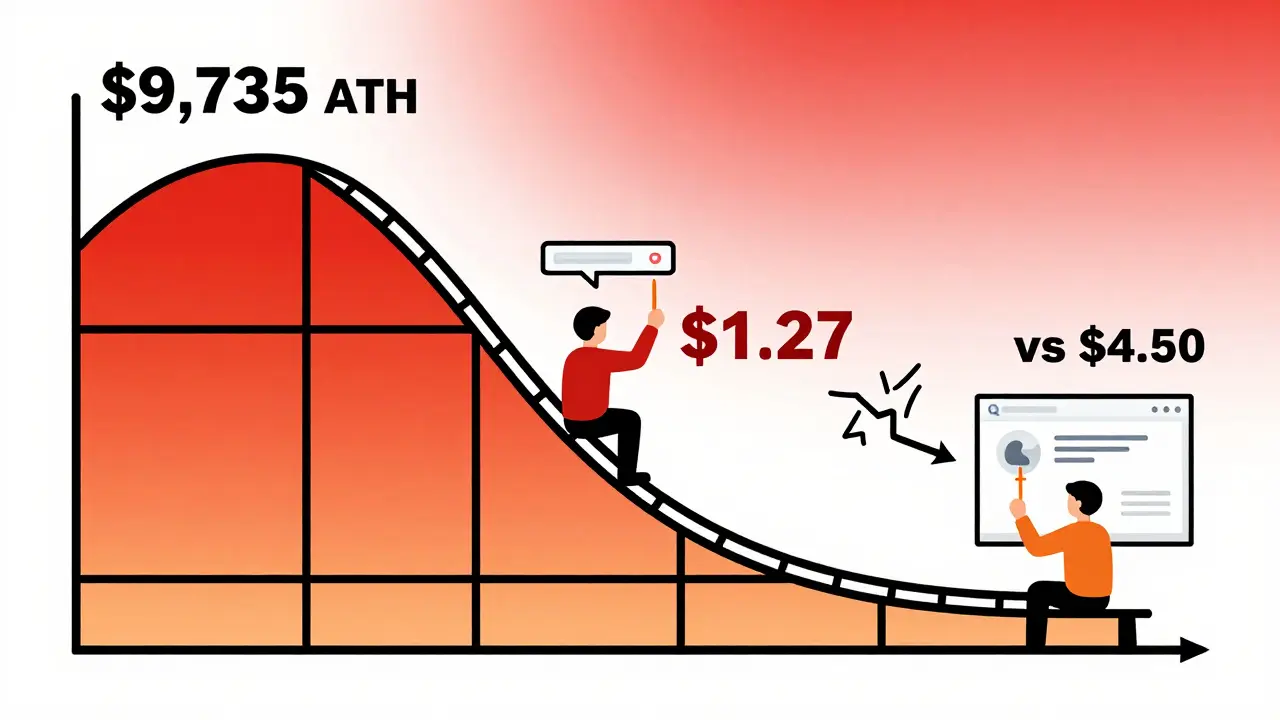
Let’s talk numbers, because they don’t add up. As of early May 2026, the price variance for WDOT is staggering. This isn’t normal volatility; it’s fragmentation.
| Platform | Reported Price (USD) | 24h Change | Notes |
|---|---|---|---|
| CoinMarketCap | $1.27 | +0.75% | Lowest reported price; zero volume listed |
| Crypto.com US | $1.28 | N/A | Aligns closely with CoinMarketCap |
| Coinbase Brazil | ~$3.93 | -4.82% | Listed in BRL (R$23.00); higher valuation |
| CoinGecko | $4.10 - $4.50 | +1.50% (7d) | Highest range; includes DEX data |
| ArthSwap (DEX) | $4.19 | +0.62% | WDOT/WASTR pair; high spread risk |
Why such a huge gap between $1.27 and $4.50? Liquidity. WDOT trades on only a handful of markets. On Binance the largest cryptocurrency exchange by volume, the price currently displays as $0 due to data errors or delisting. On smaller platforms like ArthSwap, the trading volume is thin-around $689 in 24 hours. When volume is this low, a single buy order can spike the price, while a sell order can crash it. This creates a situation where prices on different exchanges do not arbitrage efficiently.
If you see a price of $4.50 on CoinGecko but try to sell on a platform listing it at $1.27, you will lose over 70% of your value instantly. Always check the liquidity depth before entering a position.
Supply Issues: How Many WDOT Coins Exist?
Scarcity drives value, but we can’t even agree on how many WDOT tokens exist. The circulating supply data is equally fragmented.
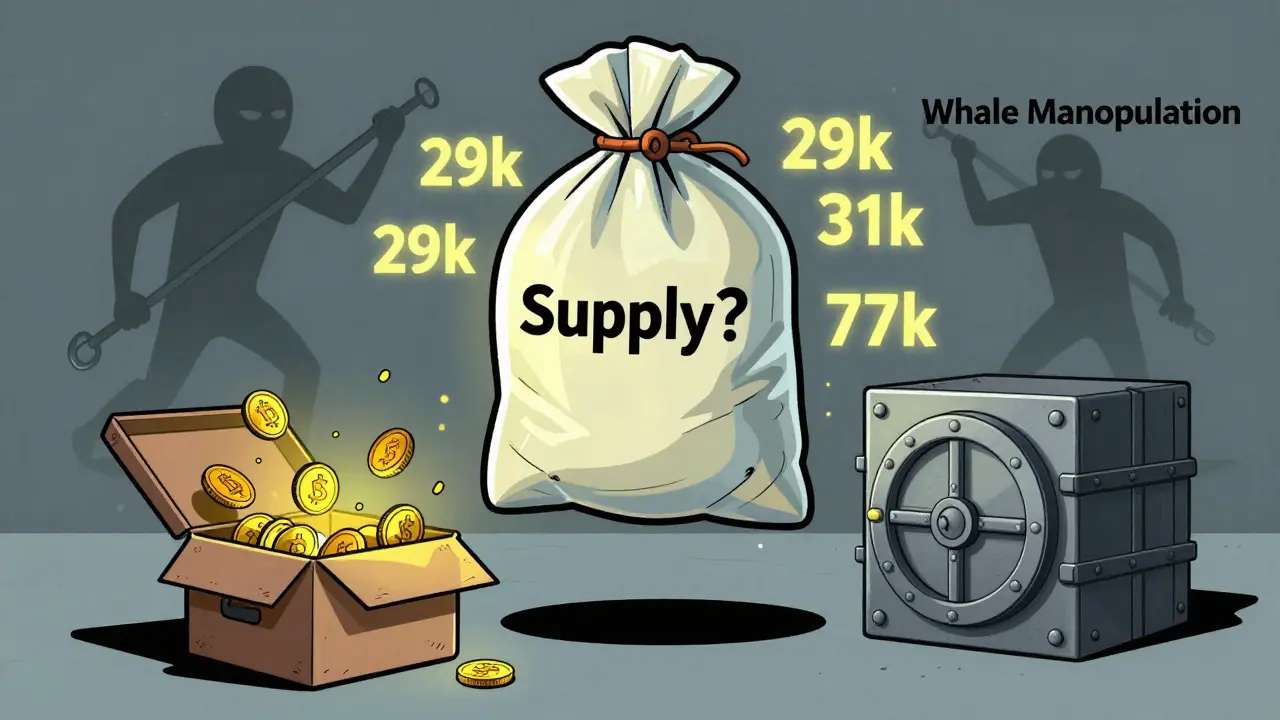
- Coinbase Brazil: Reports ~31,456 WDOT in circulation out of a total supply of 77,759.
- CoinMarketCap: Lists the circulating supply as 77,750 (matching the total supply), suggesting no maximum cap or that all tokens are already minted.
- CoinGecko: Indicates approximately 29,000 tradable tokens are actively moving on the market.
This difference matters. If there are only 29,000 tradable tokens, the market cap is tiny, making it easy for whales to manipulate the price. If there are 77,000+ tokens, the market is slightly larger but still micro-cap. The Fully Diluted Valuation (FDV) on CoinMarketCap sits at roughly $99,430, which is extremely small for a project claiming enterprise-level utility. For context, most serious DeFi projects have market caps in the millions, not tens of thousands.
Historical Performance: From $9,000 Highs to Current Lows
WDOT has seen wild swings. According to CoinGecko, the token hit an All-Time High (ATH) of $9,735.11 on January 19, 2024. Yes, you read that right-nearly ten thousand dollars per token. Since then, it has crashed dramatically. By June 2025, it hit an All-Time Low (ATL) of $3.10. Currently, it is trading around 33% above that low, but still down over 99% from its peak.
This trajectory is classic for meme coins or highly speculative assets that pump hard during a bull run and bleed out during consolidation. The fact that it is trading near its lows suggests either extreme bearish sentiment or that the earlier highs were manipulated. Be wary of "buying the dip" on a token that has lost 99% of its value without clear fundamental news to support a recovery.
Security Features: Cold vs. Hot Wallets
One area where WDOT seems to have consistent messaging is security. The project promotes a dual-wallet system designed to protect user assets. This is a standard but necessary feature for any credible crypto project.
- Cold Wallet: An offline storage solution with no internet connection. The majority of WDOT assets should be stored here to prevent hacking. This is ideal for long-term holding (HODLing).
- Hot Wallet: An online wallet connected to the internet, used for daily transactions and trading. These are more vulnerable to cyber threats but offer convenience.
If you hold WDOT, ensure your exchange or wallet provider supports this separation. Do not keep large amounts of WDOT in a hot wallet, especially given the low liquidity-if you panic-sell, you might not find a buyer at a fair price.
Should You Buy WDOT in 2026?
Here is the honest truth: WDOT is a high-risk, speculative asset. It lacks the clarity of established projects. The conflicting data regarding its blockchain platform (Astar vs. Waves) is a major warning sign. The massive price discrepancies between exchanges indicate poor liquidity and potential manipulation.
If you are an experienced trader who understands how to read order books, monitor multiple DEXs, and manage extreme risk, you might find opportunities in the volatility. However, for the average investor, WDOT offers little safety. There are no upcoming events listed on CoinMarketCal, and past catalysts seem sparse. Without active development updates or a clear roadmap, the token relies entirely on market speculation.
Before buying, ask yourself: Can I afford to lose 100% of this investment? If the answer is yes, proceed with caution. Verify the exact contract address on the blockchain explorer for the network you believe it resides on. Never trust a single data source.
Is WDOT a scam?
There is no definitive proof that WDOT is a scam, but the conflicting data across major platforms raises serious red flags. The existence of potentially two different tokens with the same ticker, combined with extreme price variances and low liquidity, makes it highly risky. Always verify the official contract address before investing.
Which blockchain does WDOT operate on?
Data is inconsistent. Coinbase lists it on the Astar Network, while CoinMarketCap associates it with Waves Enterprise. This discrepancy suggests either a data error or multiple tokens sharing the WDOT ticker. Check the specific contract address to determine the correct network.
Why is the WDOT price different on CoinGecko vs. CoinMarketCap?
The price difference ($1.27 vs $4.50+) is due to liquidity fragmentation. WDOT trades on very few exchanges with low volume. Prices on decentralized exchanges (like ArthSwap) may not reflect prices on centralized exchanges due to lack of arbitrage bots and thin order books.
What is the current circulating supply of WDOT?
Reports vary significantly. Coinbase lists ~31,456 tokens, while CoinMarketCap lists ~77,750. CoinGecko indicates only ~29,000 are actively tradable. This inconsistency makes accurate market cap calculations difficult.
Can I buy WDOT on Binance?
Currently, Binance shows a display error with the price listed as $0. This likely means the trading pair is delisted, suspended, or not available for direct fiat purchase. You may need to use decentralized exchanges (DEXs) or smaller centralized platforms to trade WDOT.

Write a comment