Imagine spending over a decade building a fantasy world, only to watch its native token drop nearly 100% from its peak. That’s the current reality for Wizardia, a blockchain-based GameFi project that promised AAA-quality turn-based battles and player-driven economies but now trades with a market cap smaller than many local businesses. If you’ve seen the ticker WZRD floating around crypto forums or exchange lists, you might be wondering: Is this a hidden gem waiting to explode, or a cautionary tale of hype versus delivery?
This guide cuts through the marketing noise. We’ll look at what Wizardia actually is, how its token economy works, where it stands in late 2026, and why liquidity is the biggest elephant in the room. Whether you’re a gamer looking for play-to-earn opportunities or an investor hunting for micro-cap assets, understanding the gap between Wizardia’s promises and its on-chain reality is crucial before putting any money down.
The Core Concept: More Than Just Another RPG
Wizardia is a cross-chain GameFi ecosystem built on Solana and BNB Smart Chain, featuring a turn-based strategy game where players battle, craft items, and manage resources using NFTs and the WZRD utility token. The project pitches itself as a bridge between traditional gaming depth and crypto ownership. Unlike simple click-to-earn games, Wizardia aims for "AAA" production values, combining dark science fiction aesthetics with classic role-playing mechanics.
The design rests on three pillars:
- Turn-Based Combat: Strategic PvP (Player vs Player) and PvE (Player vs Environment) battles where positioning and ability cooldowns matter more than reflexes.
- Player-Driven Evolution: The game world evolves based on collective player decisions, not just developer patches.
- Upgrade Progression: Characters grow stronger through gear crafting and skill trees, creating a demand loop for in-game resources.
While the concept sounds robust, it’s essential to distinguish between the design document and the shipped product. The official lightpaper describes features like base-building, exploration, and recipe research. However, independent verification of these features being fully operational and engaging for a sustained user base remains limited.
Tokenomics: Supply, Allocation, and Vesting
At the heart of the ecosystem sits the WZRD token. It serves as the primary currency for all economic activities within Wizardia. You don’t just buy WZRD to hold; you use it to mint NFTs, pay entry fees for tournaments, bet on matches, and stake for rewards.
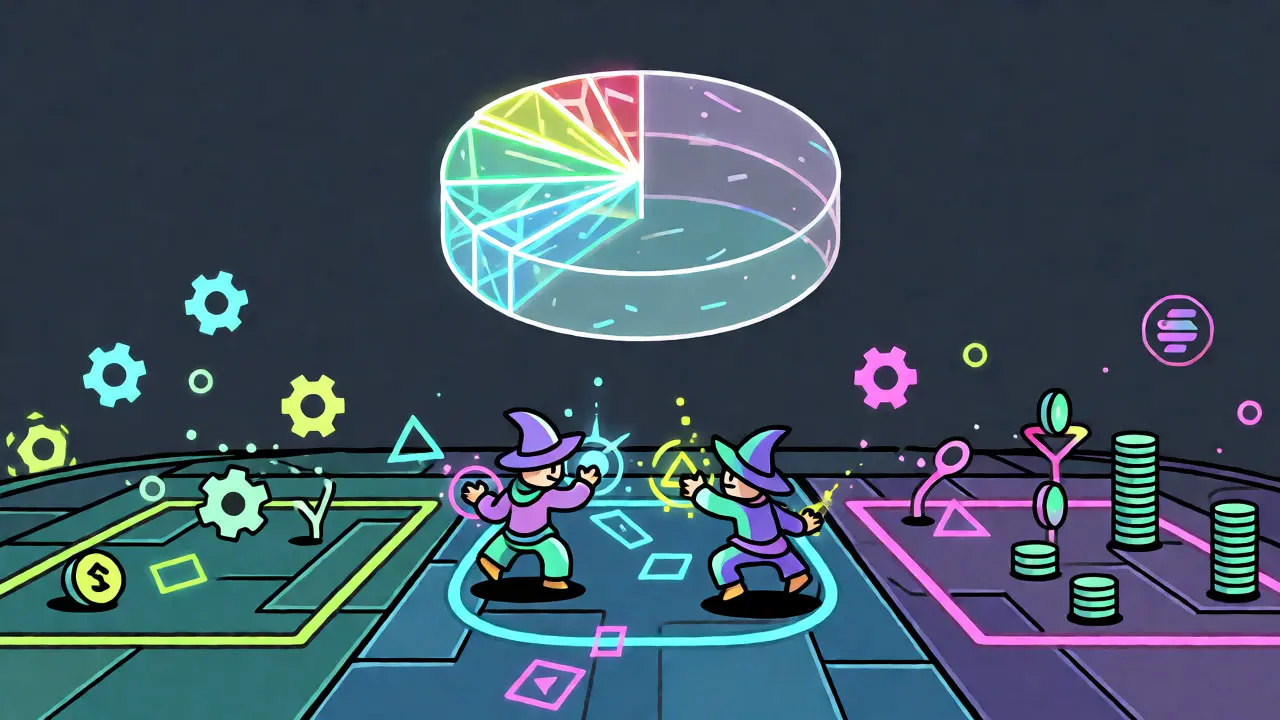
The total supply is capped at 300 million tokens. Here’s how the pie was sliced during its initial distribution:
| Category | Percentage | Token Amount | Purpose |
|---|---|---|---|
| Play-to-Earn & Staking | 40% | 120,000,000 | Rewards for players and stakers |
| Private Round | 15% | 45,000,000 | Early investors |
| Marketing & Listings | 18% | 54,000,000 | Growth and exchange partnerships |
| Team & Advisers | 18% | 54,000,000 | Incentives for developers and advisors |
| Community Round | 4% | 12,000,000 | IDO participants |
| Seed Round | 5% | 15,000,000 | Foundational funding |
A critical detail often overlooked is the vesting schedule. Early backers didn’t get their tokens immediately. Unlocks were staged over periods ranging from 5 to 19 months, extending into 2023. This structure helps prevent immediate dumping, but it also means that supply pressure has been gradual rather than sudden. As of late 2026, most of these early unlocks should have occurred, meaning circulating supply is closer to the total supply than it was in 2022.
The NFT Economy: Wizards, Arenas, and Markets
Wizardia isn’t just about one token; it’s about a suite of non-fungible tokens that represent ownership and gameplay capability. The project launched with three main NFT categories, each serving a different function in the economy:
- Wizard NFTs: These are your playable characters. Each Wizard has distinct art, stats, and abilities. They are the core asset for participating in battles and earning rewards.
- Arena Genesis NFTs: These represent partial ownership of an Arena. Holders earn a share of the revenue generated when players enter battles in that specific arena.
- Market Genesis NFTs: Similar to Arenas, these grant partial ownership of marketplace functions, allowing holders to benefit from transaction fees.
The idea here is decentralization of infrastructure. Instead of the company owning all the servers and taking all the profit, community members own parts of the game’s backbone. In theory, if the game gets popular, Arena and Market owners see passive income. In practice, this depends entirely on whether people are actively playing and trading.
Current Market Status: The Liquidity Reality Check
Let’s talk numbers, because they tell a stark story. As of October 2026, WZRD traded at approximately $0.000109. To put that in perspective, the all-time high was $0.5209. That’s a drawdown of roughly 99.98%. The market capitalization hovers around $17,400.
Why does this matter? Because a $17k market cap is tiny. For comparison, many meme coins with no utility trade higher. The daily trading volume is often under $3,000. When you look at order book depth, things get even thinner. On major exchanges like Gate.io, the buy-side depth for a 2% price impact might be less than $50. This means if you try to sell $100 worth of WZRD, you could crash the price by several percentage points.
Liquidity Warning: Low liquidity makes exiting a position difficult. You might see a price on CoinGecko, but realize you can’t sell your entire stack without accepting a significant discount due to slippage.
Project Activity: Alive or Zombie?
Determining if a crypto project is "alive" goes beyond checking if the website loads. RootData, a reputable crypto analytics platform, currently labels Wizardia as "Inactive." This doesn’t mean the smart contracts are broken or the team vanished overnight. It usually signals a lack of significant development updates, community engagement spikes, or new feature releases.
The official website did post a message in late 2025 saying "We are back," citing a renewed, smaller team focusing on integrating crypto gaming with actual gameplay. By January 2026, they updated pages related to consumables and NFT bundles. This suggests maintenance and perhaps a pivot toward a leaner operation. However, there is no public data confirming a large active player base or a fully released, polished AAA game experience comparable to mainstream titles.
Independent reviews are scarce. Most coverage dates back to the 2022 launch hype cycle. There are no verified user reviews on platforms like G2 or Trustpilot that quantify player satisfaction or earnings potential. Without this social proof, assessing the project’s health relies heavily on on-chain activity and token movement, which currently appear minimal.

Key Risks for Investors and Gamers
If you’re considering buying WZRD or investing time in the game, weigh these risks carefully:
- Extreme Volatility: With such low market cap, small buys or sells cause massive price swings. A single whale selling can wipe out weeks of gains.
- Liquidity Risk: You may not be able to sell your holdings quickly at the displayed price.
- Development Uncertainty: While the team claims to be active, the pace of visible innovation has slowed significantly since 2022. Will the "AAA" game ever fully materialize?
- Contract Complexity: WZRD exists on both Solana and BNB Smart Chain. Interacting with the wrong contract address or bridging incorrectly can lead to lost funds.
- No Guaranteed Returns: Play-to-earn models rely on new players entering to pay existing players. If growth stalls, rewards diminish.
Final Verdict: Speculative Micro-Cap
Wizardia represents a classic case of ambitious GameFi vision meeting harsh market realities. The technology stack (Solana + BNB), the tokenomics model, and the NFT utility framework are well-defined. But the execution has struggled to gain traction in a crowded market. Today, WZRD is best viewed as a speculative micro-cap asset with high risk and high potential variance, rather than a stable investment or a proven gaming platform.
Is Wizardia (WZRD) a good investment right now?
It is highly speculative. With a market cap under $20,000 and very low trading volume, it carries extreme volatility and liquidity risks. It is suitable only for those willing to lose their entire investment in hopes of a niche revival.
Which blockchains support Wizardia (WZRD)?
Wizardia operates primarily on Solana, where the original token was issued. It also has a presence on BNB Smart Chain via a bridged version of the token. Always verify the correct contract address for the chain you are using.
Can I still play the Wizardia game?
The project states it is in a "renewed development" phase. While some elements may be accessible, a full, widely adopted AAA release has not been confirmed by independent sources. Check the official website for current access requirements.
What is the maximum supply of WZRD?
The maximum supply of WZRD is capped at 300 million tokens. Approximately 160 million are currently in circulation, according to recent data.
Where can I buy WZRD?
Liquidity is concentrated on Gate.io (for the Solana version) and PancakeSwap (for the BNB Chain version). Due to low volume, expect significant slippage on larger orders.
Write a comment