You see the ticker ZUSD on a chart or an exchange, and you assume it’s just another dollar-pegged stablecoin. But here is the catch: there isn’t just one ZUSD. In fact, there are three completely different projects using that exact same ticker symbol. If you mix them up, you might end up with a token that doesn’t behave the way you expect-whether that means losing liquidity, facing unexpected regulatory hurdles, or dealing with smart contract risks instead of bank guarantees.
To use ZUSD safely in 2026, you first need to know which version you are holding. Are you looking at the regulated, bank-backed asset from Japan’s GMO Internet Group? The ecosystem-specific coin for Horizen EON? Or the decentralized, Bitcoin-backed loan instrument on the RSK network? Let’s break down each one so you can pick the right tool for your wallet.
The Main Contender: GMO Trust’s Regulated ZUSD
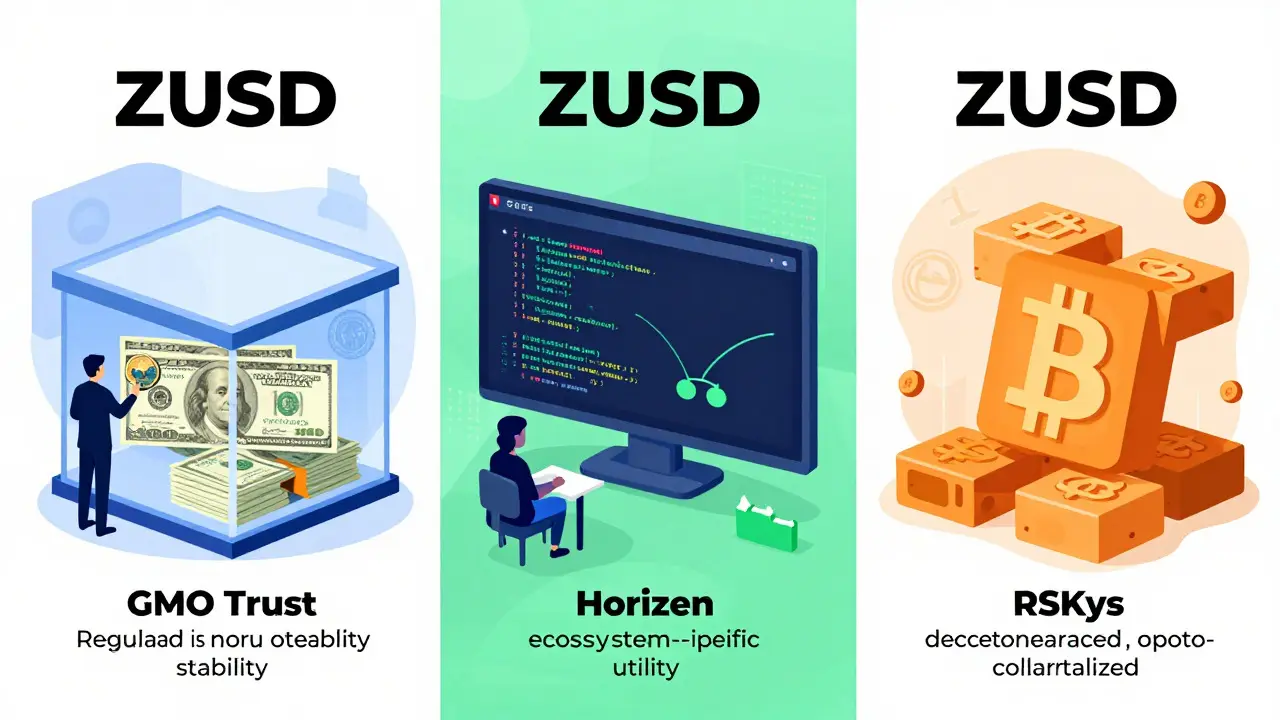
When most people talk about ZUSD in a professional context, they are referring to the stablecoin issued by GMO-Z.com Trust Company, a limited purpose trust company owned by the Japanese tech giant GMO Internet Group. This entity operates under strict supervision from the New York State Department of Financial Services (NYDFS), making it one of the few stablecoins with direct U.S. banking regulation backing its operations.
Launched in early 2021 alongside its sister token GYEN (which pegs to the Japanese Yen), this version of ZUSD is designed for institutions and traders who prioritize safety over yield. It is a centralized, fiat-collateralized stablecoin. That means for every single ZUSD token in circulation, GMO Trust holds exactly one U.S. dollar or equivalent short-term U.S. Treasury bills in reserve. There is no algorithmic magic here; it is pure balance sheet transparency.
The key selling point is accountability. GMO Trust publishes monthly attestation reports from independent accounting firms to verify that their reserves match the circulating supply 1:1. This puts it in the same regulatory tier as other NYDFS-regulated assets like Paxos Standard (PAX) or the former Gemini Dollar (GUSD). While its market cap is tiny compared to giants like USDT or USDC, its compliance framework makes it attractive for businesses needing transparent, audited settlement rails.
| Attribute | Detail |
|---|---|
| Issuer | GMO-Z.com Trust Company, Inc. |
| Regulator | New York State Department of Financial Services (NYDFS) |
| Collateral | 100% USD Cash and U.S. Treasury Bills |
| Networks | Ethereum (ERC-20), Stellar, Solana |
| Redemption | 1:1 fixed rate via KYC-verified process |
How to Use GMO ZUSD in Practice
If you want to hold or trade this specific ZUSD, you have two main paths. The first is through GMO Trust’s own portal. You complete a Know Your Customer (KYC) verification, wire U.S. dollars to their custodian, and receive ZUSD tokens directly into your wallet. This is ideal if you are moving large sums and want direct access to the issuer.
The second path, which is more common for retail users, is through supported exchanges. As of mid-2024, Bitstamp listed ZUSD, allowing traders to swap major cryptocurrencies for ZUSD without dealing directly with GMO’s banking infrastructure. Because it exists on Ethereum, Stellar, and Solana, you can move these funds across chains, though you must ensure your wallet supports the specific network you are sending to. For example, sending Ethereum-based ZUSD to a Solana address will result in lost funds.
The Niche Player: Horizen EON’s ZUSD
The second ZUSD enters the picture through the Horizen EON blockchain ecosystem. Announced in October 2024, this stablecoin was created in partnership between Stably and Horizen Labs. While it shares the name and the $1 peg, its purpose is entirely different. It is not designed for general-purpose trading on Binance or Coinbase; it is built specifically to provide liquidity within the Horizen EON DeFi environment.
Like the GMO version, Horizen’s ZUSD is fully collateralized by fiat assets held by a designated trustee. However, the minting and redemption process is gated behind Stably’s identity verification system. Users can mint ZUSD by depositing either USD or USDC, but only after passing KYC checks. This creates a hybrid model: it has the stability of a traditional bank account but lives on-chain as an ERC-20 compatible token within the EON network.
Why does this matter? If you are a developer building decentralized applications on Horizen EON, or a user wanting to earn yield in EON-specific lending pools, this ZUSD is your primary unit of account. It bridges off-chain dollars into the EON ecosystem. However, if you try to use this token on Ethereum mainnet or in Uniswap pools, you may find yourself stuck, as its liquidity is concentrated almost exclusively within Horizen’s infrastructure.
The Decentralized Option: RSK Zero Protocol’s ZUSD
The third variant is the most technically distinct. On the RSK (Rootstock) network, a project called Zero (developed by DistributedCollective) issues a ZUSD that behaves nothing like the other two. This is not a fiat-backed coin. Instead, it is a crypto-collateralized stablecoin, similar in spirit to DAI or LUSD.
Here is how it works: You lock up RBTC (Bitcoin wrapped on the RSK network) into a smart contract called a "Trove." Based on the value of your RBTC, the protocol lets you borrow ZUSD against it. The stability of the peg is maintained not by a bank, but by economic incentives. If the price of RBTC drops too low relative to your debt, your Trove gets liquidated. Conversely, if ZUSD trades below $1, arbitrageurs can redeem their ZUSD directly for RBTC from the protocol, forcing the price back up.
This version appeals to privacy advocates and DeFi purists who want censorship resistance. There is no central company that can freeze your funds. However, you take on smart contract risk and collateral volatility. If the RSK ecosystem shrinks or the code contains a bug, your ZUSD could depeg. It is a high-reward, higher-risk alternative to the safe-haven status of the GMO token.
Comparing the Three ZUSD Tokens
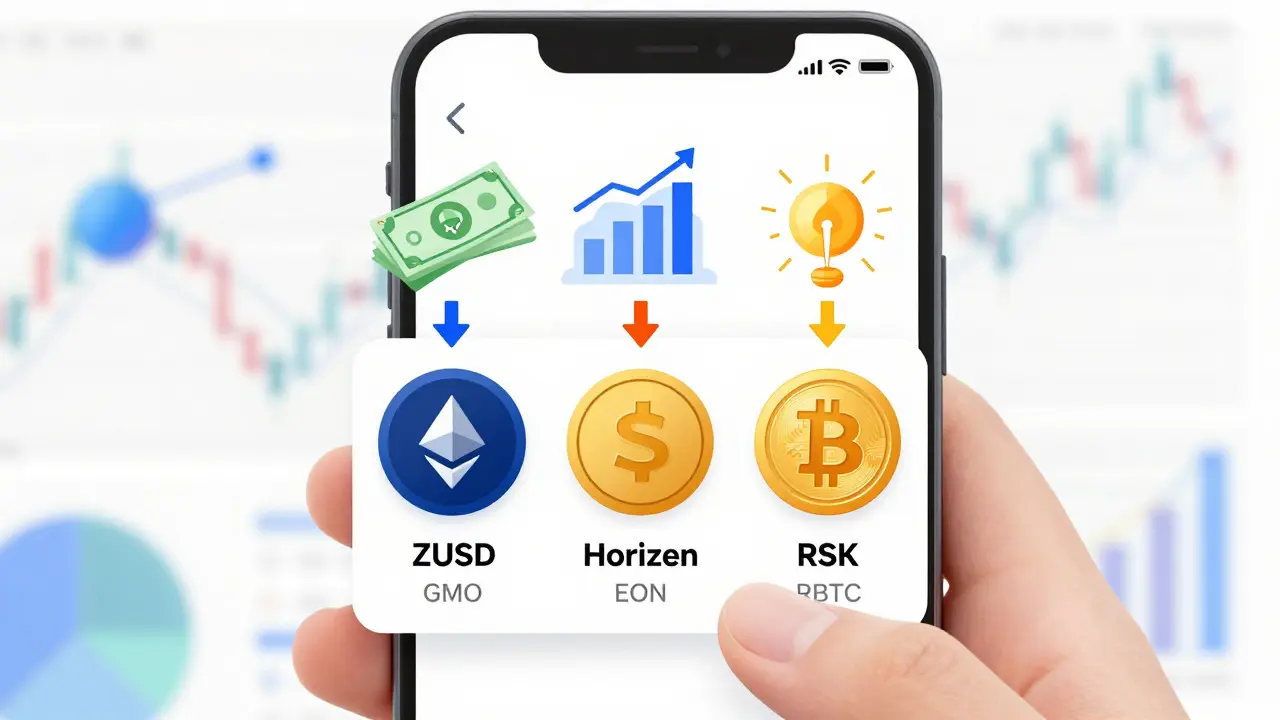
To avoid costly mistakes, keep this comparison in mind before you buy or integrate any ZUSD into your portfolio:
- For Safety & Compliance: Choose GMO Trust’s ZUSD. It is regulated by NYDFS, backed by cash/Treasuries, and audited monthly. Best for institutional payments and conservative holding.
- For Horizen EON DeFi: Choose Horizen/Stably’s ZUSD. It is fiat-backed but locked into the EON ecosystem. Best for earning yield within Horizen’s specific apps.
- For Decentralization & Leverage: Choose RSK Zero’s ZUSD. It is backed by Bitcoin (RBTC) and governed by code. Best for non-custodial borrowing and avoiding central points of failure.
Which One Should You Pick?
Your choice depends entirely on your goal. If you are a business owner in Asia or Europe looking to settle invoices in a regulated, transparent digital dollar, GMO Trust’s ZUSD is likely your best bet due to its strong legal framework and multi-chain support (Ethereum, Stellar, Solana). The presence of listings on reputable exchanges like Bitstamp adds a layer of accessibility that the others lack.
If you are a DeFi farmer exploring newer Layer-2 ecosystems, Horizen EON’s ZUSD offers a gateway into that specific community. Just remember that your liquidity is tied to the health of the Horizen network. If EON fails to attract developers, your ability to exit ZUSD smoothly could be hampered.
Finally, if you distrust banks and want to leverage your Bitcoin holdings without selling them, the RSK Zero protocol offers a sophisticated, albeit complex, solution. It requires technical literacy to manage collateral ratios and understand liquidation thresholds, but it offers true ownership of your assets.
In a crowded stablecoin market dominated by USDT and USDC, ZUSD remains a niche player. Its fragmentation into three distinct projects means brand recognition is split. Always check the contract address and the underlying blockchain before transferring funds. A simple mistake in selecting the wrong network or the wrong issuer’s token can turn a straightforward transaction into a customer support nightmare.
Is ZUSD a good investment?
ZUSD is not an investment in the traditional sense because it is a stablecoin pegged to the U.S. dollar. Its value aims to stay at $1.00. You do not buy it to profit from price appreciation. Instead, you use it to preserve value, hedge against crypto volatility, or facilitate fast cross-border transfers. The "return" comes from potential yield if you lend it out in DeFi protocols, but the principal should remain stable.
Which ZUSD is regulated by the NYDFS?
Only the ZUSD issued by GMO-Z.com Trust Company is regulated by the New York State Department of Financial Services (NYDFS). This version is backed by fiat currency and U.S. Treasury bills. The other versions, such as those on Horizen EON or RSK, operate under different regulatory frameworks or are decentralized and unregulated by traditional banking authorities.
Can I exchange GMO ZUSD for Horizen ZUSD?
Not directly. They are separate tokens on different blockchains with different issuers. To switch between them, you would typically need to sell one for a base currency (like USD or USDC) on an exchange, withdraw it, and then purchase the other type on its respective platform or exchange. Always verify the contract addresses to ensure you are interacting with the correct asset.
What backs the ZUSD on the RSK network?
The ZUSD on the RSK network (via the Zero protocol) is backed by RBTC, which is Bitcoin secured on the Rootstock smart contract platform. It is a crypto-collateralized stablecoin, meaning users lock up Bitcoin to borrow ZUSD. It is not backed by fiat currency in a bank account.
Where can I buy GMO Trust's ZUSD?
You can acquire GMO Trust's ZUSD directly through GMO Trust's official portal after completing KYC verification, or indirectly through supported cryptocurrency exchanges like Bitstamp. It is available on the Ethereum, Stellar, and Solana networks.
Paul Smith
Great breakdown! 🧠 It’s wild how many projects use the same ticker. I always double-check contract addresses now after seeing people lose funds by mixing up networks. The GMO one seems like the safest bet for most folks just trying to hold USD value without the drama. 👍
Carl Michaud
The entire premise of 'regulated' stablecoins is a facade designed to lull you into a false sense of security while they quietly siphon liquidity. GMO Trust? More like GMO Trap. They are just another node in the surveillance state's financial grid, waiting for the moment when your assets need to be frozen for 'compliance.' The RSK version is the only one that respects sovereignty, but even then, smart contracts are just code written by humans who can be bribed or hacked. Wake up.
Matt Kay
boring article
Namrata Mapgaonkar
hmm interesting read :) i never knew there were so many zusd versions out there. usually i just stick to usdt because its easy to find everywhere but this makes me think twice about safety. thanks for sharing this info it was quite helpful actually 😊
Rita Dutta
oh my god, the sheer audacity of these entities to share a ticker symbol is absolutely diabolical. it is a testament to the chaotic nature of our digital existence where identity is fluid and fragile. we are dancing on the edge of a cliff with three different pairs of shoes, hoping one doesn't fall off. the rsk one sounds like a philosophical statement on trust vs verification, very post-modern if you ask me. but really, who has time for this complexity? it is exhausting just reading about it. 🤯
Rodmun Tarnowski
This is an exceptionally well-researched piece.!! The distinction between the fiat-backed models and the crypto-collateralized model is crucial for any serious investor.!! One must remain vigilant.!! The regulatory oversight provided by the NYDFS adds a layer of credibility that is often overlooked in the fervor of decentralization.!! I appreciate the clarity.!!
Dave Kjendal
look, most of you dont know what you are talking about. the gmo one is fine for normies who want to sleep at night. but if you actually understand leverage, you go rsk. simple as that. stop overcomplicating things.
Eric Zehr
I really appreciate this clear explanation. It is easy to get overwhelmed with all the options in crypto right now. Knowing that GMO ZUSD has those monthly attestations gives me much more confidence than some of the other vague promises I have seen. Thanks for breaking it down so clearly!
Kat Bennett
I have been wondering about this for a while since I saw ZUSD pop up on a few different charts and got confused. It is fascinating how the same acronym can represent such vastly different underlying mechanisms. The part about the Horizen EON ecosystem being niche really highlights how fragmented the DeFi space still is, which can be both a barrier to entry and an opportunity for early adopters who dig deep enough to find the right tool for their specific needs.
Candice Cornett
everyone is sleeping on the fact that regulated stablecoins are just centralized databases with extra steps. why bother with blockchain if you need kyc and nydfs approval? it defeats the purpose entirely. the whole point of crypto was to escape this bureaucracy not to recreate it with worse tech.
Matthew Smith
the moral hazard here is staggering. we are trusting corporations with our money again under the guise of innovation. yet we pretend the decentralized ones are safe too. it is all a game of musical chairs. i prefer to stay away from it all honestly. let the fools play.
Prudence Flemming
peg stability is an illusion maintained by arbitrage bots and fear. the rsk model is interesting technically but economically fragile. fiat backed is just debt backed. nothing changes. just different wrappers around the same rotting core of fractional reserve banking logic applied to tokens. jargon aside its all risky.
Lance Jantz
Oh, darling, you simply must embrace the chaos! The beauty of ZUSD isn't in its stability, but in the delightful confusion it causes among the uninitiated. I personally love the RSK version because it feels like holding a secret handshake to the underground economy. It is spicy, it is dangerous, and it tastes like freedom (and maybe a little bit of liquidation risk). Don't be a boring soul with your GMO tokens! Live dangerously! 💃✨
Don Fizy
Hey everyone! Just wanted to add that if you are new to this, start small. The article mentions checking contract addresses, which is super important. I always recommend using a hardware wallet for anything significant. Hope this helps you navigate the ZUSD jungle safely! :)