Over 600,000 people in Bangladesh are using Binance every day - even though the government says it’s illegal. You won’t find any official signs saying "Crypto Allowed Here," but you’ll find plenty of young people in Dhaka, Chittagong, and Sylhet trading Bitcoin and Tether on their phones. They’re not breaking the law because they’re reckless. They’re doing it because they have no other choice.
How Can You Use Crypto If It’s Banned?
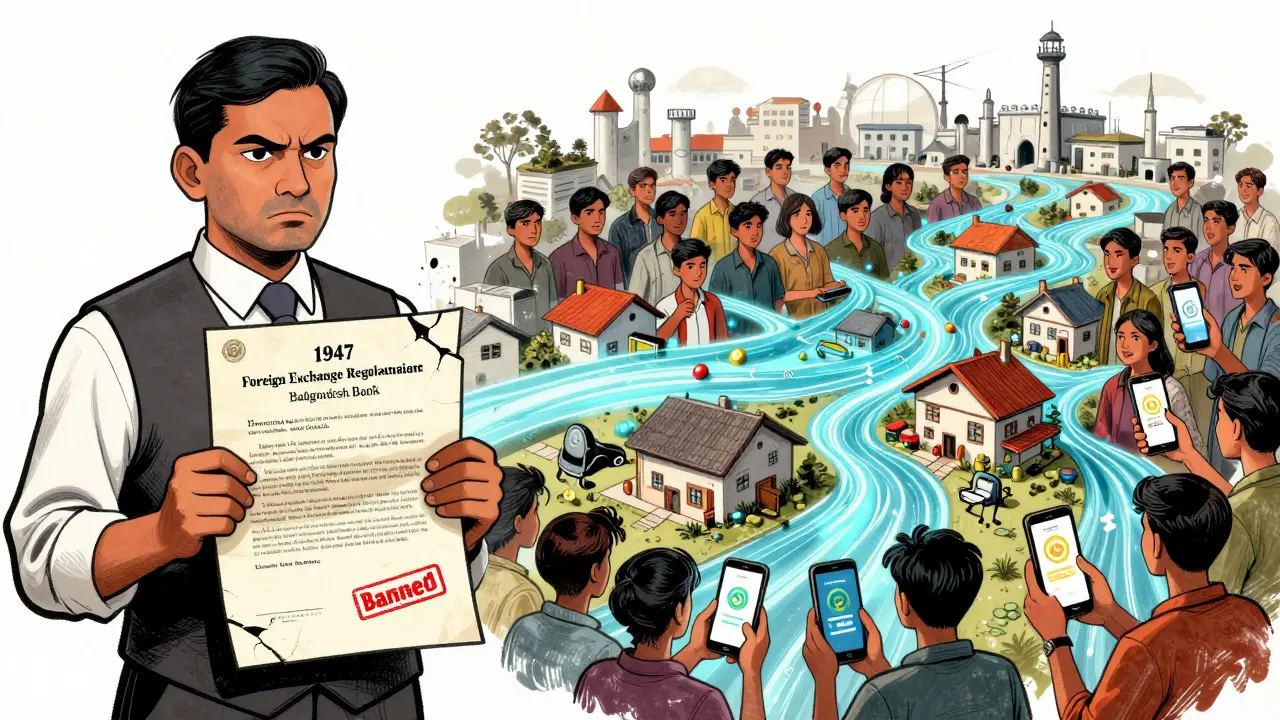
Bangladesh doesn’t have a law that says "Crypto is illegal." Instead, it uses older rules to make crypto usage risky. The Bangladesh Bank is the central bank, and since 2014, it’s warned that using Bitcoin violates the Foreign Exchange Regulation Act of 1947. That law was written for a time when people moved cash across borders in suitcases. Now, it’s being used to stop digital transactions.
Here’s the twist: the government also says blockchain technology is important. In 2020, it released a National Blockchain Strategy - meaning it sees value in the tech behind crypto, just not the currency itself. It’s like saying, "We love the engine, but we hate the car."
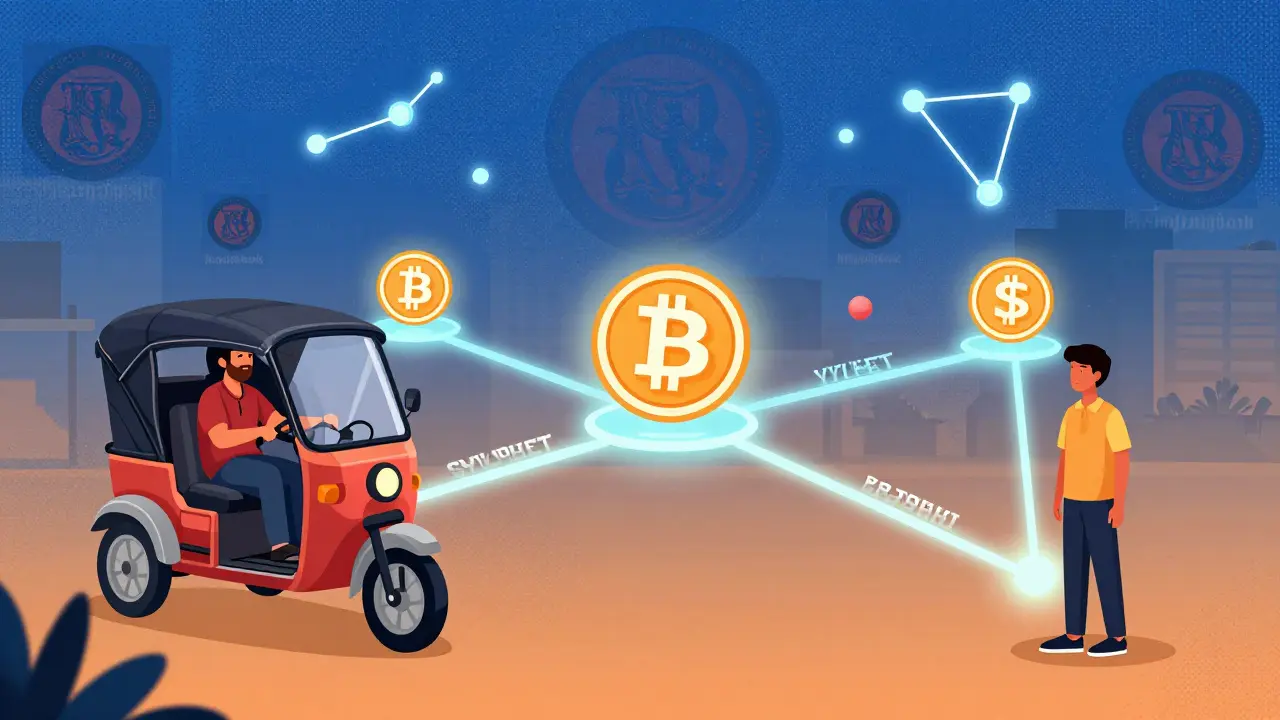
So how do people still trade? They don’t use bank apps. They use local agents. These agents take Bangladeshi Taka in cash, then send US dollars to someone overseas who buys crypto on Binance. The user gets their Bitcoin or USDT delivered digitally. The agent takes a small cut - maybe 1% to 3%. It’s not perfect, but it works. And it’s widespread.
Why Binance? Because It’s Easy to Find
You won’t find Binance on the official Google Play Store in Bangladesh anymore - but you still can download it. People use third-party APK files or older versions cached on their phones. Some even use VPNs, though most don’t need to. The app loads fine. The interface is in English, but users don’t care. They know how to buy, sell, and send.
There are no official ads. No government warnings pop up when you open the app. The Bangladesh Bank has issued statements, sure. But those are press releases, not blocks. The internet doesn’t care about press releases. And with over 120 million internet users in Bangladesh, even a small percentage of tech-savvy people adds up to hundreds of thousands.
The Real Reason People Are Doing It
It’s not about speculation. It’s about survival.
Many Bangladeshis send money home from jobs in Malaysia, Saudi Arabia, or the UAE. Traditional remittance services charge 8% to 12%. Crypto transfers? Sometimes under 1%. A worker in Dubai can send $500 to his family in Sylhet in 10 minutes, not 3 days. No paperwork. No middleman. No waiting.
Small businesses, especially those trading with India or Thailand, are turning to crypto to avoid banking delays. Indian rupees are hard to convert. Thai baht? Even harder. But USDT? Stable. Instant. Global.
And then there’s inflation. The Bangladeshi Taka has lost nearly 20% of its value against the US dollar since 2020. People aren’t just buying crypto for profit - they’re buying it to protect what little savings they have.
The Government’s Dilemma
The Bangladesh Bank says crypto violates anti-money laundering laws. But here’s the problem: the underground market is easier to track than the black market for dollars. Every crypto transaction leaves a digital trail. Cash? Not so much.
There’s no official crypto tax. The National Board of Revenue doesn’t track it. But if you earn money from crypto, they can still tax it under the Income Tax Ordinance of 1984 - if they find out. That’s the catch. Enforcement is patchy. Most people aren’t caught. And even if they are, penalties are rare.
Meanwhile, neighboring countries are moving forward. India bans crypto as payment but allows trading. Indonesia lets people buy crypto as an asset. Even Russia has a licensing system for exchanges. Bangladesh? Still stuck in 2014.
What Experts Are Saying
Dr. B M Mainul Hossain, a professor at Dhaka University and director of its Institute of Information Technology, doesn’t mince words: "Banning is not a solution. Sitting back and doing nothing is not the answer."
He’s not alone. Academics across Bangladesh point out that countries that embraced crypto regulation - like El Salvador and the UAE - didn’t lose control. They gained transparency. They created tax revenue. They protected consumers.
Why not do the same? Let people trade crypto - but require KYC. Let exchanges operate legally - but under supervision. Let the blockchain strategy become real. Instead, the government is chasing ghosts.
The Shadow Economy Is Already Here
There are now hundreds of local crypto agent networks in Bangladesh. Some operate out of small shops. Others run WhatsApp groups with 500 members. They don’t advertise. They don’t need to. Word spreads fast.
One student in Rajshahi told me: "My uncle works in Qatar. He sends me money in USDT. I use it to buy my textbooks online. If I used a bank, it would take two weeks and cost me $30. Now? It’s instant. And I pay $1."
That’s not a crime. That’s common sense.
What Happens Next?
The 600,000 users aren’t going away. They’re growing. And as more young people get online, more will join.
The government can keep pretending crypto doesn’t exist - or it can start talking to the people who are already using it. The blockchain strategy is a clue. It’s not a contradiction. It’s a lifeline.
Maybe the next policy won’t be a ban. Maybe it’ll be a license. Maybe it’ll be a tax. Maybe it’ll be regulation.
Or maybe it’ll be too late.
Is it really illegal to use Binance in Bangladesh?
Yes, under current regulations. The Bangladesh Bank says using cryptocurrency violates the Foreign Exchange Regulation Act of 1947 and the Money Laundering Prevention Act of 2012. There’s no specific law banning crypto ownership, but any transaction involving crypto is considered illegal because it bypasses the official banking system and foreign exchange controls.
How are people getting around the ban?
Most users rely on local agents who exchange Bangladeshi Taka for crypto like Bitcoin or USDT. These agents operate offline, often through cash transactions or mobile banking. Others download Binance or KuCoin directly via APK files or third-party app stores. VPNs are used by some, but aren’t necessary - the apps still load on most networks.
Can the government track crypto users?
It’s hard. While banks can see when someone sends money overseas, they can’t see if it was used to buy crypto unless they get access to exchange records - which they don’t have. Crypto transactions themselves are public on the blockchain, but user identities aren’t tied to them unless KYC is used. Most Bangladeshi users avoid KYC on Binance, making tracking nearly impossible.
Why doesn’t Bangladesh just legalize crypto?
The government fears losing control over foreign exchange, money laundering, and tax revenue. But experts argue that regulation - not prohibition - would give them more control. Legal crypto exchanges could be required to report users, collect taxes, and verify identities. That’s more effective than a ban that only pushes activity underground.
Is there any risk for users?
Yes. If caught, users could face fines or legal action under money laundering or foreign exchange laws. But in practice, enforcement is rare. No public cases of individuals being prosecuted for personal crypto use have been reported. The bigger risk is losing money - scams are common, and there’s no legal recourse if your agent disappears.
What’s the difference between blockchain and cryptocurrency in Bangladesh’s policy?
The government supports blockchain as a tool for digital government services, supply chain tracking, and public records. But it refuses to recognize cryptocurrencies like Bitcoin or Ethereum as legal assets. This creates a strange split: the tech is welcomed, but the currency built on it is banned. Experts say this inconsistency makes regulation harder, not easier.

Oliver James Scarth
It is not merely a matter of regulatory noncompliance-it is a profound assertion of economic sovereignty by a populace denied legitimate financial agency. The Bangladesh Bank clings to 1947 statutes as if they were sacred scripture, while the people, with quiet ingenuity, have engineered a parallel financial ecosystem rooted in blockchain’s immutable truth. This is not rebellion; it is evolution. The state’s refusal to adapt is not moral authority-it is institutional arrogance dressed as law.
And let us not mistake the absence of enforcement for weakness. The blockchain ledger is the most transparent record-keeping system humanity has ever devised. Every transaction, traceable. Every wallet, accountable. The real criminals are those who hide behind obscurantist policies while the people build something better in the shadows.
When a mother in Sylhet receives her son’s remittance in under ten minutes instead of three weeks, who are we to call it illegal? The system failed them. They did not fail the system.
It is time for policymakers to stop treating crypto as a threat and recognize it as a lifeline. Regulation is not surrender. It is stewardship.
Kyle Pearce-O'Brien
Bro… this is the most 🌌 metaphysical economic paradox of our era. 🤯 Blockchain = divine architecture. Crypto = the forbidden fruit. The state is like a priest who worships the temple but bans the god. 🙏💸
It’s not about money. It’s about ontological liberation. These folks aren’t ‘using Binance’-they’re performing a decentralized liturgy. USDT is their communion wine. The blockchain, their holy scripture. And the Bangladesh Bank? The Inquisition. 😇
They’re not breaking the law. They’re transcending it. The future isn’t coming-it’s already here, and it’s running on Android APKs in Dhaka. 🚀
Robin Ødis
Look, I get it, people are desperate, but this is still illegal and dangerous. You think just because it works for you it’s okay? What about the kids who lose their life savings to a WhatsApp agent who vanishes? Or the ones who get scammed with fake wallets? No one’s protecting them. No oversight. No recourse. That’s not innovation, that’s Wild West chaos. And now you’re glorifying it?
And don’t even get me started on the tax evasion. These people are making real money, and the government can’t even track it? That’s not freedom, that’s a black hole for accountability. You want change? Then you need structure. Not more chaos. Not more APKs. More rules. More enforcement. More responsibility. You can’t have it both ways.
Brittany Novak
Of course the government is scared. This isn’t about remittances or inflation. This is about control. And control means power. And power means they can’t profit off it unless they own it. They want to be the gatekeepers. They want to be the ones who decide who gets money and who doesn’t. That’s why they ban crypto-not because it’s dangerous, but because it’s DEMOCRATIC.
And now you’re telling me people are using it? GOOD. Let them. Let them build their own economy. Let them cut out the corrupt banks and middlemen. Let them send money without begging for permission. This isn’t lawbreaking. This is revolution. And if the government doesn’t like it? Then they should’ve started regulating it when they had the chance. Now it’s too late. The people have already won.
Joshua Herder
Okay, but what if the blockchain is just a glorified spreadsheet? I mean, yeah, it’s ‘immutable’-but what does that even mean? If a guy in Chittagong sends 10,000 USDT to his cousin, and the cousin turns around and uses it to buy a fake Rolex from a Telegram bot, does the blockchain care? No. It just records. It doesn’t judge. It doesn’t care about morality, justice, or human suffering. It’s a machine. A very efficient machine, sure. But a machine nonetheless.
And now we’re elevating it to a moral framework? We’re calling it ‘liberation’? That’s not philosophy. That’s techno-spiritualism. It’s like worshipping a toaster because it makes toast faster than your grandma’s oven. The real issue isn’t crypto. It’s poverty. It’s corruption. It’s a broken banking system. Crypto doesn’t fix that. It just moves the problem into a new box.
Brittany Coleman
It’s interesting how we frame this. Is it illegal? Technically, yes. But is it wrong? Not really. People are just trying to survive. They’re not gambling. They’re not trying to get rich overnight. They’re sending money home. Paying for books. Surviving inflation. That’s not criminal. That’s human.
Maybe the real crime is the system that forced them into this. Not the people using the tools they found.
Let them keep doing it. Let them build. Let them teach each other. Let the government watch, learn, and eventually join them-not as a jailer, but as a guide.
Molly Andrejko
I’ve been following this for a while, and I just want to say: the resilience here is breathtaking. These aren’t crypto bros. They’re students, nurses, factory workers, overseas laborers. They’re not trying to get rich. They’re trying to stay afloat. And they’re doing it with dignity, ingenuity, and quiet courage.
There’s no grand manifesto. No rallies. No hashtags. Just a network of trust built on WhatsApp, cash, and a shared understanding: this works. And if it works, why stop it?
The government doesn’t need to ban it. They just need to open their eyes.
David Bain
The ontological dissonance between blockchain adoption and crypto prohibition is a textbook case of institutional incoherence. The state’s embrace of distributed ledger technology as a public infrastructure imperative-coupled with its categorical rejection of native asset tokens-reveals a fundamental epistemological failure. One cannot coherently endorse the protocol while condemning the native economic substrate. This is akin to permitting the TCP/IP stack while outlawing HTTP.
The regulatory architecture of Bangladesh is thus not merely outdated-it is logically unsustainable. The path forward is not enforcement, but integration. A licensed, KYC-compliant, tax-transparent crypto ecosystem would transform shadow activity into accountable economic participation. The blockchain strategy is not a contradiction. It is a blueprint.
Alisha Arora
You think this is smart? People are risking jail for this? You’re glorifying dumb risk. What about the ones who get scammed? Who’s gonna help them? The government? No. The police? No. The banks? Nope. So now you’re saying it’s okay because it’s ‘easy’? Easy doesn’t mean right. It means dangerous. And you’re acting like it’s a cool hack. It’s not. It’s a trap. And you’re encouraging it.
Also, USDT? Tether? That’s backed by who? Who knows? You think it’s stable? It’s not. It’s a bubble. And you’re telling people to put their life savings in it? That’s not freedom. That’s exploitation.
Josh Flohre
Let me break this down for you: you’re romanticizing a black market. You’re calling it ‘resilience’ when it’s just desperation. The government didn’t create this problem. The economy did. And now you’re blaming the state for not letting people use a tool that’s unregulated, untraceable, and full of scams?
Let me ask you something-have you ever lost money to a crypto scam? No? Then don’t talk like you know what it’s like. The people doing this aren’t heroes. They’re victims of a broken system who found a dangerous workaround. And you’re patting them on the back like it’s a victory?
It’s not. It’s a tragedy dressed up as innovation.
Jordan Axtell
Okay, real talk. I’m not even mad. I’m impressed. People in Bangladesh are out here building a parallel economy with WhatsApp and APKs, and the government is still stuck on 1947 laws? Bro. That’s not governance. That’s archaeology.
I’ve seen people in Nigeria, Venezuela, Argentina do this. But Bangladesh? With 600k users? That’s next level. No one’s telling them how to do it. No one’s giving them grants. No one’s even acknowledging it. And still-they showed up.
They didn’t wait for permission. They just did it. And now they’re richer, faster, freer. That’s not illegal. That’s genius.
James Harris
I love this story. It’s not just about money. It’s about connection. A son in Dubai sending $500 to his mom in Sylhet in 10 minutes? That’s not crypto. That’s love. That’s family. That’s hope.
And yeah, it’s messy. Yeah, there are scams. But look at what’s missing: banks, bureaucracy, delays, fees, red tape. People are choosing humanity over bureaucracy. And honestly? That’s beautiful.
The government doesn’t have to ban it. They just have to listen. Because the people already figured it out. They just need someone to say, ‘We see you.’
aryan danial
It's fascinating how the state is so obsessed with maintaining control over foreign exchange, yet completely ignores the fact that the informal remittance economy already dwarfs official channels. The Bangladesh Bank's entire logic is built on a fantasy-that money flows only through sanctioned corridors. But in reality, the real economy runs on trust, networks, and mobile phones. Crypto isn't breaking the system-it's revealing its bankruptcy.
And yet, instead of adapting, they double down on 70-year-old laws. This isn't conservatism. It's institutional dementia. The blockchain strategy? A hollow gesture. A PR stunt. A distraction. The people aren't waiting for permission. They're already rewriting the rules. And the state? Still typing in Word 2003.
Kieren Hagan
While the emotional appeal of this situation is undeniable, we must not confuse necessity with legality. The Bangladesh Bank’s position is not arbitrary-it is grounded in international financial standards and anti-money laundering obligations. Legalizing crypto without a robust regulatory framework would expose the country to systemic risk.
However, I agree with the sentiment that a blanket ban is counterproductive. The solution lies not in repression, but in structured integration: licensed exchanges, mandatory KYC, real-time reporting to the National Board of Revenue, and consumer protection mechanisms. This is not capitulation. It is responsible modernization.
Let us not romanticize chaos. Let us build a better system-one that protects both the people and the integrity of the financial order.
Olivette Petersen
This gives me so much hope. People are finding ways to take care of each other, even when the system says they can’t. That’s not rebellion. That’s community.
I wish more governments could see this-not as a threat, but as a sign. A sign that people are smarter than the rules they’re stuck with.
Maybe it’s not about changing the law. Maybe it’s about listening to the people who are already living the future.
Michelle Anderson
600k users? Cute. Let me know when it’s 6 million. Until then, it’s a glitch, not a movement. And don’t act like this is sustainable. USDT isn’t magic. Tether’s reserves are a black box. One day, it cracks, and suddenly 600k people wake up with worthless digital scrip. Then what? Who pays for the fallout? The government? The banks? Or just the people who trusted the system?
This isn’t innovation. It’s a time bomb with a WhatsApp group.
Richard Kemp
Just wanted to say… I’ve been in Dhaka. Seen the agents. Talked to the students. They’re not doing this for fun. They’re doing it because they have to. And honestly? I’m not surprised. If my bank took two weeks to send money home and charged me $30, I’d do the same thing.
Let them keep doing it. The system will change when it has to.
Matthew Ryan
It’s quiet, but it’s powerful. No protests. No speeches. Just people figuring it out, one transfer at a time.
I don’t know what the right answer is. But I know banning it won’t make it go away.
Nathaniel Okubule
There’s a quiet dignity in how these communities have organized themselves-without apps, without ads, without permission. They didn’t wait for a policy. They built a system from trust.
Maybe the government doesn’t need to legalize crypto. Maybe they just need to recognize that the people already did.
Oliver James Scarth
Correction: I didn’t say the state is wrong. I said it’s obsolete. And obsolescence is not a moral failing-it’s a structural one. The real tragedy isn’t that people use Binance. It’s that the Bangladesh Bank still believes it can control money with 1947 legislation.
Imagine if they used that blockchain strategy to build a national digital currency, integrated with local agents, audited, taxed, and traceable. That wouldn’t be a ban. That would be leadership.
But they’d rather chase ghosts than build the future.
Robin Ødis
So what? You think the government’s gonna change? They’ve been saying "blockchain good, crypto bad" for years. It’s not a policy. It’s a cognitive dissonance ritual. They’re not stupid. They’re scared. And scared people don’t change. They just double down.
So yeah. Keep using APKs. Keep using WhatsApp. Keep sending USDT. The system will collapse before they do.