Imagine you are sending $10,000 worth of Bitcoin to a friend. You hit send. The network confirms it. But what if a hacker secretly rewrote the ledger behind the scenes, claiming they never received the funds? In traditional banking, a central authority prevents this. In cryptocurrency, there is no bank. There is only code and math. That math is called Byzantine Fault Tolerance, or BFT.
Without BFT, cryptocurrencies would be useless. They would be vulnerable to fraud, double-spending, and total collapse. BFT is the invisible shield that allows strangers across the globe to agree on the truth without trusting each other. It solves a problem that stumped computer scientists for decades: how do you get a group of unreliable participants to reach a consensus?
The Generals Who Couldn't Agree
To understand why BFT matters, you have to look back at 1982. Three researchers-Leslie Lamport, Robert Shostak, and Marshall Pease-published a paper describing a scenario known as the "Byzantine Generals' Problem." Imagine several generals surrounding a city. To win, they must all attack at the exact same time. If one attacks alone, he fails. If some attack and others retreat, they all fail.
The catch? They can only communicate via messengers. Some messengers might get lost. Worse, some generals might be traitors sending false messages to confuse the others. How do the loyal generals ensure they all attack together, despite the lies and delays?
In the physical world, this seems impossible. But in 2008, Satoshi Nakamoto applied a digital solution to this theoretical puzzle in the Bitcoin whitepaper. By using cryptography and economic incentives, Nakamoto created a system where the "generals" (nodes) could verify the truth without needing to trust any single leader. This was the birth of practical Byzantine Fault Tolerance in cryptocurrency.
The One-Third Rule: How Much Can Break?
BFT isn't magic; it's strict mathematics. The core rule of BFT is simple but unforgiving: a decentralized network can only tolerate up to one-third of its participants being faulty or malicious. If more than 33% of the nodes act dishonestly or fail, the network cannot guarantee safety.
Let's break that down with real numbers. If you have a blockchain with 100 validator nodes, the system can handle up to 33 bad actors. As long as 67 nodes are honest and communicating correctly, the network will reject false transactions and maintain an accurate ledger. This threshold is not arbitrary. It is derived directly from the Byzantine Generals' formulation. Vitalik Buterin, co-founder of Ethereum, has emphasized that this 1/3 bound is a mathematical necessity, not a design choice.
This creates a powerful security model. For an attacker to compromise a BFT network like Cosmos or Hedera, they don't just need to hack one server. They need to control over a third of the entire network's voting power. In large, decentralized networks, this is astronomically expensive and difficult, making the system resilient against coordinated attacks.

Deterministic vs. Probabilistic Finality
Not all blockchains handle BFT the same way. The biggest difference lies in "finality"-the point at which a transaction is irreversible.
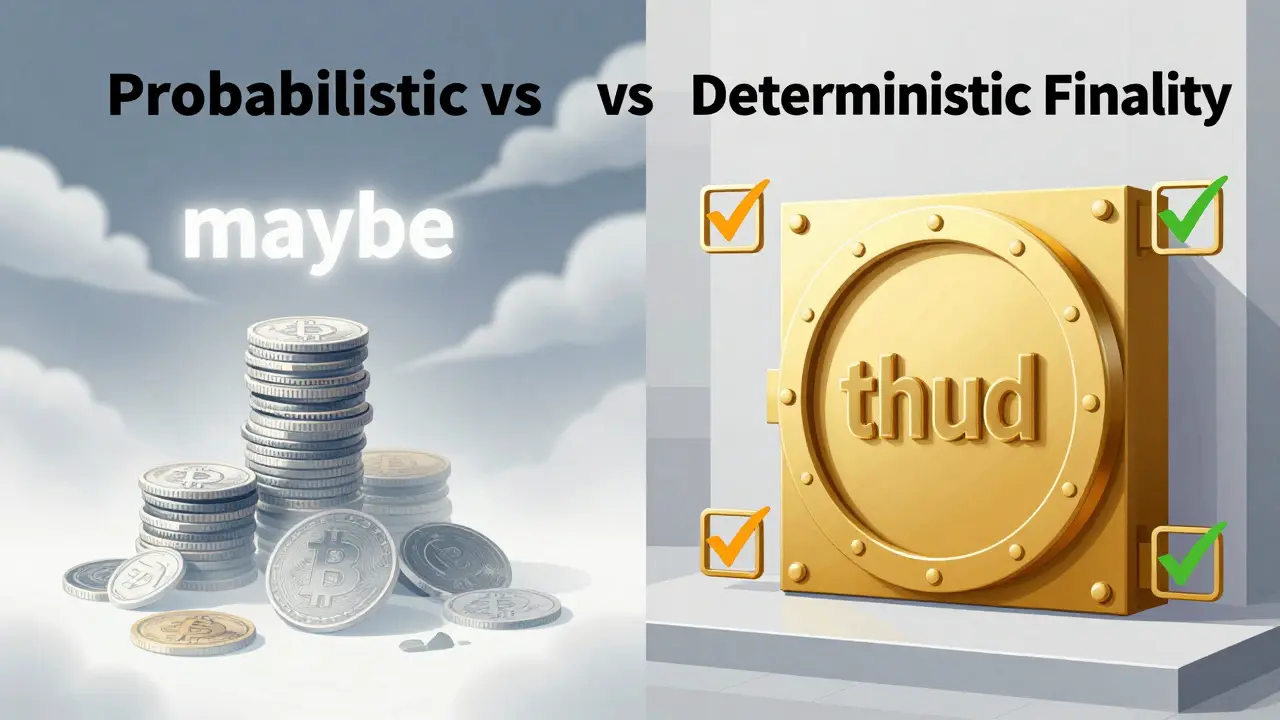
Bitcoin uses Proof-of-Work (PoW). It offers "probabilistic finality." When you send Bitcoin, it gets added to a block. But that block could theoretically be removed if a longer chain appears later. You wait for six confirmations to be 99.9% sure it's safe. It's likely safe, but not guaranteed. This worked fine for peer-to-peer cash, but it's risky for high-speed finance.
BFT-based systems, like those using Practical Byzantine Fault Tolerance (PBFT) or Tendermint, offer "deterministic finality." Once the required number of validators (usually two-thirds) sign off on a block, it is final. Period. It cannot be reverted unless the protocol itself is violated. For DeFi applications, where loans are issued and liquidated in seconds, this certainty is non-negotiable. A user losing money because a "confirmed" trade was reversed during a market crash is a nightmare scenario that BFT prevents.
| Feature | Proof-of-Work (Bitcoin) | BFT-Based (Cosmos, Hedera) |
|---|---|---|
| Finality Type | Probabilistic (likely safe) | Deterministic (guaranteed safe) |
| Fault Threshold | < 50% hashpower | < 33% validators |
| Speed | Slow (minutes to hours) | Fast (seconds) |
| Energy Use | High | Low |
Scalability: The Hidden Cost of Trustlessness
If BFT is so secure, why doesn't every blockchain use it? The answer is scalability. Traditional PBFT requires every node to talk to every other node to vote on blocks. As the network grows, the amount of communication explodes exponentially. A network with 100 nodes is manageable. A network with 10,000 nodes grinds to a halt.
This is why early BFT implementations struggled. However, new innovations are changing the game. Networks like Solana and Avalanche use hybrid approaches. They combine economic incentives (like Proof-of-Stake) with BFT-style finality gadgets. Ethereum, after its merge to Proof-of-Stake, implemented the Casper FFG finality gadget. This upgrade reduced finality time significantly while maintaining the 1/3 fault tolerance standard. These hybrids allow thousands of validators to participate without the exponential communication overhead of pure PBFT.
Real-World Impact on DeFi and Enterprise
The shift toward BFT is already reshaping the crypto landscape. According to data from DeFi Llama in late 2023, BFT-based chains like Cosmos, Solana, and Avalanche handled 58% of the total value locked in decentralized finance. Why? Because developers building lending platforms and automated market makers need speed and certainty. They can't afford the risk of probabilistic reorganizations.
Enterprise adoption follows a similar path. Banks and financial institutions care deeply about settlement finality. IBM's 2023 survey found that 73% of banking blockchain projects use PBFT variants. Regulatory frameworks are catching up too. The European Union's MiCA regulation, effective January 2024, explicitly requires cryptocurrency networks serving as financial infrastructure to demonstrate Byzantine fault tolerance properties. This means BFT is no longer just a technical preference; it's becoming a legal requirement for institutional crypto.
Challenges and Future Innovations
BFT is not perfect. Implementing it is hard. Developers need specialized training to audit BFT consensus mechanisms properly. Clock synchronization issues remain a common source of network incidents. And while the 1/3 threshold is robust, Gartner analysts warn that it may limit the size of future super-networks. If a blockchain wants 10,000+ active validators, traditional BFT math starts to strain.
Research is pushing boundaries. Stanford University presented a novel "Linear Byzantine Fault Tolerance" protocol in 2023 that aims to maintain security with fewer honest nodes under specific conditions. Projects like Polkadot are experimenting with nominated Proof-of-Stake combined with BFT finality to balance decentralization and speed. The goal is clear: keep the security guarantees of BFT while removing the scalability bottlenecks.
For users, the takeaway is simple. When choosing a cryptocurrency or a DeFi platform, look at the consensus mechanism. Does it offer deterministic finality? Does it adhere to BFT principles? These aren't just buzzwords. They are the difference between a system that holds your value securely and one that leaves you exposed to chaos.
What is the main purpose of Byzantine Fault Tolerance in cryptocurrency?
The main purpose of BFT is to allow a decentralized network to reach consensus and agree on the validity of transactions even if some participants (nodes) are malicious, faulty, or lying. It ensures the integrity of the ledger without requiring a central authority.
How many faulty nodes can a BFT network tolerate?
A standard BFT network can tolerate up to one-third (33%) of its nodes being faulty or malicious. If more than 33% of the network acts dishonestly, the system can no longer guarantee safety or consensus.
Is Bitcoin Byzantine Fault Tolerant?
Yes, Bitcoin is Byzantine Fault Tolerant, but it achieves it through Proof-of-Work rather than direct voting. It requires attackers to control less than 50% of the network's hashpower to prevent compromise, offering probabilistic rather than deterministic finality.
What is the difference between deterministic and probabilistic finality?
Deterministic finality means a transaction is irreversible immediately after confirmation by the required validators. Probabilistic finality means a transaction becomes safer the longer it stays on the chain, but there is always a tiny chance it could be reversed by a longer chain appearing later.
Why do DeFi platforms prefer BFT-based blockchains?
DeFi platforms prefer BFT because it offers deterministic finality and faster transaction speeds. This reduces the risk of failed trades or liquidations due to network reorganizations, which is critical for high-frequency financial operations.
Does BFT affect the speed of a blockchain?
Traditional BFT protocols can suffer from scalability issues, slowing down as more nodes join. However, modern hybrid BFT systems are designed to maintain high throughput and low latency, often outperforming older Proof-of-Work chains in transaction speed.


Sudarshan Anbazhagan
it is quite amusing to see the masses so enamored with this theoretical construct when in practice it fails to deliver on its most basic promises of decentralization
the notion that one can achieve true consensus without a central authority is a fantasy sold by those who profit from the confusion
one must look at the actual implementation details and realize that the 'generals' are merely validators chosen by wealth rather than merit
this creates a system that is arguably more fragile than the traditional banking systems it seeks to replace because it relies on the continued cooperation of oligarchs
the mathematical elegance does not translate to real world security when the economic incentives are misaligned
i have seen too many networks fail under pressure because the nodes were not truly independent but controlled by a few large entities
so while the theory is sound the application is deeply flawed and dangerous for the average user who lacks the technical expertise to verify the ledger themselves
John Gonzalez Bentham
lol everyone here thinks bft is some holy grail but its just another way for devs to rug pull
the math doesnt matter if the code has bugs which it always does
bitcoin is fine why complicate things
Ellie Riddell
oh sure let's pretend that deterministic finality isn't just a marketing term for 'we control the validators'
it's fascinating how people ignore the centralization risks inherent in these systems
but hey if you like handing over your sovereignty to a committee of strangers go right ahead
i'll be over here watching the inevitable collapse with popcorn in hand
Destiny Kilby
i understand the frustration with the complexity of these systems but it is important to remember that technology evolves slowly and often painfully
the transition from proof of work to proof of stake based mechanisms was necessary for environmental reasons even if it introduced new vulnerabilities
we should approach this with empathy for the developers trying to solve impossible problems rather than dismissing their efforts outright
perhaps we can learn from past failures to build better systems in the future
Tobias Gjerlufsen
you people are idiots who dont understand basic computer science
bft is the only way to scale properly and anyone saying otherwise is either lying or stupid
bitcoin is dead money held up by religious zealots who refuse to adapt to modern needs
get with the program or get left behind
Jerry CUNNINGHAM SR
it is crucial that we maintain a respectful dialogue regarding these technological advancements as they impact our financial infrastructure significantly
while differing opinions exist on the merits of various consensus mechanisms it is essential to recognize the collaborative effort required to secure decentralized networks
let us focus on constructive criticism and educational resources rather than personal attacks which serve no purpose in advancing our collective understanding
the goal should be to ensure that all users feel safe and informed when participating in these emerging markets
Shelby Cantu
just stick to what works
Ruben Michel
the vulgar simplicity of this discourse is indicative of the general populace's inability to grasp nuanced cryptographic principles
byzantine fault tolerance is not merely a feature but the foundational axiom upon which all credible distributed ledger technologies are built
those who dismiss its importance do so out of ignorance or deliberate malice
one must possess a sophisticated understanding of game theory and cryptography to appreciate the elegance of the solution provided by lamport et al
do not insult my intelligence with your trivial concerns about speed or energy consumption when security is paramount
Gavin Wonnacott
listen here you morons i've been in crypto since day one and none of you know shit
your precious btc is slow as molasses and costs an arm and a leg to move
real men use solana and avalanche where transactions happen instantly
if you cant handle the volatility and tech stack you deserve to lose your money
stop crying and start using proper tools
Samara McCallum
why does everyone act like there's a single right answer
maybe the point is that we're all just guessing anyway
the drama around which chain is best is exhausting
i just want to buy coffee without worrying about if the server crashed
Jocelyn Garcia
from a technical standpoint the interoperability challenges between different bft implementations remain significant
the lack of standardized communication protocols across heterogeneous networks hinders seamless asset transfer
developers need to focus on cross-chain messaging layers that respect the finality guarantees of each underlying protocol
otherwise we risk creating siloed ecosystems that defeat the purpose of decentralization
Amit Varpe
india is leading the way in blockchain adoption unlike the west
our startups are innovating faster than you guys ever could
keep talking about theory while we build real products :)
Bronwen Butler
actually bft is overrated
proof of history is better
read the whitepaper before commenting
Pauline Larocco71
i think its really cool how math can keep us safe online
its kinda scary though that hackers are always trying to break in
hope the coders stay awake enough to fix any holes they find
my grandma tried to send me bitcoin once and she got confused so maybe regular people need simpler interfaces
beti macedo
i beleive that with great power comes great responsibilty and these technoligies will change the world for the beter
we must support the visionaries who dare to dream big and create new systems
even if there are mistakes along the way we should encourage them rather than criticize
the future is bright and full of possibilities for everyone involved
Michelle Bonahoom
another useless article written by someone who clearly doesnt understand the real issues
no one cares about byzantine generals they care about making money
and you wont make money with these slow inefficient chains
stick to gold or cash if you want safety