You might think that a crypto billing platform is just a digital bridge between your customer's wallet and yours. It takes the order, generates an invoice, and passes the coins along. But for many traditional-style processors, that bridge has a trapdoor. They don't just pass the money; they hold it. When a billing platform holds your funds, even for a few seconds or days, you are no longer dealing with simple software. You are dealing with a financial intermediary carrying massive legal and operational weight on its balance sheet.
That weight is what we call custody risk. And right now, it is the single biggest threat to anyone accepting cryptocurrency payments through a centralized processor. Between regulatory crackdowns, accounting nightmares, and the ever-present danger of hacks, holding customer funds turns a routine sale into a high-stakes gamble. Let's break down why keeping your hands off the money is actually the smartest move for your business.
The Accounting Trap: Your Money Becomes Their Debt
To understand the liability, you have to look at how regulators view these platforms. In 2022, the U.S. Securities and Exchange Commission (SEC) released Staff Accounting Bulletin No. 121 (SAB 121). This rule changed everything for custodians. It instructed companies safeguarding crypto for users to recognize those assets on their own balance sheets alongside a "safeguarding liability" measured at fair value.
What does this mean in plain English? If a billing platform holds $1 million in Bitcoin for various merchants, they must record that $1 million as an asset. But they also have to record a $1 million liability because they owe that money back to the merchants. Suddenly, a software company looks like a bank. They carry double the balance sheet exposure for every dollar they touch. Even with updated guidance like SAB 122 in 2026 shifting toward contingency frameworks, the core truth remains: holding funds creates material obligations that do not exist if the funds never leave the customer's control until the final second.
Regulatory Heat: MiCA and Global Standards
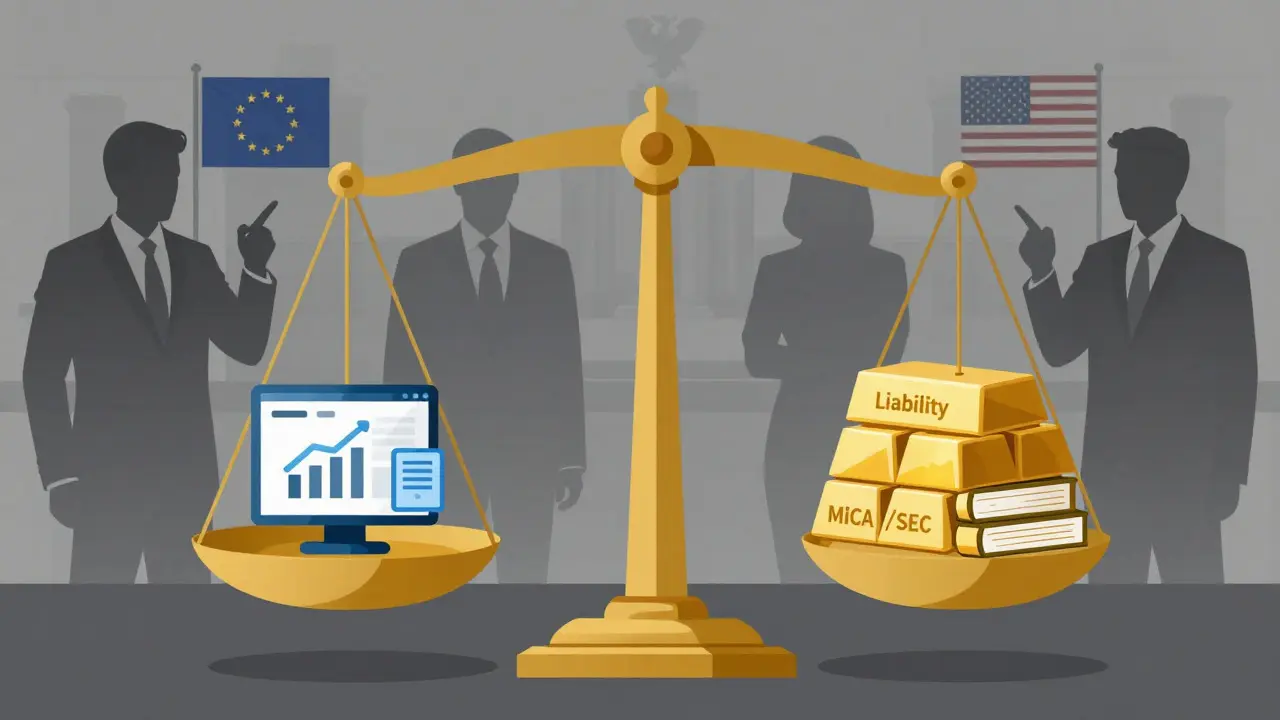
The SEC isn't the only one watching. The European Union's Markets in Crypto-Assets Regulation (MiCA), which began applying in 2024-2025, took a hard line. Under Articles 70 and 75, Crypto-Asset Service Providers (CASPs) face direct liability for losses caused by cyber-attacks, theft, or operational failures. The cap? The full market value of the lost assets.
This means if a hacker drains a custodial pool, the platform is legally on the hook to make every merchant whole. Canada followed suit in early 2026 with tighter custody rules requiring detailed segregation disclosures, while Japan introduced plans for liability reserves. Regulators worldwide are sending a clear message: if you hold the keys, you bear the risk. For a billing processor, this translates to expensive insurance, heavy capital buffers, and endless compliance audits.
Technical Vulnerabilities: The Key Management Nightmare
Beyond paperwork, there is the technical reality. To hold funds, a platform needs private keys. Managing these keys securely is incredibly difficult. Auditors like PwC categorize custody risks around confidentiality, integrity, and availability. If a key is copied, stolen, or simply lost, the assets are gone forever. There is no "forgot password" button on the blockchain.
Many exchanges and billing platforms use pooled "hot" wallets to aggregate payments. This commingling means users often hold only a debt claim against the platform rather than direct ownership of specific coins. If the platform goes bankrupt, those merchants become unsecured creditors, competing for whatever scraps remain. We saw this play out tragically with major exchange collapses where client funds were mixed with corporate operating capital. In a billing context, this architecture exposes every merchant to the bankruptcy risk of the processor itself.
The Non-Custodial Solution: Direct On-Chain Settlement
So, how do you avoid this mess? You use a non-custodial architecture. In this model, the payment gateway acts purely as software infrastructure. It never holds, touches, or controls the funds. Instead, it facilitates a direct transfer from the customer's wallet to the merchant's wallet.
Here is how it works technically:
- Extended Public Keys (XPUB): The merchant connects their hardware wallet (like a Ledger or Trezor) to the dashboard. They share only their extended public key-a string of characters that allows generating receiving addresses but cannot spend funds.
- Address Derivation: When a customer buys something, the gateway derives a unique, one-time receiving address from that XPUB.
- Blockchain Monitoring: The gateway watches the blockchain for a transaction to that specific address.
- Webhook Trigger: Once the network confirms the payment, the gateway sends a signed webhook to the merchant's server to fulfill the order.
At no point did the money enter the gateway's pocket. It went straight from buyer to seller on-chain. Because the gateway never held the private keys, it never had custody. Therefore, it has zero safeguarding liability, zero risk of freezing the funds, and zero exposure to its own insolvency affecting the merchant's revenue.
| Feature | Custodial Gateway | Non-Custodial Gateway |
|---|---|---|
| Fund Control | Platform holds private keys | Merchant holds private keys |
| Liability | High (Balance sheet exposure) | Low (Software uptime only) |
| Bankruptcy Risk | Merchants are unsecured creditors | No counterparty risk |
| Freeze Potential | Yes (Platform can freeze accounts) | No (On-chain settlement is final) |
| Regulatory Burden | Heavy (KYC, AML, Capital reserves) | Light (No asset custody) |

Operational Freedom for Merchants
For solo founders and indie hackers, the benefits of going non-custodial extend beyond safety. Traditional custodial gateways often require rigorous Know Your Customer (KYC) checks, proof of registered companies, and lengthy approval processes. They treat every merchant like a potential fraud risk because they are liable for the money passing through their hands.
Non-custodial platforms remove this friction. Since they aren't holding the money, they don't need to police who owns the destination wallet as aggressively. Platforms like TxNod exemplify this approach. By allowing merchants to connect hardware wallets via WebHID or WebUSB, they ensure that signing keys never leave the user's device. The result is a system where you can start accepting payments without becoming a banking entity yourself. You get chargeback-free, hold-free, and freeze-free settlement because the gateway structurally cannot reverse or block a transaction that happened directly on the blockchain.
Moving Forward: Verifying Your Gateway
As you evaluate billing solutions, ask the hard questions. Does the provider hold your private keys? Do they pool your funds with other customers? If the answer is yes, you are inheriting their liability. Look for systems that prioritize transparency-where you can verify that the payment address generated matches your own wallet's derivation path. Modern tools, including TypeScript SDKs that re-derive addresses locally, allow developers to build trustless integrations where the code proves the math, not just the marketing copy.
In a landscape defined by irreversible transactions and evolving regulations, the safest place for your money is always in your own control. Don't let a billing processor turn your sales into their balance sheet problem.
What is the main risk of using a custodial crypto billing platform?
The primary risk is counterparty failure. If the platform is hacked, goes bankrupt, or faces regulatory action, your funds may be frozen or lost because you only have a contractual claim against the company, not direct ownership of the assets on-chain.
How does a non-custodial gateway work without holding funds?
It uses your extended public key (XPUB) to generate unique receiving addresses for each invoice. The payment flows directly from the customer's wallet to yours on the blockchain. The gateway merely monitors the chain and notifies you via webhooks when the transaction is confirmed.
Does MiCA affect non-custodial payment providers?
Generally, non-custodial providers face lighter regulatory burdens under MiCA because they do not hold client assets. They are not classified as Crypto-Asset Service Providers (CASPs) in the same way custodians are, meaning they avoid strict capital reserve and liability requirements for asset loss.
Can a non-custodial gateway freeze my funds?
No. Since the funds settle directly to your personal wallet address on the blockchain, the gateway has no ability to reverse, hold, or freeze the transaction once it is confirmed by the network.
Is it safe to share my extended public key with a payment gateway?
Yes. An extended public key allows the generation of receiving addresses but cannot be used to sign transactions or spend funds. Your private keys remain securely stored on your hardware wallet or local device.

Candice Cornett
everyone is so scared of holding keys but who actually knows how to use a hardware wallet properly without losing access forever? the average merchant will just leave their ledger in a drawer and forget the pin. non-custodial sounds great until you realize the user error rate is basically 100% for small business owners who just want to sell socks online.
Michael Mostyn
The philosophical implication here is that trust has been entirely displaced from human institutions to cryptographic algorithms, yet we still rely on centralized interfaces to interpret those algorithms. If the interface lies about the balance, does the truth exist? The SAB 121 ruling attempts to quantify this metaphysical uncertainty with accounting standards, which feels like trying to measure the wind with a ruler. We are building a financial system on sand while arguing over the color of the grains.
Ed Mitchell
It is an absolute sham. The regulators know exactly what they are doing. They force these platforms to hold the funds so they can freeze them whenever the political winds change. It is not about safety it is about control. You think you own your bitcoin but you only own a IOU from a company that answers to Washington or Brussels. Wake up people.
Erica Johnson
actually if you read the MiCA articles carefully you will see that non-custodial providers are not completely off the hook either :P they still need to ensure the software doesn't have bugs that send money to null addresses. but yeah mostly right tho
Ken G
its all a conspiracy to keep us poor. the elites want us to use fiat because they can print more of it. crypto was supposed to be free but now we have KYC everywhere. even non custodial gateways are probably backdoored by the NSA. nothing is safe anymore.
Alex Di Mango
I think both sides have valid points though. Custodial is easier for beginners but risky. Non-custodial is safer but requires more tech knowledge. Maybe the solution is better education rather than forcing everyone into one model. What do you all think?
Amor Jordan
This article really opened my eyes! I never realized that holding funds created such a massive liability for the platform. It makes me feel so much better knowing that my money is directly in my wallet. Thank you for sharing this important information!
Nick Darring
look i get the hype around self custody but lets be real most people are lazy. they want the convenience of paypal. telling a mom-and-pop shop owner to manage XPUBs is like telling them to build their own website. its too much friction. the market will decide and honestly i think custodial wins because people hate responsibility. plus i heard a rumor that the SEC is planning to ban non-custodial wallets next year so why bother switching now?
Eden Tadesse
i agree with nick. its just too hard for normal people. also i think the article missed the point about insurance. some custodial platforms offer insurance which is nice.
Eric Zehr
You make a fair point about friction, Nick. However, the cost of failure in custodial models is existential. One hack wipes out years of profit. For high-volume merchants, the operational overhead of managing keys is negligible compared to the risk of counterparty collapse. Education is key, as Alex mentioned, but tools like TxNod are making it significantly easier.
Namrata Mapgaonkar
in india we have different problems. internet connectivity is bad sometimes so webhooks fail. also tax rules are very strict here. non custodial helps with tax transparency but its still confusing for small vendors. hope things get simpler soon :)
Rita Dutta
the whole concept of custody is a western construct rooted in colonial banking systems. true freedom is when no one holds anything. the blockchain is the ultimate liberator of capital from the shackles of institutional greed. its beautiful really. although i admit the UX needs work.
Paul Smith
Great discussion everyone! 👍 I've been using a non-custodial setup for my online store and it's been smooth sailing. The peace of mind knowing my customers' payments go straight to my wallet is priceless. 🚀💰