The WSPP airdrop by Wolf Safe Poor People on Polygon isn’t just another crypto giveaway. It’s a rare attempt to tie blockchain rewards directly to real-world poverty relief. If you’ve heard about this project and are wondering whether it’s legitimate, how to claim tokens, or if it’s still active - you’re not alone. Let’s cut through the noise and lay out exactly what happened, who got rewarded, and where things stand today.
What Is Wolf Safe Poor People (WSPP)?
Wolf Safe Poor People (WSPP) is a cryptocurrency project built around one bold claim: it’s the first digital currency designed to reduce global poverty. Unlike most tokens that focus on speculation or DeFi yields, WSPP says its core function is to redistribute wealth automatically through its tokenomics. The idea? Every time someone holds or trades WSPP, a small portion of the transaction helps fund poverty-alleviation programs.
Launched first on Binance Smart Chain (BSC), the project later moved to Polygon to take advantage of lower fees and faster transactions. The total supply is 3.2 billion WSPP tokens. The Polygon version uses the contract address 0x46d502fac9aea7c5bc7b13c8ec9d02378c33d36f and was audited by Solidity Finance - a rare step for a project of this size. You can verify the audit on their site at solidity.finance/audits/WSPP.
The project’s website, wolfsafepoorpeople.com, and its Telegram group @robowolfproject are the main hubs for updates. The team claims WSPP operates as a decentralized application (DApp) platform with no central servers, using decentralized storage like Swarm for its frontend. It also says it’s building a platform called Wolfible to integrate NFTs and DeFi tools for fundraising.
The MEXC Kickstarter Airdrop: How It Worked
The biggest WSPP airdrop ever happened on December 13, 2021, through MEXC’s Kickstarter program. This wasn’t a random giveaway. Users had to stake MX tokens - MEXC’s native token - to vote for WSPP to be listed on the exchange. The goal? Reach a specific voting threshold. Once they did, two things happened: WSPP got listed on MEXC, and every participant got free WSPP tokens.
Over 18.9 million MX tokens were staked by users to push the campaign over the line. In return, 215 million WSPP tokens were distributed to those who participated. That’s roughly 1.13 WSPP tokens for every MX token staked. The event ran from December 13, 2021, at 02:30 UTC and closed once the target was hit.
MEXC listed WSPP under its Innovation Zone - a section for high-risk, early-stage tokens. The exchange clearly warned users: “High volatility expected.” That’s a red flag for some, but for others, it’s a sign this was a grassroots effort, not a polished product.
Current Status: Is WSPP Still Active?
As of March 2026, WSPP on Polygon trades at around $0.0000000194 (1.94e-8 USD). The market cap is roughly $54. Trading volume is minimal - under $105 in the last 24 hours. On CoinMarketCap, it’s ranked #3542. The original BSC version trades even lower - at $6.24e-11 - with a tiny $1,372 daily volume.
These numbers aren’t just low - they’re near-zero. That means:
- There’s almost no liquidity. You can’t easily buy or sell large amounts without crashing the price.
- Most holders are either long-term believers or people who claimed the 2021 airdrop and never sold.
- The token isn’t listed on Binance, Coinbase, or Kraken. You can only trade it on MEXC or decentralized exchanges like PancakeSwap or QuickSwap.
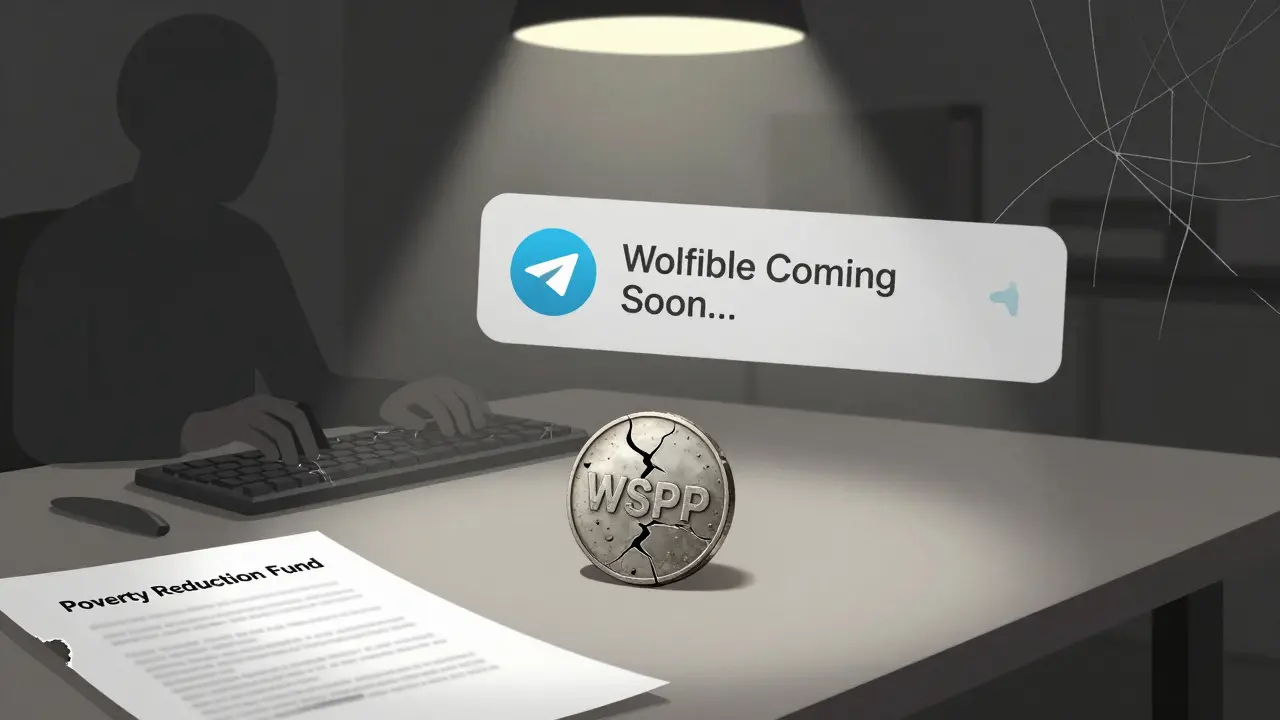
Despite the low price, the project hasn’t disappeared. The Telegram group still posts updates. The website remains live. The team continues to talk about expanding Wolfible and launching NFT-based fundraising tools. But there’s no public proof of actual poverty relief. No charity partnerships. No reports on funds distributed. No impact metrics. That’s the biggest gap.

How the Tokenomics Claim to Help the Poor
WSPP’s whitepaper-style documentation says the token has an automatic redistribution mechanism. Every time a transaction occurs - whether buying, selling, or transferring - a small percentage (usually 2-5%) is redistributed to all token holders. That’s not unusual. Many tokens do this to reward long-term holders.
But here’s the twist: WSPP claims part of that redistribution goes directly into a “Poverty Reduction Fund.” The fund, they say, is used to support global aid programs. No third-party audits of this fund exist. No public ledger shows where the money went. No NGO partners are named. That’s a major red flag.
Compare this to other social impact tokens like GiveCoin or Humanity Token. Those projects partnered with real charities, published quarterly reports, and showed bank transfers. WSPP? No transparency. Just promises.
So while the idea sounds noble - “buy this token and help end poverty” - the lack of accountability makes it hard to trust. It’s possible the redistribution is purely internal, benefiting early holders, not the poor.
Should You Still Claim or Buy WSPP?
If you missed the 2021 MEXC airdrop, you can’t claim it anymore. The event is over. The tokens were distributed once. No new airdrops have been announced since.
If you’re thinking of buying now:
- Only invest what you can afford to lose completely.
- Don’t expect returns. The token’s price is too low to make meaningful gains without massive volume - which isn’t happening.
- Don’t buy it because you believe in the mission. Buy it only if you believe the community will revive it.
There’s no technical reason to hold WSPP. No upgrades. No new features announced in 2025. No team expansion. The project is in maintenance mode, if that.
But here’s the strange part: some people still hold it. Why? Because they believe. They believe the project will one day partner with a major NGO. They believe the team will finally release the poverty fund reports. They believe in the idea more than the token.
What’s Next for WSPP?
The roadmap mentions expanding Wolfible - a platform meant to combine NFTs and DeFi for fundraising. No beta has launched. No demos exist. No GitHub repo shows active development. The last code commit was in 2022.
Without a clear path forward, WSPP is stuck. It has:
- A noble idea
- A real airdrop history
- An audited contract
- Zero real-world impact
The project needs one thing to survive: proof. Proof that real money reached real people. Proof that the token isn’t just a vehicle for early investors. Until then, it remains a curiosity - a crypto experiment that tried to do good but never showed it worked.
Final Thoughts
The WSPP airdrop was real. Thousands of people got free tokens. The contract was audited. The listing happened. But six years later, the project hasn’t delivered on its core promise. It’s not a scam - no one stole funds. But it’s not a solution either. It’s a promise left unfulfilled.
If you’re looking for crypto that helps the poor, there are better options. Projects with verified charity partnerships. Projects that publish receipts. Projects that don’t rely on hope.
WSPP? It’s a ghost of what it could’ve been. And right now, it’s just a token with a $54 market cap and a dream that never quite took off.
Austin King
Interesting breakdown. I’ve seen a lot of ‘do-good’ crypto projects, but this one actually had a real airdrop and audit. That’s more than most.
Sharon Tuck
Thanks for laying this out so clearly. It’s rare to see someone not just dismiss it as a scam but actually examine what happened and what’s missing. Hope this helps others avoid the hype trap.
Sherry Kirkham
It’s not about the token. It’s about the myth. People hold WSPP because they want to believe in a world where crypto fixes poverty-not because the math adds up.
Bryanna Barnett
so like… if no one’s getting paid and no charity is named, is this just a really weird meme coin with a sob story?
Josh Moorcroft-Jones
Let’s be real-the entire premise is a fantasy wrapped in a whitepaper. The ‘Poverty Reduction Fund’? There’s no blockchain ledger for that. No public wallet. No receipts. No transparency. And yet people still cling to it like it’s the second coming. The fact that this thing still has a $54 market cap after five years is a testament to human gullibility, not innovation. And don’t get me started on the ‘Wolfible’ nonsense-no GitHub, no commits, no demo. It’s a ghost town with a .com domain and a Telegram group full of bots.
Rachel Rowland
People who still hold it aren’t dumb-they’re hopeful. And hope is the last thing crypto kills.
Bonnie Jenkins-Hodges
USA should ban this. We have real problems. Why are we giving money to some blockchain ghost? 😠
Melissa Ritz
I read the whole thing. Honestly? I’m just confused why anyone thought this would work. The contract is audited, sure-but audits don’t verify morality. And the fact that the team hasn’t posted anything since 2022… yeah. It’s dead. Just… quietly.
Cerissa Kimball
While the technical infrastructure of WSPP demonstrates a functional smart contract architecture with verifiable audit trail via Solidity Finance, the absence of third-party verification of fund allocation mechanisms renders the social impact claim non-falsifiable. Consequently, the project operates in a regulatory gray zone where altruistic intent cannot be substantiated through empirical means. Further, the minimal liquidity and absence of exchange listings beyond MEXC and DEXs suggest market validation has been entirely absent since 2022.
Basil Bacor
they said theyd help the poor but all they did was help themselves lol
Emily Pegg
you know what’s sad? people still believe in this. i mean, i get it. we all want to believe in something good. but this? this is just a digital ghost. 🫠
Jennifer Pilot
How quaint. A token that claims to redistribute wealth-yet its entire ecosystem relies on the very speculative capitalism it purports to oppose. The irony is exquisite. The contract is audited? How charming. But the soul? The moral architecture? Unaudited. Unexamined. Unworthy. One must ask: if a project’s noble intentions are not tethered to verifiable outcomes, is it not merely a performative act of virtue signaling, disguised as decentralization? The WSPP experiment doesn’t fail because of poor tokenomics-it fails because it confuses symbolism with substance.
Jamie Hoyle
LMAO this is the most tragic crypto ghost story I’ve seen in years. A $54 market cap? After a 215M token airdrop? The team didn’t vanish-they evaporated. And now we have a bunch of believers staring at their wallets like it’s a magic piggy bank that’ll one day turn into a charity. Bro. It’s not a mission. It’s a graveyard with a website. And the ‘Wolfible’ thing? That’s not a roadmap-it’s a funeral program. Someone’s still updating the Telegram? That’s not community. That’s a cult with a spam bot.